
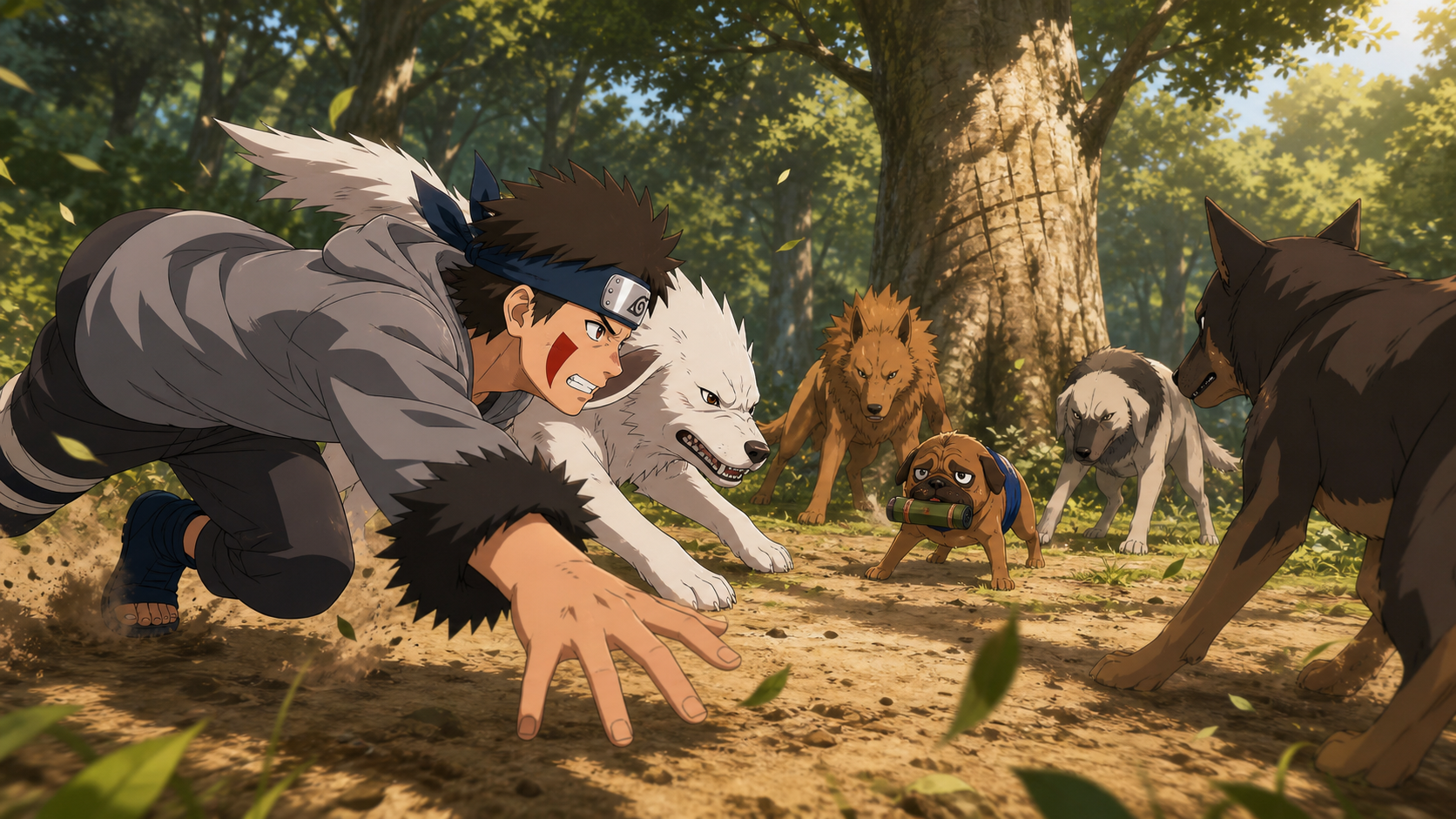
Kiba’s Determination
Kiba once ran ahead of Naruto. The old race tree shows what happened after Naruto refused to stay behind.
Bottom line
Naruto Shippuden Episode 240 gives Kiba an ugly but believable reason to train: jealousy. Naruto was once the academy dead last, while Kiba could outrun him and enjoy the certainty of being ahead. Now Naruto is Konoha’s hero, and every compliment aimed at him feels like evidence that Kiba stopped moving. The episode works when Kiba finally understands that Naruto’s advantage was never a secret technique. Naruto kept returning after losing.
Akamaru carries the emotional center. Kakashi provides the ninken challenge, but Akamaru knows when Kiba has confused one defeat with a final answer. He brings Kiba to the old race tree, where Naruto’s newer mark sits beyond Kiba’s childhood record. Kiba responds by returning to the hounds, taking the scroll, and setting a new time. He does not surpass Naruto’s whole journey. He recovers the part of himself willing to try again.
Kiba’s jealousy begins with a real reversal
Kiba remembers Naruto as the boy who trailed behind. Their academy rivalry let Kiba feel quick, capable, and naturally superior. Pain’s invasion rewrote that hierarchy in public. Naruto saved the village, received admiration from people who once rejected him, and became the standard Kiba hears at home.
Jealousy becomes understandable because Kiba has evidence for the comparison. He really did beat Naruto in childhood races. The problem arrives when he treats an old lead as a permanent entitlement. Naruto’s growth feels unfair only if Kiba ignores every year Naruto spent closing the distance.
Tsume’s praise hits the bruise directly
Kiba’s mother praises Naruto’s progress and challenges her son’s lack of comparable momentum. Tsume communicates through pressure, teasing, and blunt force. Her words land because Kiba already suspects the same truth.
The scene does not make her criticism automatically wise. Comparing a child to somebody else can turn motivation into shame. Kiba needs a direction, not merely proof that another person moved farther. Still, Tsume refuses to protect him from an uncomfortable fact: pride in past ability cannot replace present work.
Shino sees through the performance
Shino’s calm presence exposes the difference between Kiba’s loud claims and his actual preparation. Kiba often announces future victories with enough volume to make confidence sound complete. Shino understands that declarations do not create training hours.
Their exchange preserves Team 8’s familiar balance. Kiba provides heat and movement. Shino provides observation and precision. Hinata’s history with Naruto adds another quiet perspective even when the episode centers Kiba. Team 8 has watched determination change Naruto for years, while Kiba has mostly remembered the races he once won.
Asking Kakashi for help is a useful first step
Kiba seeks Kakashi because available jōnin instructors are scarce before the war. The request shows humility beneath his frustration. He admits that effort without structure has not produced the change he wants.
Kakashi does not offer a dramatic private lesson. He summons his ninken and gives Kiba a concrete task: retrieve a scroll. The assignment fits Kiba better than a lecture. A tracker who fights beside a dog must read scent, movement, pack behavior, terrain, and timing under pressure.
Kakashi teaches without becoming the center
Kakashi could defeat Kiba personally and explain the lesson afterward. Instead, he delegates the training to the ninken. That choice keeps Kiba and Akamaru responsible for solving the problem.
Good instruction does not always look like constant direct correction. Kakashi creates the obstacle, chooses opponents with relevant skills, and leaves enough space for failure to become information. His absence prevents Kiba from performing improvement for a respected teacher. Kiba must decide whether to continue when nobody stands nearby to reward the decision.
The ninken challenge attacks Kiba’s assumptions
Kiba expects speed and aggression to create an opening. Kakashi’s hounds operate as a coordinated pack. They protect Pakkun, redirect charges, control angles, and force Kiba to respond to more than one moving threat.
The scroll task exposes his habit of treating determination as forward pressure. Running harder into the same formation only repeats the failure at greater speed. Kiba needs patience, observation, and cooperation with Akamaru. The exercise becomes tactical because stubbornness alone cannot retrieve the target.
Akamaru is a partner, not equipment
Kiba’s fighting style depends on Akamaru, yet the series sometimes lets their partnership read like a shinobi using a specialized tool. Episode 240 gives Akamaru independent judgment. He watches Kiba’s confidence collapse and decides where they need to go next.
Akamaru cannot deliver a speech about comparison or persistence. He communicates by action, carrying Kiba toward the tree that holds their shared history. That choice shows memory, concern, and an understanding of what motivates his human partner. Their bond works because guidance travels both ways.
Giving up after one round reveals the real problem
The hounds defeat Kiba and Akamaru. Kiba responds as though the loss confirms every fear raised by Naruto’s success. He sees no useful middle ground between immediate victory and personal inadequacy.
That reaction explains why more raw training had not helped. Kiba wants effort to restore the old hierarchy quickly. When progress refuses the schedule, he abandons the process. The episode does not shame the exhaustion. Instead, Akamaru interrupts the false conclusion that one failed attempt settles Kiba’s future.
The race tree turns memory into evidence
The old tree carries scratched records from childhood races. Kiba remembers holding the fastest time and the social certainty attached to that mark. Then he sees Naruto’s newer record beyond his own.
The tree makes growth measurable without reducing the episode to power levels. Naruto did not erase Kiba’s childhood achievement. He returned to the same course and ran faster. The new mark records work that happened while Kiba was elsewhere assuming the old result still defined them.
Naruto’s secret was repetition
Kiba remembers Naruto losing, complaining, and trying again. From the winner’s position, those repeated challenges looked ridiculous. From the present, they look like the method that changed everything.
Naruto’s determination is not magical optimism. Repeated failure carried humiliation, loneliness, and physical pain. He continued because each loss remained temporary in his mind. Kiba finally recognizes that the quality he dismissed as stubbornness became Naruto’s most reliable training system.
Competition can reveal admiration
Kiba speaks about defeating Naruto because rivalry feels safer than openly admitting admiration. Naruto’s rise threatens him, but the threat exists because Kiba respects the result. Nobody obsesses over catching a person whose growth means nothing.
The episode lets envy become useful once Kiba separates admiration from entitlement. He can want Naruto’s persistence without resenting Naruto for developing that persistence. Competition becomes a direction for work rather than a demand that the other person shrink.
Kiba does not need to become Naruto
Naruto’s growth came through shadow clones, chakra training, teachers, loss, and the burden of the Nine-Tails. Kiba’s path involves scent, speed, transformation, pack tactics, and a lifelong bond with Akamaru. Copying Naruto’s exact routine would ignore his own strengths.
The lesson worth borrowing is procedural. Return after failure. Study the gap. Accept help. Try a different approach. Kiba can use Naruto as proof that distance can close without turning his identity into an imitation.
Public praise distorts private progress
Naruto’s welcome after defeating Pain gives Kiba a visible endpoint to compare against. Villagers cheer, adults repeat the story, and families use Naruto as an example. Nobody can see every quiet hour behind that moment. Kiba therefore compares his private frustration with Naruto’s public celebration, two categories that will never feel equal.
The race tree corrects that distortion. A scratched time is not a crowd, title, rank, or heroic reputation. The mark records one person returning to one course. Kiba can answer that evidence with his own work because the standard is concrete. He cannot manufacture a village-saving crisis to prove himself, and he should not need one.
That distinction helps Kiba recover agency. Public recognition depends on circumstances and witnesses. Practice remains available on an ordinary day. He can train with Akamaru, improve a route, and learn from Kakashi’s hounds without waiting for history to create a stage.
Akamaru protects Kiba from isolation
Jealousy often encourages secrecy. Admitting envy means admitting that another person matters and that confidence has cracked. Kiba hides behind anger, but Akamaru stays close enough to recognize the retreat.
Their partnership prevents self-improvement from becoming lonely punishment. Akamaru does not shame Kiba for losing or compare him with Naruto. He redirects Kiba toward a memory that restores context. The gesture says they have failed together before, raced together before, and can return together now.
That support does not remove Kiba’s responsibility. Akamaru carries him to the tree, not across the finish line. Kiba must interpret the record, choose the rematch, and run. Healthy partnership creates another chance for choice without taking the choice away.
The rematch matters because Kiba chooses the return
Kakashi does not drag Kiba back to the clearing. Tsume does not order another attempt. Akamaru brings him to the evidence, then Kiba decides what the evidence means.
He could treat Naruto’s mark as another humiliation. Instead, he demands a rematch. The choice makes the second attempt emotionally different before any tactic changes. Kiba no longer fights only to recover superiority. He fights against the version of himself who accepted the first loss as final.
Retrieving the scroll requires partnership
Kiba and Akamaru return with clearer purpose. The ninken remain skilled and coordinated, so success cannot come from pretending the earlier defeat never happened. The pair must use what the first round revealed.
Their victory belongs to adjustment as much as intensity. Kiba reads the pack, commits to an opening, and trusts Akamaru’s position. Taking the scroll proves that persistence works best when paired with learning. Repetition without attention would only create the same outcome.
Setting a new record gives Kiba a local victory
After the ninken challenge, Kiba runs the old course and scratches a faster time into the tree. The scale is modest beside Naruto saving Konoha. That modesty protects the ending.
Kiba does not become the village hero during one afternoon. He beats a concrete standard, recovers momentum, and leaves evidence for his future self. Progress becomes something he can build rather than something granted by public applause.
The new record may not last. Naruto could return, another academy child could grow faster, or war could make the course seem trivial. Temporary achievement still carries value. Kiba now understands that a record should invite another attempt rather than freeze the winner in place.
That changed meaning separates the ending from his opening mistake. Childhood Kiba treated being fastest as proof of who he permanently was. Present Kiba turns speed into a practice that can be tested again. The tree stops protecting his ego and starts recording his willingness to continue.
The episode understands rivalry better than ranking
A ranking asks who stands higher now. Rivalry can ask what another person’s growth demands from you. Kiba begins trapped in the first question and finishes closer to the second.
Naruto never appears to defend his status. Kiba’s conflict exists inside his interpretation of Naruto’s success. That choice prevents the episode from making Naruto responsible for soothing him. Kiba owns the jealousy and therefore owns the possibility of changing its function.
Jealousy becomes harmful when Kiba treats an old lead as ownership
He once ran faster and fought with greater confidence, so Naruto’s later success feels like something taken from him. The feeling assumes childhood ranking should remain permanent.
Naruto never promised to stay behind. Kiba’s earlier achievement remains real without granting control over another person’s growth.
Tsume identifies stagnation but risks making shame the method
Her blunt comparison breaks through Kiba’s excuses. It also reinforces the belief that worth exists only relative to Naruto’s visible success.
A stronger challenge would ask what Kiba wants to develop with Akamaru, not merely why somebody else moved farther.
Public heroism creates an impossible comparison target
Naruto defeated Pain under extraordinary circumstances before an entire village. Kiba compares that public peak with private days when his own progress feels uncertain.
No training plan can manufacture the same stage. The race tree restores a standard close enough for practice to answer.
Kakashi selects opponents who understand partnership
The ninken are not generic targets. They communicate, protect Pakkun, redirect pressure, and exploit Kiba’s tendency to charge through the most visible opening.
The task tests whether Kiba and Akamaru operate as a thinking pair rather than one fighter with an animal accessory.
Delegated instruction makes persistence private
Kakashi establishes the challenge and leaves. Kiba cannot continue merely to win praise from a famous jōnin watching nearby.
The second attempt must matter after the audience disappears, which separates genuine training from a performance of determination.
Akamaru recognizes withdrawal before Kiba names it
Years of shared movement let the dog read posture, scent, mood, and the difference between physical fatigue and surrender.
He responds with memory rather than a command. Bringing Kiba to the tree creates evidence while leaving interpretation and choice with his partner.
The old record changes meaning across time
Childhood Kiba used the mark as proof that he was faster. Naruto’s later mark reveals it was always a temporary measurement available for another attempt.
A record becomes healthy when it invites revision. It becomes a trap when the holder needs everyone else to stop testing it.
Persistence needs observation or it becomes repetition
Returning matters because Kiba also reads the ninken formation, accepts the first loss as information, and coordinates differently with Akamaru.
Naruto’s example is not mindless refusal to stop. His best training repeatedly combines stubbornness with feedback, teachers, and altered methods.
Rivalry should produce work, not ownership
A healthy rivalry preserves the other person’s right to grow. Naruto’s success can challenge Kiba without becoming an offense Kiba expects Naruto to repair.
Envy supplies information: Kiba wants momentum, recognition, and proof that his own effort still matters. Those needs become useful only when converted into a specific practice he can control.
The race and ninken challenge give him that scale. Neither requires Naruto to lose.
Team 8 should help turn the lesson into sustained development
Shino recognizes the bluff behind Kiba’s declarations, and Hinata understands Naruto’s persistence from years of observation. Both could help Kiba build strategy beyond one afternoon.
Kiba’s speed, scent, transformations, and coordination with Akamaru belong within a reconnaissance team whose members already cover different information channels.
A stronger continuation would show him applying the ninken lesson beside Shino’s insects and Hinata’s Byakugan, proving improvement through team decisions rather than another solo record.
Akamaru’s agency needs to shape the training plan
The dog does more than comfort Kiba. He selects the memory capable of reopening effort and participates in the adjusted rematch.
Because their techniques combine bodies, Akamaru’s health, consent, perception, and fatigue should influence how often they train and which risks they accept. Kiba cannot claim partnership while treating the ninken exercise as only his personal comeback.
The episode gestures toward mutuality when Akamaru initiates the return.
A new record is evidence, not identity
Kiba scratches a faster time into the tree and earns satisfaction. The number records what he accomplished that day under those conditions.
It cannot promise future superiority, measure every shinobi skill, or settle his place beside Naruto. That limitation is healthy. Progress becomes repeatable because no mark has to remain sacred.
The tree changes from a monument to childhood status into a notebook shared across years.
RaeRae’s final word on Kiba’s determination
Kiba spends half the episode offended that Naruto refused to remain the academy dead last for his convenience. Jealousy is not pretty, but at least the man eventually does something useful with it.
Akamaru is the actual coach. He drags Kiba back to evidence, refuses the dramatic surrender, and leaves the choice to try again where it belongs.
Kiba does not catch Naruto. He catches himself standing still, then moves.
Kiba’s most important improvement is not speed. It is learning to remain present after evidence threatens his pride. Akamaru does not erase the jealousy or carry him through the rematch. He restores the chance for Kiba to choose work over retreat. That choice can be trained again tomorrow, even when records fall.
What landed and what did not
Akamaru bringing Kiba to the race tree is the strongest beat because the dog acts from memory and care rather than waiting for a human command. Kakashi’s ninken also make the training specific to Kiba’s partnership instead of offering a generic strength montage.
The episode repeats Kiba’s envy more often than needed, and the comedy sometimes makes his insecurity feel smaller than the underlying issue. Tsume and Shino identify the problem but receive little room to show how Team 8 might support his development. A sharper tactical rematch would also make Kiba’s learning more visible.
Final reaction
“Kiba’s Determination” does not pretend jealousy is noble. Kiba resents Naruto because an old rival grew while he trusted the memory of being ahead. The episode becomes worthwhile when he stops demanding that history protect his pride.
Akamaru leads him back to the tree. Naruto’s record shows that losing once never made the race meaningless. Kiba returns to the hounds, earns the scroll, and runs again. His victory is not catching Naruto. His victory is refusing to let comparison become an excuse for standing still.
RaeRae’s call
Kiba does not need Naruto to become smaller. He needs to stop treating an old lead as permanent identity, learn from the ninken, trust Akamaru’s judgment, and return after losing.
Episode details and viewing routes
Naruto Shippuden Episode 240, “Kiba’s Determination,” first aired in Japan on December 15, 2011. The anime-original episode belongs to the Paradise Life on a Boat stretch and follows Kiba and Akamaru training in Konoha before the Fourth Shinobi World War.
- Official episode reference: Naruto Official episode guide
- Licensed episode route: Crunchyroll licensed episode page