
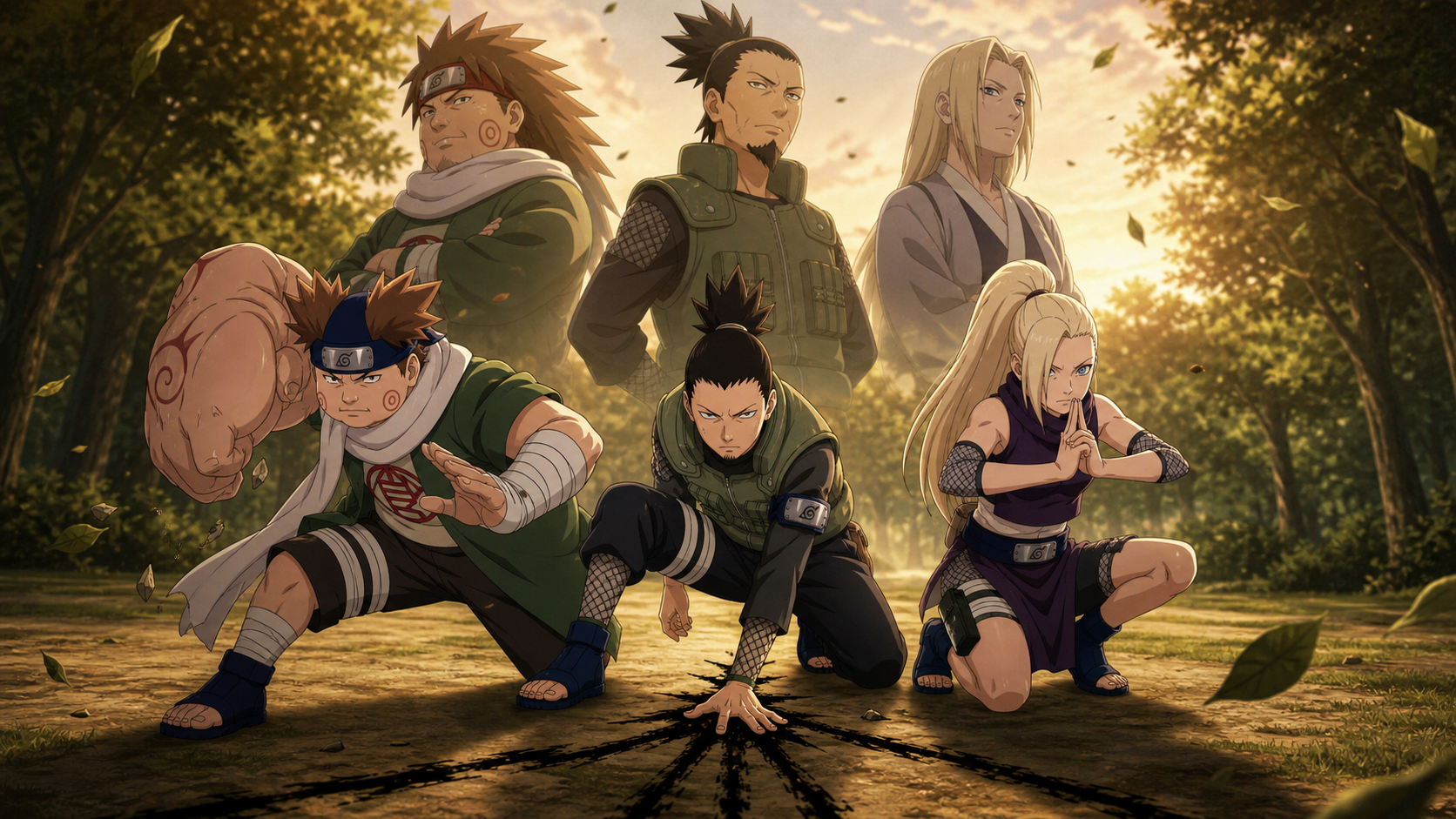
The Legendary Ino-Shika-Cho Trio
Three clans gave them the formation. War asks Ino, Shikamaru and Choji what their generation will make from the inheritance.
Bottom line
Naruto Shippuden Episode 239 asks whether inheritance should feel like a gift, a debt, or a standard nobody can reach. Ino, Shikamaru, and Choji meet Kosuke after effortlessly stopping three boys from fighting. His praise opens two memories: Team 10 saving him during an early genin mission, then their fathers protecting him during the Konoha Crush. What begins as a small reunion becomes a comparison between two generations of Ino-Shika-Cho.
The younger trio initially hears that history as proof that they remain behind. Shikaku, Inoichi, and Choza look legendary because Kosuke remembers the finished formation, not every awkward step that built the formation. Shikamaru finally breaks the comparison by focusing on what Team 10 already owns: intelligence, trust, complementary skills, and allies who will stand beside them in the coming war. Legacy becomes a starting language instead of a ceiling.
Ino’s argument with her father carries war anxiety
Ino begins angry because Inoichi entered her room without knocking, then teased her about choosing between Shikamaru and Choji. The comedy works on the surface, but their exchange also happens while Konoha prepares for the Fourth Shinobi World War. Inoichi tries to ask whether his daughter has something weighing on her and hides concern inside clumsy teasing.
Ino has every right to defend her privacy. The episode does not need the intrusion to become sentimental merely because her father worries. Their friction establishes a family relationship where affection and irritation coexist. That same pattern later matters when Ino evaluates the enormous professional legacy Inoichi represents.
The three boys reveal Team 10’s reflexes
Ino, Shikamaru, and Choji notice three boys brawling. Shikamaru catches them with Shadow Imitation while Choji and Ino help settle the conflict. Nobody announces a formal strategy. Each teammate reads the problem and fills the correct role.
That ordinary intervention gives the episode its strongest evidence. Before Kosuke names Team 10 as a great formation, the audience watches their coordination happen without ceremony. Shikamaru controls movement, Choji brings physical presence without escalating force, and Ino redirects the boys socially. The solution uses restraint rather than punishment.
Kosuke sees a pattern they take for granted
Kosuke Maruboshi watches the encounter and praises their teamwork. Team 10 reacts as if they performed nothing special because their coordination has become normal from the inside. Kosuke has the distance needed to notice the pattern.
His perspective matters because growth often becomes invisible to the people living through the repetitions. Shikamaru, Ino, and Choji remember mistakes, losses, and the strength they still lack. Kosuke sees three shinobi who respond as one unit before anybody asks. Both views are true, but only one view lets them recognize progress.
Their first rescue was not polished
Shikamaru recalls an early genin mission when the trio found Kosuke threatened by bandits. The younger Team 10 did not possess their current control, confidence, or battlefield experience. They still combined their clan techniques and saved him.
The flashback protects the legacy theme from becoming pure bloodline worship. The team’s formation did not emerge complete because their surnames carried Nara, Yamanaka, and Akimichi history. They had to make decisions under pressure, trust one another’s timing, and survive the gaps between inherited technique and practical use.
Ino-Shika-Cho works because no role stands alone
The formation is sometimes described as a neat list: mind, shadow, and body. Episode 239 shows why that summary is incomplete. Each technique creates vulnerability alongside power. Shadow possession limits movement but ties Shikamaru to the target. Mind transfer can seize control but leaves Ino’s body exposed. Choji’s expansion supplies force but needs direction and protection.
Together, their limitations become connection points. Shikamaru creates an opening, Ino changes the enemy’s decision-making, and Choji converts control into decisive physical action. The formation depends less on three spectacular attacks than on three people accepting that another person completes the move.
Kosuke carries living village history
Kosuke is an elderly genin, yet rank does not make him irrelevant. He has survived long enough to witness separate generations respond to danger. His memory connects Team 10 to their fathers without relying on a monument, clan archive, or official ceremony.
Naruto often links worth to advancement through ranks, exams, and command. Kosuke complicates that ladder. He may remain a genin, but he remembers who protected civilians and how people behaved when the village broke open. His testimony gives Team 10 a form of history that institutional records could flatten.
The fathers’ Konoha Crush formation earns the legend
Kosuke remembers Shikaku, Inoichi, and Choza fighting invading Sound shinobi during the Konoha Crush. Choza’s expanded body creates overwhelming physical pressure. Shikaku’s shadows pull and hold enemies in a controlled field. Inoichi’s mind technique turns an attacking group against itself.
The sequence deserves its legendary reputation because the three fathers operate as a system. Their power is not three solo demonstrations placed side by side. Range, restraint, disruption, and force arrive in an order that multiplies every contribution. Kosuke survives because their coordination converts clan specialties into collective protection.
Their fathers are people before they are standards
The younger trio hears the story after years of knowing those men at home. Ino knows the father who enters without knocking. Shikamaru knows the brilliant strategist whose domestic conversations can become weary complaints. Choji knows a warm father who understands both clan pride and his son’s sensitivity.
Kosuke remembers those same men at maximum battlefield clarity. The contrast shows how legends are built from partial views. Public memory preserves the finished technique while children remember habits, arguments, meals, expectations, and affection. Team 10 must inherit from whole people rather than idealized statues.
Shikaku’s prediction creates pressure
During the remembered battle, Shikaku says their children may surpass them within a few years. The confidence sounds generous when spoken by a father. For the children, hearing the prediction later creates a deadline they never agreed to carry.
Surpassing a parent cannot mean recreating the same battle with larger attacks. The next generation faces different enemies, alliances, and moral decisions. Team 10 honors the prediction when they adapt the formation to their own war, not when they imitate every movement from the Konoha Crush.
Team 10 measures itself at the wrong moment
Ino, Shikamaru, and Choji feel discouraged after Kosuke finishes. They compare their unfinished present to the fathers’ most memorable victory. That comparison removes the years of training, failure, and ordinary missions behind the legend.
The coming war intensifies the mistake. Every young shinobi wants proof of readiness before entering a conflict larger than any previous assignment. Kosuke’s story supplies inspiration and fear at once. If their fathers once protected Konoha with perfect coordination, Team 10 wonders whether anything less would betray the name.
Asuma remains inside the formation
Episode 239 focuses on the three clans, but Team 10’s development cannot be separated from Asuma. He taught them how to operate beyond inherited techniques, treated their personalities as tactical realities, and trusted Shikamaru with leadership. His death forced the trio to turn grief into a coordinated fight against Hidan.
Their father’s formation represents bloodline continuity. Asuma represents chosen mentorship. The younger Ino-Shika-Cho becomes distinct because both inheritances meet. They carry clan jutsu from home and battlefield trust from the teacher they lost.
Choji’s strength depends on being seen correctly
Choji’s role can look simplest because expansion produces visible force. His history proves otherwise. Shame, bullying, and fear once made his power difficult to claim. Shikamaru’s early friendship and Asuma’s faith gave him space to grow without reducing him to size or appetite.
The formation needs Choji’s physical commitment, but Team 10 needs his empathy just as much. He understands how quickly mockery can turn a person defensive. During the boys’ fight, his presence helps end harm without humiliating them. That emotional judgment belongs in the team’s legend too.
Ino is more than the connector between two boys
The opening joke treats Shikamaru and Choji as possible romantic choices, then the episode risks positioning Ino as the third piece between their better-known friendship. Her actual function rejects that reduction. Ino reads people, acts decisively, and provides the mind technique that can change an entire engagement.
She also maintains Team 10’s emotional movement. Ino speaks when Shikamaru withdraws and pushes when Choji doubts himself. Her directness can create conflict, but silence would leave the trio strategically and emotionally weaker. Inheritance for Ino means claiming authority, not merely supporting male teammates.
Shikamaru changes comparison into preparation
Shikamaru finally answers the trio’s discouragement by naming what they already possess. They are smart, they understand strategy, and they will enter the war beside other capable shinobi. He refuses the idea that Team 10 must become a sealed unit responsible for winning alone.
That response shows leadership. Shikamaru does not promise easy victory or claim they already surpassed their fathers. He reframes readiness as the ability to think, cooperate, and rely on a larger alliance. The legendary formation becomes one tool inside collective defense.
The coming war changes the meaning of clan tradition
The Allied Shinobi Forces require villages and clans to coordinate beyond old boundaries. A formation built through generations of three Konoha families enters a battlefield where former rivals share intelligence, medicine, sensory work, and command.
Team 10 can preserve its identity without treating tradition as private property. Their strongest inheritance is a method: know each person’s capacity, cover every vulnerability, and combine techniques around a shared objective. That method scales beyond three surnames.
A formation is also a promise of rescue
Kosuke’s two memories share one result: somebody vulnerable gets to live because three shinobi coordinate. The episode could have framed the formation only as an efficient way to defeat opponents. Centering rescue gives the inherited techniques a moral purpose.
That purpose matters before a war where commanders will discuss units, divisions, casualties, and acceptable risk. Team 10’s family history reminds them that strategy is never merely an elegant pattern on a battlefield map. A shadow holds an attacker so a civilian can escape. A mind technique breaks an assault before more bodies fall. Choji’s strength places protection between danger and another person.
The boys in the present create a much smaller version of the same obligation. Team 10 interrupts violence without treating the children as enemies. Their response proves that protective instincts do not need a declared war or famous opponent. Legend begins when ability serves people who cannot solve the danger alone.
Surpassing does not require forgetting who helped
Shikaku’s prediction about the children surpassing their fathers can sound like a clean transfer of status. Team 10’s history rejects that simplicity. Their progress includes lessons from their families, Asuma’s guidance, missions with other Konoha teams, medical support, intelligence networks, and painful encounters that exposed weaknesses.
Surpassing the previous generation therefore remains collective. The children can go farther because the adults gave them techniques and because peers challenge the limits of those techniques. Shikamaru’s closing faith in the allied force recognizes that truth. Pride becomes healthier when Team 10 can name every relationship that made its growth possible.
That perspective also leaves room for gratitude without obedience. Ino may appreciate Inoichi’s concern while demanding privacy. Shikamaru may inherit Shikaku’s strategy without copying his resignation. Choji may honor Choza’s strength while defining courage through his own sensitivity. Love for a legacy does not cancel the right to revise what gets carried forward.
Legacy stories edit out the years when coordination failed
Kosuke remembers formations that worked because those moments saved his life. His gratitude naturally preserves clarity, timing, and decisive rescue.
The younger trio hears a finished legend without every disagreement, mistimed technique, and ordinary mission their fathers needed before reaching it.
Comparison becomes unfair when one side is still developing
Ino, Shikamaru, and Choji measure current uncertainty against a past victory already selected for remembrance. The comparison makes growth invisible by changing the evidence standard.
A responsible legacy should provide methods and confidence, not demand that children reproduce an adult peak before entering their own war.
The clan formation contains engineered vulnerability
Mind transfer leaves Ino’s body exposed. Shadow techniques restrict Shikamaru and connect his movement to targets. Expansion changes Choji’s speed, energy use, and physical exposure.
Trust is not decorative affection around three powerful jutsu. It is the operational condition that makes each dangerous commitment usable.
Ino’s communication is tactical leadership
She reads emotional movement, names problems other people avoid, and pushes the trio toward action when Shikamaru withdraws or Choji doubts himself.
Those skills matter before Mind Transfer begins. A formation cannot coordinate if nobody keeps information and urgency moving between its members.
Choji’s empathy belongs inside the legend
His size and expansion techniques provide visible force, but emotional judgment helps Team 10 interrupt the boys’ fight without escalating humiliation.
Strength used proportionally is more difficult than maximum impact. Choji understands what mockery can do and refuses to turn frightened children into enemies.
Shikamaru inherits teaching as well as strategy
Asuma and Shikaku gave him frameworks for reading people, responsibility, and the village’s future. He now has to translate those frameworks for peers and younger shinobi.
Leadership appears when he changes discouragement into a usable standard rather than displaying intelligence for its own sake.
Kosuke’s rank challenges promotion as the only archive of worth
An elderly genin carries memories, survival knowledge, and testimony unavailable in official records. His rank cannot measure the lives he witnessed or the continuity he preserves.
The village needs people who remember how protection felt from the position being protected, not only commanders who recorded victory.
Inheritance includes the right to revise family habits
Ino can value Inoichi while demanding privacy. Shikamaru can use Shikaku’s brilliance without adopting every weary assumption. Choji can honor Choza while defining courage through his own sensitivity.
Gratitude becomes healthier when it does not require obedience to every trait bundled with a technique.
The alliance asks tradition to work beyond inherited boundaries
The formation becomes stronger when its purpose survives beyond bloodline pride. Ino, Shikamaru, and Choji will fight beside shinobi whose families do not share Konoha history and whose villages were once rivals.
Mind, shadow, and body remain their specialized language, but the method can expand: understand another person’s capacity, cover exposure, communicate timing, and use combined force toward protection.
Tradition becomes useful to the alliance when it teaches cooperation without demanding that every participant belong to the same three clans.
Asuma makes the younger trio more than a family sequel
The fathers provide technique and domestic inheritance. Asuma taught the children how those abilities behaved inside one team, noticed personality beneath clan function, and trusted them with responsibility.
His death also forced them to coordinate while grief disrupted judgment. Their victory over Hidan was not a copy of the fathers’ Konoha Crush formation. It was an answer built from chosen mentorship and personal loss.
Any account of the younger legend that excludes Asuma turns development into biology and misses the relationship that made Team 10 itself.
Surpassing should mean changing what strength protects
Larger techniques and faster execution provide one measure. The next generation also inherits the consequences of wars, clan expectations, and institutions that repeatedly spend young lives.
Team 10 can surpass its parents by coordinating across village lines, valuing prevention, protecting civilians without spectacle, and refusing to confuse inherited authority with automatic correctness.
The standard should move because history moved. Repeating a famous battle more impressively would still leave the deepest lessons untouched.
RaeRae’s final word on the legendary trio
Kosuke remembers the fathers at maximum competence, while the children remember household habits and every step they still have not mastered. Both portraits belong to the same men.
Ino, Shikamaru, and Choji do not need to become statues before war. They already stop violence through reflexive trust and know how to make three vulnerable techniques protect one another.
The legend is not a finish line. It is a working language the next trio gets to revise.
The trio’s future will not be proven by matching one remembered formation. It will be proven when fear, distance, and unfamiliar allies make coordination harder, and the three still choose to communicate, cover exposure, and keep protection larger than pride. Kosuke’s memory gives them evidence. Their own war will decide what they do with it.
What landed and what did not
The episode’s best choice is letting a minor act of conflict prevention prove Team 10’s growth before the long flashbacks begin. Kosuke’s memories then give clan history a human witness and connect personal anxiety to the coming war.
The structure also spends too much time replaying battles rather than giving Ino, Shikamaru, and Choji a new present-day decision. Ino’s opening embarrassment is broader than necessary, and Choji receives less interior attention than his teammates. A final training sequence could have turned reflection into immediate action.
Final reaction
“The Legendary Ino-Shika-Cho Trio” understands that children rarely inherit a clean legacy. They inherit techniques, expectations, family habits, unfinished grief, and stories polished by time. Team 10 feels small because Kosuke remembers their fathers at the exact moment everything worked.
Shikamaru offers the healthier measure. They do not need to become copies before the war starts. They need to trust the work already completed, keep improving, and enter the alliance knowing no formation survives alone. The name Ino-Shika-Cho remains legendary because each generation learns how to make three different people act with one purpose.
RaeRae’s call
Ino-Shika-Cho is legendary because three vulnerable specialties become reliable through trust. The younger trio does not owe a copy of their fathers’ best day; they owe one another preparation, honesty, and rescue.
Episode details and viewing routes
Naruto Shippuden Episode 239, “The Legendary Ino-Shika-Cho Trio,” first aired in Japan on December 8, 2011. The anime-original episode belongs to the Paradise Life on a Boat stretch and centers Team 10 in Konoha before the Fourth Shinobi World War.
- Official episode reference: Naruto Official episode guide
- Licensed episode route: Crunchyroll licensed episode page