
Ah, the Medicine of Youth
Naruto turns one swallowed bottle into a promise for Lee, then discovers that a rare flower can make the enemy in his thoughts dangerously real.
Bottom line
Naruto Shippuden Episode 186, "Ah, the Medicine of Youth," begins with Rock Lee bringing a special remedy for the unconscious Tsunade. The gesture reminds Sakura of the period when Lee was hospitalized after the Chūnin Exams and his own future as a ninja was uncertain.
Naruto accidentally drinks Lee's final dose of Guy's youth medicine. When Guy explains that the rare Jofuku Flower is out of stock, Naruto becomes determined to replace the dose. A later delivery mission with Sakura and Ino takes them toward the flower's forest, allowing Naruto to turn official work into his personal promise to Lee.
Episode 186 builds a warm chain of care: Tsunade once offered Lee a future, Lee now brings hope to Tsunade, and Naruto tries to repair the medicine he accidentally consumed. The story's best insight is that honoring someone does not require copying them. Naruto serves Lee most effectively when he carries his friend's determination into skills that are genuinely his own.
Lee offers care from the position he once occupied
In the present, Lee is healthy enough to bring medicine to Tsunade. The reversal matters because Tsunade was the surgeon who gave him a path back to training. He cannot wake her through determination alone, but he can contribute the kind of care he once received.
The remedy is framed through Guy's exaggerated language of youth, yet Lee's gratitude is sincere. Recovery created an obligation to support someone else rather than a private victory he keeps for himself.
Sakura understands the full circle. She watched Lee face the possibility that surgery could end his life or restore his dream. Now she watches him place hope beside her unconscious mentor.
Lee cannot repay Tsunade through an equivalent medical act, and the episode never asks him to. Gratitude moves forward in a different form. He brings what he can, trusts Sakura's care, and refuses to let helplessness become absence.
Naruto's mistake becomes a promise rather than a joke
Naruto consumes the last special drink without understanding the bottle's purpose. The accident is careless, particularly because Lee's medicine is difficult to replace.
His response shows why the others forgive him. He does not minimize the loss or assume Guy will solve the shortage. Once he understands what the dose means to Lee, he commits to finding the missing ingredient.
Naruto's sense of responsibility is immediate and personal. He may not know medicinal plants, but he knows what Lee's recovery represents. Replacing the flower becomes a way to protect the hope Lee fought to maintain.
Responsibility means more than feeling guilty. Naruto converts embarrassment into work. He seeks information, notices an opportunity inside another assignment, and continues despite lacking the expertise that Sakura and Ino bring. The promise becomes credible because he accepts help rather than treating remorse as proof enough.
Naruto remembers the moment Lee refused to surrender
Naruto explains that he saw Lee continue trying to fight Gaara even after losing consciousness. Lee's damaged body moved because the discipline of standing back up had become deeper than deliberate thought.
That image shaped Naruto's belief in him. Supporting Lee was not empty reassurance. Naruto had evidence that Lee would use any chance he received.
Their friendship is built through recognition between people dismissed for different reasons. Naruto was treated as a failure because of his behavior and the fear surrounding the Nine-Tails. Lee was treated as limited because he could not use ninjutsu or genjutsu. Each understands the value of someone refusing the category assigned to him.
Naruto does not romanticize the injury that followed Lee's stand. He remembers the cost and still refuses the conclusion that trying was pointless. That distinction connects the medicine to more than physical recovery. The remedy represents another chance for someone whose will was already present.
The Jofuku Flower looks like medicine worth protecting
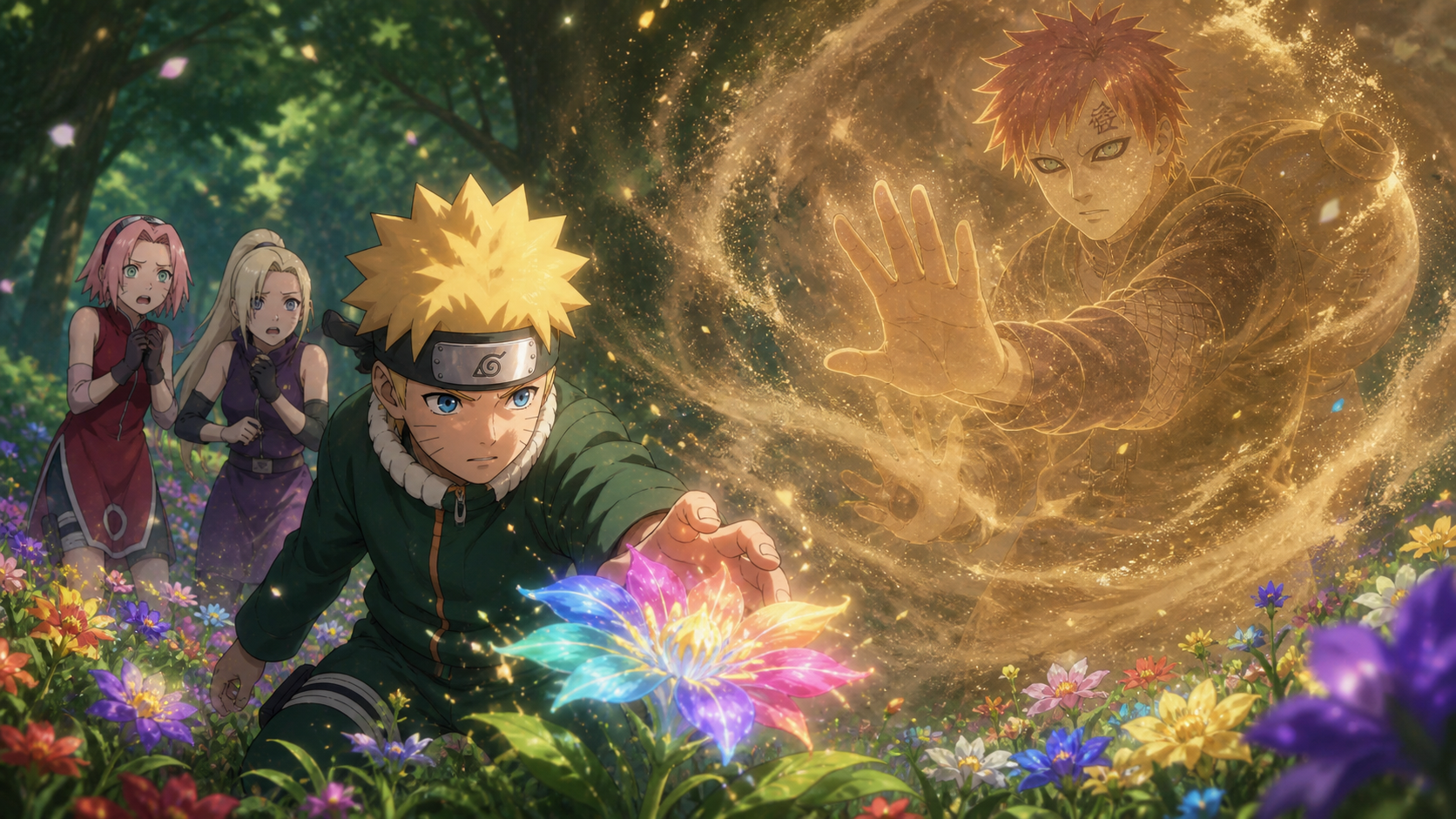
The flower glows in seven colors, making its rarity visually obvious. Ino's surprise is funny because her family runs a flower shop, but ordinary botanical knowledge does not guarantee familiarity with a chakra-reactive plant found near the border.
The beauty invites harvesting. Its defense mechanism exists because a valuable plant without protection would disappear under human demand.
Naruto approaches with urgency rather than caution. He sees the ingredient Lee needs and reaches before asking what the surrounding ecosystem might require.
The flower's rarity introduces an important limit to good intentions. Wanting medicine for a friend does not automatically authorize careless extraction. Sustainable access requires knowledge of the plant, its defenses, and the person responsible for tending the forest.
The flower weaponizes the gatherer's own idea of an enemy
When Naruto plucks the plant, pollen rises into an apparition of Gaara. The defense does not store one guardian. The pollen reads the person disturbing the flower and produces the rival or threat occupying that person's mind.
This makes the encounter psychologically precise. Gaara is connected to Lee's injury and to Naruto's memory of the fight that proved Lee's determination. The apparition is both an obstacle and the reason Naruto came.
The flower turns motive against action. Naruto wants to help Lee because of what Gaara did, so that memory becomes the barrier between him and the medicine.
Gaara's form is psychologically exact because Naruto's fear is not simply about an opponent's strength. The apparition carries the moment Lee's courage met catastrophic injury. To reach the remedy, Naruto has to face the memory that made the remedy feel necessary.
Wearing green does not make Naruto fight like Lee
Naruto has adopted a green training suit in solidarity, and he attempts to channel Lee's taijutsu. The tribute is heartfelt, but clothing and enthusiasm cannot reproduce years of specialized training.
The apparition's Sand Armour blocks his strikes. Naruto learns that honoring a friend does not require copying the friend's method when his own skills offer a better answer.
This is an important form of respect. Lee's identity remains his own. Naruto can carry Lee's determination while using shadow clones, combination attacks, and the Rasengan that belong to his path.
The green suit expresses affection, but the failed imitation establishes a boundary. Years of taijutsu discipline cannot be borrowed through clothing. Naruto respects the labor behind Lee's style once he stops treating enthusiasm as a substitute for training.
Naruto's switch to ninjutsu is adaptation, not betrayal
After the taijutsu approach fails, Naruto changes tactics. He uses the Naruto Uzumaki Combo and finishes the pollen guardian with Rasengan.
The sequence does not suggest ninjutsu is inherently superior. The tactical switch shows that support is most effective when a person contributes genuine strengths instead of performing an imitation.
Naruto defeats the apparition because he combines what Lee inspired with what he personally trained to do. Friendship connects different paths without flattening them into one style.
Sakura and Ino bring knowledge Naruto lacks
Sakura understands the medical purpose of the mission, while Ino provides botanical awareness even when the supernatural flower surprises her. Their presence keeps Naruto's promise from becoming a solo adventure.
Both can evaluate the plant and the danger more carefully than he can. Naruto supplies commitment and combat response, but retrieving medicine also requires people who know how to handle a living ingredient.
The trio demonstrates a useful mission balance: emotional motivation, medical judgment, and plant expertise all matter.
Naruto may be the person who made the promise, but he is not automatically the best person for every part of fulfillment. Sakura and Ino keep care connected to knowledge. Their participation turns one boy's guilt into a competent team response.
Furofuki reveals that the official mission and Naruto's promise align
The woman living near the forest accepts the letter the team was assigned to deliver. The message contains Guy's request for Jofuku Flowers to be sent to Konoha.
Naruto discovers that his self-appointed quest was already embedded in the official task. Guy understood the supply problem and used the mission system to solve the shortage responsibly.
The reveal is gently comic because Naruto treated himself as the only person taking action. In reality, his mentor network was working toward the same goal through planning, correspondence, and logistics.
Guy's letter does not make Naruto's effort meaningless. The parallel actions reveal two valid forms of care. Naruto responds through immediate personal commitment, while Guy builds a repeatable supply route. Emotion starts the search; planning makes future shortages less likely.
The flower's defense rewards understanding after combat
Furofuki explains that the Gaara apparition was generated by the plant. The knowledge changes the encounter from a mysterious attack into a predictable ecological response.
Future harvesting can account for that defense rather than treating every apparition as an unrelated enemy. Information makes the medicine safer to obtain and helps prevent needless damage to the flower bed.
The episode therefore ends with a better supply relationship, not merely one stolen ingredient. Konoha can receive flowers through the person who tends them.
Recovery moves through a community
No single character owns the episode's care. Tsunade performed the surgery that restored Lee's path. Guy maintained the medicine and contacted Furofuki. Lee brought hope back to Tsunade. Sakura and Ino carried medical and botanical knowledge. Naruto supplied urgency and accepted the danger created by his mistake.
That network makes recovery more believable than a miracle bottle. Medicine matters, but so do surgery, cultivation, delivery, research, gratitude, and people willing to notice when supplies run low.
The story also refuses a simple division between giver and receiver. Lee once needed care and now offers care. Naruto causes the shortage and helps repair the shortage. Roles change as circumstances change.
The Gaara apparition turns memory into a test
Naruto is not facing Gaara as the Kazekage he knows in the present. The pollen summons the version attached to Lee's broken body and Naruto's fear that determination may not be enough to save someone.
Defeating that image does not rewrite the Chūnin Exam fight. Lee was injured, and the surgery carried real risk. Naruto instead proves that the memory can motivate adaptive action rather than trapping him in imitation.
The encounter becomes a test of how influence works. Copying Lee fails. Carrying Lee's refusal to surrender into Naruto's own tactical language succeeds.
Care needs logistics as much as passion
Naruto's promise is emotionally satisfying because he reacts immediately. Guy's letter is operationally satisfying because one recovered flower would not solve the underlying shortage. A dependable relationship with Furofuki can support future needs without raiding a protected habitat.
That contrast fits CVM Sekai's larger interest in the work beneath dramatic gestures. A bottle reaches a hospital because someone grows the plant, someone knows the route, someone writes the request, and someone completes the delivery.
The episode ends with affection translated into infrastructure. Guy's care becomes correspondence and supply planning, while Naruto learns that keeping a promise can mean joining a system already moving toward the same goal.
Tsunade and Lee exchange hope across different recoveries
Lee cannot return the surgery Tsunade gave him. He can bring a remedy, stand beside her student, and insist that the person who restored his future still has one of her own.
The gesture avoids the fantasy of equal repayment. Care does not settle a debt. It keeps moving until the former patient becomes somebody capable of supporting the next bedside.
Naruto’s guilt becomes useful only after it becomes work
Drinking the last dose is careless. Feeling terrible does not replace it. Naruto earns forgiveness by seeking the ingredient, accepting other people’s expertise, and staying with the problem after the joke has ended.
That pattern is one of his better forms of accountability. He does not spend the episode defending his intention. He focuses on repairing the consequence.
The Jofuku Flower protects itself from desperate good intentions
Naruto wants medicine for a friend, which gives him a loving reason to reach. The plant still answers intrusion with pollen and danger. Nature does not waive boundaries because the gatherer has a sympathetic story.
The episode quietly separates need from entitlement. Sustainable care requires a relationship with the person tending the flowers, not one heroic raid on a rare resource.
Gaara represents the wound beneath Naruto’s promise
The apparition is not random strength. It carries the Chūnin Exam moment when Lee’s extraordinary discipline met a body-breaking limit. Naruto is fighting the fear that admiration cannot protect somebody from consequence.
That memory makes imitation tempting. If he can become Lee for a moment, perhaps he can symbolically finish what Lee could not. The sand refuses the fantasy.
The failed green-suit performance protects Lee’s specificity
Naruto means every ounce of the tribute, but intention cannot manufacture years of taijutsu conditioning. Lee’s craft belongs to the labor that built it.
Respect deepens when Naruto stops treating another person’s style as a costume. He can carry the courage forward without pretending their bodies, training, or answers are interchangeable.
Ino and Sakura keep the promise connected to knowledge
Naruto supplies urgency. Sakura understands medical consequence. Ino brings plant knowledge and recognizes where ordinary expertise reaches its limit. None is sufficient alone.
The mission values a team precisely because love can move faster than judgment. Friends help the promise survive its own impatience.
Guy’s letter turns one remedy into a supply relationship
Naruto searches for the missing dose. Guy has already asked the grower to send flowers to Konoha. The mentor addresses tomorrow’s shortage while the student answers today’s guilt.
Both responses matter. Passion locates the emergency. Planning prevents the same emergency from becoming routine.
Recovery is a chain without a single hero
Tsunade operates, Guy maintains treatment, Furofuki cultivates, Sakura and Ino bring professional knowledge, Lee offers gratitude, and Naruto carries urgency into action. The medicine reaches people through a network.
That distribution makes the tenderness believable. Nobody needs to become perfect. Each person contributes the form of care they can actually sustain.
RaeRae's reaction to Ah, the Medicine of Youth
I love the circular care at the heart of this episode. Tsunade once made Lee's recovery possible. Lee now brings medicine while she cannot wake, and Naruto remembers why he never stopped believing Lee would return.
The Gaara apparition is a clever defense because the guardian emerges from Naruto's reason for being there. His memory of Lee's worst injury blocks access to the ingredient meant to support Lee.
Naruto trying to fight in green is sweet, but the better tribute comes when he stops copying. He carries Lee's refusal to quit into his own techniques. That is how influence should work: not by replacing one person's identity, but by strengthening another person's path.
The final joke about Guy's letter also lands. Naruto's promise matters, yet love is not always loud improvisation. Sometimes care looks like a mentor quietly arranging the supply line before anyone else notices the bottle is empty.
I especially appreciate that Lee's green suit does not become a shortcut to Lee's skill. Naruto's failed imitation protects the specificity of his friend's labor. The best tribute is not becoming a copy. The best tribute is letting another person's courage make your own path more disciplined.
The present makes Lee’s gift more than a callback
Tsunade’s coma leaves everyone searching for action that might reach her. Lee brings the same language of hopeful persistence that once surrounded his hospital bed. He cannot command an outcome, but he can refuse emotional absence.
Sakura receives the gesture as somebody who witnessed both sides of the circle. Her memory joins surgery, friendship, medicine, and reconstruction into one continuing practice of showing up.
The episode lets gratitude change jobs
Lee’s gratitude begins as a bottle beside Tsunade’s bed. Naruto’s gratitude for Lee becomes a dangerous search. Guy’s devotion becomes correspondence with a grower. Sakura’s respect becomes continued medical care while her mentor cannot answer.
None of these gestures looks alike, which is why the chain feels alive. Affection is not one approved performance repeated by every character. It changes form according to skill, circumstance, and what the next person actually needs.
That flexibility is also the lesson Naruto learns in combat. Copying Lee produces a weak imitation. Translating Lee’s courage into shadow clones and Rasengan produces an honest response. The same principle governs care: honor the source, then contribute something that genuinely belongs to you.
Care changes hands without losing meaning.
RaeRae’s final word on Ah, the Medicine of Youth
This episode understands that love can be ridiculous without becoming shallow. Lee arrives with Guy’s youth medicine like gratitude can be bottled, Naruto drinks the last dose by accident, and suddenly a glowing flower is guarded by the worst memory attached to Lee’s body.
The green suit makes me soft because Naruto is trying so hard to honor his friend. It also has to fail. Lee’s taijutsu is not fabric, enthusiasm, or a pose anybody can borrow. It is years of work shaped around limits Naruto does not share.
The real tribute comes when Naruto uses his own skills without releasing Lee’s determination. Influence should make a person more fully themselves, not produce a copy.
Guy’s quiet letter may be the most mature act in the episode. Naruto replaces what he consumed. Guy builds the relationship that can keep medicine coming. One action repairs guilt; the other repairs supply.
Lee once received a future from Tsunade and now carries hope back toward her bedside. That circle is the medicine underneath the medicine, and it works because everybody gives something different.
RaeRae’s call
Naruto honors Lee only after he stops trying to become him. Carry the determination, use your own gifts, and let care grow into a supply line strong enough to outlast one dramatic promise.