
Animal District
Condor narrates the legend of the ninja-animal squad that made Naruto’s routine retrieval mission question who really controlled the forest.
What happens in Naruto Shippuden Episode 185?
Naruto Shippuden Episode 185, "Animal District," gives the microphone to Condor, the ostrich previously captured by Team 7. During Konoha's reconstruction, he tells a brood of young ostriches about the rival who repeatedly interfered with his freedom: Naruto Uzumaki.
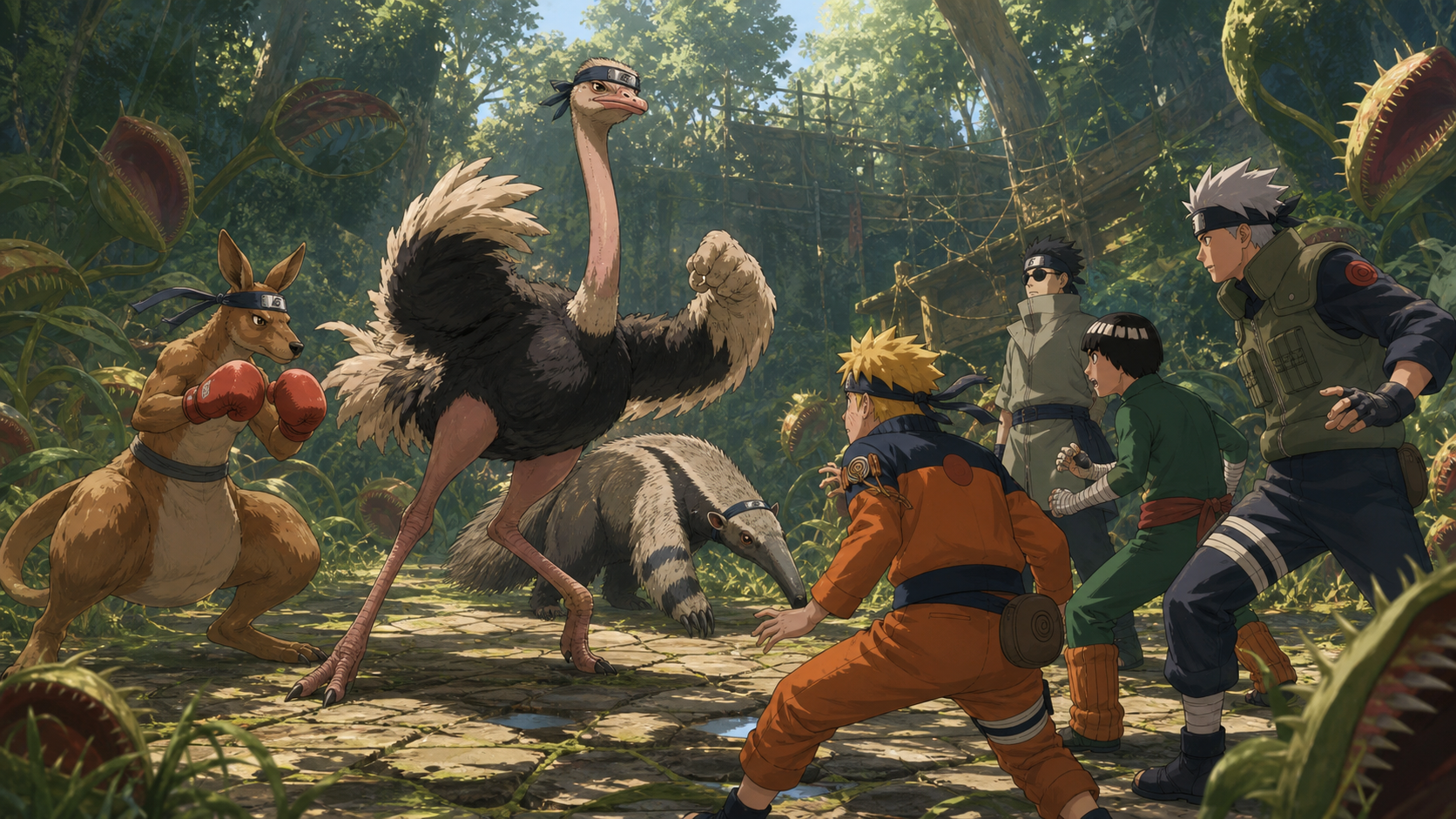
After escaping captivity, Condor trained himself in ninja movement and taijutsu. Tsunade eventually dispatched Naruto, Shino, Rock Lee, and team captain Kotetsu to retrieve him from the restricted Zeroth Training Ground. The mission looked like animal control until the forest began countering each shinobi's specialty.
Condor tells the story like a legendary warrior
The framing lets Condor narrate his own myth. To the chicks, he is not an escaped animal evading village authorities. He is a freedom fighter who mastered ninja arts and built an elite squad in hostile territory.
His confidence is the joke, but it also gives the episode coherence. Condor interprets every retreat as strategy and every defeat as proof that Naruto is a worthy lifelong rival.
The young ostriches listen because stories teach identity. Condor wants them to understand that an animal can learn, organize, and refuse to remain a passive mission objective.
Zeroth Training Ground is an ecosystem, not an arena
The retrieval team enters a forest where plants and animals have adapted into specialized threats. Giant insect-eating plants counter Shino's kikaichū. Uneven terrain gives fast animals escape routes. Dense cover makes ordinary tracking unreliable.
The setting punishes the assumption that human ninja automatically control every environment. Techniques developed for fights against other shinobi do not transfer cleanly when the forest itself participates.
Kotetsu's team has to observe before escalating. Capturing Condor without understanding the habitat would expose them to dangers unrelated to the ostrich.
Shino loses his usual information advantage
Shino begins with the sensible plan of using insects to locate and restrain the target. Carnivorous plants consume the bugs, stripping him of the network that normally makes him the calmest person on a pursuit mission.
The counter is funny because it is biological rather than tactical. No enemy studied clan techniques or designed a jutsu. The local food chain simply has a direct answer to his method.
Shino remains useful because expertise includes knowing when a tool has failed. He identifies the environmental problem rather than feeding more insects into it.
Rock Lee meets a boxing kangaroo built for his language
Lee pursues Condor and finds a kangaroo ready to exchange punches. The match gives him an opponent whose entire physical design supports explosive kicks, balance, and close-range striking.
Lee takes the challenge seriously because he respects effort wherever he sees it. The kangaroo's gloves are absurd, but its commitment to training is legible to him.
Losing does not diminish Lee. It expands the episode's central joke: the animals have developed a squad whose specializations correspond unnervingly well to the humans sent after them.
Naruto and Kotetsu underestimate Condor's taijutsu
Condor no longer runs like an ordinary ostrich. He reads attacks, changes direction, and strikes with the reach and force of his legs. Naruto and Kotetsu discover that surrounding him is not the same as controlling him.
Naruto is particularly vulnerable to treating the mission as a rematch. He recognizes Condor from earlier chaos and assumes persistence will be enough. Condor has used the time between encounters to improve.
The reversal gives the animal agency. He is not waiting in the same state for the hero to return. He has a training history of his own.
Retreat is the first intelligent decision the team makes
After each specialty is countered, Kotetsu orders a withdrawal. The mission has produced new information: Condor can fight, the environment disables standard methods, and additional animals may be coordinating with him.
Retreat is not failure. It prevents a comic assignment from becoming a serious injury and gives the team room to reorganize.
The episode pokes fun at Kotetsu's dramatic internal attachment to Izumo, but his command decision remains sound. Leadership sometimes means admitting the briefing was wrong.
The Four Ninja Animal Warriors reveal the real opponent
Condor does not work alone. The boxing kangaroo and giant anteater join him as the Four Ninja Animal Warriors. Their emergence converts separate encounters into a coordinated defense.
The name is grander than the roster, which is part of the charm. Yet the animals genuinely cover one another's weaknesses. Condor supplies speed and command, the kangaroo controls close range, and the anteater disrupts insect techniques.
The team has formed through shared habitat and purpose. They are defending autonomy from humans who enter the forest expecting obedience.
Izumo's arrival restores Kotetsu's balance
Kotetsu spends the mission missing his usual partner. When Izumo arrives, their practiced coordination gives the humans the stability they lacked.
This mirrors the animal squad. Individual strength matters, but familiar partners make decisions faster and cover gaps without lengthy explanation.
The comparison keeps the conflict playful. Humans and animals are both organized around bonds, specialties, and ridiculous amounts of confidence.
Capturing Condor does not erase his achievement
The Leaf team eventually overwhelms the animals and completes the retrieval. Condor narrates the result without surrendering his legend. Naruto remains the rival who can interrupt his escapes, not the person who proved he should never have tried.
That interpretation is emotionally useful for the chicks. Condor can acknowledge defeat while preserving the value of training and cooperation.
His story suggests that freedom is not a single successful escape. It is a continuing practice, including the ability to build a community that shares the effort.
The episode lets animal intelligence become more than a gag
Naruto's world already includes summons, ninja dogs, messenger birds, and creatures capable of speech. Animal District takes that premise to its comic extreme, but the underlying question is consistent: when does a mission target become a person with preferences?
Condor plans, trains, speaks, remembers, and teaches. Treating him as ordinary property becomes harder once those capacities are visible.
The episode does not resolve the ethics of the reserve. It uses comedy to make the human assumption of ownership feel less automatic.
Condor controls the edit because Condor controls the story
The episode hands narration to the least neutral witness available. Condor is teaching young ostriches who he believes himself to be, so every escape becomes strategy, every setback becomes adversity, and Naruto becomes the rival required by legend.
That perspective does more than produce jokes. It lets an animal previously treated as a capture objective become the author of his own continuity.
The chicks are an audience and a future
Condor does not tell this story into empty space. He addresses listeners who may inherit his understanding of humans, freedom, training, and resistance. The performance is identity work.
His embellishment teaches courage even when the facts are conveniently polished. Communities often begin by deciding which defeats still contain something worth passing forward.
Naruto has accidentally acquired an ostrich nemesis
Of all the rivalries this series could revisit, Condor’s commitment is gloriously specific. Naruto remembers an unruly mission target. Condor remembers the shinobi whose interference gave shape to his entire heroic era.
The imbalance makes the rivalry funnier. Naruto does not need to agree that a legend exists for Condor to build one around him.
Freedom becomes training rather than simple escape
Condor does not spend his time outside captivity hiding. He studies movement, practices taijutsu, and organizes allies. Staying free requires skills capable of answering the people sent to retrieve him.
That preparation gives his autonomy substance. He is no longer merely fleeing ownership. He is building a life with discipline, community, and a story about why both matter.
Zeroth Training Ground refuses human centrality
The forest does not behave like neutral terrain waiting for shinobi combat. Its plants consume insects, its animals exploit uneven paths, and its cover breaks familiar tracking assumptions.
The retrieval team enters as outsiders whose prestigious techniques may be irrelevant to the local ecology. Nature has not studied their reputation and does not care who usually wins.
Shino encounters a food chain instead of a counter-jutsu
His kikaichū normally provide surveillance, pursuit, and restraint with quiet efficiency. Carnivorous plants answer by eating them. No tactician designed this humiliation. Biology simply places his advantage on the menu.
Shino’s real competence appears when he recognizes the failure. Expertise includes stopping before confidence turns a bad method into a larger loss.
Lee respects the kangaroo before the joke ends
A boxing kangaroo is visual nonsense tailored perfectly to Lee’s seriousness. He reads stance, effort, balance, and commitment in an opponent everyone else might dismiss as a gag.
That respect lets the comedy breathe without making the animal disposable. The kangaroo trains in a language Lee understands, and Lee honors the work by fighting sincerely.
The animals mirror the shinobi instead of imitating them badly
Each animal’s body creates a specialization: legs for speed and striking, appetite for insect disruption, mass and terrain knowledge for control. Their team grows from what they are.
They do not need human jutsu to become organized opponents. Coordination turns ecological traits into tactics, which is the same principle behind a strong ninja squad.
Kotetsu receives captaincy over a briefing that is already obsolete
The assignment sounds like straightforward retrieval. The target can fight, the habitat counters the team, and allied animals may be defending him. Every assumption collapses shortly after entry.
Leadership begins when Kotetsu accepts the mismatch. Pretending the original plan remains adequate would protect pride and endanger everyone.
Retreat is the mission’s first mature victory
Leaving the first engagement does not look heroic, especially while an ostrich celebrates. It preserves the team and converts surprise into usable information.
Naruto stories often praise endurance, but persistence without reassessment can become vanity. Kotetsu proves command by choosing thought over the need to look dominant.
Kotetsu missing Izumo is tactical and deeply personal
The joke keeps returning because the partnership is so established that separation feels like missing equipment. Kotetsu knows how Izumo reads danger, fills gaps, and responds without an explanation.
His longing is funny because the show refuses to disguise it. It is also evidence that practiced trust changes what each shinobi can safely attempt.
The Four Ninja Animal Warriors earn their ridiculous name
The title is oversized, the roster is absurd, and the entrance commits to every syllable. Still, the group has coverage, purpose, and loyalty. They are more organized than the humans expected.
A grand name can begin as play and become real through conduct. Condor understands branding before half the villages do.
Humans and animals solve the same teamwork problem
The retrieval squad initially behaves like separate specialists: Shino scouts, Lee pursues, Naruto charges, and Kotetsu reacts. The animal group coordinates around shared ground and a shared definition of freedom.
The humans improve only when they begin covering weaknesses with the same intention. The episode’s silliest opponents deliver its clearest team lesson.
Izumo’s arrival restores a missing rhythm
He does not arrive as a miraculous weapon. He restores the communication pattern Kotetsu relies on. Familiar partners reduce hesitation because each person already understands where responsibility shifts.
The reunion validates bonds without claiming teams should never adapt. It shows why adaptation feels harder when one of your usual senses is a person.
Naruto underestimates anyone he remembers as a nuisance
He assumes Condor remains the same target from the earlier capture. Condor has trained during the time Naruto spent elsewhere. Memory becomes a bad briefing when it freezes another being at the last encounter.
The rematch corrects that arrogance. Every character, even an ostrich, has a life continuing outside the hero’s attention.
Capture settles the mission without settling Condor’s identity
The Leaf completes its objective, but Condor does not surrender the meaning of what happened. He trained, formed a team, defended territory, and forced skilled shinobi to revise their plan.
Defeat determines location. It does not erase achievement, relationship, or the story he chooses to tell afterward.
Animal intelligence makes ownership harder to ignore
Naruto already treats summons, ninken, messenger birds, and other creatures as partners capable of preference. Condor speaks, plans, remembers, teaches, and argues for freedom. Calling him ordinary property stops fitting the evidence.
The episode does not resolve the reserve’s ethics. It makes the human assumption feel strange enough that viewers cannot accept it without noticing.
The frame gives Condor what the mission denied him
During the chase, humans define the objective, boundaries, and acceptable outcome. In the closing story, Condor decides where the adventure begins, which moments matter, and what the children should learn.
Narration becomes a small territory nobody can recapture. Naruto can interrupt his freedom, but not own his interpretation.
RaeRae's reaction to Animal District
This episode commits completely to the idea that an ostrich can become Naruto's rival, and that commitment makes it work. Condor is funny because he believes every word of his heroic narration.
The specialized animal counters are my favorite part. Shino meets a forest that eats his bugs. Lee meets a kangaroo that has apparently trained for exactly this day. Kotetsu discovers that his partnership with Izumo is not optional emotional equipment.
Under the absurdity, the team structure is surprisingly clean. The humans fail when they act as four separate experts and improve when they coordinate. The animals succeed for the same reason.
Condor ends as a storyteller rather than a defeated target. Naruto may always interfere with his escapes, but he cannot take away the training, allies, or legend Condor built. For a ninja ostrich addressing the next generation, that counts as a victory.
Comedy makes room for a serious autonomy question
A solemn version of this plot might collapse under the weight of explaining why Konoha maintains a restricted animal district. The ridiculous version lets Condor’s agency become obvious without demanding a legal conclusion.
We laugh at his narration and still understand why he does not want capture to be the only story told about his life.
Condor’s legend is useful even when it is biased
He gives the chicks an example of an animal who learned, organized, resisted, lost, and kept speaking. Heroic exaggeration protects continuity after the result could have produced humiliation.
The story does not need perfect factual neutrality to carry emotional truth. Condor was changed by the effort, and his community now has language for imagining more.
The mission report and the campfire story serve different power
Konoha’s official version would record personnel, objective, resistance, and successful retrieval. Condor’s version records effort, fellowship, territory, and the indignity of Naruto appearing yet again. Both describe events, but only one lets the captured subject decide what counts as meaning.
That contrast is sharper than the episode pretends. Institutions preserve outcomes. Communities preserve the reasons people kept trying after outcomes went against them.
Training gives Condor a self beyond human usefulness
Humans usually evaluate animals in this world by what they can carry, track, deliver, summon, or guard. Condor trains for an ambition that belongs to him. His skill is not offered as service to a village.
That private purpose is part of why Naruto reads him incorrectly. A mission target should wait to be found. A rival develops between appearances, gathers allies, and returns with new techniques plus an unreasonable amount of confidence.
Respect arrives through the rematch
Naruto begins from familiarity and mild annoyance. He ends by having to take Condor’s movement and striking power seriously. The fight changes recognition even if it does not change the final custody.
Condor wanted freedom, but he also wanted his growth witnessed by the person attached to his earlier defeat. Naruto becoming a worthy opponent validates the work in a language Condor values.
The animal squad refuses to be scenery
The kangaroo, anteater, and their allies could have remained environmental jokes appearing one at a time. Naming themselves as a unit transforms the habitat into defended community.
Their coordination says Condor did not merely hide among wildlife. He formed relationships across difference and persuaded others that his struggle belonged to them. However ridiculous the pose, solidarity is the achievement underneath it.
Kotetsu learns that flexible command requires humility
He is not mocked for lacking an instant answer to a forest nobody briefed correctly. He retreats, listens, waits for support, and changes the approach.
That humility keeps a comic mission from turning cruel. Overwhelming the animals immediately would prove human power. Understanding their coordination first lets the episode treat them as opponents rather than moving targets.
RaeRae’s final word on Animal District
This episode looked at Naruto’s enormous world and decided what it truly needed was an ostrich delivering his own documentary to a captive classroom. I respect the commitment. Condor does not wink at the premise once.
The animal counters are beautifully rude. Shino enters with one of the best tracking systems in the village and the forest eats it. Lee meets a kangaroo who has apparently been waiting for a worthy sparring partner. Kotetsu learns that missing Izumo is both emotional truth and a tactical emergency.
Under all that nonsense, the team writing is clean. The humans struggle while acting like separate experts. Condor’s crew succeeds because every strange body contributes a different answer. Coordination, not dignity, decides who controls the forest.
I also love that capture does not get the final word. Condor becomes the narrator. He decides that training mattered, his allies mattered, and Naruto was a rival rather than an owner restoring order.
You can call that unreliable narration. I call it refusing to let the mission report be the only history available to the next generation of ninja ostriches.
RaeRae’s call
Condor loses the retrieval mission and wins the right to narrate it. His training, animal squad, and absurdly sincere rivalry turn a capture target into somebody whose freedom has a history worth teaching.