
Gaara’s Bond
A Sand assassination plot becomes the first moment Gaara sees teammates from his own village choose friendship over inherited fear.
What happens in Naruto Shippuden Episode 182?
Naruto Shippuden Episode 182, "Gaara's Bond," opens in the Hidden Sand after news of Pain's attack reaches Gaara, Temari, and Kankurō. The destruction of Konoha and Tsunade's condition raise a practical question: can the Leaf recover? Gaara answers with confidence because Naruto is there.
That confidence comes from a joint mission after the Konoha Crush, when Sand and Leaf were rebuilding their alliance. Team 7 was assigned to clear bandits near the border. Sand sent Gaara with Korobi and Yaoki, two shinobi who feared their own squad leader more than the enemy.
Gaara's present certainty was earned in an earlier crisis
Gaara does not dismiss the scale of Konoha's damage. He understands what it means for a village to lose confidence in its institutions and to depend on one feared weapon for security. His answer is not that Naruto can rebuild every wall personally.
Naruto gives people a reason to return to the work. He creates bonds that survive panic and encourages others to act rather than wait for a perfect leader. Gaara knows this because Naruto once supplied that turning point for him.
The episode uses the flashback to show that Gaara's faith is evidence-based. He has watched Naruto confront fear without accepting the labels a village places on its jinchūriki.
The joint mission begins with an alliance on paper
Sand and Leaf agree to cooperate after the invasion that nearly destroyed their relationship. Sending squads against border bandits is a manageable way to turn diplomacy into conduct. The mission requires communication, shared risk, and a visible result that benefits both sides.
Team 7 is uneasy when Gaara arrives. Sakura remembers being trapped by his sand and nearly killed. Naruto sees the person behind Shukaku, but that does not erase everyone else's experience.
The Sand squad has the same problem more intensely. Korobi and Yaoki have been ordered to work beside someone their village describes as unstable and monstrous. Their fear is understandable. What matters is whether new evidence can change it.
Gaara volunteers because change needs a place to be practiced
Gaara joins the mission as part of his attempt to choose a different path after fighting Naruto. Wanting to change is important, but intention alone cannot create trust. He needs situations in which he can protect people, respect limits, and accept cooperation.
The assignment gives him that opportunity while surrounding him with suspicion. Every quiet movement can be read as menace. Every use of sand recalls the violence people associate with him.
Gaara does not demand immediate acceptance. He performs the responsibilities of a teammate even when the others do not return the recognition. That patience is one of the clearest signs that Naruto changed him.
The Sand Council treats Gaara as a disposable weapon
Before the squads separate, Gaara warns Kakashi that Sand assassins have been sent to kill him. The council uses the border mission as cover, gambling that his death can be blamed on bandits or the hazards of joint operations.
This exposes the contradiction in how the village treats a jinchūriki. It created Gaara as a military asset, isolated him because of the danger, then attempts to destroy him when control seems uncertain. The institution refuses responsibility for the conditions it imposed.
Gaara's calm warning suggests this is not a surprising betrayal. He expects his own people to attack and plans around it. That normality is more disturbing than a sudden ambush.
Water puppets target Gaara's strength precisely
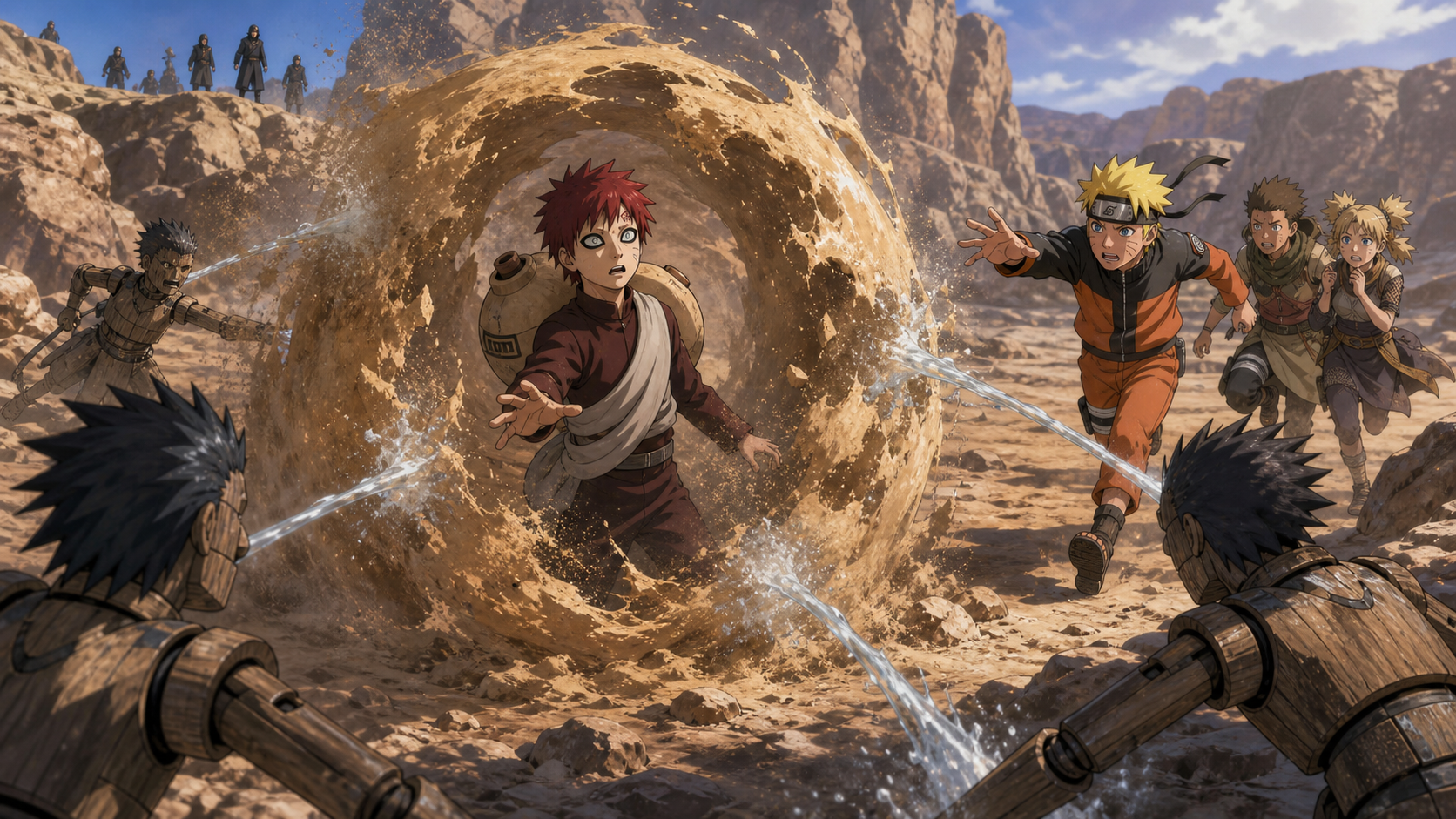
The assassins use puppets that spray water across the battlefield, weighing down the sand and weakening Gaara's automatic defense. The tactic confirms that the attack was designed by people with detailed knowledge of him.
Gaara is not overwhelmed because an enemy happens to be stronger. His village has engineered a countermeasure for the child it made into a weapon. The wet sand collapsing around him becomes a visual expression of institutional rejection.
Even trapped, Gaara tells Korobi and Yaoki to run. He does not use them as shields or demand they die proving loyalty. His first response is to remove them from the danger aimed specifically at him.
Korobi and Yaoki finally see protection instead of menace
The order to flee initially confirms their instinct to escape. Then its meaning changes. Gaara could have sacrificed them to buy time. Instead, he accepts being left alone so they can survive.
That act gives them evidence stronger than rumor. The person they were taught to fear has protected them without asking for anything in return. Their shame is not that they felt fear. It is that they treated fear as a complete judgment.
Naruto forces the moral question into the open when he confronts them for abandoning a teammate. His anger is sharp because he recognizes the pattern. A village isolates a jinchūriki, then cites that isolation as proof the person cannot form bonds.
Returning is the decision that makes them teammates
Korobi and Yaoki choose to go back. Their return matters more than an apology offered after safety is guaranteed. They move toward the assassins while Gaara is still vulnerable.
Naruto's shadow clones create pressure, and the Sand shinobi add their support. The combined response gives Gaara enough room to recover and defeat the remaining attackers with Sand Bullet.
For Gaara, the tactical assistance is almost secondary to the surprise that someone from his own village returned. Naruto already believes he can change. Korobi and Yaoki become the first peers from Sand to act on that belief.
Gaara's mercy rejects the council's definition of loyalty
After Kakashi arrives, Gaara asks Naruto and the others to spare the assassins because they are still Sand shinobi. This is not passive acceptance of the plot. It is a refusal to let the council decide that belonging only operates when affection is returned.
Gaara's mercy also protects the fragile alliance. Killing Sand operatives during a joint mission could create another political rupture. He chooses a response shaped by the village he hopes to lead rather than the vengeance his childhood would have encouraged.
The decision shows why he can eventually become Kazekage. Leadership is not simply controlling the strongest technique. It is holding responsibility for people who have failed to recognize your humanity.
A small friendship becomes the foundation of public trust
After the bandits are defeated, Korobi and Yaoki call Gaara their friend. The moment is modest, which makes it believable. The entire village does not reverse its opinion overnight. Two teammates revise their judgment because they shared danger and saw his choices.
Trust expands through witnesses. Korobi and Yaoki can tell others what Gaara did. Their testimony begins replacing inherited fear with observed conduct.
That is how the flashback connects to Gaara's present authority. Becoming Kazekage required public recognition, but the foundation was built through individual encounters in which he protected people before they trusted him.
Gaara’s answer begins in the present
When Temari wonders whether Konoha can recover from Pain, Gaara does not offer empty diplomacy. He says Naruto is there. That certainty carries the weight of somebody who once believed connection was a lie and then had his life redirected by one stubborn boy.
The episode is not simply remembering an old mission. It explains why the Kazekage trusts Naruto as a civic force. Naruto cannot rebuild every home alone, but he can make wounded people believe rebuilding together is still possible.
The alliance asks children to repair an adult disaster
Sand invaded Konoha through a conspiracy designed by leaders, yet the repair arrives through young teams sharing a border assignment. The adults sign agreements. The children must turn those signatures into behavior while carrying fear created by the same institutions.
That is a familiar Naruto contradiction. Villages manufacture trauma at policy level, then depend on the next generation to create emotional solutions. Team 7 and Gaara’s squad become diplomats without receiving the title.
Sakura’s fear is memory, not shallow prejudice
Sakura remembers Gaara’s sand closing around her while he moved toward killing Sasuke. Her unease does not disappear because Naruto reached him afterward. Forgiveness belongs to the injured person, and trust cannot be ordered on an alliance timetable.
The episode lets cooperation begin before comfort. Sakura can remain alert and still complete the mission. That distinction matters because peace does not require pretending the previous violence never happened.
Naruto sees the possibility before everyone sees proof
Naruto recognizes Gaara’s change because their fight reached the loneliness underneath his brutality. He knows what it means to be named a monster before anyone bothers to meet the child carrying it.
His faith is personal, but Gaara still has to build evidence other people can evaluate. Naruto opens the door. Gaara’s repeated choices are what keep it open.
Korobi and Yaoki inherit fear as professional knowledge
The Sand teammates are not merely nervous boys standing beside a celebrity. Their village trained them to understand Gaara as an unstable weapon. Fear arrives dressed as common sense, safety procedure, and loyalty to everyone except him.
They have never been given a reason to imagine that he might protect them. The mission becomes difficult before an enemy appears because the squad has no shared definition of teammate.
Gaara volunteers for the ordinary work of change
He could treat surviving Naruto as a private revelation and wait for the village to notice. Instead, he joins a routine cooperative mission where change must operate through timing, restraint, and responsibility.
Transformation becomes credible in unglamorous repetition. Gaara does not demand applause for wanting to be different. He enters situations where others can judge what he actually does.
The council’s assassination plan protects its own failure
Sand leaders created Gaara, neglected him, feared the result, and decided removal was cleaner than accountability. Sending assassins during a joint mission lets them erase the person while hiding the policy that shaped him.
The plot is institutional cowardice with tactical polish. Every specialized weapon says the council studied how to kill Gaara more carefully than it studied how to help him live.
Gaara’s warning to Kakashi reveals practiced betrayal
He explains the danger without shock because attempts from his own village are already part of his normal. Betrayal has become weather: something to anticipate, endure, and plan around.
That composure should not be mistaken for peace. A child who calmly predicts state-sponsored murder has learned that survival requires treating horror as routine.
Water turns the automatic defense into dead weight
The assassins understand that Gaara’s sand is both weapon and shield. Water makes it heavy, slowing the protection that usually moves before conscious thought. The attack reaches past strength toward the mechanism that has always kept him alive.
Visually, the collapse is vicious. The village takes the defense built around an unwanted child and designs a way to make it fail exactly when he needs it.
Gaara refuses to spend his teammates
When the trap closes, he tells Korobi and Yaoki to run. He could use their bodies as distraction or demand sacrifice as proof of loyalty. Instead, he separates their safety from the danger aimed at him.
This is the decision that proves his change before anyone names it. Power no longer gives him permission to treat nearby lives as disposable.
Running away is understandable and still incomplete
Korobi and Yaoki obey because every story they inherited tells them Gaara is not worth dying beside. Their first response is fear doing what fear does: narrowing the world to escape.
The episode does not need them to be fearless. It needs them to reconsider after recognizing what his order meant. Moral growth begins when instinct no longer gets the final vote.
Naruto translates protection into language they can hear
Naruto’s anger is not delicate, but it identifies the moral fact they missed. Gaara sent them away because he wanted them alive. The monster story cannot comfortably contain that evidence.
Naruto has spent his life watching people reinterpret every good act by a jinchūriki as threat or accident. He refuses to let the same machinery erase Gaara’s choice in real time.
Returning matters because danger has not ended
An apology offered afterward would acknowledge shame. Turning back while the water puppets still control the field changes the relationship through action. Korobi and Yaoki choose Gaara before safety guarantees that choice will be rewarded.
They do not become elite fighters or rescue him alone. They contribute what they can, which is how belonging usually starts. Friendship is not measured by who lands the final blow.
Teamwork restores more than Gaara’s sand
Naruto’s clones create pressure, the Sand teammates add support, and Gaara finds room to answer. The battle shifts because isolated strengths finally operate together.
For Gaara, the emotional victory precedes Sand Bullet. Someone from his village returned. The tactical opening is also proof that his future does not have to remain solitary.
Mercy is Gaara’s first rehearsal for leadership
Once the assassins are defeated, Gaara asks that they be spared because they are Sand shinobi. He refuses the council’s lesson that belonging ends whenever another person fails you.
Mercy here is political intelligence as well as compassion. Their deaths could fracture the young alliance and bury evidence. Restraint protects the village Gaara hopes Sand can become.
Calling him friend revises Sand’s official story
Korobi and Yaoki cannot transform an entire village with one sentence. They can become witnesses. They saw Gaara protect them, endure betrayal, and spare the people sent to murder him.
Public trust grows from small testimony repeated across ordinary spaces. Before Gaara can become Kazekage, somebody has to say the feared weapon acted like a teammate. This is where that language begins.
RaeRae's reaction to Gaara's Bond
The strongest part of the episode is that Gaara changes before the village rewards him. He protects teammates who fear him, spares assassins sent by his own council, and completes the mission without any promise that people will finally accept him.
Korobi and Yaoki are important because their fear is not treated as cartoon cruelty. Gaara really was dangerous, and the village gave them every reason to expect the worst. Their responsibility begins when new evidence contradicts that expectation.
Naruto acts as the interruption the pattern needs. He does not create Gaara's compassion, but he makes sure the frightened teammates understand what Gaara's order to flee actually meant.
In the present, Gaara's faith in Konoha feels earned. He knows one acknowledged person can change how a village responds to its most isolated child. Naruto did that for him, and Gaara carries the proof in every bond he built afterward.
Gaara and Naruto model different parts of repair
Naruto disrupts the belief that isolation is deserved. Gaara does the slower work of behaving differently when fear, betrayal, and power give him excuses to repeat the old pattern.
Neither part can replace the other. Recognition helps a person imagine change. Practice turns that possibility into a life other people can safely join.
The episode makes belief a form of village infrastructure
Walls, offices, ranks, and treaties give a village visible shape, but none can make people return after devastation. Gaara understands that recovery also needs a person whose presence reminds everyone their effort still belongs to a shared future.
Naruto became that person for him long before Konoha named him anything official. He argued through action that Gaara could choose what happened next. Korobi and Yaoki then made that argument social by answering change with change of their own.
Friendship does not excuse what Gaara did before
The warmth of the ending works because it does not ask Sakura, the Sand teammates, or viewers to pretend Gaara was always gentle. He caused real terror. His new conduct matters precisely because it breaks with conduct that harmed people.
Accountability becomes visible through protection, restraint, and repetition. Gaara cannot edit the past, but he can stop demanding that the past dictate every future encounter. The episode gives redemption labor instead of treating it as a flattering label.
Being seen once can change what survival is for
Before Naruto, Gaara survived to prove his own existence through violence. After Naruto, survival can carry him toward service, friendship, and leadership. The motive underneath strength changes, so the same sand begins protecting lives instead of merely defending isolation.
That is why this flashback belongs beside Pain’s destruction. Konoha is injured, frightened, and uncertain about its identity. Gaara has lived through that emotional ruin. He knows Naruto can help a community imagine itself beyond the damage because Naruto once did exactly that for him.
That faith has history, evidence, and witnesses.
RaeRae’s final word on Gaara’s Bond
This one gets me because Gaara earns trust while nobody is promising him any. He protects two teammates who are visibly afraid of him, warns Kakashi about his own village’s scheme, and still chooses mercy when the assassins lose.
Korobi and Yaoki are not brave because their fear disappears. They are brave because they turn around after understanding that fear gave them an incomplete answer. That return is tiny beside a war, but enormous inside Gaara’s life.
The Sand Council wanted a useful weapon without accepting responsibility for the child inside it. When that child became inconvenient, leaders tried to erase him. Gaara answers by becoming more responsible for Sand than Sand has ever been for him.
So when the Kazekage says Konoha can recover because Naruto is there, believe him. Gaara is standing in the future Naruto helped him imagine, surrounded by bonds that began when a few frightened people chose to come back.
RaeRae’s call
Gaara’s bond does not begin when fear vanishes. It begins when protection is finally recognized, frightened teammates return, and a boy his village marked for death chooses to lead it toward mercy anyway.