
Naruto’s School of Revenge
Naruto tries to coach a reluctant avenger, only to learn that persistence becomes dangerous when the story behind a vendetta is wrong.
What happens in Naruto Shippuden Episode 181?
Naruto Shippuden Episode 181, "Naruto's School of Revenge," continues the conversation with Tazuna and Inari during the Leaf's reconstruction. Their praise makes Sakura remember a much earlier Team 7 mission, when Naruto's enthusiasm was louder than his judgment and an escaped ostrich was considered legitimate ninja work.
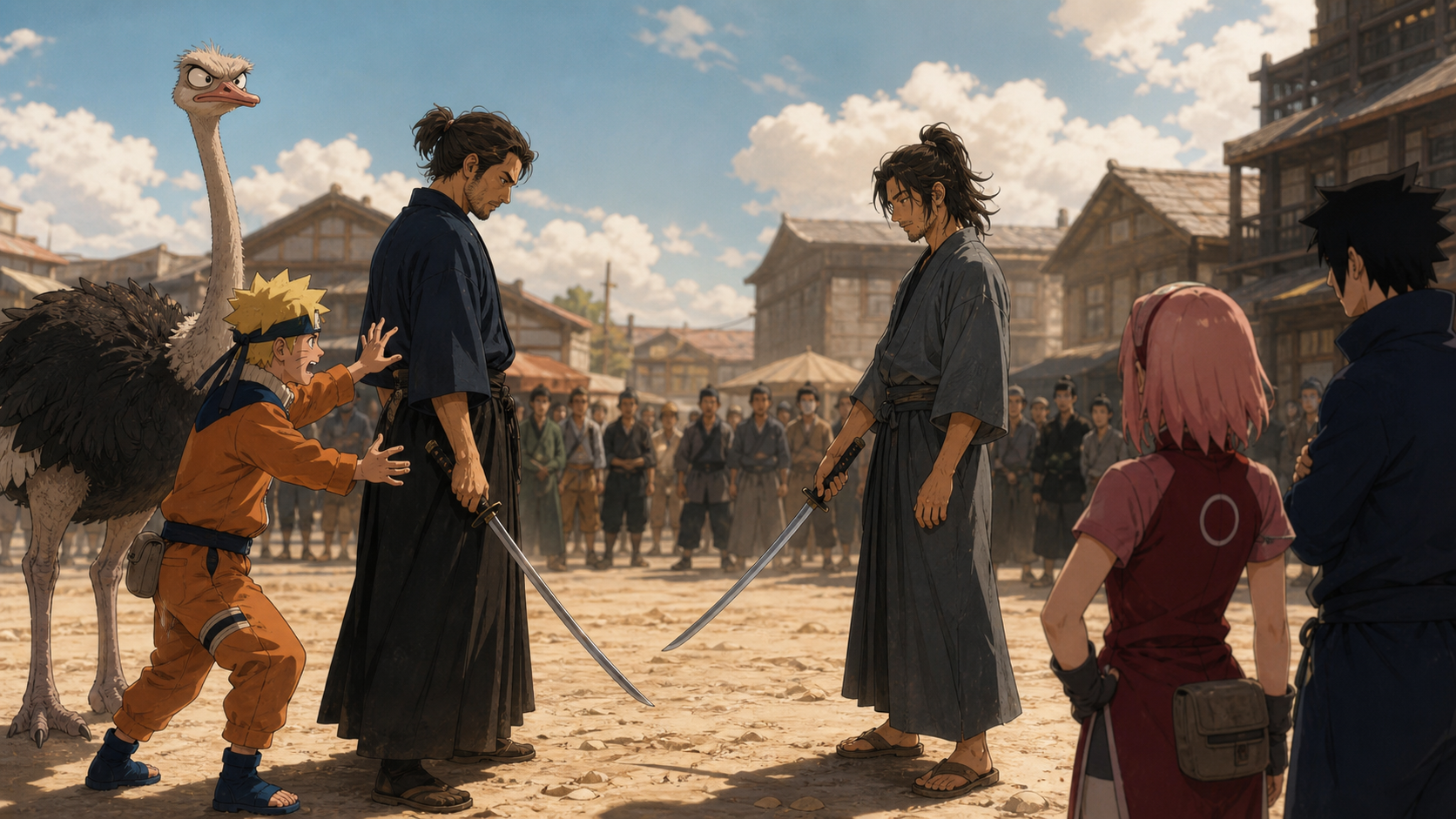
Team 7 is escorting Condor when they stop in a town and witness a formal vendetta between two swordsmen. Tsukado has been ordered by his family to avenge the death of a distant relative by killing Katazu. After repeated failed attempts, he is exhausted by the obligation. Naruto sees a revenge mission and immediately appoints himself Tsukado's instructor.
The ostrich mission establishes the episode's comic scale
Sasuke is offended that a ninja team capable of surviving the Land of Waves is still assigned animal work. The complaint is familiar, but Condor makes the routine mission unusually chaotic. An ostrich is fast, stubborn, and entirely uninterested in shinobi dignity.
The comedy also places Team 7 before its later tragedies. Naruto and Sasuke can argue about an embarrassing assignment because neither has yet crossed the boundary that will separate them. Sakura can remember their irritation as something almost comforting.
That light frame is important once revenge enters the story. The episode does not treat vengeance as glamorous destiny. It places it beside a runaway bird and a public spectacle, exposing how inherited violence can become absurd without becoming harmless.
Tsukado is trapped by an obligation he does not want
Tsukado is skilled enough to fight, but he has failed to complete the vendetta dozens of times. His hesitation is not cowardice. He does not truly want to kill Katazu, and the family command has converted grief into a job he cannot resign from without shame.
Naruto initially reads failure as a training problem. If Tsukado learns stronger attacks and a fiercer attitude, the revenge will succeed. That response reflects Naruto's limited understanding at this point. He knows what it is to be angry, but he has not yet confronted the full cost of building a life around retaliation.
The episode gives Tsukado a sympathetic weakness: he wants to return home. His family treats revenge as proof of loyalty, while his exhaustion suggests that endless pursuit has already taken more from him than Katazu ever could.
Naruto teaches determination before asking whether the goal deserves it
Naruto is a natural coach because he believes persistence can solve almost anything. He understands discouragement and knows how to keep moving after humiliation. Those qualities have saved him repeatedly.
Here, the same strength becomes a blind spot. Determination is morally neutral until it is attached to a goal. Helping someone persist toward reconciliation is not the same as helping someone persist toward murder.
Naruto's revenge lessons are funny because they exaggerate his instinct to motivate. Underneath the jokes, the episode shows why empathy requires more than matching another person's emotion. Naruto identifies with Tsukado's frustration before he understands the facts that produced it.
Katazu's refusal to attack is evidence, not weakness
During the staged duel, Naruto notices that Katazu is not fighting back. This observation breaks the simple story on which the vendetta depends. If Katazu were the unrepentant murderer described by Tsukado's family, repeated chances to kill his pursuer would make sense. His restraint points toward missing context.
That is the moment Naruto's instruction improves. He stops trying to manufacture aggression and starts paying attention. The shift matters because revenge narratives survive by reducing people to fixed roles: victim, avenger, killer. Katazu's conduct does not fit his assigned role.
The episode rewards Naruto for noticing behavior rather than blindly honoring tradition. A family command may feel authoritative, but observable facts still deserve investigation.
The twin revelation dismantles the inherited story
Katazu explains that the fatal struggle involved his twin brother and that Tsukado's relative died by accident. Identity confusion and incomplete testimony transformed a tragic event into a supposedly clear murder.
The revelation does not erase the death. It changes what justice can reasonably demand. Killing Katazu would not restore the relative, punish the responsible person, or correct an ongoing danger. It would create a new victim because a family preferred certainty to accuracy.
Tsukado's relief is revealing. He does not feel robbed of revenge. He feels released from it. The truth gives him permission to admit what his repeated hesitation has said all along: he never wanted this killing to define his life.
Kanabun turns private grief into public entertainment
The Kanabun Gang has money riding on the vendetta and stages another confrontation for spectators. Their involvement exposes a second system sustaining the feud. Tsukado's family supplies obligation, while gamblers supply pressure and spectacle.
For the gang, the truth is inconvenient because reconciliation ruins the event. They do not care who was responsible for the old death. They care that two armed men continue performing hatred on schedule.
This makes their attack after the duel collapses thematically precise. Violence is no longer presented as justice. It becomes enforcement for a business model that needs people to remain enemies.
Team 7 fights to end the cycle, not complete it
Once Tsukado and Katazu refuse the vendetta, Naruto, Sasuke, Sakura, and Condor help drive off the gang. The action resolves the external threat without restoring the original revenge logic.
Tsukado does not need to prove his strength by killing Katazu. Katazu does not need to accept death to honor someone else's grief. They can defend their decision together, which transforms former opponents into allies against the people profiting from their conflict.
Even Condor belongs in that resolution. The ridiculous escort target becomes part of a team effort that rejects the gang's carefully staged violence. The episode lets comedy puncture the false grandeur of the feud.
Sasuke's absence changes the memory in the present
When Tazuna asks about Sasuke, the warm reunion becomes difficult. Naruto says that Sasuke left after a fight and promises he will bring him home. Sakura recognizes the kindness in the explanation because it protects both Tazuna and Inari from the most painful details.
The memory of Tsukado now carries a sharper meaning. Naruto once helped a man discover that revenge rested on incomplete information. Sasuke's revenge is more personal and more deeply supported by real atrocity, but it is also shaped by hidden facts and people who benefit from his isolation.
Naruto cannot dismiss Sasuke's pain as a misunderstanding. He can recognize that a person consumed by revenge may be following a story whose missing pieces matter.
Sakura’s memory follows praise into discomfort
Tazuna and Inari celebrate how much Naruto has changed. Their warmth makes Sakura remember a mission when his confidence outran his judgment and Sasuke still stood beside them.
Nostalgia does not stay uncomplicated. Every funny Team 7 memory now contains the absence nobody in the present can ignore.
Condor attacks shinobi dignity by being an ostrich
Sasuke wants missions worthy of the danger Team 7 survived in the Land of Waves. Chasing an enormous, stubborn bird feels insulting to his sense of progress.
The assignment reminds him that service includes unglamorous work. Skill does not guarantee every need will flatter the person answering it.
Naruto enjoys the chaos because embarrassment cannot exclude him
Condor disrupts everyone’s composure equally. Naruto knows how to operate inside ridiculous situations where polished students lose control.
The comedy gives him room to contribute without measuring himself only against Sasuke’s technical precision.
The vendetta looks official enough to escape questioning
Tsukado carries family instruction, a named target, and ritual around the confrontation. Tradition makes murder appear like duty rather than a decision requiring current evidence.
Inherited authority can preserve grief and preserve errors. Age does not make the story accurate.
Tsukado’s repeated failure communicates refusal
He has attempted the task many times without completing it. Family members interpret hesitation as weakness or insufficient training. His body keeps expressing what obligation will not let him say.
He does not want to build his future around killing Katazu. Failure becomes resistance before he has language for refusal.
Naruto recognizes discouragement and misreads the goal
He sees somebody ashamed of failing and reaches for the method that helped him survive: persistence, practice, and louder belief. The empathy is genuine and incomplete.
Understanding how a person feels does not establish that the objective deserves support. Naruto skips the ethical question because emotional similarity feels like enough evidence.
Determination amplifies whatever direction receives it
Naruto’s refusal to quit can protect friends, master techniques, and challenge inherited prejudice. It can also help someone continue toward an unnecessary killing.
Persistence is not automatically virtuous. Judgment decides whether endurance serves care or harm.
The revenge school turns pain into a curriculum
Naruto invents exercises, motivation, and strategy around completing the vendetta. The joke works because teaching form can make any goal appear legitimate.
A structured program does not remove the need to ask who benefits, who gets hurt, and whether the founding story is true.
Katazu’s restraint contradicts the assigned villain role
He has repeated chances to exploit Tsukado’s weakness and does not. Naruto finally notices that observed behavior conflicts with the story he accepted.
Curiosity begins when a person refuses to force evidence back into inherited categories.
Stopping instruction is part of becoming a better teacher
Naruto does not protect pride by continuing the plan after doubt appears. He pauses and lets new information revise what help should mean.
Good guidance includes admitting the original goal was wrong, even after investing effort and enthusiasm in it.
The twin confusion exposes fragile certainty
Katazu’s brother was involved in the fatal struggle, and the death was accidental. Identity error and incomplete testimony became a multigenerational command.
One missing distinction can transform grief into permission to kill an innocent person.
Truth changes justice without erasing loss
Tsukado’s relative remains dead. The family still carries sorrow. Learning Katazu is not a murderer removes the justification for retaliation without making the original tragedy unreal.
Accurate grief is not smaller grief. It refuses to create another victim for the sake of emotional certainty.
Tsukado feels relief because revenge was never his desire
He does not mourn the loss of an honorable mission. He can finally stop performing loyalty through violence. Truth returns a future family obligation had confiscated.
His relief is evidence that refusing inherited vengeance can be liberation rather than betrayal.
The gambling gang needs hatred to remain scheduled
Kanabun profits from spectators expecting a duel. Reconciliation threatens the event and the money attached to it. Facts become obstacles to business.
Violence gains institutional supporters whose interests have nothing to do with the original dead person.
Public spectacle pressures both men to perform fixed roles
A crowd expects avenger and killer, action and blood, victory and defeat. Admitting the story is wrong disappoints people who came to consume certainty.
Ending the feud requires courage to look foolish before spectators invested in its continuation.
Team 7 defends the refusal rather than completing revenge
When the gang attacks, Naruto, Sasuke, Sakura, and Condor fight so Tsukado and Katazu can leave the assigned roles behind. Force protects reconciliation.
The action scene does not reward vengeance. It prevents profiteers from restoring it through coercion.
Condor punctures the feud’s false grandeur
An ostrich participating in the resolution makes the ritualized vendetta impossible to treat as noble tragedy. The absurdity is useful.
Inherited violence often survives through ceremony and seriousness. Comedy exposes how much performance sustains it.
RaeRae's reaction to Naruto's School of Revenge
I enjoy how the episode makes Naruto's best quality temporarily dangerous. His refusal to quit is inspiring when the goal is survival, friendship, or protection. Applied without examination, it can push someone harder toward a terrible choice.
Tsukado's relief is the emotional center for me. He has performed vengeance because his family told him that grief requires it. The truth does more than clear Katazu. It returns Tsukado's future to him.
The ostrich and the gambling gang keep the story playful, but the lesson is serious. Revenge attracts institutions that want it to continue: families protecting pride, crowds demanding spectacle, and criminals collecting money. Ending the cycle requires enough courage to disappoint all of them.
Naruto leaves the memory with a better question than the one he brought. Strength is not only the ability to finish a fight. Sometimes it is the ability to stop when the reason for fighting no longer survives the truth.
Sasuke’s absence makes the lesson painfully unfinished
Naruto once helped another person question a revenge story built from missing facts. Sasuke’s grievance rests on real atrocity and is also manipulated through information withheld by powerful people.
The parallel cannot solve Sasuke. It warns Naruto that pain and truth must be approached together.
RaeRae’s final word on Naruto’s School of Revenge
Naruto’s motivational gift is hilarious and dangerous here. He knows how to make someone keep going and forgets to ask where the road ends.
Tsukado’s relief tells the truth before the twin revelation explains it. He never wanted murder to become proof of family loyalty. He needed permission to stop.
The gambling gang exposes how many people can profit from a feud they did not suffer. Tradition supplies honor, spectators supply pressure, and money supplies enforcement. None serves the dead.
Naruto learns a crucial correction: quitting can be courage when the goal does not survive the facts. Persistence should protect people, not preserve a wrong story because somebody inherited it loudly.
The episode asks who owns a dead person’s meaning
Tsukado’s family treats the relative’s death as an instruction handed to the living. Grief becomes authority, and authority becomes a task nobody present is allowed to question. The dead person cannot confirm that another killing would honor anything they valued.
Katazu is also stripped of authorship. A mistaken identity assigns him the role of murderer, and his repeated refusal to exploit Tsukado cannot compete with a family story already treated as fact. Ritual protects the accusation from evidence.
Naruto initially joins that system because helping an underdog feels morally familiar. He recognizes humiliation, repeated failure, and the desire to prove everyone wrong. Emotional identification creates confidence before investigation creates knowledge.
That mistake is important for his later pursuit of Sasuke. Loving someone and recognizing their pain do not automatically tell Naruto what intervention will help. He can become another person pushing Sasuke toward an assigned role if he cares more about his own preferred ending than the facts Sasuke carries.
Episode 181 stays playful, but the correction is serious. Naruto improves when he observes Katazu’s restraint and allows behavior to challenge the story. Empathy becomes more responsible once curiosity joins it.
The twin revelation could be treated as a convenient trick, yet it illustrates how revenge narratives demand clean identities. Someone must be victim, killer, and avenger. A confused face is enough to keep the structure moving because certainty is socially useful.
Families may use vengeance to organize helpless grief. The command gives mourners a target, a duty, and the promise that action will restore balance. Tsukado’s exhaustion reveals the hidden cost: the next generation inherits a life narrowed around somebody else’s death.
The gambling gang recognizes that narrowed life as a market. Once spectators and money depend on the feud, truth threatens people with no emotional connection to the original loss. Violence develops stakeholders who will enforce repetition after the grieving parties want to stop.
That pattern is larger than one town. Shinobi villages turn historical injuries into missions, budgets, promotions, and political legitimacy. Individuals may desire peace while institutions remain invested in the machinery of hostility.
Tsukado and Katazu standing together changes the alignment. Former roles dissolve, and the people profiting from division become visible as the actual immediate threat. Reconciliation does not require passivity. It redirects force toward protecting the choice to stop.
Condor’s ridiculous presence helps strip prestige from the conflict. Nobody can pretend a staged vendetta interrupted by an ostrich represents sacred justice untouched by absurdity. The comedy clears room for people to admit the ritual has become detached from truth.
Sakura’s present-day memory carries all of this toward Sasuke. Tazuna asks an innocent question, and she hears the absent teammate inside every warm recollection. Naruto gives a gentle answer because the full truth would burden people who cannot change it.
That kindness also conceals how unresolved Team 7 remains. Sasuke’s revenge has valid origins, manipulated evidence, institutional profiteers, and a target whose identity changes as hidden history emerges. The little feud does not map neatly onto him. It teaches Naruto to keep questioning the story around any vendetta before helping determination harden it.
Naruto’s best moment is not defeating the gang. It is changing his mind before pride turns bad guidance into another obligation Tsukado must carry. He notices the contradiction, investigates, and accepts that the student does not need better revenge technique. He needs release from the premise. That flexibility is growth hiding inside comedy. Naruto remains loud, impulsive, and eager to help, but help becomes accountable to evidence. The lesson will matter when the stakes stop being an accidental death and become the Uchiha massacre. Sasuke cannot be coached out of grief through slogans, and persistence alone cannot tell Naruto which promise honors their bond. He will need facts, patience, and the willingness to let new truth revise his approach without revising Sasuke out of his humanity. Episode 181 gives him a tiny rehearsal: stop treating completion as virtue when the goal itself has become the trap before kin hand children blades and call that love again.
RaeRae’s call
Naruto teaches revenge with full enthusiasm until Katazu’s restraint exposes missing facts. The better lesson is knowing when truth makes stopping more honorable than finishing what a family demanded.