
Iruka’s Decision
A reckless Academy dare sends Naruto into a dangerous forest, where Iruka must decide whether grief or responsibility will define him as a teacher.
What happens in Naruto Shippuden Episode 178?
Naruto Shippuden Episode 178, "Iruka's Decision," finishes the memory that began with Iruka looking at the damaged Academy. Young Naruto has accepted a classmate's dare to enter a forest that still contains enemy shinobi. Iruka follows, determined to bring him back before a reckless attempt to earn attention becomes a real casualty. Naruto refuses because the danger is precisely what gives the dare value. If he returns empty-handed, the children who already mock him will have one more reason to dismiss him.
That argument lands because Naruto understands his own social position with painful accuracy. He is not wandering into danger because he cannot recognize it. He believes danger is the entrance fee for acknowledgment. Iruka tells him to return, but Naruto says a teacher who is accepted by the village cannot understand what it means to be treated like dirt. Then he uses the Sexy Technique as a distraction and escapes deeper into the forest.
Naruto's dare is a test the Academy cannot grade
The episode turns a childish challenge into an indictment of the environment around Naruto. His classmates ask him to retrieve an item from the body of an enemy ninja. They get the thrill of suggesting it while Naruto bears all the risk. Their approval is conditional, and the condition is designed so that failure will entertain them almost as much as success.
Naruto still chooses to go. That choice matters, but it does not make the adults around him irrelevant. A child who repeatedly risks himself for attention is announcing a need in the only language that has produced a response. Punishment may stop one prank. It cannot replace the belonging that the prank is trying to obtain.
Iruka begins to understand that distinction. He has spent the previous episode seeing Naruto through the memory of the Nine-Tails attack. In this episode, the immediate danger forces him to see the boy in front of him. Naruto is frightened, hungry, inventive, and terribly practiced at expecting no one to come after him.
The kunai turns bravado into a real mission
Naruto finds an enemy kunai while looking for proof that he completed the dare. He does not know that a secret intelligence report is attached to it. To him, the weapon is an object he can carry back to the Academy. To three enemy kunoichi, it is sensitive information that must be recovered.
This misunderstanding gives the chase an effective imbalance. Naruto has no idea why armed adults are pursuing him, but he immediately understands that surrendering the kunai will not necessarily make him safe. He runs, improvises traps, and uses the terrain to create distance. The sequence shows the raw survival intelligence that formal classroom scores fail to capture.
His solutions are messy rather than polished. That is exactly right for this point in his life. Naruto does not yet have a disciplined toolkit, but he can observe pressure, exploit impatience, and keep moving when panic would freeze another student. The future ninja is visible inside the problem child, even before the Academy has language for his strengths.
Iruka chooses responsibility before affection feels easy
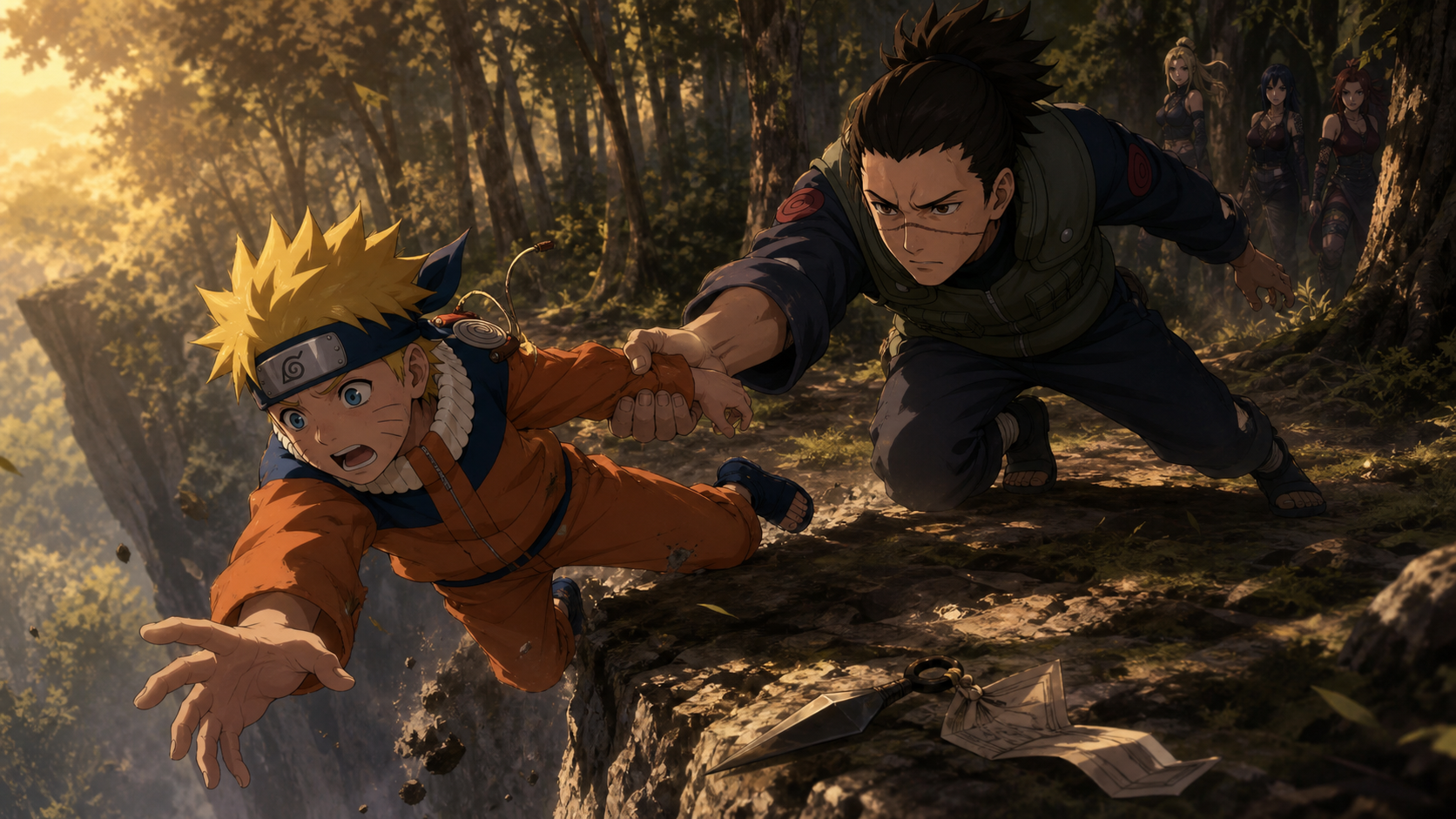
Iruka catches up when Naruto falls near a cliff. The rescue is the episode's decisive action. He does not wait until his grief is resolved or until Naruto becomes easier to like. He reaches for him because being a teacher means protecting the student whose behavior is hardest for him to understand.
That is a more honest turning point than sudden sentimentality. Iruka's parents are still dead. The village's fear of the Nine-Tails has not vanished. Naruto has not stopped being exhausting. What changes is the hierarchy of those truths. The child in immediate danger comes before the adult's inherited resentment.
The physical image of Iruka holding Naruto also reverses the boy's expectation. Naruto entered the forest believing he had to prove his value alone. Iruka's hand says that his life has value before he brings back evidence, wins a contest, or impresses a classmate.
Kakashi's arrival does not erase Iruka's choice
Iruka cannot defeat every enemy pursuing them, and Kakashi arrives to neutralize the threat. The rescue does not make Iruka's intervention meaningless. Kakashi can solve the combat problem because Iruka first solved the moral one: he went after Naruto.
This division of responsibility is important. Courage is not measured only by who lands the finishing blow. Iruka acts while knowing that he may be outmatched. He carries Naruto, creates escape time, and remains between the child and the attackers. Kakashi's competence completes the rescue, but Iruka's decision begins it.
The episode also quietly shows a healthier village at work. One instructor notices a missing child. Another shinobi responds to the danger. Protection becomes a network instead of a single heroic gesture. Naruto does not yet trust that network, but this is one of the moments that begins teaching him it can exist.
Hiruzen gives Iruka a different way to remember loss
The Third Hokage helps Iruka confront the confusion between Naruto and the creature sealed inside him. Hiruzen does not ask him to forget his parents or pretend the attack caused no damage. He asks him to recognize that Naruto carries consequences from that night too.
Naruto did not choose the seal, the isolation, or the fear projected onto him. He inherited a burden before he could understand language. Iruka's grief and Naruto's loneliness are not competing claims where acknowledging one invalidates the other. They are two wounds created by the same catastrophe.
That recognition allows Iruka to stop treating compassion as betrayal. Caring for Naruto does not diminish the love he has for his parents. It honors the protective work they died doing by refusing to let another child be consumed by the aftermath.
Recognition has to come before achievement
Naruto's entire plan depends on the belief that acceptance follows a spectacular act. Retrieve the dangerous object, survive the forbidden forest, and the other students may finally look at him differently. The episode offers Iruka's attention as a direct challenge to that belief.
Iruka sees Naruto before Naruto succeeds. He searches before there is proof of talent. He protects him before the kunai's intelligence value is understood. This order matters because conditional care would only reinforce Naruto's worst lesson. If affection arrived after a victory, he would learn to keep gambling with himself whenever he felt invisible.
Instead, Iruka begins providing the ordinary recognition Naruto has been missing. It is not indulgence. He still sets boundaries, rejects reckless behavior, and expects accountability. The difference is that correction now comes from a person who has accepted responsibility for the child rather than from an institution trying to control a nuisance.
Why Iruka's decision changes Naruto's future
The title refers to more than entering the forest. Iruka decides what kind of teacher he will be. He can preserve emotional distance and repeat the village's suspicion, or he can separate Naruto from the Nine-Tails and respond to the lonely student asking to be seen.
The later bond between them depends on this choice being repeated. Trust is not created by one speech. It grows through meals, discipline, protection, and the consistency of returning. Episode 178 supplies the foundation for why Iruka will later recognize Naruto when public opinion remains hostile.
It also reframes the present-day scene after Pain's assault. Adult Naruto has become the village hero, but Iruka remembers when recognition was scarce and private. The crowds celebrating Naruto now are important. The teacher who valued him before the applause is indispensable.
The dare lets classmates outsource cruelty
Other children suggest the dangerous task and remain safe enough to enjoy whatever follows. If Naruto succeeds, they receive a story. If he fails, his humiliation confirms what they already say about him.
The arrangement resembles adult prejudice in miniature. A marginalized child bears the risk while the group treats his response as entertainment and evidence.
Naruto knows the danger and values recognition more
He is not too foolish to understand that the forest is unsafe. He decides public acceptance is worth gambling his body because ordinary routes have produced rejection.
That logic is devastating precisely because it is rational inside the social world adults allowed to form around him.
A deadly object becomes an imagined admission ticket
The enemy kunai looks like proof Naruto can carry back. He does not know an intelligence report makes it valuable to hostile shinobi. He only knows it can establish that he completed the dare.
The object gains two incompatible meanings, and Naruto is endangered by information nobody trusted him to possess.
The enemy pursuit exposes skills the Academy misses
Naruto reads terrain, creates distance, improvises distractions, and keeps moving against trained adults. His solutions lack polish, but they reveal survival intelligence far beyond one failed classroom target.
Formal evaluation measures important basics and remains incomplete. A poor score is not the full inventory of a child’s capacity.
The Sexy Technique is ridiculous and strategically useful
Naruto deploys embarrassment and surprise because those are tools he understands. The technique interrupts adult expectations long enough for escape.
Comedy does not make the decision meaningless. He turns the way people underestimate him into temporary control over the encounter.
Iruka goes after a student who assumes nobody will
Searching is the first answer to Naruto’s belief that he can disappear without consequence. Iruka does not wait for the child to return with proof or for danger to become convenient.
Presence begins before affection feels easy. Responsibility moves Iruka through unresolved grief.
Naruto accuses Iruka with painful accuracy
He says a teacher accepted by the village cannot understand being treated like dirt. Iruka is also an orphan and carries real pain, but his adult position now gives him authority Naruto does not possess.
Shared loss does not erase unequal treatment. Iruka must listen for the truth inside an unfairly absolute statement.
Iruka cannot demand trust through his title
“Teacher” means authority to Naruto long before it means safety. Adults have disciplined him, watched him differently, and withheld the story shaping his life.
Iruka has to demonstrate that the role will include protection, consistency, and care not purchased through achievement.
The cliff removes every symbolic excuse
Naruto slips, and the immediate question becomes whether somebody will catch him. Iruka’s hand reaches before philosophical certainty or healed grief arrives.
The child’s life takes priority over every association attached to Kurama. Action establishes the hierarchy words could not.
Being caught contradicts Naruto’s expected ending
He entered alone because proving himself seemed like the price of acceptance. Iruka appears before the trophy can matter and treats survival as valuable by itself.
The rescue supplies new evidence: an adult may come because Naruto is missing, not because Naruto has already succeeded.
Iruka’s decision does not require liking every behavior
Naruto has lied, run away, ignored instructions, and created danger. Protecting him does not convert those actions into good choices.
Care establishes the relationship within which correction can finally mean something besides rejection.
Kakashi solves the combat problem after Iruka solves the moral one
The enemy kunoichi outmatch a rookie Academy instructor. Kakashi’s arrival supplies the force and experience needed to finish the rescue.
Iruka’s choice remains decisive because he placed himself between Naruto and danger before knowing stronger help would come.
Protection works as a network
One adult notices the absence, one follows, and another responds when the threat exceeds the first person’s capacity. No single heroic figure must contain every skill.
Naruto begins learning that dependence can mean community rather than weakness or debt.
Hiruzen asks Iruka to separate two victims
Kurama killed Iruka’s parents. Naruto was made its container as an infant and punished socially for the same attack. Their wounds share a source without sharing responsibility.
Seeing Naruto clearly does not betray Iruka’s parents. It refuses to let the catastrophe claim another child through misdirected blame.
Compassion is compatible with grief
Iruka does not need to stop missing his parents before protecting Naruto. He needs to stop treating the child as the agent of their loss.
The distinction lets memory remain honest while ending harm produced in memory’s name.
The intelligence report shows how adult wars find children
Naruto stumbles into a conflict he cannot understand because military information is hidden inside the object classmates dared him to retrieve. The forest converts social desperation into geopolitical danger.
Children living in shinobi villages are never as separate from adult violence as their lessons pretend.
Iruka chooses the teacher he will have to keep becoming
Catching Naruto is a beginning. Trust will require meals, repeated discipline, patient return, and the later moment when Iruka openly names Naruto as a person rather than the fox.
One decision establishes direction. Relationship supplies the distance.
RaeRae's reaction to Iruka's Decision
This episode works because it refuses to make Iruka's grief disappear. He becomes better by acting responsibly while the grief is still present. That feels far more human than a clean revelation that erases every difficult emotion.
Young Naruto is heartbreaking here because his logic is coherent. He is willing to enter a lethal forest because humiliation already feels like his normal state. The dare promises a possible exit, and he has not yet learned that people who require self-destruction as proof are not offering friendship.
Iruka reaching over the cliff is therefore the image I keep. Naruto believes he must climb back into the village carrying a trophy. His teacher arrives and tells him, through action, that returning alive matters more. That is the beginning of recognition without performance, and it explains why Iruka's place in Naruto's life can never be replaced by later fame.
The memory changes the meaning of the hero celebration
Present-day Konoha praises Naruto after he saves everyone. Iruka remembers the moment when saving Naruto required no evidence of future greatness.
That earlier choice is the moral foundation beneath the crowd’s later recognition.
RaeRae’s final word on Iruka’s Decision
Naruto entering the forest for classmates who do not care whether he returns makes me furious. He understands their approval is conditional and still believes conditional approval is better than none.
Iruka reaches him before grief becomes easy. That is the part I respect. Adults do not get to wait until they feel perfect before protecting the child in front of them.
Kakashi handles the enemy because community should distribute danger according to capacity. Iruka’s courage is going after Naruto, catching him, and refusing to let being outmatched become an excuse for absence.
The decision grows into every later bowl of ramen, correction, and act of recognition. Naruto learns that one adult will come looking. That knowledge becomes part of how he survives long enough for an entire village to do the same.
The rescue changes what authority can mean to Naruto
Before the forest, authority mostly arrives as rules, punishment, secrecy, and adults deciding what Naruto can know about himself. Iruka’s authority enters danger with him. The teacher does not remain safe at the boundary and demand obedience from a distance.
That choice gives later correction credibility. Naruto can begin hearing “no” from someone whose actions have also said, “Your life matters to me.” Boundaries stop functioning only as proof that the village wants less of him.
Iruka cannot complete that transformation with one catch. Naruto has years of evidence supporting distrust. Every later return must strengthen the new pattern until care becomes more predictable than abandonment.
The episode also refuses to make Naruto’s resourcefulness a reason adults can neglect him. He survives the chase creatively, reads terrain, and improvises under pressure. Competence does not mean a child should have been left to solve adult violence alone.
Kakashi’s intervention demonstrates what a functioning support system can do. Iruka recognizes the missing student and reaches him. Kakashi answers a threat outside Iruka’s combat capacity. Protection succeeds because responsibility moves through the network instead of becoming a contest over who deserves the hero label.
That model contrasts with the classmates’ dare. They distribute risk downward and keep the story for themselves. The adults distribute responsibility toward the people equipped to carry it and center Naruto’s survival. Both are group actions with opposite ethics.
Hiruzen’s guidance gives Iruka language for seeing Naruto as another child harmed by the Nine-Tails attack. The insight is important and overdue. The Hokage still bears responsibility for leaving so much of Naruto’s daily care dependent on whether individual adults reach that insight alone.
A village serious about protecting Naruto would not rely on exceptional compassion. It would build expectations, support, and accountability that make dehumanization harder to reproduce. Iruka’s decision reveals what policy failed to guarantee.
Present-day Iruka remembers the forest after Naruto returns as Konoha’s hero because he knows recognition began in the opposite direction. Naruto did not first prove he could save Iruka. Iruka decided Naruto was worth saving.
That order is why Iruka remains completely irreplaceable. Kakashi can teach tactics, Jiraiya can expand his world, and Fukasaku can give him Sage Mode. Iruka teaches the first condition that makes any future possible: Naruto can be difficult, frightened, reckless, and unfinished without becoming disposable. The forest rescue turns that truth into something his body can remember. A hand reaches before achievement. An adult comes after him before the village has a hero to recover. Every later bond grows more safely because one rookie teacher chose the child over the association, responsibility over avoidance, and continued relationship over the clean emotional distance grief offered him.
RaeRae’s call
Naruto risks his life because acceptance seems to require proof. Iruka catches him before the prize matters and begins teaching the lesson Konoha withheld: Naruto deserves to return alive before he earns anything.