
Iruka’s Ordeal
Naruto’s rivalry with Sasuke turns failure into public theater while Iruka confronts the grief he carries into every attempt to teach the child.
What happens in Naruto Shippuden Episode 177?
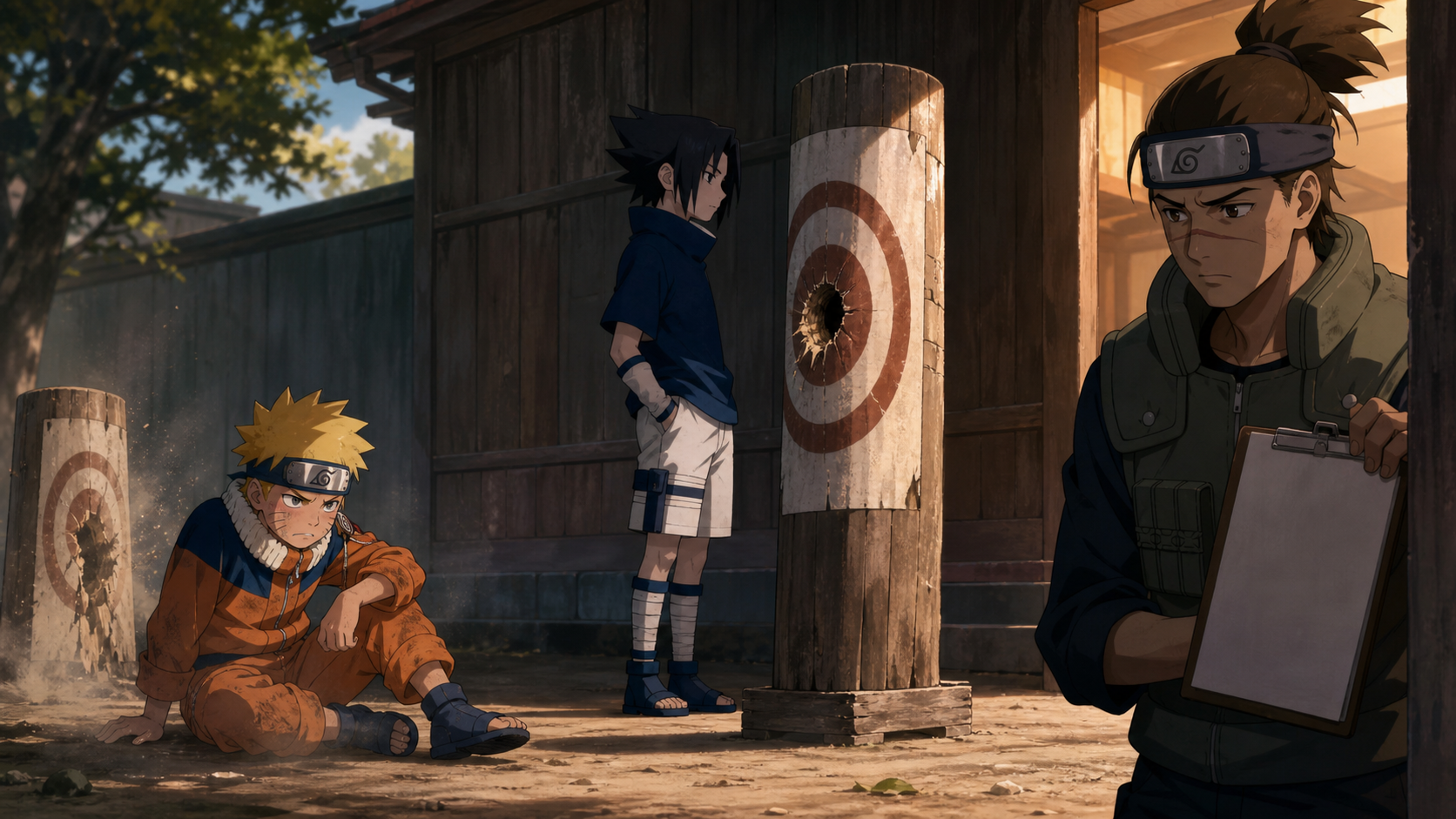
Naruto Shippuden Episode 177, "Iruka's Ordeal," continues Iruka's memory of his rookie teaching years. Naruto spends his Academy days competing with Sasuke, failing in front of classmates, and turning embarrassment into louder disruption. Sasuke's natural skill gives Naruto a visible standard he cannot yet reach.
Iruka knows Naruto is a child, not the Nine-Tails, but grief does not obey that knowledge neatly. The attack that killed his parents remains attached to Naruto's face in ways Iruka is ashamed to admit. Teaching him requires more than classroom technique. Iruka has to decide whether he will let trauma define the student before he has actually met him.
Naruto, meanwhile, reads every frustrated look as confirmation that this teacher will reject him too. Their ordeal is shared, even though neither has language for that yet.
Naruto turns Sasuke into a measurement of belonging
Sasuke is praised for the things Naruto struggles to do. His throws land. His technique looks controlled. Adults recognize his talent without requiring a performance first.
Naruto does not only want to beat Sasuke because he enjoys rivalry. Sasuke represents the kind of child the classroom knows how to value. If Naruto can surpass him, perhaps recognition will become unavoidable.
That makes every failure feel larger than a missed target. Naruto experiences it as evidence that he remains outside the category of students worth respecting.
Sasuke is lonely in a form the classroom rewards
The contrast between the boys is not simple popularity. Sasuke is also carrying catastrophic loss. His quiet competence makes that pain easier for adults to leave alone.
Naruto's loneliness is noisy, so it becomes a discipline problem. Sasuke's loneliness is controlled, so it becomes maturity. Neither interpretation reaches the child underneath.
Their rivalry begins partly because each sees something the other appears to possess. Naruto sees effortless acknowledgement. Sasuke sees a boy who keeps reaching toward people even after rejection.
Iruka's trauma enters the classroom with him
Iruka wants to be fair, but the Nine-Tails attack is not a distant lesson. It is the night he lost his parents and the event that divided his life.
Naruto's presence forces Iruka to confront the village's most damaging confusion: treating the child who contains the fox as the fox itself. The taboo against discussing the attack has not healed that confusion. It has pushed it into glances, avoidance, and emotional reflex.
Iruka's ordeal is learning that being a teacher means taking responsibility for what he brings into the room, not only what students bring.
A correct response can still come from the wrong place
Naruto does need structure. He disrupts lessons and turns rivalry into reckless behavior. Iruka is allowed to correct him.
The problem appears when correction carries fear or resentment the child cannot understand. Naruto hears the same rejection beneath every instruction, so even reasonable boundaries become proof that he is unwanted.
Teaching changes when Iruka can distinguish between setting a limit and using authority to discharge his own grief.
Failure becomes public theater
Naruto rarely fails privately. Academy exercises happen in front of peers, and his classmates' laughter turns skill gaps into social identity.
Once everyone expects him to fail, the performance begins before the exercise. Naruto can pretend he meant to be funny, become angry, or sabotage the moment before the result can expose him.
Those defenses protect him from shame in the short term and make improvement harder. Iruka has to notice that the clowning is armor, not proof that Naruto does not care.
The classroom mirrors the village
Children learn who Naruto is by watching adults. Even without knowing the Nine-Tails secret, they notice who is invited, who is avoided, and whose mistakes receive a different kind of attention.
The Academy cannot isolate itself from village prejudice. A teacher who says nothing may still reproduce it through hesitation and lowered expectations.
Iruka's eventual change matters because classrooms are places where collective habits can be repeated or interrupted. Seeing Naruto differently gives other children permission to do the same.
Naruto is testing whether Iruka will return
Many of Naruto's provocations function as tests. How angry can he make an adult before the adult leaves? Will the teacher come looking for him? Does punishment mean someone noticed he was missing?
The tests are unfair to Iruka, but they come from experience. Naruto has learned not to trust care that appears briefly. Consistency has to be demonstrated.
Iruka will become important because he keeps returning after frustration. The bond is built through repetition long before its decisive moment.
Grief can create empathy only after it is faced
Iruka and Naruto both know what it is to go home without parents. That parallel will eventually let Iruka understand Naruto more deeply than many adults can.
Shared pain does not automatically create compassion. At first, Iruka's grief makes Naruto harder to approach. Empathy becomes possible only when Iruka stops using similarity as a threat and recognizes the child's separate life.
The episode is honest about that sequence. Pain can connect people, but it can also make them retreat behind blame.
The title belongs to both teacher and student
Iruka's ordeal is the moral challenge of teaching the child linked to his greatest loss. Naruto's ordeal is being taught by an adult whose fear he can feel but cannot explain.
Neither can resolve the relationship alone. Naruto cannot behave well enough to erase Iruka's trauma, and Iruka cannot demand trust before offering reliable recognition.
Their future bond will matter because both cross part of that distance.
Recognition has to come before achievement
Iruka cannot wait for Naruto to become easier to teach before deciding he deserves full attention. If care arrives only after success, Naruto will understand it as payment rather than belonging.
This is the quiet principle underneath their future relationship. Iruka will celebrate Naruto's growth, but his most important choice is seeing value before the village has evidence. The child who misses the target and embarrasses himself is not a rough draft that can be discarded until the hero appears. He is the same whole person.
That recognition also changes what improvement can mean. Naruto no longer has to make every exercise prove he deserves a place in the room. He can fail at a skill without experiencing the result as a verdict on whether anyone will stay.
The target exercise turns skill into public ranking
Sasuke lands the throw cleanly. Naruto misses under the attention of classmates already expecting failure. The exercise measures technique and simultaneously confirms the social order of the room.
Once ability becomes identity, practice stops feeling safe. Naruto is not simply learning where to aim. He is defending whether he belongs beside the student everyone praises.
Naruto chooses rivalry because rivalry recognizes an equal
Being ignored is worse than being challenged. Declaring Sasuke a rival places Naruto inside the same contest, even when current skill makes the comparison painful.
The rivalry can be immature and emotionally useful at once. Naruto creates a relationship where the classroom offered a hierarchy.
Sasuke receives praise he cannot use for grief
Adults recognize his talent and clan name. None of that restores his family or reaches the fear beneath his control. Competence makes him easier to admire and easier to leave alone.
The Academy rewards the presentation that conceals need. Sasuke’s quiet pain becomes maturity while Naruto’s loud pain becomes misconduct.
The boys see opposite freedoms in each other
Naruto sees acknowledgment, skill, and the social permission Sasuke receives without begging. Sasuke sees somebody who keeps reaching toward others and making noise after rejection.
Each envies an incomplete picture. Their rivalry grows around needs neither boy knows how to name directly.
Public laughter lets classmates borrow adult power
Children notice that Naruto occupies a category adults treat differently. Laughing at his failure aligns them with the safer side of that boundary.
Prejudice does not require a classroom lesson. It travels through who receives patience, whose errors seem expected, and whom adults hesitate to defend.
Naruto performs indifference because shame needs cover
If the missed target becomes a joke he controls, classmates cannot fully own the humiliation. Loudness returns some authorship to him.
The performance also convinces adults that he does not care about improvement. Armor protects the wound and hides it from the people capable of helping.
Iruka sees disruption before he sees defense
As a rookie instructor, he has responsibility for the entire class and little confidence separating individual need from challenges to authority. Naruto’s behavior appears designed to undermine him.
The visible problem is real. The interpretation remains incomplete until Iruka asks what embarrassment and rejection are teaching the child to do.
A boundary can be fair and still feel like rejection
Naruto needs consequences, practice, and expectations. Iruka cannot build trust by pretending every action is harmless. The delivery matters because Naruto has learned adult attention usually arrives with removal.
A useful boundary says the behavior must change and the relationship will remain. Iruka is still learning how to communicate both.
Iruka’s grief changes his face before it changes his words
He knows Naruto is not Kurama. His body still remembers the attack, his parents’ deaths, and the village’s terror when he looks at the child carrying the fox.
Naruto reads hesitation even when nobody explains it. Children become experts in expressions adults insist they never made.
Knowledge does not automatically undo trauma
Iruka can recite that Naruto contains the Nine-Tails and did not cause the attack. Emotional association survives correct facts. Healing requires confronting the response repeatedly.
The responsibility belongs to Iruka and the adults supporting him, not to Naruto proving he is harmless enough to deserve fairness.
The village’s taboo protects secrets and preserves stigma
Adults cannot tell the younger generation what happened. They still communicate fear through avoidance. Children receive a conclusion without evidence and reproduce it socially.
Silence becomes an active curriculum. Naruto experiences punishment for a history he is forbidden to understand.
Hiruzen sees the child and tolerates a broken system
The Third Hokage offers Naruto moments of kindness and monitors his safety. The larger village continues excluding him. Individual concern does not substitute for institutional protection.
A leader can care personally and still leave harmful structures intact. Naruto lives in that gap.
Iruka is asked to repair what policy refuses to name
The classroom contains Naruto’s behavior, peer prejudice, teacher grief, and a secret shaping every interaction. Iruka receives authority without a framework for addressing the actual problem.
His ordeal is personal and institutional. Becoming kinder will help Naruto, but the Academy also needs practices that do not depend on one instructor’s breakthrough.
Consistency matters more than one perfect response
Naruto tests whether Iruka will return after frustration. One gentle conversation cannot reverse years of abandonment. Trust develops through the adult showing up again after mistakes on both sides.
The eventual bond is credible because repetition, not instant insight, carries it.
Shared orphanhood does not create automatic understanding
Iruka and Naruto both lost parents through Kurama’s attack. At first, that similarity produces distance because Naruto activates the source of Iruka’s grief.
Empathy begins when Iruka recognizes that parallel pain belongs to two separate people rather than using his pain to define Naruto.
The ordeal tests what kind of teacher Iruka will become
He can protect classroom order by placing Naruto permanently outside it, or accept the harder responsibility of teaching a child whose needs unsettle him.
The second choice does not require perfection. It requires accountability, curiosity, and the willingness to revise authority.
Naruto needs someone to see effort beneath performance
He cares enough to compare himself with Sasuke, rage at failure, and return to the exercise. The clowning does not prove indifference. It proves exposure feels dangerous.
Recognition of effort gives Naruto a reason to practice without making every attempt a referendum on his humanity.
RaeRae's reaction
Watching Naruto compare himself to Sasuke this early makes their entire relationship sadder. He is not only jealous of skill. He is jealous of how naturally the room agrees that Sasuke matters.
I appreciate that Iruka's difficulty is not softened. We know he will become Naruto's first real protector, but that future does not excuse the moments when grief controls his face. Naruto notices every one of them.
The classroom scenes also show how prejudice survives without anyone speaking the forbidden truth. Children can tell that Naruto occupies a different category. They turn adult distance into laughter and expectation.
Iruka's growth has to happen before the famous scroll confrontation because Naruto needs more than one dramatic rescue. He needs an adult who learns to see the missed target, the prank, and the loud challenge as parts of a child still trying to enter the room. Episode 177 stays in the uncomfortable middle where that learning is not complete, and that is exactly why the bond will mean something when Iruka finally chooses it openly.
The episode keeps Iruka in the uncomfortable middle
We know he will protect Naruto. The memory refuses to skip the resentment, fear, and uncertainty preceding that choice.
Growth means more when the story preserves what had to change instead of pretending care was effortless.
RaeRae’s final word on Iruka’s Ordeal
Naruto is not jealous of one clean target hit. He is jealous of a room that knows how to value Sasuke without making him beg for visibility first.
Sasuke’s pain is easier for adults because it behaves. Naruto’s pain interrupts. The Academy mistakes presentation for need and leaves both boys alone in different ways.
I respect the episode for showing Iruka’s grief as real and his responsibility as equally real. Losing his parents explains why Naruto’s presence hurts. It cannot make Naruto responsible for carrying that hurt.
The future bond begins when Iruka stops asking only how to control the student and starts examining what he brings into the classroom. Naruto needs boundaries, but he needs one adult whose care survives them.
What the Academy rewards can hide what students need
Sasuke’s clean performance receives admiration because the institution knows how to measure it. Accuracy, speed, control, and composure fit the exercise. Nobody has to ask what the result costs him emotionally. Success makes privacy look healthy.
Naruto’s failure produces questions about discipline before anyone asks about support. His need becomes visible in the least socially acceptable form, so adults treat visibility as the problem. The contrast teaches both boys that suffering is easier for other people when it stays useful or quiet.
Iruka stands at the point where that institutional habit can continue or change. He cannot heal every student or rewrite village culture alone. He can refuse to let one target exercise become a permanent verdict on who deserves his patience.
That refusal requires examining praise as carefully as punishment. Sasuke should be recognized for skill, but praise that isolates him as the exceptional child may strengthen the belief that connection is unnecessary. Naruto should face consequences, but correction that humiliates him before peers strengthens the belief that belonging must be fought for publicly.
A better classroom creates room for competence and need to coexist. Sasuke can excel and still require care. Naruto can disrupt and still possess effort worth seeing. Neither child should have to choose a performance that makes adults comfortable before receiving attention.
The rivalry could become constructive if both boys learn that comparison supplies information rather than identity. Sasuke’s precision shows Naruto what practice can build. Naruto’s persistence shows Sasuke that failure does not automatically end participation. Their strengths become dangerous when the village turns them into fixed categories.
Iruka’s ordeal therefore includes resisting the easy story available about each student. Sasuke is not the perfect prodigy. Naruto is not the hopeless troublemaker. Teachers inherit labels from families, colleagues, records, and village gossip, then decide whether observation will challenge them.
Naruto notices every moment Iruka hesitates because vigilance has kept him emotionally safe. Trust will require experiences strong enough to revise that pattern. Iruka has to return after the prank, look for effort after the missed target, and communicate that correction will not become abandonment.
None of this makes teaching soft. Reliable expectations are a form of care when they come with resources and relationship. Naruto needs somebody who believes he can improve enough to demand work and values him enough to stay when improvement is slow.
The adult Naruto becomes will remember that combination. He can challenge people without declaring them disposable because Iruka eventually demonstrates the difference. The lesson reaches Nagato’s chamber years later, where Naruto condemns the harm, refuses easy forgiveness, and still keeps the relationship between action and humanity from breaking completely.
That is why a school flashback belongs after the Pain arc, even if the pacing feels abrupt. World-changing restraint did not appear from nowhere. It grew through small encounters where one teacher learned that seeing a child clearly could interrupt what pain was preparing both of them to become.
Iruka has not completed that growth here. Naruto sees doubt on his teacher’s face, and Iruka feels grief before judgment can catch it. The relationship exists in the difficult space between intention and practice. Every return gives them another piece of evidence against the belief that pain decides who must fear whom. Naruto cannot behave his way out of prejudice, and Iruka cannot care his way around accountability. They have to build trust through repeated choices that name the harm, preserve the boundary, and keep the person inside the room after everybody expects rejection to win.
RaeRae’s call
Naruto misses the target and turns shame into rivalry. Iruka’s real ordeal is deciding whether his grief will define the child before teaching gives them both another way to understand what happened.