
Danger! Sage Mode Limit Reached
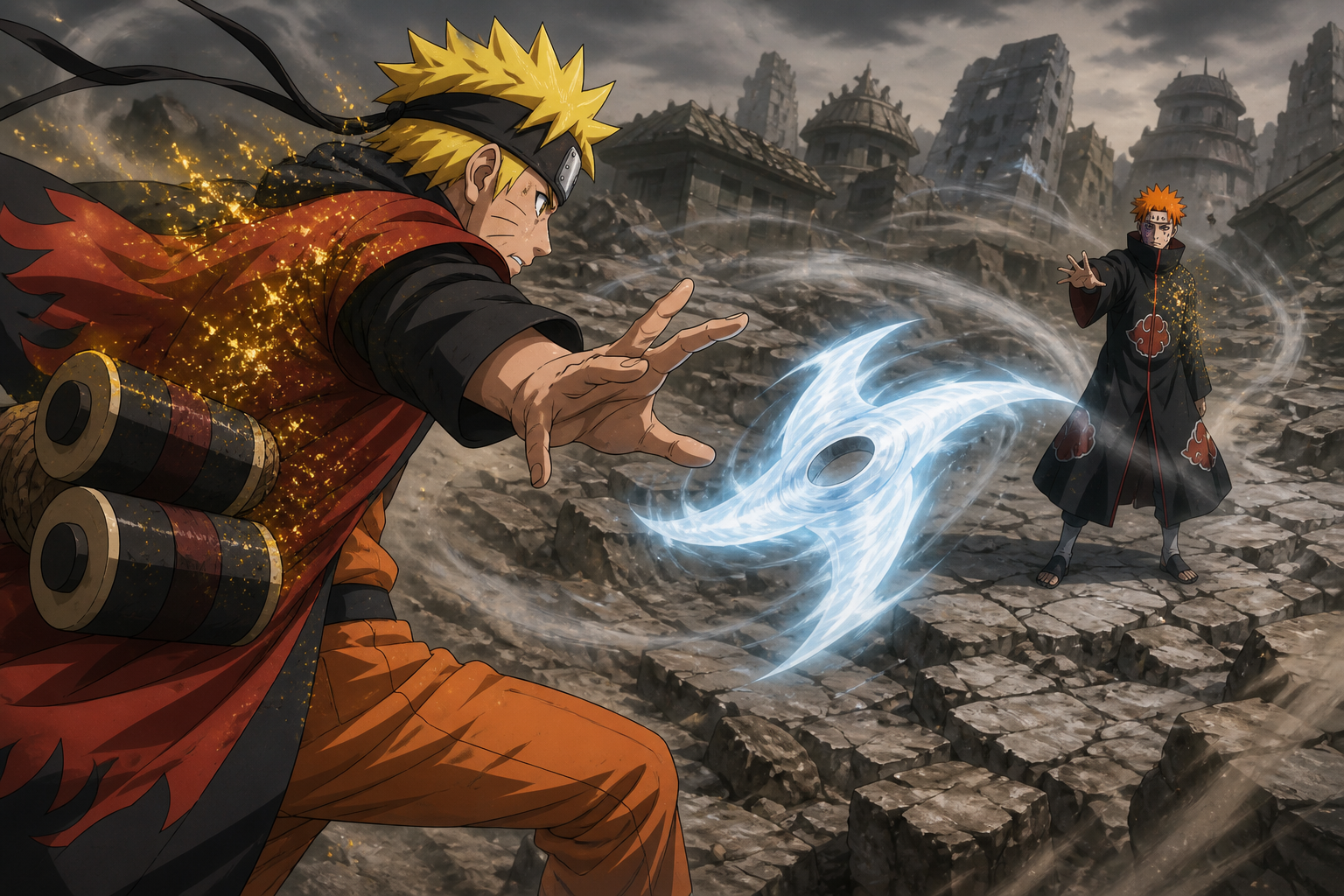
Naruto’s perfected Rasen Shuriken changes the battle, but Sage Mode’s fading reserve turns every remaining attack into a decision against the clock.
What happens
Naruto attacks Pain with the Sage Art version of Wind Style: Rasen Shuriken. The technique is stronger, faster, and usable at range, allowing him to pressure the Paths without accepting the same damage the original version inflicted on his arm.
The Human Path is defeated, but the remaining bodies quickly reorganize. Pain's shared vision and divided roles keep the battle dangerous even after Naruto's explosive opening.
Then the limit built into Sage Mode becomes immediate. Naruto's stored natural energy begins to run out, forcing him to depend on preparation, timing, and the shadow clones left gathering energy at Mount Myoboku.
Rasen Shuriken has become sustainable
Naruto's earlier use of Rasen Shuriken endangered his own chakra network because he had to drive the technique into an opponent at close range. Sage Mode changes that relationship.
Throwing it allows him to preserve distance and use the attack as an actual projectile. The improvement is not merely a larger explosion.
It shows Naruto revisiting a dangerous achievement and finding a form that respects his future ability to keep fighting.
Range becomes a moral and tactical choice
The crater provides space for a large technique, but survivors remain near the battlefield. Naruto cannot treat open ground as empty ground.
Using range lets him target Pain without moving the most destructive energy through his own allies. It also reduces the opportunity for the Paths to interrupt him before release.
Power becomes more responsible when the user can decide where exposure begins and ends.
The Human Path is a strategic target
The Human Path can extract information directly from a person's mind and soul. It is the body that confirmed Naruto's location at Mount Myoboku.
Removing it prevents Pain from repeating that form of interrogation against more defenders. Naruto is therefore reducing the enemy's information-gathering capacity, not simply lowering the number of bodies.
The choice reflects a growing ability to see the Paths as specialized functions inside one system.
Shared vision protects the formation
Every Path can contribute sight to the others. An attack that appears hidden from one angle may still be visible through another body or summon.
That network makes ordinary flanking unreliable. Naruto and the toads must create moments when vision is blocked, overloaded, or physically separated.
Pain's strength comes from coordination as much as individual techniques. Defeating one body changes the network, but does not dissolve it.
Sage Mode is powerful because it is finite
Naruto cannot remain in Sage Mode indefinitely while moving. Gathering natural energy requires stillness, and the battlefield refuses to provide it.
The time limit prevents the transformation from becoming an answer without cost. Every attack spends part of a reserve that cannot be replenished casually.
That boundary makes judgment visible. Naruto has to decide which opportunities deserve the limited power available now.
The title changes victory into a clock
Naruto's early successes create momentum, but “Limit Reached” turns momentum into pressure. The audience can measure danger through depletion rather than injury alone.
Pain does not have to overpower every technique if he can survive until the transformation ends. Time becomes another member of his formation.
Naruto must therefore fight the opponent in front of him and the expiration occurring inside his own body.
Preparation at Mount Myoboku matters
Naruto left shadow clones gathering natural energy before returning to Konoha. That decision creates reserve Sage Mode activations he can access through summoned scrolls.
The plan is clever because it accepts a known limitation instead of pretending training removed it. Naruto prepared infrastructure for the version of himself who would be too busy to stop.
Past discipline becomes present rescue. The clone waiting elsewhere is a resource created before the crisis reached its worst point.
The scrolls are a visible countdown
Each stored clone can restore Sage Mode, but the number is limited. The scrolls make the reserve concrete.
Once a clone is released, that preparation cannot be used again. Naruto gains another window while also moving closer to the final one.
This creates a more interesting tension than endless transformation. Resource management becomes part of the emotional rhythm of the fight.
Pain adapts after surprise
Naruto's arrival caught the Paths before they understood his new abilities. That advantage shrinks with every exchange.
Pain watches the reach of Frog Kata, the force of Rasen Shuriken, and the timing of Naruto's transformation. The network learns even as bodies are lost.
Naruto must therefore vary his approach. Repeating a successful move can become dangerous once shared vision has recorded its conditions.
Fukasaku supplies more than advice
Fukasaku understands Sage Mode's mechanics and can recognize changes in Naruto's reserve. His battlefield guidance connects training knowledge to immediate decisions.
The relationship matters because Naruto cannot monitor every variable alone while fighting several opponents. Expertise shared at the right moment prevents strength from becoming waste.
Fukasaku also represents continuity with Jiraiya, but he contributes as an active partner rather than a symbol standing outside the fight.
The remaining Paths become more dangerous
Removing one body reduces Pain's options, yet it can also concentrate the surviving formation. Each remaining Path understands more about Naruto than the defeated one did.
The Preta Path can absorb chakra. The Animal Path can disrupt scale and positioning. The Deva Path's full power is recovering after the village-level Almighty Push.
Naruto's window is closing from both sides: his own reserve is fading while Pain's most dangerous ability moves closer to returning.
Limits expose character
Unlimited power reveals little about priorities because every option appears affordable. A limit forces Naruto to show what he values.
He spends natural energy to protect allies, disable specialized threats, and create openings rather than to stage the most impressive possible attack.
The transformation's boundary therefore becomes part of its meaning. Sage Mode is not maturity because it is strong; it is maturity when Naruto uses finite strength with judgment.
Naruto makes the Rasen Shuriken look finished
The old version required him to carry a storm of microscopic blades into somebody at arm’s length and let the same violence chew through his own chakra network. That was never sustainable. Here, he throws it. The change sounds simple until the entire battlefield has to respond to a weapon that can curve, expand, and erase a Path before the others can comfortably close distance.
This is what growth should look like. Naruto did not abandon the technique because the first version hurt him, and he did not pretend the injury did not matter. He solved the part that made his achievement unusable. The result is louder, yes, but it is also smarter.
The fake throw is pure Naruto
Pain has shared vision, multiple angles, and enough bodies to punish an obvious attack. Naruto still turns a direct technique into misdirection. The first Rasen Shuriken forces the formation to reveal how it plans to evade. The transformed shadow clone hiding inside the follow-up makes the apparent failure part of the trap.
I love this because Sage Mode has not replaced the kid who built fights out of audacity and clones. Training gives him stronger tools. Experience teaches him how to layer those tools. The victory belongs to both versions of Naruto at once.
Shared vision can transmit the wrong conclusion
Pain’s linked sight usually shuts down surprise. Every body sees what the others see, so blind spots disappear and coordinated defense becomes brutally efficient. Naruto attacks the assumption underneath that strength. If all the Paths agree that the projectile missed, they can all organize around a lie.
A network is only as reliable as its interpretation. More eyes do not guarantee better judgment when every eye accepts the same performance. Naruto does not break the Rinnegan connection. He feeds it information designed to produce the opening he needs.
The Human Path falls because Naruto understands the system
The Human Path is not merely another target in matching robes. It can rip information and souls from people, which made it central to Pain’s search for Naruto. Removing it protects survivors from another round of forced interrogation and weakens the formation’s ability to turn captured people into intelligence.
Naruto is learning to fight functions instead of silhouettes. That distinction matters against an enemy whose bodies divide one person’s arsenal. He is not counting knockdowns. He is dismantling a machine one necessary piece at a time.
Sage Mode ends at the worst useful moment
The episode lets Naruto demonstrate exactly why this transformation terrifies Pain, then takes it away before the fight can become a parade. His eyes change. The sensory reach, physical strength, and natural-energy reserve drop. Suddenly the crater feels larger and every surviving Path feels closer.
That limit does not cheapen the power. It gives every second a price. Naruto cannot spam his strongest moves and wait for the story to call him impressive. He has to decide what deserves a finite resource while the Deva Path’s own devastating ability moves closer to returning.
Stillness remains the price Naruto cannot pay here
Sage Mode requires gathering natural energy without moving. That lesson was difficult on a quiet mountain with teachers watching him. In the middle of Pain’s formation, stillness would be an invitation to die. The environment has changed, but the rule has not bent for the hero.
This is one of the arc’s best choices. Mastery does not mean a limitation disappears because Naruto wants it badly enough. Mastery means he understands the limitation clearly enough to prepare an answer before it becomes fatal.
The Mount Myoboku clones are planning made visible
Naruto left shadow clones seated in stillness, gathering natural energy where Pain could not interrupt them. A scroll and reverse summoning let him dismiss one clone and receive the experience and chakra it accumulated. The solution is wonderfully Naruto and completely earned.
He uses the clone technique that once represented chaotic excess as disciplined infrastructure. One Naruto fights. Another prepares the next window. The hero on the battlefield is being supported by work he completed earlier, when nobody was applauding and the village had not yet seen his entrance.
Each waiting clone is also a countdown
The reserve system buys time, but it does not create infinity. Naruto has a limited number of clones at Mount Myoboku. Every restored Sage Mode window consumes one. The scroll therefore functions like an ammunition counter for the transformation itself.
That makes the plan better, not worse. A clever answer can still have an edge. Naruto must turn each reserve into meaningful progress before the final clone disappears. Preparation gives him chances. Judgment determines whether those chances become survival.
Fukasaku cannot solve this limit for Naruto
Jiraiya maintained Sage Mode through fusion with Fukasaku and Shima, allowing them to gather natural energy while he moved. The Nine-Tails refuses that arrangement for Naruto. Kurama’s hostility reaches beyond the seal and blocks a partnership that should have removed the time limit.
The interference is a reminder that Naruto’s greatest internal power is not yet an ally. Sage Mode proves what he can build through cooperation, while the fox’s rejection exposes the relationship he still has not transformed. Power inside him is not the same as power working with him.
Pain’s formation keeps learning after every loss
The surviving Paths now know about Frog Kata, the thrown Rasen Shuriken, Naruto’s deceptive clones, and the visible end of Sage Mode. Shared vision turns every exchange into a lesson delivered across the formation. Naruto’s opening advantage shrinks each time he reveals another answer.
This is why the fight never feels like six unrelated one-on-one matches. Pain behaves like one intelligence distributing risk through several bodies. Naruto has to defeat opponents while preventing their collective understanding from catching up to his remaining options.
The Preta Path turns ninjutsu into a liability
A giant technique cannot solve every body. The Preta Path can absorb chakra, which means Naruto’s most spectacular attack can become wasted Sage energy if he chooses the wrong target. The counter forces him back toward observation, taijutsu, and natural energy’s stranger properties.
There is something satisfying about a battle that refuses a universal answer. Naruto’s new strength is real, but real strength includes knowing when the signature move is exactly what the opponent wants you to spend.
Natural energy contains a punishment for taking without balance
Sage training taught Naruto that absorbing too much natural energy without balancing it against physical and spiritual energy leads to petrification. The Preta Path can swallow chakra, but absorption is not understanding. Naruto can weaponize the difference by allowing the body to take in energy it cannot regulate.
Pain’s philosophy treats people, bodies, and suffering as instruments. The natural world refuses that kind of extraction. You cannot simply consume its force and assume ownership. Balance is not decorative language here. It is the rule that makes stolen power dangerous.
The Deva Path’s recovery changes the whole clock
After flattening Konoha with an enormous Almighty Push, the Deva Path temporarily loses access to its gravitational technique. Naruto’s early assault happens inside that rare weakness. Every moment he spends elsewhere gives Pain’s central body time to recover.
Two clocks now run against Naruto. Sage Mode drains from inside him while the Deva Path’s power returns outside him. The tension comes from watching those lines approach each other. Naruto needs to remove enough of the formation before the most dangerous ability comes back online.
Victory cannot depend on the village staying silent
Naruto asked everyone to keep out of the fight because he can sense the battlefield and because Pain’s attacks make rescue attempts lethal. The request is tactically sound. Emotionally, it is still brutal. Konoha has finally recognized him and immediately places its remaining hope on his limited reserve.
The episode makes that faith feel both beautiful and unfair. Naruto wants the responsibility, but wanting to protect people does not mean he should become a disposable answer to every institutional failure that came before his arrival.
Finite power reveals priorities
If Sage Mode lasted forever, Naruto could answer every problem eventually. Because it ends, his sequence matters. He protects Tsunade, removes specialized Paths, saves large attacks for openings, and relies on the toads where their strengths preserve his own limited time.
That is the real maturity in this fight. The transformation looks heroic, but the allocation of its power tells us who Naruto has become. He is not chasing the flashiest victory. He is spending himself according to what keeps other people alive.
RaeRae reaction
I appreciate that this episode refuses to let the Sage Mode entrance settle into a victory lap. Naruto is genuinely impressive, and Rasen Shuriken finally looks like the technique it was always meant to become, but the story immediately asks what happens when that power starts running out.
The prepared clones are my favorite detail because they make planning feel heroic. Naruto knew he would not be able to gather natural energy while moving, so he built a bridge between Mount Myoboku and the future battlefield before leaving. The solution is not a sudden loophole. It is evidence that he listened to the limits of his training.
Pain's adaptation also keeps the fight honest. Shared vision means every spectacular attack becomes information for the surviving bodies. Naruto cannot rely on surprise forever, and removing one Path does not erase the intelligence already passed through the network.
“Danger! Sage Mode Limit Reached” makes finite power more compelling than infinite escalation. Naruto's reserve matters because each use expresses a decision. The danger is not only that Sage Mode will end. It is that he must spend it well enough for the village to have a future after it does.
The episode refuses an easy coronation
Episode 163 gave Naruto the entrance fans waited years to see. Episode 164 immediately asks whether that entrance can survive mechanics, adaptation, and time. That refusal to coast is why the triumph still lands. The story respects Naruto enough to test the work behind the pose.
He looks like Konoha’s answer, but he still needs teachers, summoned allies, stored clones, and information from survivors. Heroism remains communal even when the camera knows exactly whose face belongs in the close-up.
RaeRae’s final word on Danger! Sage Mode Limit Reached
This is Naruto at his best: clever, prepared, a little ridiculous, and unwilling to let somebody else define what his limits mean. Pain sees Sage Mode expire and reads weakness. Naruto sees a problem he already planned around.
The shadow-clone reserve is not a loophole. It is the payoff to years of watching Naruto turn the same basic technique into education, reconnaissance, misdirection, labor, and now stored stillness. Nobody in this series has ever gotten more mileage out of one jutsu.
I also appreciate that the episode does not confuse a new form with automatic wisdom. Naruto can still lose. Pain is still studying him. Kurama is still obstructing cooperation. Every spectacular answer opens another uncomfortable question.
Sage Mode matters because it ends. The limit forces Naruto to show us what he values with every attack, and he keeps choosing people over performance. That is a far stronger statement than unlimited chakra could ever make.
That distinction matters to me because fandom loves crowning a new form before asking what the character does when it fails. Naruto does not collapse into panic or demand another miracle. He reaches for preparation, trusts the allies holding their positions, and keeps reading the enemy. The limit reveals the shinobi underneath the spectacle.
RaeRae’s call
Naruto’s Sage Mode runs out, but his thinking does not. The clones waiting at Mount Myoboku turn discipline into a second chance, and Pain learns that a visible limit is not the same thing as an easy defeat.