
Explosion! Sage Mode
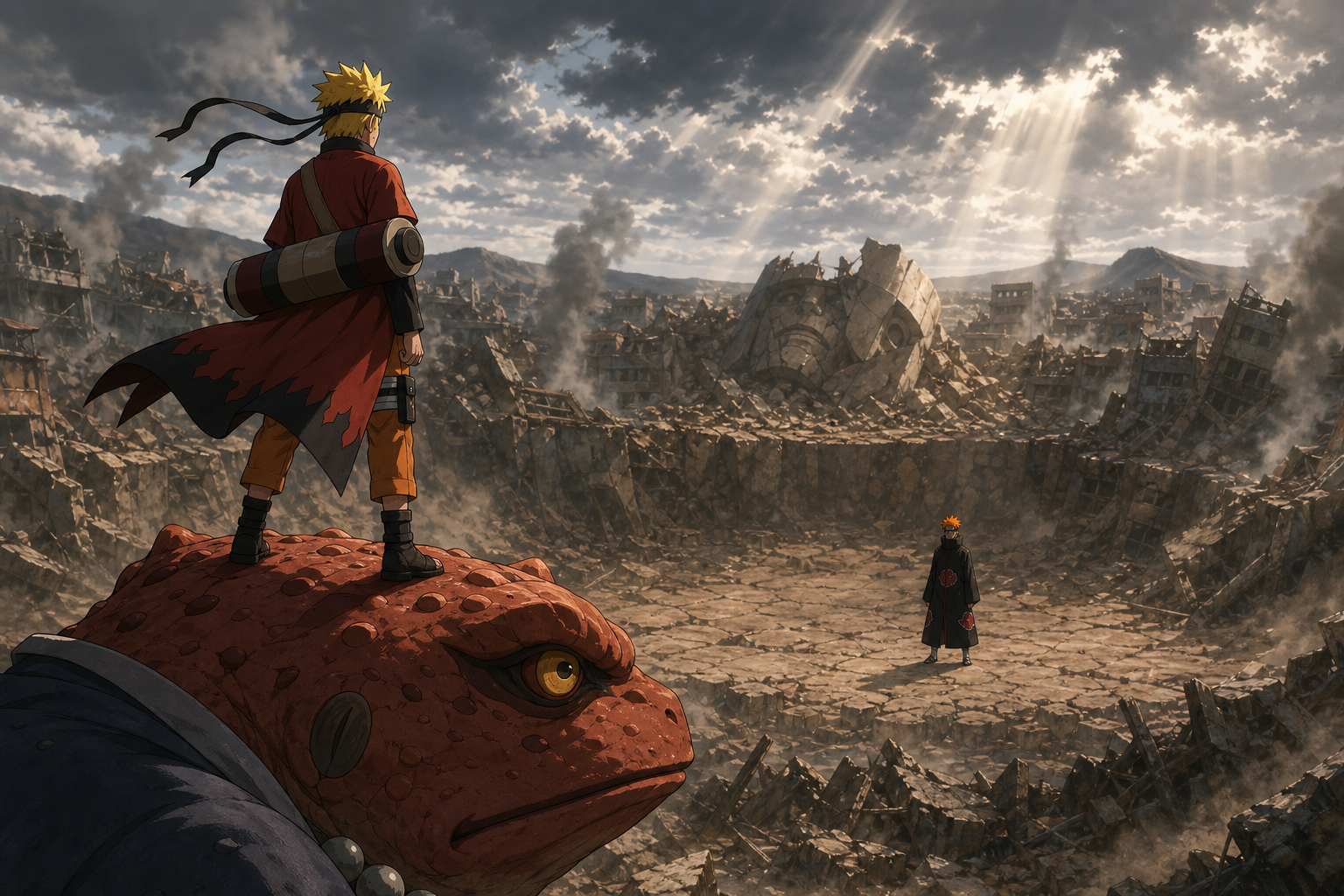
Naruto returns to a crater where his home should be and answers the shock with the balanced, collective strength of Sage Mode.
What happens
Naruto and Fukasaku sense danger and return from Mount Myoboku. They arrive with the great toads expecting to defend the Leaf Village, but the place Naruto knows has been reduced to a vast crater.
The destruction gives him almost no time to grieve. Pain remains present, Tsunade is exhausted from protecting survivors, and summoned creatures still threaten the people left alive.
Naruto enters Sage Mode and takes control of the battlefield. His arrival is not merely a display of new power; it is the moment his training becomes responsibility toward the community that once refused to see him.
Naruto returns to absence
Homecoming usually depends on recognition: a familiar street, a landmark, a person waiting at the entrance. Naruto finds the negative space where those things should be.
The crater forces him to understand the assault before anyone can explain it. Destruction becomes the first message Konoha delivers.
That shock matters because Naruto trained to prepare for Pain, but no exercise could prepare him for the sight of his home erased at once.
Sage Mode begins with stillness
Sage Mode requires balance among physical energy, spiritual energy, and natural energy. Naruto cannot reach it through anger alone.
That discipline becomes crucial now. Pain has created exactly the kind of grief that could make Naruto abandon judgment for immediate retaliation.
His controlled posture shows that training has given him more than stronger attacks. It has created a way to hold emotion without letting emotion choose every movement.
The great toads make his return collective
Naruto does not arrive as a solitary savior descending from nowhere. Fukasaku, Gamabunta, Gamakichi, Gamaken, and Gamahiro connect the battlefield to Mount Myoboku.
Their presence represents teachers, allies, and a tradition Naruto entered through effort. The strength he brings is relational.
This matters because Konoha's crisis cannot honestly be solved by pretending one person is self-sufficient. Even Naruto's most iconic entrance is built on cooperation.
Tsunade recognizes the person who returned
Tsunade spent enormous chakra protecting villagers through Katsuyu. When Naruto arrives, she sees both the student who left and the shinobi his training has produced.
Her trust does not mean she stops being Hokage. It means she allows new capability to change the command structure.
Leadership includes recognizing when someone else is best positioned for the next task, especially after carrying responsibility to the edge of exhaustion.
The village finally looks toward Naruto
Naruto once performed pranks because negative attention felt preferable to invisibility. Now survivors look toward him because his presence represents a real chance to resist.
The shift is emotionally powerful, but it should not erase the years that preceded it. Recognition arrives after Naruto has repeatedly proved his care for people who did not always return it.
The village's hope is meaningful because it acknowledges change. It is also a responsibility the community must learn not to place entirely on one young person.
Sage strength changes the physical scale
Natural energy expands Naruto's strength, perception, endurance, and reach. Opponents who once would have required a whole team can now be answered directly.
The change is visible in how efficiently he moves. Sage Mode does not make him frantic; it makes actions carry more consequence.
That efficiency contrasts with Pain's catastrophic excess. Naruto's power is concentrated toward stopping threats rather than proving dominance over the entire landscape.
The Asura Path learns the difference
Pain's bodies rely on shared vision and coordinated roles. The Asura Path is built for mechanical force and sudden attack.
Naruto's return disrupts the system because the Paths do not yet understand what his training has changed. A body that once overwhelmed senior defenders can be neutralized before the network adjusts.
The moment establishes Sage Mode without suggesting Pain has become simple. Surprise creates an advantage, not a permanent solution.
Frog Kata makes the unseen physical
Frog Kata extends the effect of Naruto's movements through natural energy. An opponent can misjudge the attack because the visible fist is not the complete striking range.
The technique rewards the balance Naruto learned rather than brute force alone. His body, awareness, and surrounding energy operate together.
It also reverses Pain's earlier advantage. Pain used invisible force to make defenders doubt distance; Naruto now brings his own form of reach that sight alone cannot measure.
The summoned animals widen the battlefield
The Animal Path's summons create threats too large for ordinary streets. They can divide attention, crush shelters, and force defenders away from the human-scale battle.
The great toads meet them at that scale. Their role prevents Naruto from spending every reserve on simultaneous giant opponents.
Again, the episode's spectacle depends on specialization. Naruto can focus because allies accept the dangers suited to their own strengths.
Rasengan reflects disciplined abundance
Sage Mode allows Naruto to form larger and more destructive Rasengan variants. The image of that power is explosive, but the underlying method remains precise chakra control.
The technique grows because Naruto learned structure, not because he abandoned it. Greater capacity increases the importance of deciding where force belongs.
Inside a village already destroyed, every attack must be aimed with the knowledge that survivors may be nearby.
Grief is postponed, not removed
Naruto cannot stop to ask about every teacher, friend, or neighbor. The enemy remains active and other lives depend on the fight beginning now.
That postponement is a cost. Functioning under pressure does not mean the loss has failed to reach him.
The episode lets determination and grief occupy the same body. Naruto's discipline is not emotional emptiness; it is a promise to make space for feeling after immediate danger is contained.
The title names controlled release
“Explosion! Sage Mode” suggests sudden overwhelming force, yet the transformation rests on patience and balance. That tension defines Naruto's growth.
Earlier versions of him often rushed toward a problem and improvised after impact. This Naruto arrives, reads the battlefield, accepts support, and commits his strength with purpose.
The explosion is not a loss of control. It is stored work becoming visible at the moment the village needs it.
The reverse summoning lands Naruto inside consequences he never saw develop
At Mount Myoboku, the village exists as an emergency message and a reason to hurry. One instant later, Naruto stands inside the physical result. The transition gives him no gradual approach to the damage.
That compression mirrors traumatic news. A person can move from anticipation to irreversible reality before the mind creates any emotional bridge.
The missing village becomes Naruto’s first tactical problem
Landmarks, roads, sight lines, and familiar positions have vanished. Naruto cannot rely on the map built through years of missions and childhood wandering.
Sage sensing and Katsuyu’s information become essential because the crater has destroyed the ordinary geography defenders would use to coordinate.
Tsunade’s survival network briefs the arriving fighter
Katsuyu can tell Naruto what happened, identify the Paths, and connect him to survivors. The slug carries more than medical chakra. She preserves situational awareness across a broken command system.
Naruto’s entrance works because somebody can translate the battlefield before spectacle outruns understanding.
Naruto’s anger remains specific
He sees the crater, Tsunade’s exhaustion, and Pain standing where home should be. Rage could easily expand until every target looks interchangeable.
Sage discipline keeps the anger attached to the people harmed and the opponent responsible. Specific anger can guide protection. Indiscriminate anger would repeat Pain’s method.
The toad formation is a deployed team, not decorative backup
Gamabunta, Gamaken, Gamahiro, Gamakichi, Fukasaku, and Shima arrive with different sizes, weapons, knowledge, and functions. They create battlefield capacity Konoha no longer has available.
The entrance is iconic because a coordinated community appears, not because Naruto suddenly needs impressive scenery.
Shima and Fukasaku carry Jiraiya into the formation
They trained him, fought beside him, and survived his final mission. Standing with Naruto continues a relationship that Pain could not end by killing one student.
Their presence makes the battle personal without turning grief into private revenge. They are protecting a village and the next person carrying shared work.
Naruto’s cloak and scroll show preparation rather than transformation alone
The visual design marks growth, but the scroll also points toward stored options and the logistics of Sage Mode. He arrives with a plan for managing limits.
A costume change earns meaning when the new appearance reflects training, alliances, and practical readiness rather than simple promotion.
The Asura Path attacks Tsunade because exhausted care remains a threat
Tsunade has little combat chakra left, yet she still represents command, medical coordination, and the refusal to surrender Naruto. Removing her would damage every surviving network at once.
Naruto’s immediate intervention protects the person who spent herself protecting everyone else.
One punch carries weeks of invisible work
The Asura Path falls quickly, but the speed does not mean the victory was easy. Stillness training, nature-energy balance, clone learning, and toad instruction are compressed into one efficient strike.
The episode lets preparation look explosive without pretending preparation never happened.
Sage sensory range changes the ethics of force
Naruto can perceive chakra and nearby life beyond ordinary vision. Greater awareness should allow greater discrimination about where and how he attacks.
Inside a crater containing buried survivors, sensing is not a bonus. Sensing helps prevent rescue from becoming another source of harm.
Frog Kata answers invisible force with embodied relationship
Tendo repels through a power opponents cannot see. Naruto’s natural-energy reach also extends beyond the visible fist, but the source depends on balance with the surrounding world.
Two unseen forces express different politics. Pain imposes distance. Naruto enters connection with the environment and directs the result toward a chosen target.
The giant summons protect Naruto’s limited Sage time
Animal Path can bury the battlefield under massive creatures. If Naruto answered every summon alone, Sage chakra would disappear before he reached the central bodies.
The great toads accept those matchups so his limited reserve can be used where the team needs him most. Specialization becomes conservation.
Tsunade hands over the fight without handing over the village
Recognizing Naruto’s strength does not remove her authority or reduce her earlier work. She gives him current information and space to engage while Katsuyu continues protecting survivors.
Leadership shifts tasks according to capacity. The exhausted Hokage remains part of the response.
The village’s hope carries debt as well as love
Residents once looked away from Naruto or saw only the Nine-Tails. Their hope now acknowledges the person he fought to become.
The recognition is moving and late. Konoha should not place the entire cost of redemption on Naruto by expecting him to save everyone without support.
Pain sees a jinchuriki while Konoha sees Naruto
Akatsuki’s mission reduces him to the beast required for a weapon. The surviving village calls on relationships, memories, and witnessed choices that exceed the seal.
The battle will test whether Naruto can preserve that personhood while using power connected to forces larger than himself.
RaeRae reaction
Naruto's return works because the episode gives the image time to hurt before it becomes heroic. He does not arrive at the gates to cheers. He arrives inside a crater and has to understand that the home he meant to protect is already gone in the physical sense.
Sage Mode is the right answer to that moment because it demands balance. Anger would be completely understandable, but Pain's whole project depends on pain reproducing itself without reflection. Naruto's first resistance is refusing to let shock decide his form.
I also appreciate how collective the famous entrance really is. Fukasaku guided the training. The great toads carry the fight at a scale humans cannot. Tsunade spent herself protecting survivors. Katsuyu keeps people connected. Naruto stands at the center of the frame, but a network of care and instruction made that position possible.
“Explosion! Sage Mode” celebrates power without separating it from responsibility. Naruto has become strong enough for the village to look toward him, yet his most important growth is that he can receive all that fear, grief, and expectation without immediately becoming another person who answers pain by striking everything in reach.
The entrance earns grandeur because the crater remains visible
Naruto does not arrive against a clean background designed to flatter him. Ruin fills the frame and prevents triumph from erasing the cost already paid.
Every powerful pose is accountable to the people beneath the rubble.
Surprise belongs to Naruto only once
The Paths do not understand his new strength, sensing, or Frog Kata during the first exchanges. That ignorance gives him an advantage.
Pain’s shared vision and rapid adjustment mean Naruto must convert surprise into removed bodies before the system learns him.
Sage Mode makes discipline visible at heroic scale
The audience sees force, speed, and confidence. Underneath those results sits the quiet lesson Naruto hated most: stop moving long enough to listen.
The heroic image works because stillness survives inside every decisive movement.
RaeRae’s final word on Explosion! Sage Mode
Naruto’s return is iconic because the episode refuses to separate power from the people who made the power possible. Fukasaku taught. Shima supported the training. The great toads accept whole sections of the battlefield. Tsunade and Katsuyu kept survivors alive long enough for anyone to return to.
The crater gives Naruto every reason to lose control. Pain wants suffering to reproduce itself. Sage Mode begins with balance, which means Naruto’s first answer is refusing to let shock choose the shape of his power.
Destroying the Asura Path in one move feels enormous because weeks of difficult work live inside the speed. The strike is not a shortcut. The strike is preparation finally becoming visible.
Konoha looks toward Naruto as a protector after years of looking through him as a threat. That recognition matters. The village must still remember that hope is a relationship, not permission to place every remaining life on one young man’s shoulders.
Naruto’s new competence changes how others speak to him
Fukasaku and Katsuyu give information directly because Naruto needs the full battlefield picture. Nobody hides the danger to protect his feelings or issues an empty order to be heroic.
The communication treats him as a responsible participant. Trust appears through access to facts, not applause.
The crater destroys privacy along with buildings
Homes have been opened, records scattered, bodies exposed, and personal possessions mixed into public rubble. Survivors will face loss beyond shelter.
Naruto’s fight buys time for a recovery that must protect dignity as well as life. Rebuilding requires secure records, family reunification, and respect for property nobody can immediately retrieve.
The great toads make intercommunity aid visible
Mount Myoboku is not governed by Konoha, yet its residents enter the village’s emergency because relationships cross borders. Their aid does not wait for a treaty ceremony.
The alliance shows another model of power: communities can share risk through chosen bonds instead of forcing weaker places to absorb conflict alone.
Naruto’s entrance reverses the direction of inherited teaching
Jiraiya once brought Naruto toward the toads. Now the toads bring Naruto back toward Jiraiya’s killer. The same relationship that formed through training becomes transportation, intelligence, and battlefield support.
Teaching creates infrastructure that survives the teacher when other people continue honoring the connection.
Fast victories should not hide Sage Mode’s budget
Natural energy runs out. Clones can hold reserves only under specific conditions. Every large Rasengan spends part of a limited window.
Naruto must choose targets in an order that breaks Pain’s system before the advantage expires. Spectacle remains accountable to arithmetic.
The Animal Path is a logistical threat
Summons occupy space, separate allies, damage rescue routes, and force defenders to spend strength away from the central opponent. Their danger is not only teeth and size.
The toad team answers by controlling lanes and preserving Naruto’s attention. Battlefield management makes the later duel possible.
Tsunade’s trust does not become a command to win alone
She recognizes Naruto’s growth and gives him the central fight. Katsuyu continues supplying information, toads handle summons, and survivors keep working beneath the rubble.
The shared response prevents belief from becoming abandonment dressed as confidence.
The iconic pose contains a child returning home too late
Naruto looks composed, capable, and transformed. Inside that image is the person who expected streets, familiar faces, and a village still standing.
The scene works because heroism does not erase the shock. His body begins the fight while his grief has barely found language.
That emotional delay will matter. Every missing person can become another reason to attack without listening, and Pain is waiting to prove that pain always reproduces pain. Sage training gives Naruto a physical practice for holding several forces in proportion. The moral test will ask him to do the same with anger, love, history, and responsibility. Episode 163 celebrates the body becoming ready before the heart has caught up. The coming episodes must show whether balance can survive new information, new loss, and the sight of an enemy who believes Naruto’s grief is evidence for his own worldview. The village watching Naruto should also resist turning his return into proof that every earlier failure was secretly necessary. Neglect did not create his compassion. Naruto built compassion while surviving neglect, helped by the few people who chose to recognize him before recognition became popular. Sage Mode does not vindicate adults who feared the Nine-Tails or left a child alone. The transformation proves what becomes possible when teachers share knowledge, communities provide support, and a student receives room to adapt. Konoha can celebrate the protector standing in the crater while still owing the lonely boy an honest account of why he had to fight so hard to belong there after the cheering and fighting finally stop again.
RaeRae’s call
Naruto arrives with power built from stillness, teachers, toads, clones, and grief. Sage Mode matters because balance survives the moment rage would be easier.