
Mystery of Pain
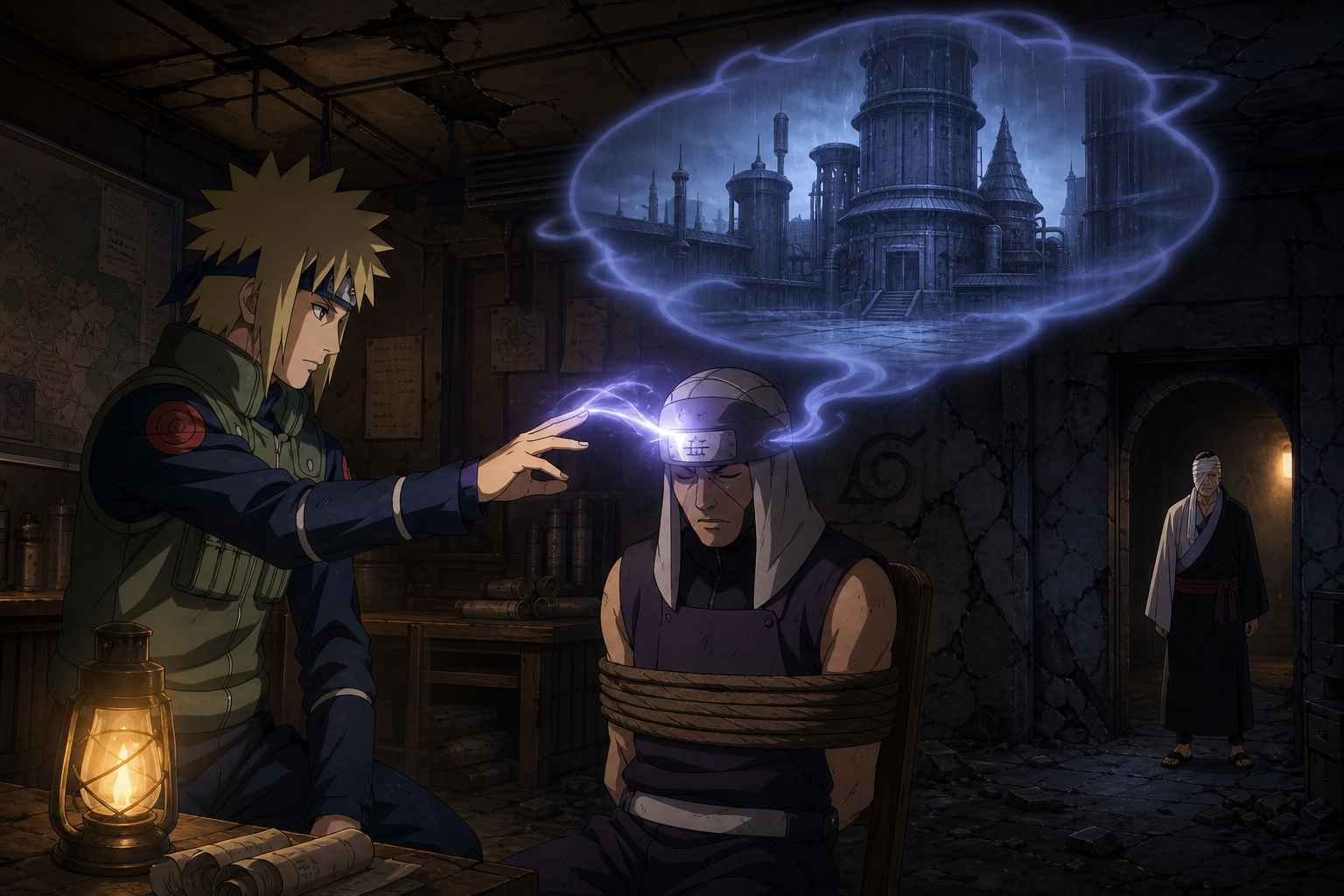
Inoichi searches a captured shinobi’s memories for Pain’s hidden structure while Danzo treats the village’s suffering as an opening for power.
What happens
The Leaf Village remains under coordinated attack, but this episode follows two quieter struggles beneath the visible destruction. Inoichi Yamanaka searches the mind of a captured Rain shinobi, hoping to recover information about Pain before more defenders are lost.
Elsewhere underground, Danzo orders the Foundation to remain hidden. He sees the crisis not only as a threat to Konoha but as an opportunity to weaken Tsunade and position himself for power.
The episode places investigation beside ambition. One leader searches another person's memories to protect the village, while another withholds his forces because the village's suffering may serve his political objective.
Pain's mystery is a structural problem
Konoha knows that several bodies share the name Pain, yet knowing that fact does not explain how they operate. The defenders need the relationship behind the bodies, not merely a catalogue of their abilities.
That distinction shapes Inoichi's work. A single memory may not contain a direct explanation, but it can reveal routes, procedures, and places that expose the larger system.
The mystery will not yield to one dramatic clue. It has to be assembled from fragments whose importance becomes visible only when investigators compare them.
Inoichi enters a damaged archive
A human mind is not an orderly record. Memory is selective, emotional, and shaped by what the person understood at the time.
Inoichi therefore cannot treat the captured shinobi's recollections as a perfect recording. He must navigate impressions, identify recurring details, and separate meaningful experience from incidental noise.
His technique looks supernatural, but the work resembles careful archival research. Access is only the beginning; interpretation determines whether the information can save anyone.
The Rain shinobi's memory has limits
The captive does not possess Pain's full secret. He was a participant inside a controlled system, not the person designing it.
That limitation is useful because it keeps the investigation honest. Konoha cannot force certainty from a witness who never had it.
Instead, Inoichi looks for what the man actually saw: movements through the Rain Village, unusual locations, guarded deliveries, and the behavior of people who understood more than they revealed.
A tower becomes a question
The memory of a particular structure matters because places can preserve patterns people fail to explain. A tower may connect personnel, material, and authority even when no witness knows the complete purpose.
For investigators, geography becomes evidence. Who enters, what is carried, how often routes repeat, and which areas remain restricted can expose an organization indirectly.
The episode respects that kind of clue. The tower is not an instant answer; it is a more precise question that can guide the next search.
Intelligence work buys time
Inoichi is not confronting Pain in the street, yet his work belongs to the same defense. Every useful detail can shorten the period in which Konoha fights blind.
That contribution is easy to overlook because it lacks the spectacle of a jutsu collision. Its stakes are just as immediate.
The village needs fighters to delay the enemy, medics to preserve lives, messengers to connect teams, and analysts to turn survival into understanding. None of those roles can replace the others.
Danzo chooses absence
Danzo's response is chilling because he possesses people who could help. His inaction is deliberate, not the result of confusion or isolation.
He calculates that a weakened Tsunade may create space for his own rise. The village becomes a political instrument, and the casualties become costs he expects someone else to absorb.
This is a different kind of violence from Pain's assault, but it exploits the same destruction. Danzo benefits from chaos while preserving the appearance that he did not create it.
The Foundation's loyalty is narrowed
Foundation members are trained to obey Danzo as though his judgment and Konoha's welfare are identical. The crisis exposes the danger in that assumption.
When one leader can define service privately, disciplined shinobi may be ordered to abandon the people they were formed to protect.
Their secrecy prevents public accountability. Citizens cannot evaluate a force they do not know exists, and other commanders cannot coordinate with agents who have been removed from the shared defense.
Tsunade and Danzo represent opposing leadership
Tsunade commits resources to the village even when doing so threatens her authority and safety. Danzo protects his resources so that he can claim authority after others have paid the cost.
Both leaders understand risk. The difference is who they believe should carry it.
Tsunade accepts responsibility for uncertain decisions. Danzo transfers danger outward while preserving himself as the imagined solution to the disaster he chose not to resist.
Secrecy can protect or corrupt
The intelligence division also works away from public view, but secrecy serves a different purpose there. Inoichi protects sensitive knowledge while trying to distribute usable findings to defenders.
Danzo uses secrecy to prevent scrutiny and isolate decision-making. The same condition therefore produces opposite ethical results.
The question is not whether information is hidden. It is whether concealment protects people and enables accountable action, or protects power from the people it affects.
The village is fighting for shared reality
Pain's separate bodies create confusion. Danzo's hidden orders fragment command. The intelligence team's task is to rebuild a common understanding faster than those forces can divide it.
Shared reality is strategic. Defenders who know the same limits and objectives can coordinate even when they cannot see one another.
The enemy benefits whenever Konoha's groups operate with incompatible pictures of the crisis. Every verified clue reduces that advantage.
Inoichi's restraint matters
Mind-reading could be portrayed as effortless access, but the episode gives the process friction. Inoichi has to work within the available memories rather than inventing what he wants to find.
That restraint separates investigation from confirmation bias. A desperate village may want a quick answer, yet a false conclusion would send defenders toward the wrong target.
Useful intelligence depends on the courage to report what is known, what is inferred, and what remains unresolved.
Shizune reads the body as a record of control
The autopsy team studies chakra receivers embedded inside a Pain body. Flesh, metal, and transmitted chakra form a system whose purpose becomes visible through physical evidence.
Shizune’s work complements Inoichi’s memory search. One team examines what the body can reveal. The other examines what a witness saw. Their findings become stronger when the two routes meet.
The black receiver changes the question from identity to transmission
If chakra arrives through an implanted object, the visible body may be a terminal rather than the original source. Investigators can begin asking about range, direction, signal strength, and the location of the controller.
The object makes Jiraiya’s message physically plausible. “The real one is not among them” stops sounding mystical and becomes a testable model.
A corpse used as a Path carries stolen history
Jiraiya recognized faces from his travels among the bodies. That detail means Nagato did not create anonymous shells. He took people with prior lives and turned their remains into roles.
Konoha needs to identify those histories because past location, death, and movement may reveal how the system was assembled. The dead deserve names beyond the ability assigned to them.
Inoichi’s memory route depends on context he does not own
He can enter the Rain shinobi’s recollections, but geography and local custom remain difficult to interpret from outside Ame. A remembered tower means more to someone who knows the city’s industrial routes and restricted zones.
Konoha should treat the memory as evidence requiring local context, not as a complete truth available through force.
The Hidden Rain’s surveillance culture shapes what witnesses remember
Residents lived under observation, secrecy, and restricted movement. A courier may notice routes and instructions while deliberately avoiding questions that could attract punishment.
Missing knowledge is therefore part of the political environment. People survive authoritarian systems by learning not to know too much.
Danzo’s underground position is a visual confession
While Konoha burns above him, Danzo remains physically separated with a force trained to obey him. The location mirrors the politics. He wants authority over the village without sharing the village’s immediate danger.
Secrecy allows him to imagine casualties as numbers inside a future argument about leadership.
Foundation discipline removes the friction that might stop a bad order
Agents trained to suppress identity and emotion have fewer tools for challenging a command that betrays the public mission. Loyalty becomes narrow enough to fit one man.
A healthy command structure needs lawful refusal, independent reporting, and accountability outside the leader issuing the order. Danzo designed Foundation to remove those safeguards.
Withholding fighters is an active battlefield choice
Danzo can claim he did not cause Pain’s assault. He still decides that available defenders will not assist while civilians and shinobi absorb the attack.
Inaction changes the outcome when capacity exists. Political calculation does not become neutral merely because somebody else delivered the first blow.
Tsunade’s legitimacy is built through visible responsibility
She spends chakra on Katsuyu, coordinates teams, protects patients, and makes decisions whose consequences can be traced back to her. Leadership places her inside the cost.
Danzo preserves strength for later and hopes destruction will make his claim look necessary. One model earns trust through service. The other manufactures dependence through absence.
The intelligence teams model ethical uncertainty better than Danzo does
Inoichi and Shizune distinguish observation from conclusion. They share partial findings and keep testing. Danzo treats his political belief as certainty that excuses withholding help.
Humility improves the investigation because uncertainty invites more evidence. Certainty corrupts leadership when no one can challenge the premise.
Konoha’s archives should connect bodies, memories, and mission records
Identifying former shinobi among the Paths requires records from many villages and years. Faces, scars, missions, disappearances, and known deaths may reveal Nagato’s collection pattern.
Information becomes useful when separate archives can be compared without erasing who produced the records or why gaps exist.
The real controller must remain near enough to transmit
Chakra receivers suggest physical constraints. Even extraordinary control may depend on distance, elevation, barriers, and a position suited to broadcasting.
The investigation can map likely locations instead of searching all of Fire Country. A supernatural mystery becomes geography, engineering, and sensory work.
Searching another mind carries moral risk even during emergency
The captured Rain shinobi cannot give ordinary consent under these conditions. Konoha has a real need to stop an active mass attack, but necessity does not erase the intrusion.
Responsible use should remain narrow, documented, and focused on the threat. Emergency power becomes dangerous when institutions treat one justified search as permanent permission.
Pain and Danzo both use fear to centralize authority
Pain creates terror so people will accept his version of peace. Danzo allows terror to weaken Tsunade so people may accept his version of security.
Their methods differ in scale, but both imagine suffering can make political consent easier to control.
The mystery is solved through people Danzo would treat as tools
Inoichi, Shizune, analysts, captured witnesses, medics, and messengers each carry one fragment. Their judgment matters because no leader can produce the answer alone.
Danzo’s model suppresses individual thought. The investigation succeeds through individual expertise shared across a team.
RaeRae reaction
I like that “Mystery of Pain” moves away from the loudest battlefield without lowering the tension. Inoichi's search feels urgent because every second of careful interpretation is happening while someone else is holding Pain back.
The episode also gives Danzo's ambition an especially ugly shape. He does not need to attack Tsunade directly. He can simply preserve his own force, allow the crisis to damage her, and present himself after the suffering as the person who should have been in charge.
That contrast makes Inoichi's work feel morally important as well as tactically useful. He enters another person's fragmented memories to create knowledge that can be shared. Danzo hoards people and information to create dependence on himself.
The mystery of Pain is therefore not the episode's only mystery. Konoha must also confront what happens when an institution claims to protect the village while separating its own survival from everyone else's. The answer begins with evidence, communication, and leaders willing to make their knowledge useful before the cost becomes irreversible.
The episode makes quiet rooms part of the battlefield
A memory chamber and autopsy table can decide who survives outside. The absence of explosions does not reduce the urgency.
Every careful observation shortens the time defenders must fight an enemy described as divine because nobody understands the mechanism.
Evidence turns divinity back into technique
Pain’s name, eyes, and impossible coordination cultivate the image of a god. Receivers, intervals, corpses, and transmission expose constructed parts.
The power remains terrifying. Understanding the parts returns the possibility of resistance without pretending the danger was an illusion.
Danzo wants the aftermath more than he wants the village safe
He imagines weakened rivals, frightened citizens, and an opening for his authority. That future depends on other people paying enough pain to make his politics persuasive.
A protector who requires preventable suffering to prove his necessity has already chosen power over protection.
RaeRae’s final word on Mystery of Pain
Inoichi and Shizune do the work Danzo refuses to do. They enter difficult evidence, admit what they do not know, and build findings meant to leave the room and help somebody else survive.
The chakra receivers are the hinge. Pain’s bodies stop looking like six supernatural selves and begin looking like controlled stations in a transmission network. Jiraiya’s final message gains a physical mechanism.
Danzo creates the episode’s ugliest contrast. He has trained fighters available beneath a village under attack and chooses to preserve them for his own political future. Calling that choice strategy does not clean the blood from the calculation.
The mystery of Pain will yield because many people share incomplete knowledge. Konoha’s internal danger grows because Danzo hoards complete control. One system treats uncertainty as a reason to collaborate. The other treats crisis as permission for one man to decide alone.
The captured shinobi remains a person inside the evidence
Inoichi needs information urgently, but the Rain shinobi’s mind contains a life beyond the useful route. Memories may include fear, family, routine, and private details unrelated to Pain.
Ethical investigation requires discipline about what gets extracted, recorded, and shared. A person should not become an open archive merely because one memory may protect Konoha.
Shizune’s medical knowledge becomes counterintelligence
Her understanding of bodies, chakra pathways, and foreign objects lets the team interpret the receiver as more than a weapon. Medicine reveals how control travels.
That crossover matters. Training designed to heal can expose an enemy’s architecture because both tasks require close attention to what a body is being forced to carry.
Different evidence streams need one shared timeline
Jiraiya’s encounters, the Rain shinobi’s memory, the corpse’s condition, and current battlefield reports happened at different times. Analysts must ask which details describe a stable system and which reflect a temporary arrangement.
A shared timeline prevents one true observation from being applied carelessly to every later moment.
The controller’s absence creates both power and vulnerability
Nagato avoids direct exposure by placing bodies between himself and danger. Distance gives him protection and lets six Paths occupy multiple spaces.
The same distance requires transmission. Receivers, range, and a hidden location create dependencies investigators can target. Protection becomes a trail once the mechanism is understood.
Foundation’s silence damages the evidence picture
Hidden agents may observe routes, enemies, casualties, or structural damage that other teams never see. Danzo’s refusal to join the common defense also withholds those observations.
Hoarding personnel therefore hoards reality. Commanders make worse decisions because one private force has removed its knowledge from the shared map.
Political ambition changes who receives emergency protection
Danzo expects central districts, medical teams, and ordinary defenders to absorb damage while Foundation survives below. His imagined future government begins with unequal exposure to the present attack.
That distribution reveals the values behind his security language. People closest to his power receive protection first, while the village becomes proof for his argument.
The investigation gives Konoha a chance to reject myth
Pain presents himself as divine because mystery expands fear. Every receiver identified, body named, route mapped, and interval measured returns the system to human choices and material limits.
Rejecting myth does not minimize Nagato’s power. The process restores accountability by showing that a person built the machinery and decided how to use the dead.
The episode’s strongest defense therefore happens through classification, memory, anatomy, and honest doubt. Inoichi and Shizune cannot stop the explosions themselves. They can prevent spectacle from becoming theology. Once Konoha understands that Pain depends on bodies, signals, locations, and a controller, defenders can ask practical questions instead of surrendering to a god’s performance. Danzo moves in the opposite direction. He wants fear to become political mythology proving only his authority can save the village. The intelligence teams protect Konoha by making reality shareable. Danzo threatens Konoha by making power private. That contrast should follow Konoha after the attack. Rebuilding streets without changing information systems would leave the village vulnerable to another leader who can hide forces, suppress messages, and wait for public fear to improve his position. Emergency review must include who knew what, which units were available, why those units never appeared, and who possessed authority to challenge the order. Accountability is not a distraction from external defense. Accountability determines whether internal power serves the residents paying for that defense. Pain’s receivers make remote control visible inside corpses. Foundation makes remote control respectable inside uniforms. Konoha needs to recognize both systems before either one can claim obedience is the same thing as peace after the immediate danger passes.
RaeRae’s call
Shizune and Inoichi turn bodies and memories into shared evidence. Danzo turns hidden people into private power. Only one kind of secrecy is protecting Konoha.