
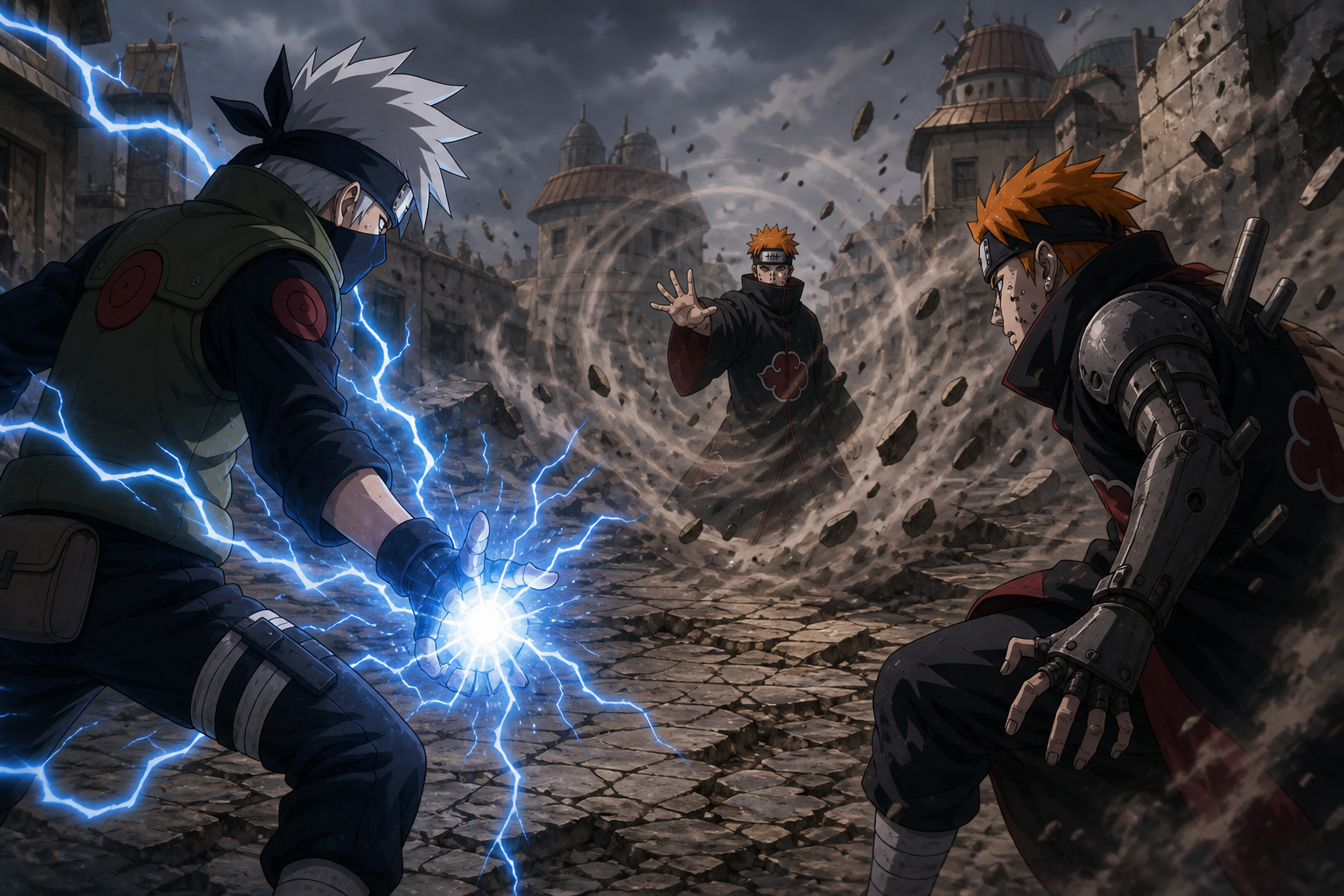
Pain vs. Kakashi
Kakashi studies Tendo Pain under fire, searching for the one repeatable limit that can turn a brutal two-on-one fight into a tactical opening.
What happens
Kakashi confronts Tendo Pain among the ruins of the Leaf Village. The fight begins as a difficult attempt to understand an unfamiliar technique, then becomes far more dangerous when Shurado joins the battlefield.
Tendo seems able to repel attacks without touching them. Kakashi cannot afford to treat the effect as ordinary ninjutsu, because every failed approach gives Pain another chance to kill him or move deeper into Konoha.
With two bodies coordinating against one defender, observation becomes as important as offense. Kakashi has to survive long enough to turn scattered impressions into a usable theory.
Kakashi begins with a question
Kakashi's first task is not to overpower Tendo. It is to determine what kind of rule governs the space around him.
That distinction matters. A mysterious ability feels limitless only while its conditions remain hidden. If Kakashi can identify timing, distance, or a repeatable sequence, then fear can become a tactical problem.
He fights like an investigator under fire. Every clone, feint, and change of angle tests a possibility while also protecting the person gathering the evidence.
Tendo Pain controls distance
Tendo's repulsive force changes the meaning of proximity. Closing the gap usually rewards a skilled close-range fighter, but here the final step becomes the most dangerous part of the approach.
The attack also makes the battlefield itself unreliable. Rubble, walls, and bodies can all be displaced, so cover may become a projectile and stable footing can disappear in an instant.
Kakashi cannot simply move faster. He needs to understand when the technique is available and create an opening during the moment it is not.
Shurado turns pressure into a trap
The arrival of Shurado transforms a tense duel into coordinated containment. One opponent controls space while the other supplies mechanical force and attacks from another direction.
Their abilities complement each other. Tendo can interrupt Kakashi's movement, and Shurado can punish the position where that interruption leaves him.
The two-on-one disadvantage is therefore more than a difference in numbers. Kakashi is facing a system whose parts cover one another's weaknesses.
Kakashi studies the interval
Kakashi's greatest weapon in this encounter is his refusal to accept mystery as an answer. He watches what happens before and after Tendo uses his power.
A short interval between attacks would be easy to dismiss in the chaos, yet it may be the boundary that makes resistance possible. Finding it requires attention while injured, threatened, and surrounded by destruction.
That is the practical value of experience. Kakashi does not possess perfect information, but he knows which details might convert survival into a counterattack.
Clones protect information
Shadow clones and substitutions are often described as deception, but here they also protect knowledge. A false body can force the enemy to reveal a response without making the real Kakashi pay the entire cost.
Each exchange tests whether Tendo must face a target, whether the force has a range, and whether both Pain bodies can act independently.
The technique is useful because Kakashi gives every decoy a question to answer. Misdirection without a purpose would only delay defeat.
Choji and Choza change the equation
The arrival of Choji and Choza Akimichi gives Kakashi more than extra strength. It creates the possibility of timing attacks from different positions.
Against opponents who coordinate perfectly, Konoha's defenders must build coordination of their own. Kakashi shares what he has learned instead of guarding the insight as personal expertise.
That exchange is essential. Information becomes valuable only when allies can act on it before the enemy changes the situation.
The battle rewards disciplined trust
Choji and Choza have to commit to a plan whose margin for error is painfully small. Kakashi has to trust their timing, while they have to trust his reading of Tendo's limitation.
This is not blind faith. It is disciplined trust built from a clear explanation of the danger and a shared understanding of each person's role.
The defenders cannot imitate Pain's linked vision, but they can answer it with communication, specialization, and a willingness to expose themselves for the same objective.
Lightning Blade becomes a calculated risk
Kakashi's Lightning Blade is devastating at close range, yet reaching that range against Tendo is exactly the problem. The technique cannot solve the fight by itself.
Its value appears only after observation and teamwork create a narrow route. Power is the final component of the plan, not the plan's substitute.
That ordering makes the battle compelling. Kakashi's famous technique matters because patient analysis has made one decisive attempt possible.
Pain's bodies behave like one opponent
Tendo and Shurado do not fight as two independent personalities competing for attention. They behave like coordinated instruments directed toward the same purpose.
Their shared awareness reduces the value of ordinary blind spots. An attack hidden from one body may still be visible to the other.
Kakashi's side must therefore create an opening that remains valid even when both enemies understand it. Surprise helps, but timing and physical constraint matter more.
The ruins sharpen the stakes
This fight unfolds inside Konoha rather than on a distant mission route. Every collapsed wall represents a home, workplace, or path civilians once used.
Kakashi is not merely defending territory. He is buying time for evacuations, medical response, and the larger effort to understand why Pain has come.
The damaged village makes retreat morally complicated. Survival matters, but allowing these bodies to advance unchallenged would shift the cost onto people with less ability to resist.
Kakashi's calm is active work
Kakashi appears composed, but composure here is not the absence of fear. It is the work of keeping fear from consuming attention.
He separates urgent facts from distracting noise: which body attacked, how long the interval lasted, where his allies can stand, and what sacrifice a failed attempt might demand.
That mental discipline is a form of protection. His allies need a plan they can understand, not a leader pretending the danger is smaller than it is.
The five-second interval is bought with bodies and attention
Kakashi identifies the delay between Tendo’s uses of Almighty Push, but the discovery is not a clean laboratory result. Every test risks a person, consumes chakra, and gives Shurado another angle.
The interval becomes valuable because Kakashi can communicate the timing quickly enough for allies to act. Knowledge without a shared clock would remain useless.
Kakashi’s earth wall is observation disguised as defense
Cover protects him while also revealing how Tendo’s force interacts with solid material and distance. Defensive ninjutsu becomes an instrument for measuring the enemy.
That layered use separates experience from reflex. Kakashi chooses moves that keep him alive and produce information at the same time.
The chain trap respects Pain’s vision
A simple surprise attack would fail because the Paths share sight. Kakashi’s plan needs physical restraint timed during the repulsion interval, not merely an angle one body cannot see.
The chain turns understanding into a condition the enemy cannot solve through awareness alone. Seeing the trap does not automatically restore a technique still inside its cooldown.
Choza and Choji bring family coordination into the fight
The Akimichi pair knows each other’s rhythm, body expansion, and willingness to commit. Their relationship allows Kakashi to build a plan with fewer explanations under pressure.
That familiarity is not magical. Years of shared training become fast communication when every second matters.
Shurado’s body exposes how Pain treats flesh as hardware
Mechanical weapons open from a human shape, turning limbs and faces into platforms for missiles and blades. The horror is easy to miss during the action.
Nagato condemns villages for consuming bodies through war while operating corpses as replaceable equipment. His method reproduces the dehumanization inside his grievance.
Kakashi protects Choji because information must survive the witness
Once Choji carries crucial knowledge about Tendo’s interval, escape becomes more valuable than another attack. Kakashi redirects the final resources toward getting that report to Tsunade.
A battlefield lesson dies if every observer dies with the lesson. Retreat can be a duty to everyone who will face the enemy next.
Kamui becomes sacrifice through precision
Kakashi has little chakra left, yet he uses Kamui to remove a missile aimed at Choji. The technique does not win the duel. It preserves the messenger.
The choice reveals his priorities more clearly than a speech. He spends the last reserve on another person’s chance to carry knowledge home.
Choji’s grief cannot be allowed to stop the mission
Believing Choza has died threatens to collapse his ability to move. Kakashi does not deny the pain. He tells Choji what the information means and why leaving now protects more people.
The demand is brutal, but the purpose is specific. Choji is not asked to stop caring. He is asked to carry care into action before the next team repeats this loss.
Kakashi’s apparent death follows the logic of his whole fight
He spends himself in stages: testing abilities, coordinating allies, protecting the trap, saving Choji, and preserving the report. No single choice looks grand enough to explain the final cost.
The accumulation makes the sacrifice believable. Tactical leadership can consume a person one necessary decision at a time.
The conversation with Sakumo turns an old wound into a meeting
Kakashi has lived under the memory of a father condemned for choosing comrades over mission rules. Near death, he finally sits with Sakumo rather than arguing with the village’s judgment through silence.
The scene connects Kakashi’s adult choices to the child who never received a complete conversation. He has spent the battle choosing people and mission together whenever possible.
Sakumo does not need a courtroom defense from his son
The emotional power comes from presence, not a formal verdict about whether every past choice was correct. Father and son share the fire and begin speaking across years of shame.
Kakashi can recognize love and harm together. Reconciliation does not require pretending the suicide left no wound.
Pain wins the local fight without solving the village
Kakashi falls, but the five-second interval leaves the battlefield through Choji. Pain removes a dangerous defender and fails to contain what the defender learned.
The outcome shows why distributed resistance matters. One person’s body can be defeated while the community preserves the result of that person’s work.
The episode refuses to make genius invulnerability
Kakashi reads the technique, creates a workable counter, coordinates reinforcements, and still loses under superior resources. Intelligence improves odds; intelligence does not cancel physical limits.
That honesty makes his decisions more impressive. He calculates while knowing correct reasoning may still end with his death.
The village owes Choji care after using his survival
Delivering the report does not end his experience. He carries fear for his father, witnessed Kakashi’s final effort, and ran while people he loved remained behind.
Konoha needs the intelligence and also owes the messenger medical attention, truthful updates, and room to process what the mission demanded.
RaeRae reaction
What stays with me is how quickly this episode turns Kakashi's intelligence into something physical. He does not get to solve Pain's technique from a safe distance. Every useful observation arrives attached to impact, exhaustion, or the possibility that the next test will be fatal.
The two-on-one setup also explains why Kakashi is such an effective teacher and squad leader. He does not hoard the mystery once he notices a pattern. He translates it into timing that Choji and Choza can use, then places his own strongest attack inside a team plan.
I also like that Lightning Blade is not treated as a magic answer. The technique is frightening, but Tendo's control of distance makes raw power irrelevant until the defenders earn an opening. Analysis, communication, and trust do the structural work.
“Pain vs. Kakashi” presents tactical brilliance without making it effortless. Kakashi's calm is expensive, and every conclusion carries consequences for the people fighting beside him. The episode understands that intelligence in battle is not knowing everything. It is finding the one rule that can still matter before the enemy closes every remaining path.
Kakashi answers Pain with a different kind of network
Pain coordinates bodies through receivers and shared vision. Kakashi coordinates allies through explanation, trust, and choices each person understands.
One network removes agency from corpses. The other depends on living people accepting risk together. The tactical resemblance makes the moral difference sharper.
The cooldown turns overwhelming power into a rule
Almighty Push first appears absolute. Five seconds change the category. The technique remains devastating, but the interval creates a place where planning can enter.
Kakashi’s gift to later defenders is not victory. He turns terror into a measurable condition.
The final missile proves Shurado remains dangerous after apparent defeat
Mechanical bodies complicate ordinary assumptions about injury. A damaged Path can still contain weapons and complete a command.
Kakashi reacts because he refuses to let visual collapse substitute for confirmed safety. That attention saves Choji and costs the chakra Kakashi needed for himself.
RaeRae’s final word on Pain vs. Kakashi
Kakashi does almost everything right and still cannot purchase an easy win. That is why the episode lands. Pain has more bodies, shared sight, complementary abilities, and enough force to punish every expensive test.
The five-second interval is Kakashi’s real victory. He takes a power that feels divine and finds the ordinary limitation inside the performance. Then he makes sure another person can carry that knowledge beyond his body.
Choji’s escape matters more than pride. Kakashi spends Kamui on the missile because information and a younger life have become the remaining mission. The choice follows Sakumo’s shadow without simply repeating his father’s story.
The quiet fire with Sakumo hurts because Kakashi finally has time for the conversation only when his own life appears finished. He reaches that space after choosing comrades, village, evidence, and the next generation in one brutally compressed fight.
The five seconds create a public obligation
Once Choji reaches command, the interval cannot remain a clever detail admired after the battle. Every squad facing Tendo needs the timing, the trigger conditions, and a warning that another Path may cover the opening.
Kakashi’s sacrifice gains practical meaning only if Konoha distributes the finding faster than Pain can exploit another team.
Choza’s presence changes Kakashi’s available courage
Kakashi can attempt a dangerous trap because Choza and Choji bring strength suited to restraint and impact. Courage is often described as an individual decision, but available allies change which brave decisions are rational.
The Akimichi do not merely witness Kakashi’s brilliance. Their bodies, timing, and trust create the opening his analysis identified.
The battle shows why famous techniques need ordinary logistics
Lightning Blade needs range. Kamui needs sight and chakra. The chain trap needs placement. The report needs a surviving messenger and a route to Tsunade.
Every spectacular ability depends on positioning, communication, stamina, and somebody doing the less glamorous work. The episode keeps those dependencies visible.
Kakashi’s chakra limit makes every choice moral
He cannot use Kamui without cost. Spending chakra on the missile means less power available for his own survival. The resource limit forces priorities into the open.
Kakashi chooses Choji and the report because leadership measures success beyond the leader’s body. The choice is admirable and still devastating.
Sakumo’s fire gives Kakashi a space without command
Throughout the fight, people need decisions from him. Near death, he enters a quiet place where no squad waits for instructions and no enemy controls the timing.
He can become a son again. That return matters because responsibility has defined so much of his life since childhood.
The father and son meeting complicates Konoha’s old verdict
Sakumo was condemned for choosing comrades over mission success. Kakashi spent years obeying rules, then learned through Obito that abandoning comrades could be worse.
Episode 159 places him near Sakumo after a battle where mission, comrades, and village survival could not be separated. His choices challenge the simple judgment that destroyed his father.
Pain’s victory creates evidence against Pain’s philosophy
He overwhelms Kakashi through coordinated bodies stripped of ordinary agency. Kakashi answers by trusting living allies with information and choice.
The controlled network wins the immediate fight. The voluntary network carries knowledge forward. Pain can defeat a person without proving that domination builds the stronger future.
Kakashi’s apparent final moments therefore contain more than noble sacrifice. They expose the institutional cost of sending skilled people into a battle with partial intelligence, show the value of communication under impossible pressure, and return an old family wound to the center of his choices. Choji running toward Tsunade is not a retreat from courage. He carries the part of Kakashi that Pain failed to kill: a precise observation offered to the community. That report will enter other plans, other bodies, and other chances to resist. The copy ninja’s last move is not copying an enemy. He makes sure the village can learn. That lesson belongs beside the emotion of Sakumo’s fire. Kakashi spent years believing a shinobi had to choose between successful duty and condemned compassion. His fight against Pain rejects that split. He studies the enemy because civilians need protection. He coordinates the Akimichi because no individual technique can solve the system. He spends Kamui on Choji because the mission now depends on a person surviving. Every choice serves people and objective together, even when the result cannot save Kakashi himself. The village once punished Sakumo for allowing comrades to alter a mission. Kakashi’s final sequence shows a mature commander doing the opposite of careless sentiment. He calculates the value of one life, one report, and one remaining technique, then chooses the future those pieces can still protect after the battle is over.
RaeRae’s call
Kakashi cannot defeat Pain here. He does something the village desperately needs: finds the five-second limit and spends his last strength making sure the knowledge survives him.