
Rogue Ninja’s Past
The Mist calls Utakata a fugitive, Naruto sees Hotaru’s protector, and a wounded memory explains why the title of master feels like a threat.
What happens
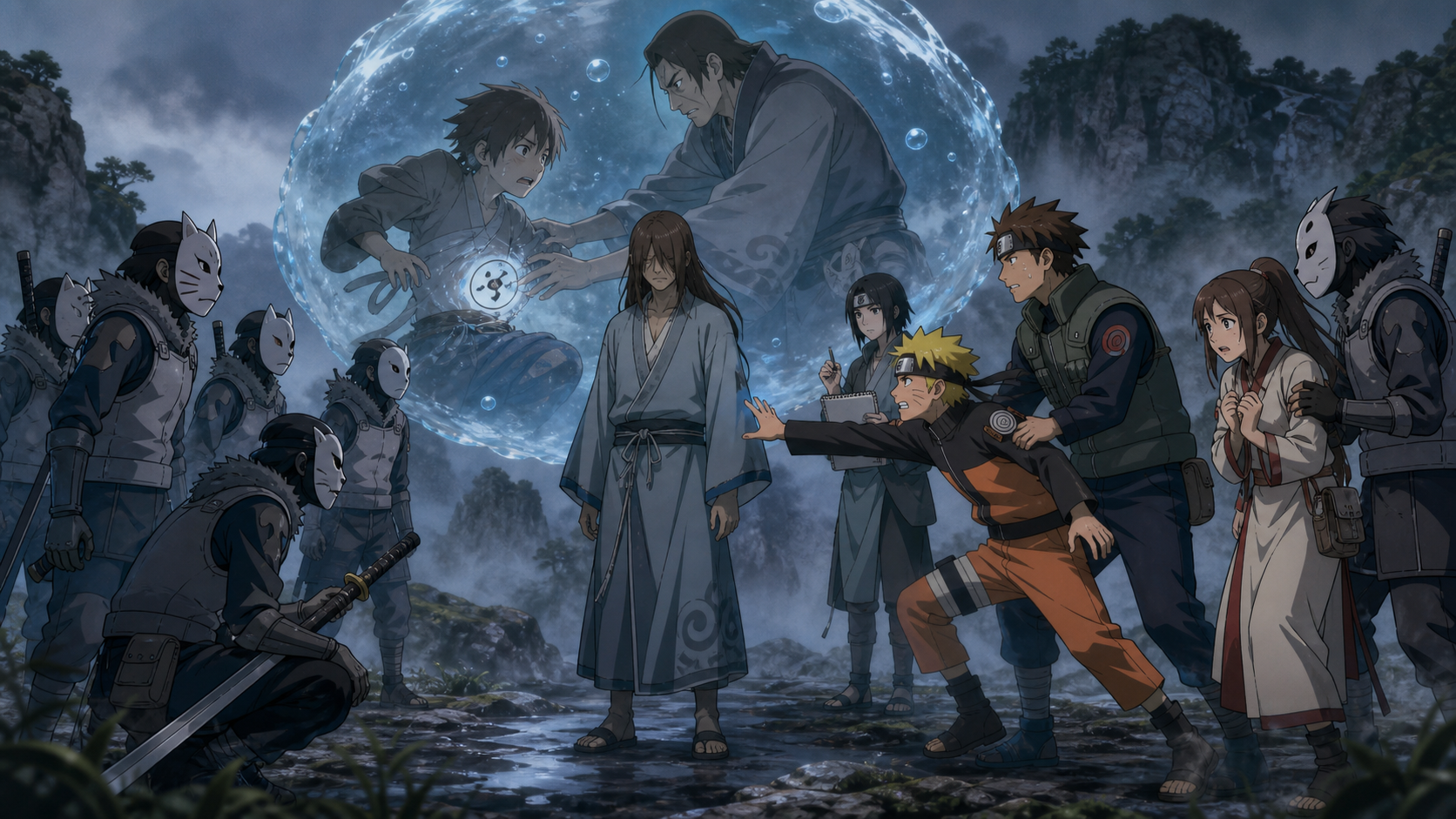
Hidden Mist tracker ninja surround Utakata and demand that the Leaf hand him over in exchange for Hotaru. Yamato and Sai recognize the trackers' role, but Naruto attacks before the situation can be explained.
The confrontation exposes a conflict between village authority and immediate evidence. The Mist identifies Utakata as a wanted rogue. Naruto sees the person who repeatedly protected Hotaru and refuses to treat the label as sufficient proof of guilt.
Utakata's memories return to his own master, Harusame. What Utakata experienced as betrayal involved an attempt to interfere with the power sealed inside him, leaving trauma attached to the title Hotaru keeps asking him to accept.
The Mist demand makes Hotaru leverage in a dispute she does not understand. Naruto, Yamato, and Sai must protect her while determining whether returning Utakata would enforce justice or deliver a hunted person back to the institution he fled.
Naruto attacks the category before the people
Naruto's first response is impulsive. He sees masked trackers enclosing Utakata and Hotaru, hears an exchange demand, and moves before Yamato can establish facts.
That reaction creates risk, but it also comes from a consistent refusal to let institutions reduce people to assigned status. Naruto knows what it is to be treated as dangerous because of the power inside him.
He does not know Utakata's full past. He knows that the wanderer's recent actions have protected Hotaru while the current demand treats her safety as bargaining material.
Naruto's instinct is morally legible even when his timing is tactically poor: a bingo-book entry cannot be the entire person.
Trackers represent a village claim
The Hidden Mist trackers are not ordinary bounty hunters. They act on behalf of a village seeking a missing ninja and the secrets attached to him.
That authority matters because rogue status has consequences in the shinobi system. A ninja carries training, intelligence, techniques, and political knowledge that a village considers its property or security concern.
But institutional authority does not automatically settle whether the institution acted justly. The same system that calls Utakata rogue may have contributed to the circumstances that made escape feel necessary.
Yamato's caution recognizes both sides. The trackers cannot simply be dismissed as villains, and their demand cannot simply be obeyed without context.
Hotaru becomes currency again
The proposed exchange places Hotaru between two claims that are not hers. She is threatened because of the forbidden technique, then held as leverage in the Mist's pursuit of Utakata.
Her value to the people around her keeps being translated into access: access to the jutsu, access to the wanderer, access to compliance.
This is the opposite of the master-student bond she wants. Hotaru wants Utakata to recognize her as a person worthy of guidance. The exchange recognizes her only as something he may surrender himself to recover.
Protecting her requires refusing both forms of reduction.
Harusame's hands carry two meanings
Utakata remembers his master reaching toward the seal and causing intense pain. From inside the experience, the act looked like an attempt to seize or weaponize what was contained in him.
That memory explains why the word “master” feels dangerous. A teacher is supposed to guide and protect, yet Utakata associates the role with physical vulnerability and broken trust.
The episode leaves room for the possibility that Harusame's purpose was more complicated than Utakata understood. Intent, however, does not erase the trauma of the method or the absence of an explanation he could trust.
Hotaru asks Utakata to step into the same role whose failure shaped his wandering. His resistance is no longer emotional distance without cause.
Jinchuriki power sits beneath the dispute
The sealed force in Utakata's memories connects his story to the series' larger treatment of jinchuriki. Villages rely on their power while often denying them control over how that power is managed.
Extraction, sealing, training, and surveillance can all be described as necessary security. To the person undergoing them, those processes may feel like ownership of the body.
Naruto does not yet have every detail about Utakata, but their shared sensitivity to imposed control gives the confrontation another layer.
The Mist wants a missing asset returned. Hotaru wants a master to stay. Utakata wants the freedom to decide what relationships and obligations can reach inside his life.
Yamato and Sai provide necessary restraint
Naruto's empathy keeps him from accepting the exchange, but empathy alone cannot manage a confrontation between villages. Yamato and Sai identify the trackers and slow the escalation enough for negotiation.
Their recognition prevents Naruto's attack from becoming an accidental declaration against legitimate Mist personnel. It also creates space to ask what the trackers know and what they intend to do with Utakata.
This is where the team works well. Naruto sees the human stakes quickly. Yamato sees the diplomatic and operational stakes. Sai observes identity, formation, and information.
None of those perspectives is sufficient alone. Together they keep protection from collapsing into either blind obedience or uncontrolled force.
The past makes Hotaru's wish harder, not smaller
Learning that Utakata was wounded through a master relationship does not make Hotaru's request selfish by definition. It explains why he cannot answer it easily.
If he accepts her, he must believe that teaching can become something other than the control he remembers. If he refuses, he risks repeating abandonment from the opposite position.
Hotaru cannot heal that history simply by trusting him. Utakata cannot protect her fully while pretending the history has no effect on the present.
Their bond needs truth, consent, and time, three things the trackers, attackers, and forbidden jutsu crisis keep denying them.
Naruto reacts to coercion before he understands jurisdiction
The Mist trackers present an exchange: Utakata for Hotaru. Naruto sees a young woman turned into leverage and a protector surrounded by masks. His body answers before diplomacy catches up.
The move is risky, but the moral alarm is correct. A legitimate uniform does not make hostage logic acceptable.
Yamato stops escalation without silencing Naruto’s concern
Leadership requires preventing an impulsive attack from becoming conflict between villages. It also requires preserving the human question that produced the impulse.
Yamato creates time for facts. Restraint works because it is a pause for judgment, not automatic obedience to whoever claims official authority.
The trackers speak for a village that considers Utakata recoverable property
Missing ninja threaten secrets, techniques, and military reputation. Villages describe retrieval as security.
For a jinchuriki, retrieval also means the institution asserting control over a body containing strategic power. The distinction between citizen and asset becomes dangerously thin.
Rogue is a legal status, not a complete moral biography
Utakata left the Mist and appears in its bingo book. Those facts matter. They do not tell us whether leaving followed crime, abuse, political conflict, self-defense, or several causes at once.
A label can identify a dispute without deciding who acted justly inside it.
Hotaru is used to enforce a claim she did not create
She has no authority over Mist law, Utakata’s departure, or the sealed power villages want controlled. The trackers make her safety contingent on his surrender anyway.
That tactic repeats the extraction logic surrounding her inheritance. Her body becomes the pressure point somebody else uses to access a desired person.
Naruto recognizes the violence hidden inside administrative language
He has heard people discuss jinchuriki as weapons, risks, and village property. Official words can make control sound neutral.
Seeing Utakata called rogue while Hotaru is offered in exchange activates knowledge Naruto earned through being categorized before being known.
Harusame’s touch lives in Utakata’s memory as violation
Whatever the master’s full intention, Utakata remembers pain, intrusion, and danger centered on the seal. The body stores the experience before later explanation can revise it.
Trauma does not wait for a historian to determine whether the person causing pain meant well.
Good intention cannot replace informed consent around a sealed body
If Harusame tried to remove or manage the Six-Tails for Utakata’s benefit, the method still needed truthful preparation and agreement wherever possible.
Secret intervention teaches the student that care is another word adults use before taking control.
The master title contains the wound Hotaru cannot see
Hotaru hears teaching, safety, and chosen connection. Utakata hears authority close enough to reach inside him while claiming protection.
Neither meaning is ridiculous. Their relationship cannot advance until the same word stops carrying two hidden histories.
Hotaru cannot heal Utakata by needing him enough
Her trust may show that a different mentorship is possible. It cannot perform the work of processing betrayal for him.
Making a student responsible for proving all future bonds safe places an adult wound on the more vulnerable person.
RaeRae reaction
I understand why Naruto attacks, even though Yamato is right to stop the situation from becoming a village incident. The demand uses Hotaru as currency, and Naruto has never been good at waiting politely while someone is treated like an object.
The important part of Utakata's flashback is not a simple verdict about Harusame. It is that Utakata experienced a trusted teacher reaching toward his sealed power and learned to associate guidance with violation.
That context changes every earlier scene with Hotaru. His refusal to be called master is not proof that he does not care. It may be the boundary he built around the place where care once became pain.
“Rogue Ninja's Past” asks us to hold labels lightly until we understand who applied them and why. Utakata can be a wanted Mist ninja, a traumatized former student, a powerful jinchuriki, and Hotaru's protector at the same time. The episode gets stronger when none of those truths is allowed to erase the others.
Utakata can refuse mentorship and still owe disclosure
He has the right not to accept Hotaru as a student. His wanted status and sealed power now create danger she shares through association.
That shared danger makes some explanation necessary. Privacy cannot be used to remove another person’s ability to consent.
The Mist may have legitimate concerns and still use illegitimate methods
Utakata may possess sensitive knowledge or unresolved responsibility. A village can seek answers without threatening Hotaru as bargaining material.
Ends do not clean the means. Institutional legitimacy should demand higher standards, not excuse lower ones.
Sai’s observation is valuable because the scene punishes instant certainty
Naruto reads the emotional emergency. Yamato reads diplomacy. Sai can watch formation, language, and the gaps between what each side claims.
A team needs multiple ways of knowing when every label arrives attached to an interested institution.
The episode mirrors Hotaru and Utakata through unwanted ownership
Enemies treat Hotaru as access to forbidden power. The Mist treats Utakata as a missing carrier of village power.
Both face organizations that describe control as a right created by lineage, training, or jurisdiction. Their bond forms partly through recognizing that pressure.
Running away can be self-preservation without becoming a complete solution
Leaving may have saved Utakata from a system he experienced as violation. Continued wandering prevents capture.
It also prevents accountability, healing, and stable relationship if flight becomes the only available response to every demand.
Returning him without investigation could repeat the original harm
If the Mist abused his jinchuriki status or misunderstood Harusame’s death, surrender would place him back under the authority he fled.
If he committed serious wrongdoing, ignoring the claim would also fail justice. The answer requires evidence beyond the bingo book.
Naruto’s empathy needs Yamato’s process
Empathy identifies the person hidden by the category. Process tests claims and prevents care from becoming reckless projection.
The team works best when neither dominates. Blind procedure returns bodies to institutions; blind identification can ignore real victims.
Hotaru deserves to stop being the bridge everyone fights across
Her inheritance draws attackers. Her relationship with Utakata draws trackers. Her safety becomes the currency used to settle disputes among adults.
Protection should move her out of the bargaining position and give her direct authority over what happens next.
The exchange demand reveals what the trackers think Hotaru is worth
They value her as pressure capable of moving Utakata into custody. Once he surrenders, her personhood becomes negotiable cargo returned to its side.
A lawful claim pursued through hostage logic announces that the institution values possession more than the standards supposedly distinguishing law from capture.
Naruto distrusts a system that repeatedly calls cages protection
Villages seal Tailed Beasts into children, monitor the children, demand useful service, and describe control as public safety. He knows the vocabulary from inside it.
That history makes his response biased in Utakata’s favor, but bias grounded in lived harm can expose what detached procedure normalizes.
Yamato has to protect Naruto from becoming Tobi’s opposite mistake
Tobi weaponizes selective truth to force a conclusion. Naruto can weaponize selective empathy if he decides shared jinchuriki pain proves Utakata innocent of everything.
Slowing the encounter allows solidarity without abandoning inquiry. Care becomes stronger when it can survive inconvenient evidence.
Harusame’s intention and Utakata’s experience require separate records
A master may have tried to free the student. The student may have experienced the attempt as attack because pain arrived without trustworthy explanation.
Neither account should be erased to simplify the relationship. Repair begins when intention stops demanding authority over impact.
The seal makes bodily autonomy a village security dispute
Utakata cannot decide what happens to his own body without officials interpreting the choice through the Six-Tails. Personal medical or spiritual boundaries become military concerns.
That pressure helps explain why every reach toward the seal can feel larger than one person’s hand.
Hotaru sees mentorship where Utakata remembers extraction
She asks him to come close enough to teach power safely. His memory says closeness gives a trusted authority access to the most vulnerable place.
The relationship cannot move through reassurance alone. Utakata needs evidence that guidance can preserve boundaries rather than override them.
Wanted people still retain the right to protect someone
The bingo book may justify arrest or investigation under Mist law. It does not transform every good act Utakata performs into deception.
Moral judgment must be capable of recording change, contradiction, and action outside the state’s preferred story.
Hotaru needs advocates who do not make her choose sides immediately
Forcing her to declare Utakata innocent or trust the trackers would repeat the pressure adults already place on her inheritance.
She can describe what she witnessed, demand safety, and reserve judgment about history she has not heard.
The scene is about evidence under unequal power
The trackers possess official status and numbers. Utakata possesses feared power and a fugitive label. Hotaru possesses the least institutional authority while bearing the greatest immediate leverage.
A just resolution must begin by removing the threat against the person with the least control over the dispute.
The most honest position in this episode is uncertainty with boundaries. The Leaf does not know enough to declare Utakata innocent. The Mist has not shown enough to make surrender just. Hotaru should not remain hostage while adults debate either claim. Naruto’s instinct and Yamato’s restraint belong together: remove coercion, prevent escalation, gather evidence, and keep the people with the least power from paying for the delay.
I also need fandom to stop treating Harusame’s possible good intention as a magical eraser. If he tried to help, that matters. If Utakata felt invaded, terrified, and betrayed, that matters too. A relationship can break when care arrives through a method the recipient cannot distinguish from control. Teachers carry responsibility for making consent and purpose legible, especially when touching a student’s body or sealed power.
Hotaru walks into this conflict wanting the master title because she associates it with stability. Utakata hears the same title and remembers stability collapsing. Their opposite meanings are not proof they should separate forever. They are proof that affection cannot substitute for a conversation about what teaching will permit, require, and never repeat.
Naruto can help because he knows both sides of mentorship: the hunger to be chosen and the fear of being valued mainly for power. His best contribution is not deciding who Utakata is. It is insisting that no village, master, tracker, or successor gets to bypass the humanity of the person carrying a Tailed Beast. That principle protects Utakata, Hotaru, and any possible victim whose story the bingo book cannot tell.
The word rogue describes Utakata’s relationship to the Mist, not his complete relationship to morality. The word tracker describes official work, not automatic righteousness. The word successor describes Hotaru’s inheritance, not consent to be traded. Every label is useful and dangerously incomplete. This episode succeeds when it makes us ask what each category reveals, what it conceals, and who gains power when everybody stops asking after the first official answer arrives too soon again.
RaeRae’s final word on the rogue ninja’s past
I understand Naruto swinging first because the demand is ugly. The Mist cannot place Hotaru in danger, offer her back for a body it wants, and expect the village uniform to make the exchange righteous.
I also understand Yamato stopping him. Utakata’s past may contain harm the Leaf does not know, and empathy cannot become permission to erase possible victims.
The flashback explains why master feels like a threat. Harusame reached toward the seal, pain followed, and Utakata learned that guidance could hide bodily control. Later context may complicate intention, but it cannot make the remembered terror fake.
The episode earns its ambiguity by refusing easy categories. Utakata is wanted and protective. Naruto is impulsive and morally alert. The trackers may hold a legitimate assignment while using coercive tactics. Hotaru needs everybody to stop turning those contradictions into a reason she becomes currency.
RaeRae’s call
A bingo-book label justifies questions, not surrender without evidence. Naruto is right to reject Hotaru as currency, and Yamato is right to demand enough context to protect every person involved.