
The Successor’s Wish
Hotaru’s village cannot keep danger out, and the wanderer who returns to protect her carries a wanted history she has never been told.
What happens
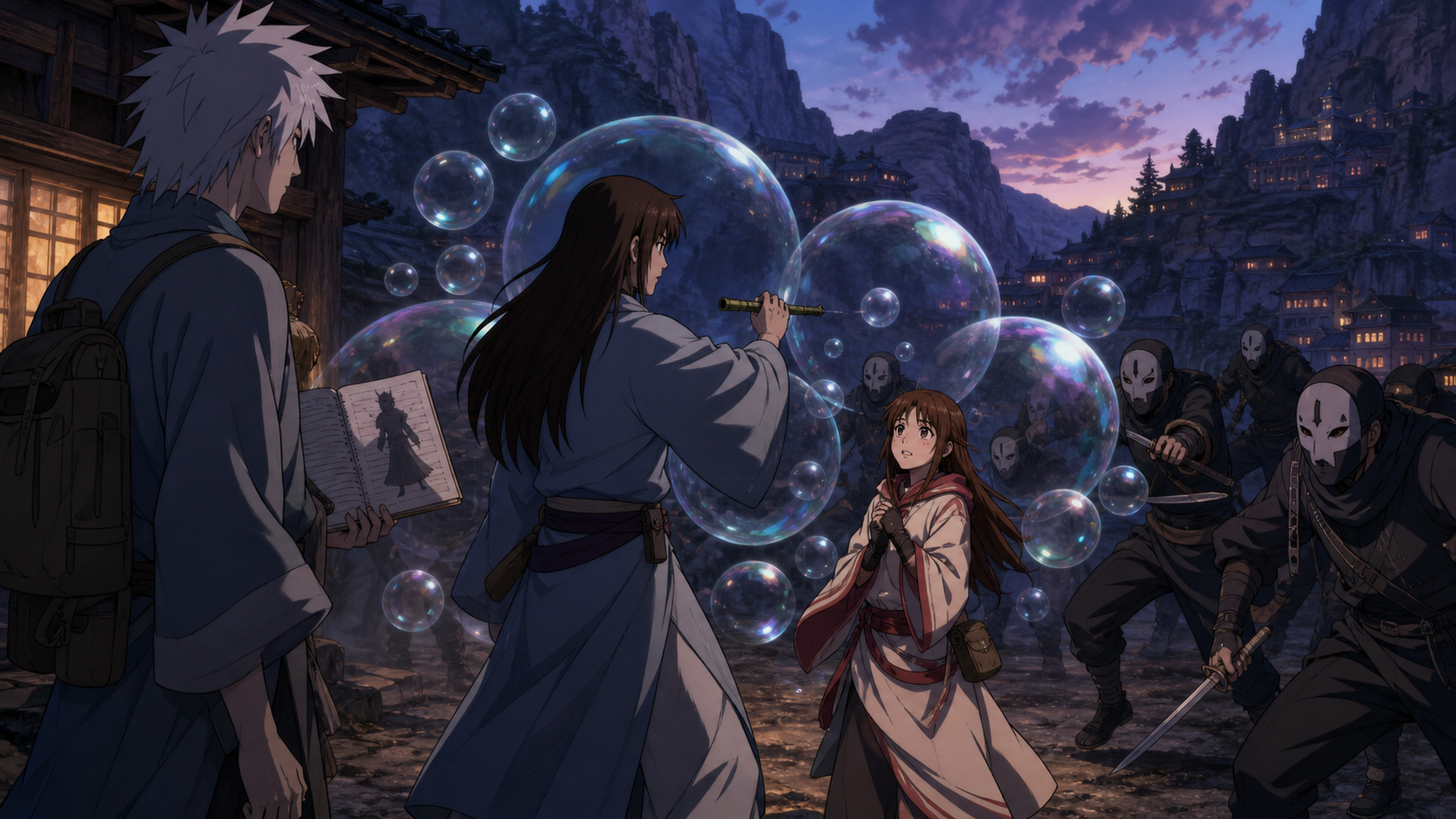
Hotaru reaches the Tsuchigumo village and parts from Naruto's team, but the destination does not provide the security the escort expected. The Magaki Troops have already moved ahead of the Leaf ninja and pressure her to surrender the forbidden jutsu.
The villagers' distance leaves Hotaru exposed. Her status as En no Gyoja's successor makes her important to outsiders seeking power while complicating her place among the people who should recognize her clan connection.
Utakata returns when the threat becomes immediate. His bubbles stop the attackers and confirm that, despite rejecting the role of master, he continues to respond when Hotaru is endangered.
Shiranami sees Utakata and recognizes him from the Hidden Mist's bingo book. The protective wanderer Hotaru trusts is also a wanted rogue ninja, turning her wish for him to remain into a question with consequences beyond this village.
Arrival does not equal safety
The Leaf team's assignment had a clear route: bring Hotaru to the Tsuchigumo village. Completing that route creates the appearance of mission success.
The Magaki Troops expose the weakness in that definition. A destination is only safe if the people, defenses, and information around it can actually protect the person delivered there.
Hotaru's vulnerability is social as well as tactical. She returns carrying a legacy that makes others cautious, resentful, or interested in what can be taken from her.
The episode challenges the comforting idea that inherited community automatically becomes belonging.
The successor is treated as access
The Magaki Troops do not approach Hotaru as a person with a claim to her own future. They see a route to the forbidden jutsu.
That logic resembles the way organizations approach jinchuriki: identity is reduced to the power someone contains or can unlock. Hotaru's fear, preferences, and understanding become secondary to extraction.
Her title as successor should imply authority, but in practice it attracts people who want to override that authority. The more valuable the inheritance, the less freedom others allow her around it.
Protecting Hotaru therefore requires defending her right to decide what succession means, not merely preventing one theft.
Utakata returns through action
Utakata's reappearance resolves one question while deepening another. He may refuse the emotional language Hotaru uses, but he does not remain absent when she is threatened.
The bubble barrier makes his position visible. He places himself between Hotaru and the people treating her as an object.
That choice is protective, yet it does not automatically make him ready to teach. Rescue can come from instinct, debt, affection, or refusal to witness harm without becoming a promise about the future.
Hotaru understandably reads the return as evidence that the bond she names is real. Utakata still has to decide whether he can accept what the bond asks of him.
The bingo book changes the meaning of wandering
Before Shiranami's recognition, Utakata's wandering can be read as temperament: a private person avoiding commitment. The Hidden Mist bounty adds institutional pursuit.
A rogue ninja does not simply travel freely. He exists outside the authority of a village that records him as dangerous, missing, or valuable enough to hunt.
The label creates questions the episode deliberately leaves open. What happened between Utakata and the Hidden Mist? Did he betray a duty, escape abuse, resist control, or carry power the village wants returned?
The bingo book offers a status, not a complete history. Shiranami's recognition gives the audience information without yet giving judgment enough context.
Hotaru's wish is specific
Hotaru does not only want Utakata nearby. She wants him to accept her as a student and remain long enough to teach her.
That wish contains a need for structure. The forbidden jutsu makes her dangerous to enemies and uncertain to her community. A master could help her turn inheritance into controlled knowledge rather than fear.
Utakata's skill and outsider status make him appealing because he does not initially define her through the clan's expectations. He sees immediate danger and responds to it.
The risk is that Hotaru may place all hope for belonging in someone whose own life is organized around leaving.
Shiranami occupies the position of informed observer
Shiranami knows enough to recognize Utakata, which gives him authority in the scene. Other characters must decide what to do with information he supplies.
Recognition can be useful, but it can also direct suspicion. A face in a bingo book invites people to treat the listed person as a category before hearing his account.
The episode has already shown how inherited labels distort Hotaru's life. Utakata now faces a parallel reduction: the person protecting her is translated into “wanted rogue.”
Both characters need others to look beyond the status attached to them without ignoring the real danger those statuses may represent.
Naruto's mission expands after completion
Naruto's team could argue that their escort ended when Hotaru entered the village. The attack proves that responsibility cannot always be contained by the original wording of an assignment.
Naruto is especially unlikely to accept a technical completion while the person he escorted remains endangered. His ethics consistently prioritize the human purpose of a mission over its narrow procedural boundary.
Utakata's return also gives Naruto a new point of contact with Hotaru's story. He can see why she trusts the wanderer while learning that the man carries a conflict with another village.
The problem is no longer only “deliver the successor.” It is understand who is hunting her, what she carries, and which protector can be trusted under pressure.
The village exposes the limits of map-based protection
Naruto’s team reaches the destination, transfers responsibility, and could reasonably believe the escort succeeded. The attack proves a safe dot on a mission map can conceal hostile social conditions.
Protection must ask who controls the space, what information residents possess, and whether the person delivered there is accepted. Geography alone cannot answer any of that.
Hotaru belongs by blood and remains isolated in practice
Her clan connection should make the village home. The forbidden inheritance makes neighbors read her through risk, history, and obligation before relationship.
Conditional belonging tells a person they are welcome only while the dangerous part of their identity stays hidden, controlled, or useful elsewhere.
The Magaki Troops exploit a community already keeping distance
Attackers do not create Hotaru’s isolation. They use it. A successor without strong communal bonds is easier to corner, threaten, and remove.
Security is relational. Neighbors who know, trust, and defend one another create resistance no wall can replace.
Utakata’s return makes his care undeniable
He could keep moving and preserve the detached identity he claims. Instead, he places his body and technique between Hotaru and armed pursuers.
The act does not force him to accept the master title. It does mean he has chosen the responsibilities of care again.
Rescue answers danger without answering the future
Hotaru can survive this encounter and still remain uncertain whether Utakata will teach her, explain his past, or stay after the attackers leave.
Crisis makes connection visible but postpones negotiation. The relationship needs language when nobody is throwing a weapon.
The bingo book provides a verdict before a history
It says Utakata is a missing ninja wanted by the Hidden Mist. The listing cannot explain what conditions produced his departure, whose authority he resisted, or which accusations remain self-serving.
Official classification is evidence. It is not a substitute for context.
Shiranami’s recognition gives him power over the room
He knows a fact others do not, and speaking it changes how every person interprets the protector in front of them.
Information becomes social force. A careful listener should ask why this fact is offered now and what action the speaker hopes it will trigger.
Wanted status and protective action can both be true
Utakata may have harmed someone, violated village law, escaped abuse, or carried power officials wanted returned. The episode has not yet shown enough to choose.
What we do know is that he protects Hotaru here. One observed act cannot erase unknown history, and an unknown history cannot erase the observed act.
Hotaru’s wish becomes vulnerable to institutional pursuit
She wants a master who will remain. Learning that a village may hunt him makes departure feel less like personal rejection and more like a danger following him.
The new context complicates her request without making it disappear. She may want honesty even more once she knows silence can conceal threats affecting both of them.
Utakata may believe distance protects Hotaru from his status
If association with a wanted Mist ninja attracts hunters, refusing the bond can look like sacrifice. Leaving might reduce one category of danger.
Without explanation, Hotaru experiences only abandonment and continues seeking him. Secret protection can reproduce the risk it intends to prevent.
RaeRae reaction
I like that the village arrival fails almost immediately. It prevents the story from pretending a clan name is enough to create community or that escorting someone to a marked location completes protection.
Utakata's bubbles answer Hotaru's emotional question without fully answering her request. He comes back. He chooses her safety. Those actions matter, even if they do not yet mean he can accept being her master.
The bingo-book reveal is effective because it does not erase what we just saw. Utakata is wanted by the Hidden Mist, and he is also the person standing between Hotaru and armed attackers.
“The Successor's Wish” works because Hotaru wants more than rescue. She wants guidance, recognition, and someone who will stay. The episode gives her proof of care and a new reason to fear that the person she chose may be taken away.
Hotaru wants instruction because power without guidance is terror
She inherits something enemies desire and her village fears. A master could help her understand technique, restraint, and the decisions earlier generations made.
Her request is not simply emotional dependency. It is a rational demand for education around a burden everyone expects her to carry.
The village owes education as part of belonging
If residents expect Hotaru to preserve En no Gyoja’s restraint, they must give her history, care, and practical support. Outsourcing every difficult question to Utakata leaves both successor and wanderer unsupported.
Community cannot claim the legacy while treating its living carrier as somebody else’s problem.
Naruto recognizes the difference between law and moral truth
He has seen village authorities classify people through jinchuriki status, clan fear, and missing-nin labels. He knows an official record can contain facts while omitting the conditions that make those facts meaningful.
That experience should keep him curious about Utakata without dismissing the warning entirely.
Bubble defense answers violence without copying its texture
The attackers arrive with pressure and capture. Utakata responds through floating barriers and controlled bursts that redirect space.
His technique refuses the idea that protection must resemble domination. Gentleness of appearance can carry serious tactical authority.
The successor and wanderer mirror each other’s labels
Hotaru is defined by a role inherited from clan history. Utakata is defined by a status imposed through village history.
Both need people willing to examine the person beyond the category. Neither can safely pretend the category has no real consequences.
Trust requires disclosure proportional to shared danger
Utakata does not owe Hotaru every private wound immediately. If his wanted status places her at risk, she deserves enough information to make choices about traveling with him.
Privacy protects dignity. Withholding material danger removes consent.
Hotaru should not have to earn protection by proving usefulness
The treaty, forbidden technique, and lineage explain why powerful groups notice her. They should not be the reason her life deserves defense.
Konoha’s obligation begins with an agreement, but the human ethic is simpler: armed people are trying to take a young woman who has the right to remain free.
Naruto’s mission expands because the original definition was inadequate
Delivering Hotaru did not secure her. Protecting her now requires understanding the attackers, the village’s distance, Utakata’s history, and the inheritance everyone is circling.
Good duty responds to evidence instead of hiding behind completed paperwork.
The wish is for stability, not ownership of Utakata
Hotaru wants somebody skilled and trusted to remain while she learns to carry a dangerous future. That need can be met through an honest teaching relationship or a broader network of care.
Respecting Utakata’s autonomy should not require mocking the stability she lacks.
The village treats inherited danger as Hotaru’s personality
Residents respond to the forbidden technique as though she chose the history attached to it. Fear of what might happen becomes distance from the person carrying the possibility.
That substitution is convenient. The community can avoid examining its obligations by making Hotaru herself the uncomfortable thing.
Isolation makes extraction easier and then gets blamed on the victim
The Magaki Troops find a successor without a strong circle ready to defend her. The village’s caution becomes part of the attackers’ opportunity.
If Hotaru is captured, people may say the legacy attracted inevitable danger. They should also ask what communal neglect made the approach possible.
Utakata’s wanted status may explain his fear of titles
A formal master-student bond creates a traceable relationship and a lever hunters can use. Refusing the title may be an attempt to keep Hotaru outside his conflict with the Mist.
The strategy fails when his repeated returns make the bond visible anyway. Secrecy cannot protect what behavior continually reveals.
Hotaru needs the difference between danger and guilt explained
Association with Utakata may expose her to pursuit. That does not make her responsible for the village that hunts him or for choices he made before they met.
Young people often absorb adult danger as personal blame when nobody provides clear language. Honest explanation prevents that burden from hardening.
Shiranami should be judged by what he does with recognition
Knowing the bingo-book entry is not suspicious by itself. The next action reveals whether information serves protection, curiosity, fear, or manipulation.
People who possess a relevant fact gain responsibility to present its limits. “Wanted” should begin investigation, not end it.
Naruto can recognize Utakata without idealizing him
Both are jinchuriki shaped by villages, pursuit, and adults deciding what their bodies mean. Shared experience may create empathy.
Empathy does not require assuming Utakata handled every relationship well. Naruto can defend him from dehumanization while still asking what Hotaru deserves.
The episode asks whether returning counts as staying
Utakata comes back whenever danger peaks. Hotaru needs continuity between emergencies, when training, trust, and explanation can happen.
Heroic return is emotionally powerful. Reliable presence is quieter and may demand more courage from someone organized around flight.
Hotaru’s wish cannot be solved by rescue alone
Defeating the Magaki Troops addresses the immediate threat. It does not give her a teacher, communal belonging, or authority over the inherited technique.
The story must resist treating survival as the finish line when the conditions producing vulnerability remain intact.
The contradiction I keep circling is that Utakata protects Hotaru best when danger is visible and communicates worst when danger becomes relational. Armed attackers give him a clear position: stand between them and her. A request for mentorship asks him to explain history, limits, fear, and future intention. Bubbles can solve the first problem. No technique can solve the second without vulnerability.
Hotaru is not wrong for reading return as evidence. People teach us what to expect through repetition. If someone repeatedly appears at the moment we most need them, hope will build around that pattern even when they refuse the official name. Utakata does not owe her permanent access to his life, but he does owe honesty about whether the pattern can continue.
The bingo book makes that honesty urgent because private history has become shared risk. Hotaru cannot consent to travel beside a wanted shinobi if she does not know pursuit may follow. Utakata can preserve details that are not hers to claim while still telling enough truth for her choices to be real.
And the village does not get to escape responsibility by pointing at him. Hotaru’s neighbors should provide belonging, education, and collective protection whether or not the wanderer remains. Making one damaged outsider the entire support system lets the clan keep its legacy without caring for the successor carrying it. Her wish is personal, but the conditions making it desperate are communal.
That is why the title belongs to Hotaru rather than the technique. Her wish is not to become powerful. She wants guidance and recognition to stop feeling like the dangerous inheritance arrived before the person. The adults around her can honor that wish without forcing Utakata into a role: build a circle of teachers, let her question decisions, explain the risks, defend her from extraction, and treat her future as something she authors. If Utakata chooses to join that circle, his presence becomes relationship instead of rescue under silence.
RaeRae’s final word on the successor’s wish
The village failing Hotaru immediately is the right ugly choice for this story. It proves belonging written in lineage means nothing when neighbors refuse the living person standing before them.
Utakata’s return is care, full stop. It is not automatic consent to become her master, but he cannot keep pretending his repeated protection creates no relationship and no need for explanation.
The bingo-book reveal should make us cautious, not obedient. A wanted label matters. So does the fact that official villages repeatedly classify valuable or resistant bodies in ways serving institutional control.
Hotaru’s wish deserves an answer large enough for both people. She needs guidance and truthful safety. Utakata needs autonomy and a chance to tell his own history. Neither need is honored by another unexplained disappearance.
RaeRae’s call
Utakata’s return proves the care Hotaru names is real, while the bingo book proves his silence affects her safety. He can refuse the master title, but shared danger makes honest explanation part of protection.