
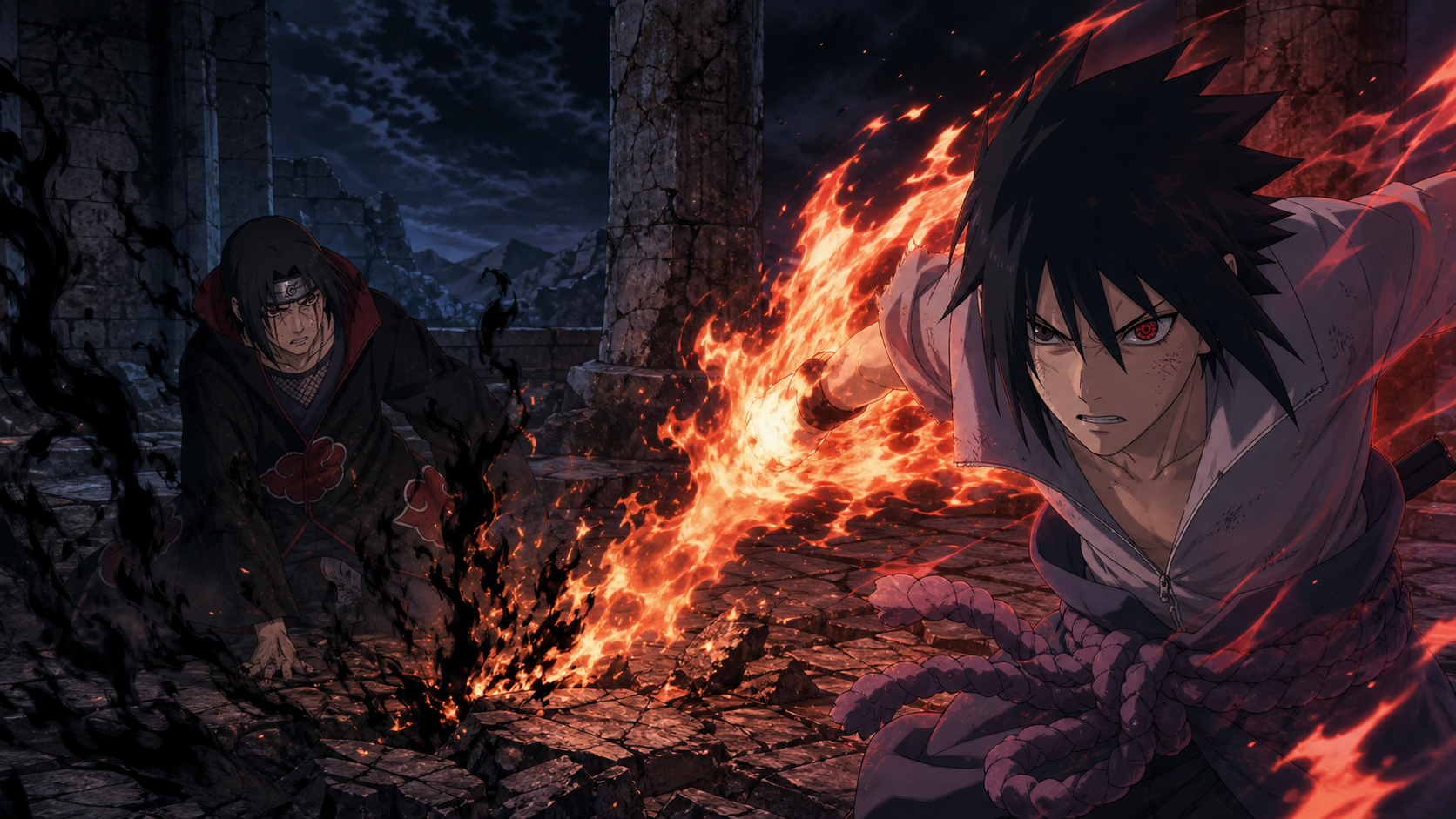
Amaterasu!
Sasuke tears through Tsukuyomi and turns the duel physical, but Itachi’s failing eye still holds a black flame beyond ordinary Fire Style.
What happens
Sasuke appears to lose his left eye to Itachi, but the injury exists inside Tsukuyomi. He recognizes the illusion and forces his way free, turning what looked like Itachi's victory into proof that Sasuke can now resist one of his brother's most feared techniques.
The confrontation shifts from genjutsu to direct ninjutsu. Both brothers use Fire Style, testing power, timing, and remaining chakra while Zetsu watches from outside the fight and comments on Sasuke's growth.
Sasuke drives Itachi backward and takes advantage of his worsening condition. Itachi is coughing blood, his vision is failing, and the strain of maintaining the Sharingan has become visible.
When ordinary flame is no longer enough, Itachi prepares Amaterasu. The episode closes around the threat of black fire and the knowledge that the brothers are spending resources neither can easily recover.
Escaping Tsukuyomi changes the relationship
Sasuke has lived for years beneath the memory of Itachi's illusion. Tsukuyomi was not merely an attack; it was the mechanism through which Itachi repeatedly fixed the massacre inside his younger brother's mind.
Breaking it now is therefore larger than a technical counter. Sasuke proves that the sensory world Itachi creates is no longer absolute. He can recognize the prison, locate its structure, and force an exit.
That does not heal what the earlier illusions did to him. It does, however, change the balance inside this room. Itachi can still manipulate perception, but he cannot assume Sasuke will remain a passive witness.
Sasuke's comeback begins with this refusal. Before he attacks Itachi's body, he takes back authority over what he believes has happened to his own.
The fight becomes physically honest
Once the illusion breaks, the brothers move into fire techniques and weapons. The battle is still strategic, but its consequences are easier to read: walls crack, flames spread, bodies tire, and chakra diminishes.
That material clarity feels almost relieving after the layered genjutsu. A fireball can be countered by another fireball. Position and timing become visible problems rather than uncertain images.
Yet physical combat is not truly separate from the psychological battle. Sasuke's aggression is powered by the truth he wants, while Itachi's choices continue to shape what Sasuke expects from each exchange.
The duel has become more honest in form, not necessarily in meaning. Itachi still knows more about his own condition and intentions than either Sasuke or the audience.
Itachi's body interrupts the legend
For much of Sasuke's life, Itachi has existed as an almost abstract standard of power. He was the prodigy who destroyed the clan, defeated Sasuke effortlessly, and appeared to control every encounter.
This episode makes his body impossible to ignore. His coughing, blood, strained eye, and uneven movement expose limits that the legend concealed.
Sasuke notices and presses forward. That is tactically sensible, but it also forces him to confront a destabilizing possibility: the brother he built his entire purpose around may be mortal, weakened, and running out of time.
Itachi's vulnerability does not make him safe. It makes the remaining techniques more dangerous because each one may be chosen as a final expenditure.
Zetsu gives the duel an audience
Zetsu's commentary creates a perspective outside the brothers' private history. He evaluates techniques, recognizes Sasuke's progress, and notices changes the combatants cannot stop to explain.
His presence also reminds us that the battle is not sealed away from the larger world. Akatsuki has interests here, and information about the outcome will travel.
The brothers may experience the fight as the conclusion of a family tragedy, but other people see assets, abilities, and strategic consequences. The Sharingan is personal inheritance and coveted power at the same time.
That outside gaze makes the duel feel less private precisely when its emotions become most intimate.
Fire answers fire until it cannot
The Fire Style exchange suits the Uchiha confrontation because it uses a shared clan language. Sasuke and Itachi draw from related training, yet their choices reveal different conditions.
Sasuke uses pressure and momentum, forcing Itachi to respond while conserving a larger plan. Itachi answers with experience, but his body makes every sustained technique more expensive.
Ordinary flame still allows comparison: whose attack is larger, whose position is stronger, whose chakra will last. Amaterasu breaks that scale. Its black fire is introduced as something beyond the familiar rules of heat and extinguishing.
The transition announces that the brothers are leaving measured exchange behind. Once Itachi opens that eye, survival will depend on more than winning the previous contest.
Amaterasu is a desperate escalation
The episode title names Itachi's next technique before he fully unleashes it, allowing anticipation to shape every preceding moment. We know the fight is moving toward a form of fire Sasuke has not yet faced.
That anticipation changes how Itachi's weakness reads. His failing sight is not evidence that the danger has passed; it is the cost of accessing something more severe.
Amaterasu also continues the episode's concern with vision. The black flame is directed through the eye, joining perception and destruction in a single act. To look is to target, and to target is to pay with sight.
Itachi's power remains frightening because it consumes him while threatening Sasuke. The weapon and its consequence arrive together.
Sasuke does not simply resist Tsukuyomi, he embarrasses its certainty
Itachi built years of authority around the idea that his gaze decides what Sasuke experiences. The false eye removal should have ended the argument before the physical fight resumed. Sasuke recognizing the trap means the younger brother can now inspect the story while standing inside it.
That is why Zetsu’s surprise matters. He does not praise stubbornness. He recognizes technical comprehension, chakra control, and the maturity required to challenge a technique that once shattered Sasuke psychologically.
Orochimaru’s training helped without owning the victory
Sasuke gained strength during ugly years under an abusive teacher who wanted his body. The series should never make us pretend that exploitation becomes noble because the victim learned useful skills.
Sasuke uses what he survived. He does not owe Orochimaru moral credit for every ability developed while resisting possession. A survivor can reclaim knowledge from a harmful place without rewriting the harm as mentorship.
The brothers speak Uchiha through fire
Fire Style is clan language before it is spectacle. Fugaku measured young Sasuke through the Great Fireball Technique, and Sasuke spent childhood chasing the standard Itachi seemed to embody effortlessly.
Now their flames meet without a father deciding whose performance counts. Sasuke forces Itachi upward, expands the attack, and makes the prodigy answer him as an equal combatant. The visual competition carries every old comparison into the sky.
Itachi’s illness changes tactics, not accountability
Watching him cough blood complicates the monster Sasuke expects. It does not erase the choices that placed Sasuke in this room. Illness explains why Itachi’s movements and chakra fail. It does not demand that Sasuke stop defending himself against a brother still trying to control the encounter.
Compassion and accountability can occupy the same scene. Naruto is strongest when it lets both remain uncomfortable.
Amaterasu makes vision an act of violence
Most fighters look in order to understand danger. Itachi looks and produces danger at the point of focus. The eye becomes weapon, targeting system, and payment method at once.
The black fire does not behave like the clan flame Sasuke learned. It consumes the object of sight and resists ordinary extinction. Familiar inheritance mutates into a power that threatens its own bloodline.
Black flame turns pursuit into a horror sequence
Sasuke’s speed initially feels like an answer. Then the flame follows where Itachi aims, converting open ground into a narrowing corridor. Running no longer creates safety because being seen keeps relocating the attack.
The sequence works because Amaterasu is not merely bigger fire. It changes the rule governing distance. Sasuke must break Itachi’s visual lock, create misdirection, and sacrifice part of his Curse Mark transformation to survive.
Sasuke’s substitution is intelligence under unbearable pressure
Shedding the burning wing is not a glamorous counter. It is fast, costly problem solving. Sasuke recognizes that preserving every piece of his transformed body would get the entire body consumed.
That choice separates him from Itachi’s family mythology. The older story treats bodies as resources for power. Sasuke gives up power to keep ownership of his life.
Zetsu knows techniques but not the brothers
His commentary helps the audience read mechanics, yet his amazement also exposes the limit of an observer who treats the duel like a field report. He can identify Tsukuyomi, Fire Style, and Amaterasu. He cannot fully measure what breaking those techniques means to the child Itachi traumatized.
Technical knowledge remains useful, but emotional context decides why each reversal lands.
RaeRae reaction
I like that Sasuke's most important victory here happens before the largest flames. Breaking Tsukuyomi answers years of humiliation in a way that brute force could not. He proves that Itachi cannot simply define reality for him anymore.
The shift into Fire Style gives the episode a clean rhythm after the deliberately unstable genjutsu. We can finally measure distance and damage, which makes Itachi's physical decline land harder.
Zetsu's commentary is useful without stealing the scene. His surprise confirms that Sasuke's growth is real, while his detached interest reminds us how many outside forces have treated the Uchiha tragedy as a source of useful power.
By the time Amaterasu approaches, the episode has turned Itachi's weakness into suspense. He looks closer to collapse, but that only raises the question of what he is willing to spend before he falls. Sasuke has escaped the illusion. Now he has to survive the eye that sets the world itself on fire.
Amaterasu reveals the price hidden inside legendary power
Itachi’s bleeding eye refuses the easy fantasy that elite techniques are free rewards for exceptional people. Every use costs vision, chakra, and bodily stability. Power does not lift him above consequence. It accelerates consequence.
Sasuke sees the damage and still cannot relax, because a collapsing opponent may spend everything on one last attack. Weakness and danger grow together.
The Curse Mark remains both tool and evidence
Sasuke’s wings give him movement and a means of escape, but they also display Orochimaru’s mark on the fight. He arrives to settle Uchiha history carrying another predator’s alteration in his flesh.
Using that power does not mean the predator won. Sasuke bends an imposed transformation toward his own survival, then discards a burning portion rather than worshiping the power as sacred.
Itachi extinguishing the flames preserves the question of motive
He can stop Amaterasu after it catches Sasuke, which means the technique is not simply an uncontrolled disaster. That control makes every choice around it more revealing.
Does he want Sasuke dead, tested, exhausted, or positioned for the next stage? The episode keeps intention unstable while making physical danger undeniable. Sasuke cannot risk trusting a hidden mercy.
Survival is not proof that the test was loving
Fans sometimes use Sasuke’s growth as evidence that Itachi’s cruelty worked. That argument gives the abuser ownership of the survivor’s strength. Sasuke grew because he fought, studied, adapted, and kept living through conditions he did not choose.
An ordeal producing competence does not make the ordeal ethically necessary. Results cannot retroactively grant consent.
The duel is consuming every inheritance at once
Clan fire, Sharingan perception, Mangekyo techniques, Curse Mark power, childhood memory, and political secrecy all enter the same ruined space. Nothing arrives untouched by an adult agenda.
Sasuke’s task is not to become pure. Purity is impossible after this history. His task is to decide which inherited tools serve his life and which inherited stories demand that he surrender it.
Itachi’s legend collapses into a sick young man with terrible power
The image is deliberately difficult. He is not the untouchable prodigy from Sasuke’s childhood, but he is not harmless. Blood runs down his face while black fire tears across the battlefield.
The contradiction makes him more human without making him innocent. Human beings, especially desperate ones serving violent systems, can cause devastation while believing they are containing something worse.
Sasuke has earned the right to be angry at every version of Itachi
He can hate the apparent murderer, later grieve the compromised brother, and still condemn the person who tortured and manipulated him. New information may expand judgment, but it does not cancel earlier injury.
Fandom does Sasuke no favor when it treats understanding Itachi as a command to stop understanding the child who paid the bill.
The black flame is the perfect symbol for a controlled truth
Amaterasu begins exactly where Itachi directs his eye. It spreads, consumes, and becomes difficult to stop once released. The truth of the massacre will work similarly when it finally reaches Sasuke through another manipulator.
Information can illuminate. Delivered as a weapon at the chosen moment, it can also burn through every structure a person used to survive.
Sasuke makes observation look more powerful than spectacle
The loudest attack belongs to Itachi, but the episode keeps rewarding Sasuke for noticing details. He reads the illusion, tracks the blood, measures the weakened body, and responds to the black flame’s actual behavior instead of freezing before its reputation. That discipline matters because Sasuke has every emotional reason to rush. He waited years for this room. Revenge could make him careless, yet he keeps separating anger from impulse.
People love calling him consumed by hatred as though hatred switched off his brain. This fight shows the opposite. His anger supplies purpose, while his analysis keeps him alive. The combination is dangerous, but it is not mindless.
Itachi’s gaze recreates the childhood power imbalance
Sasuke once stood helpless while his brother controlled what he saw. Amaterasu translates that same imbalance into physical space: wherever Itachi focuses becomes unsafe. The younger brother must move according to the older brother’s vision again.
The difference is that Sasuke now understands movement as a counterargument. He does not plead for the gaze to soften. He studies its limits and refuses to stay where Itachi expects. Agency appears through a string of imperfect escapes, not one magical declaration of freedom.
Power that burns until its target disappears is a moral nightmare
Amaterasu carries the fantasy of an attack that finishes what its user selects. That sounds efficient only if we ignore the question of selection. Who deserves to become a target? Who gets to decide when nothing should remain? The technique gives one person’s sight enormous authority over another person’s continued existence.
That logic echoes the massacre hanging over the fight. Officials selected a clan as danger, Itachi carried out the solution, and Sasuke remained as the exception somebody chose to spare. A power defined by inextinguishable targeting belongs in this story because the politics already worked that way.
Being spared can become another form of control
If Itachi deliberately manages the flames to keep Sasuke alive, survival still comes on Itachi’s terms. Sasuke receives no explanation, no ability to refuse the test, and no protection from the terror required to complete it. Mercy without honesty can preserve a body while colonizing the future.
This is the trap inside Itachi’s plan. He may want Sasuke strong and alive, but he defines strength through suffering and engineers the suffering himself. The result cannot be called freedom simply because death was never the intended ending.
The episode refuses to let brotherhood feel naturally safe
Everything shared between them has become weaponized: eyes, fire training, clan stories, memories, and even concern. That does not mean affection never existed. It means the institutions surrounding the brothers taught Itachi to express protection through secrecy, pain, and control.
Sasuke is fighting the person in front of him and that entire definition of brotherhood. His resistance asks whether family can mean anything beyond inheritance, sacrifice, and ownership. The answer will not arrive with the final flame, because killing Itachi cannot automatically teach Sasuke a healthier language for love.
Sasuke proves that spectacle does not own the center of a battle. Amaterasu is unforgettable, but the episode’s pulse comes from a brother recognizing that the terror used to define him has limits. He can be frightened and observant together. He can lose a wing without losing command of himself. That distinction matters because survival stories often get cleaned into triumph. Nothing here is clean. Sasuke escapes by calculating what he can afford to sacrifice, while Itachi keeps spending a body near collapse. The black flame looks supernatural. The real horror is how familiar both brothers have become with paying for other people’s plans.
RaeRae’s final word on Amaterasu
I came for black fire and stayed for the way this episode tears authority away from Itachi one layer at a time. Sasuke breaks the illusion, wins the ordinary flame contest, and keeps thinking when the supernatural answer arrives. He is not lucky cargo moving through Itachi’s plan. He is a tactician making decisions under pressure.
Itachi remains terrifying because his failing body does not reduce the precision of his choices. Every bloody blink says the end is near, while every targeted flame proves he can still dictate the cost of reaching it.
The episode refuses a clean victory. Sasuke survives Amaterasu by losing part of the power he brought with him. Itachi unleashes the named technique and damages himself to do it. Their inheritance offers no triumph without extraction.
That is the point I cannot let fandom polish away. Love, illness, duty, and hidden sacrifice may complicate Itachi. None of them turns Sasuke into acceptable collateral. The younger brother’s intelligence and survival belong to him.
RaeRae’s call
Sasuke breaking Tsukuyomi is the episode’s deepest win. Amaterasu raises the danger, but his refusal to let Itachi define reality is the fire that actually changes their relationship.