
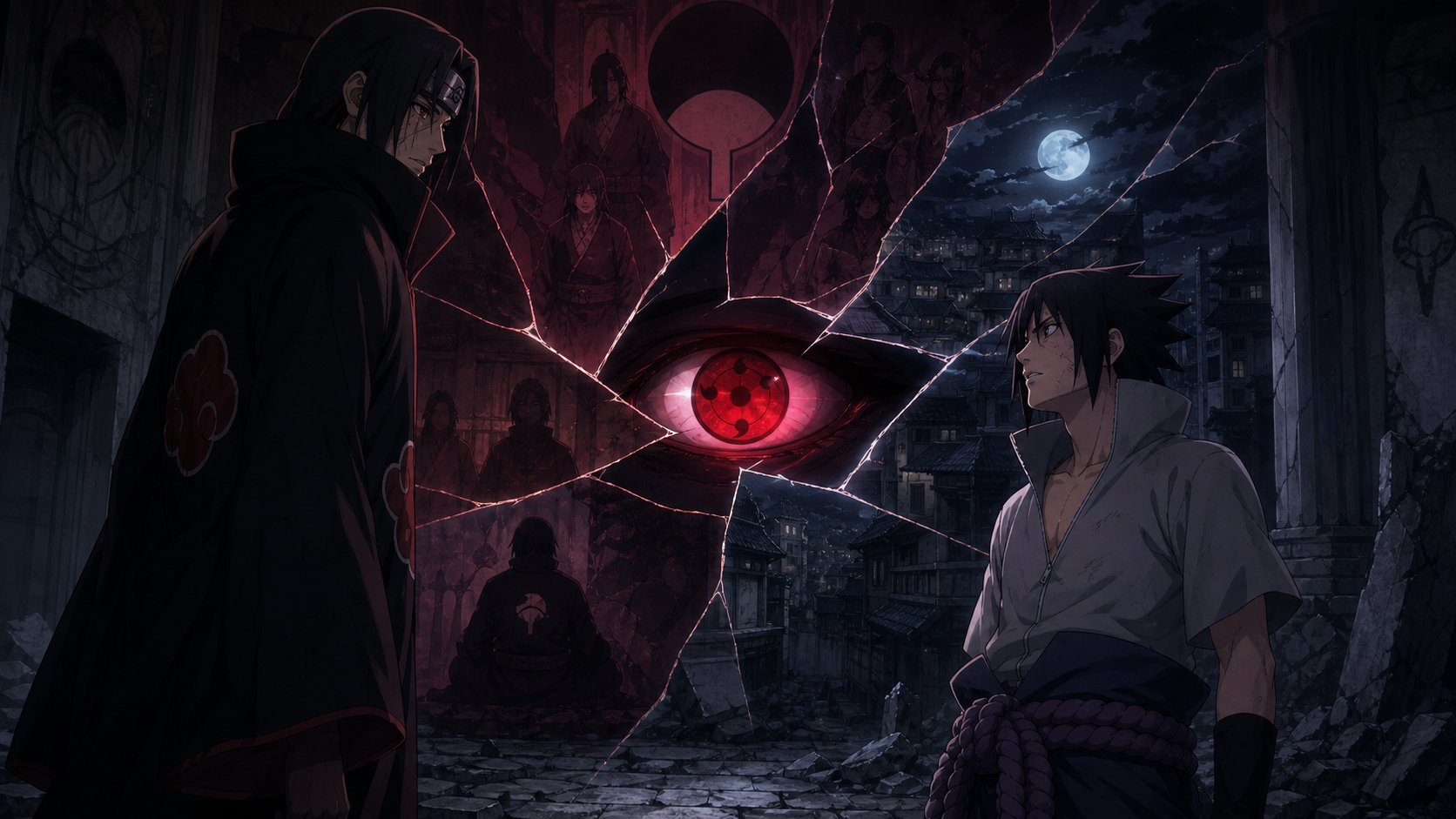
The Light & Dark of the Mangekyo Sharingan
Itachi turns the Mangekyo Sharingan’s history into a threat, while Sasuke fights to separate inherited truth from a carefully controlled illusion.
What happens
Sasuke and Itachi continue their duel inside the Uchiha hideout, but the first battle is fought through perception. Their Sharingan-led genjutsu turns injury, distance, and even victory into temporary claims rather than reliable facts.
Itachi uses the confrontation to explain the Mangekyo Sharingan and the cost traditionally associated with awakening it. He frames the Uchiha clan as a history of exceptional sight shadowed by loss, rivalry, and the pursuit of greater power.
The lesson becomes personal when Itachi describes the deterioration of his own vision. He presents Sasuke's eyes as the answer, claiming that taking them would restore and permanently strengthen his sight.
Sasuke refuses the role assigned to him. He breaks through the illusion and forces the battle back toward the physical world, where every technique must now carry the weight of what Itachi has revealed, or chosen to make him believe.
A history lesson delivered as a threat
Itachi does not pause the fight to offer neutral information. His account of the Mangekyo Sharingan is designed to control Sasuke's emotions while defining the terms of their conflict.
That difference matters. Facts spoken by an enemy can still be true, but their arrangement can serve a purpose. Itachi selects a story about brothers, sacrifice, blindness, and stolen sight because it turns family history into an immediate warning.
Sasuke is asked to see himself as the younger brother in a pattern that has already happened. Itachi casts himself as the powerful elder whose ambition will consume what remains of the family.
The explanation therefore works on two levels. It expands the mythology of the Sharingan, and it attempts to make Sasuke feel that resistance has already been accounted for by history.
Light and dark are not simple opposites
The title sounds like a division between good and evil, but the episode treats light and darkness as conditions of sight. The Mangekyo grants extraordinary perception while gradually taking vision away.
That contradiction fits the Uchiha story Itachi tells. Greater knowledge does not necessarily create clarity. Power may reveal hidden structures while narrowing the person who uses it until obsession becomes the only thing still visible.
Itachi appears to understand more than Sasuke about the clan, the massacre, and the eye technique. Yet his command of the story makes him harder to read, not easier. Information becomes another dark room in which Sasuke must find his footing.
Sasuke's answer is not to accept either side of Itachi's framing. He watches, tests, and breaks the image placed before him.
The Mangekyo turns grief into inheritance
The episode links the Mangekyo Sharingan to profound loss, making emotional trauma part of the clan's power system. Grief is not allowed to remain private; it becomes technique, status, and historical precedent.
That is a cruel inheritance for Sasuke. His power developed through the destruction of his family, and now Itachi suggests that the next stage would repeat the logic by making one brother's body useful to the other.
The eyes become more than organs or weapons. They represent the way one generation's pain can be handed to the next as if repetition were destiny.
Sasuke has spent years pursuing Itachi, but his refusal here is also a refusal to be reduced to raw material in Itachi's version of the clan story.
Itachi performs monstrosity
Itachi's claim that he wants Sasuke's eyes is deliberately intimate and horrifying. It gives Sasuke a concrete motive to fight while reinforcing the image of an older brother consumed by power.
The performance is effective because it uses details Sasuke can recognize: Itachi's damaged vision, the Mangekyo's strain, and the clan's history. A convincing lie does not need to invent every part of itself.
The episode keeps the audience inside Sasuke's uncertainty. We can see that Itachi is directing the conversation, but we cannot safely separate confession from provocation.
That ambiguity gives the duel its pressure. Sasuke is not only trying to defeat Itachi's body. He is trying to survive a story constructed to make hatred feel like the only possible truth.
Sasuke's resistance is analytical
Sasuke's anger is obvious, but the episode does not portray him as thoughtless. He studies each illusion, looks for inconsistencies, and refuses to treat apparent damage as final before testing it.
His growth is visible in that discipline. The child trapped inside Tsukuyomi could only endure what Itachi showed him. The young man in the hideout can challenge the mechanism and answer with his own control of the Sharingan.
Breaking genjutsu is therefore both a tactical achievement and an emotional statement. Sasuke cannot undo the images that shaped his life, but he can stop accepting every new image on Itachi's authority.
The victory remains incomplete because the physical battle is still ahead. Even so, Sasuke has forced the confrontation out of Itachi's preferred layer.
RaeRae reaction
What works for me is how the episode makes exposition feel dangerous. Itachi is explaining one of the series' central abilities, yet the scene never becomes a detached lecture. Every piece of history changes what Sasuke believes might happen to his body.
The light-and-dark idea is strongest when it stays connected to perception. These eyes can expose deception, copy movement, and impose entire realities, but they cannot guarantee wisdom. The more absolute the technique appears, the more urgently the episode asks who controls the account surrounding it.
I also like that Sasuke's response is not a speech about rejecting destiny. He demonstrates that rejection by reading the illusion and breaking it. His resistance is practical, precise, and earned through everything he has survived since the massacre.
The episode leaves us with a sharper version of the brothers' central problem: they share blood, eyes, and history, but not an agreed reality. Before either can win the physical duel, Sasuke has to keep proving that Itachi no longer owns the world he sees.
The Mangekyo turns trauma into a clan institution
My bottom line is that the eye technique does more than reward grief with power. It teaches generations to interpret catastrophic loss as access, status, and inheritance. Pain becomes something the clan’s history can organize and reuse.
Sasuke is asked to see repetition as destiny. Itachi’s story says brothers have already occupied these roles and that resistance merely completes the pattern.
Blindness makes greater sight physically contradictory
The Mangekyo exposes and imposes realities while degrading the user’s ability to see. Power expands perception at the cost of the organ carrying it.
The contradiction fits Itachi’s control of history. He appears to know more than Sasuke while revealing information through a method that makes clarity less trustworthy.
Stolen eyes convert kinship into a resource chain
Itachi frames Sasuke’s body as the solution to his deteriorating vision. Brotherhood becomes compatibility. Family survival becomes material one relative can harvest from another.
Sasuke’s refusal is therefore more than self-defense. He rejects a clan story that treats his life as replacement parts for inherited ambition.
A convincing performance uses facts as structure
Itachi’s failing sight, Mangekyo strain, and stories of Uchiha power may all contain truth. The claim that he wants Sasuke’s eyes arranges those facts into a monster role designed for Sasuke to defeat.
A lie becomes stronger when accurate details carry the false conclusion.
The Eternal Mangekyo story makes kinship anatomical
Brotherhood becomes valuable because related eyes can preserve power. Family is reduced from relationship, memory, and obligation to biological compatibility. The body of one brother becomes the maintenance plan for another.
That is a horrifying inheritance even before we know which parts of Itachi’s performance are false. The clan story teaches intimacy through extraction.
Consent disappears when history presents theft as tradition
Calling eye transplantation an established path can make violation sound inevitable. A tradition remains a series of choices made by people with power over other bodies.
Sasuke does not owe participation because earlier Uchiha repeated the act. History can explain a pattern without granting it moral authority.
Itachi uses clan mythology to shrink the imaginable future
He describes brothers awakening power, losing sight, and taking eyes as though the sequence naturally completes itself. Sasuke is invited to see only two roles: thief or material.
Resistance begins by refusing the available roles, not merely by winning within them.
Sasuke’s eyes already carry other people’s decisions
The Sharingan awakened through massacre trauma and developed under the pressure of Itachi’s commands. Orochimaru valued the body because of the same inheritance. Now Itachi presents the eyes as a resource again.
Sasuke’s anger contains the repeated experience of powerful people treating his body as future property.
Breaking genjutsu becomes a claim to bodily authority
Each illusion tries to decide what Sasuke feels, sees, and believes about imminent violation. Detecting the layer and breaking it restores temporary control over his senses.
The act does not erase earlier trauma. It proves Itachi can no longer impose reality without resistance.
Itachi’s damaged vision is fact and theatrical evidence
Physical strain supports the story he tells. Sasuke can notice deterioration and reasonably believe the threat. The performance uses a real cost to make the false motive persuasive.
Truth becomes stage material rather than an ethical gift.
The clan’s history is being narrated by someone hiding state history
Itachi can discuss Madara, brothers, Mangekyo techniques, and ancient ambition while omitting surveillance, segregation, the planned coup, Danzo’s coercion, and Hiruzen’s failed negotiations.
A long history can still be narrow if it excludes the institutions most relevant to the crime under discussion.
Myth can protect modern officials by moving blame backward
If Uchiha tragedy comes from ancient curse, exceptional eyes, and inevitable brotherly rivalry, current leaders appear incidental. The clan becomes responsible for repeating its own darkness.
Political mythology often works by making a preventable decision feel older than anyone alive.
Madara functions as warning, precedent, and distraction
The name can explain how transplanted eyes work and signal another participant in the massacre. It can also move Sasuke’s attention away from the Leaf officials who controlled Itachi’s immediate choices.
One relevant truth does not exhaust responsibility.
Sasuke is fighting for the right to interpret inheritance
He cannot choose the clan, eyes, or massacre he received. He can decide whether those inheritances dictate what he does with another person’s body or his own.
Refusing Itachi’s frame is a political act even when Sasuke experiences it as personal survival.
Light is not goodness and darkness is not ignorance
The title works when light means exposure and dark means the limits surrounding exposure. Mangekyo perception can illuminate technique while power makes the user’s moral field narrower.
Knowing more about how to dominate another person does not create wisdom.
Itachi’s monstrosity performance makes Sasuke’s hatred useful
If Sasuke believes his brother wants eyes and power, killing him feels like self-defense, justice, and clan revenge at once. The motives reinforce one another until hesitation looks dangerous.
Itachi constructs a role Sasuke can defeat without discovering the political burden waiting afterward.
A planned sacrifice can still manipulate the person made to perform it
Itachi may intend to die and transfer freedom or power. Sasuke did not consent to becoming the instrument of that ending.
The survivor will carry the act after the planner is gone. Protective sacrifice does not erase imposed grief.
The duel tests whether Sasuke can outgrow the only story he was given
His skill lets him challenge illusions. The harder task will begin when the villain narrative collapses and no clear purpose replaces revenge.
Winning the battle may remove the structure that organized every previous victory.
Fandom should resist turning coercion into proof of perfect love
Itachi’s care for Sasuke can be sincere and his methods devastating. Love explains why he wanted the child alive. It does not make torture, deception, and engineered revenge harmless.
A complicated character deserves analysis strong enough to hold affection and accountability together.
Itachi’s failing eyes do not make Sasuke a spare-parts drawer
Disability does not create a debt payable in somebody else’s body. Itachi’s deteriorating sight deserves compassion because pain is pain, even when the person suffering has caused harm. That compassion cannot become permission to take Sasuke’s eyes. The story he tells turns need into entitlement and family into supply. Naruto has shown this logic before: a useful body becomes village property, clan property, or a powerful man’s next container. Sasuke keeps meeting adults who look at him and see what they can extract.
The shinobi world keeps confusing protection with ownership
Orochimaru wanted Sasuke’s body. Itachi claims to want his eyes. Konoha wanted the Uchiha controlled, useful, and quiet until control failed. Each demand comes with a different excuse, but the child underneath receives the same message: your future belongs to whoever can justify taking it. That is why this fight cannot be reduced to technique. Sasuke is defending the right to remain a person when nearly every institution around him has treated personhood as conditional.
Retroactive love cannot manufacture consent
Knowing more about Itachi later may change how viewers judge his motive. It cannot travel backward and give Sasuke information he never received. Sasuke makes choices inside a reality built through torture, threats, omissions, and carefully planted hatred. Calling that arrangement loving without naming the coercion asks the victim to approve a plan he was never allowed to understand. I can ache for Itachi’s impossible position and still refuse to pretend that Sasuke freely chose the road laid under his feet.
The village benefits when the brothers blame only each other
A private revenge story is politically convenient. If Sasuke believes one monstrous brother destroyed the clan for power, he never has to examine the officials who feared the Uchiha, restricted them, monitored them, and accepted massacre as policy. If Itachi dies carrying every visible sin, the system survives looking cleaner than it was. The brothers bleed while the adults who designed the trap become background. That is not ancient fate. That is power laundering responsibility through a family tragedy.
Even Itachi’s self-sacrifice centers his control
He chooses the villain role, the timing, the information, and the ending he wants Sasuke to deliver. Sacrifice sounds noble, but controlling every condition means Sasuke still performs somebody else’s plan. The younger brother must kill, grieve, and rebuild after the architect is gone. Itachi may believe he is carrying the burden alone. In practice, he transfers the final weight to Sasuke without warning. Love can motivate that choice while arrogance shapes its method.
Tobi is waiting for the silence Itachi leaves behind
The moment Itachi’s version ends, another interested narrator can fill the empty space. Tobi does not offer truth as a gift. He offers selected facts because an isolated, devastated Sasuke is easier to redirect. That is the danger of hiding history for someone’s supposed protection: the secret does not disappear. It becomes leverage for the next person willing to reveal it at the most destructive moment. Itachi controls the archive until his death, then loses control of what the archive does.
Sasuke’s real victory is the right to question the frame
Breaking Tsukuyomi matters because it proves his mind is no longer an unlocked room Itachi can enter and arrange. Yet freedom requires more than resisting one illusion. Sasuke will need to question every explanation attached to his eyes, his clan, his brother, and his village. He has been trained to pursue certainty through a single enemy. The truth waiting beyond this duel is messier, angrier, and more political. Surviving Itachi means inheriting questions revenge was designed to postpone.
The episode’s light exposes facts without guaranteeing justice
Light reveals damaged vision, hidden techniques, and pieces of Uchiha history. Darkness remains in whoever chooses the angle of that light. A spotlight can expose one face while keeping the room invisible. Itachi shows Sasuke enough to make the battle meaningful, but not enough to make the massacre understandable. The title lands because sight and knowledge are never neutral here. The Mangekyo sees extraordinary things while the people using it keep deciding what another person is permitted to see.
My final answer is compassion without absolution
I will not flatten Itachi into a greedy eye thief, because the performance is doing deliberate work. I will not flatten him into a perfect brother either, because Sasuke pays for that work with his childhood, body, and ability to choose. The tragedy lives in both truths. Itachi loved Sasuke fiercely. Itachi also controlled him brutally. Any reading that erases one side makes the story smaller, and this episode is too sharp about power, family, and manipulated memory to deserve that shortcut.
Sasuke does not leave this fight healed. He leaves with his central certainty broken, which is far more dangerous than a physical wound. The episode understands that revelation can injure before it liberates. Once Itachi falls, Sasuke must decide what to do with a truth delivered too late, by people who still want something from him as well.
RaeRae’s final word on light and darkness
I love that exposition remains physically dangerous. Itachi is not teaching neutral clan history. He is deciding what Sasuke fears will happen to his eyes and body.
Sasuke’s analytical resistance matters because anger does not erase thought. He breaks illusions, tests apparent injuries, and refuses to let Itachi’s authority make every image final.
The Mangekyo can expose visual deception without exposing political omission. Sasuke still lacks the village records, clan testimony, and independent witnesses required to judge the massacre.
Light and darkness occupy the same eye because power and clarity are not synonyms. The more Itachi reveals, the more carefully Sasuke must ask who arranged the revelation and what remains outside its frame.
RaeRae’s call
Itachi turns Mangekyo history into an intimate threat, while Sasuke refuses to become either stolen eyes or the younger brother in a pattern somebody else declared inevitable.