
Tales of a Gutsy Ninja: Part 2
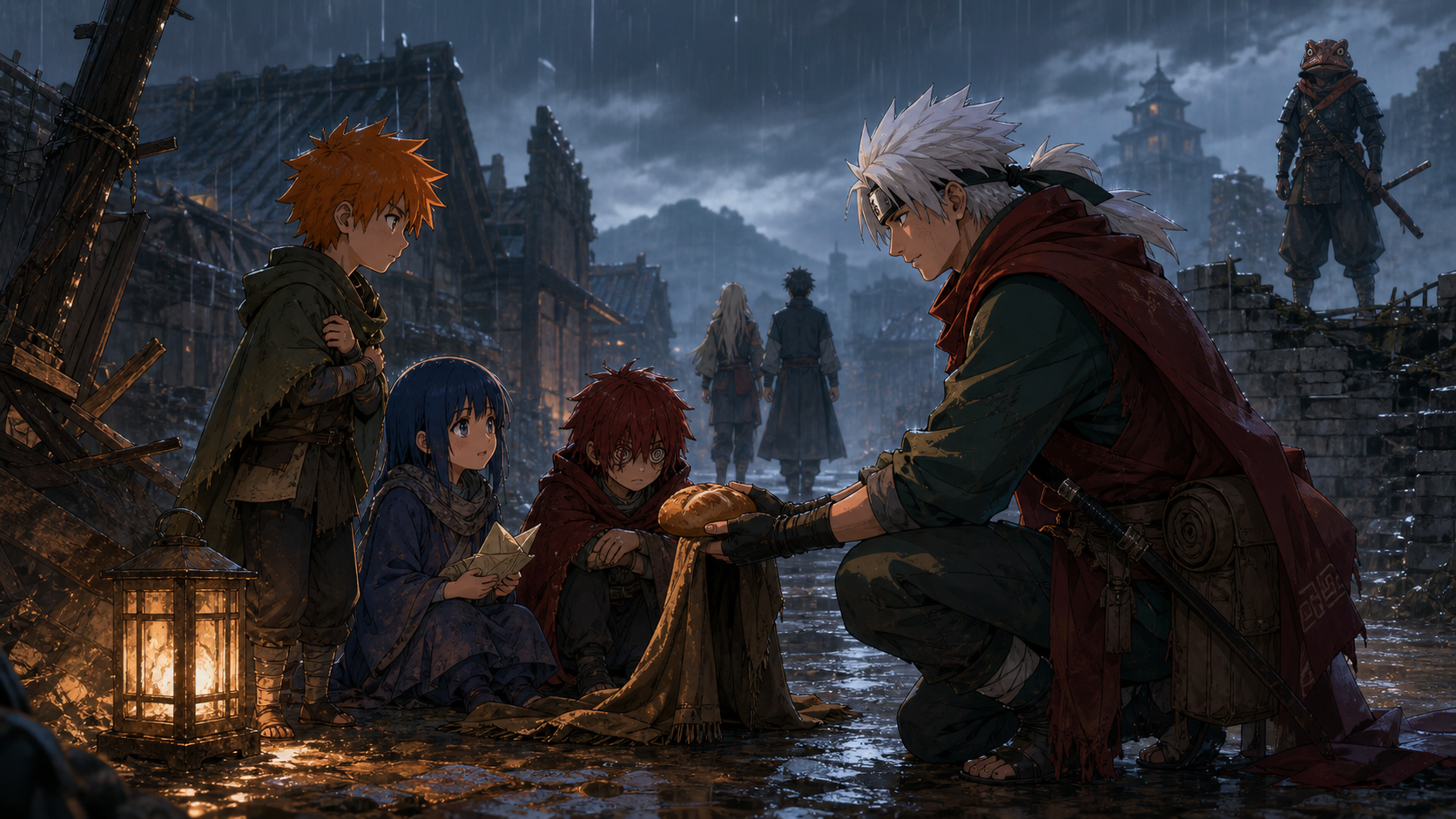
A battlefield title makes Jiraiya famous, but choosing three abandoned children is what makes him a teacher.
What happens
Jiraiya's search for the student named by prophecy is interrupted by the Third Great Ninja War. He returns to active duty beside Tsunade and Orochimaru, fighting Hanzo of the Salamander in the Hidden Rain.
Hanzo spares the exhausted trio and names them the Legendary Sannin, turning survival into a title that will follow them for the rest of their lives. The honor comes from an enemy and is born inside a country devastated by larger nations' conflict.
As the three prepare to leave, they meet Yahiko, Konan, and Nagato, children left hungry and alone by the war. Orochimaru suggests killing them as a mercy. Jiraiya refuses and chooses to remain in the Rain to teach them how to survive.
He trains the children, learns their hopes, and recognizes Nagato's Rinnegan as a possible sign of the prophecy. After they become capable ninja, he returns to the Leaf believing they can build their own future.
A legendary title inside somebody else's ruin
The name “Sannin” sounds glorious when later generations repeat it. Here, its origin is muddy, exhausted, and morally complicated.
Hanzo acknowledges their strength, but the battlefield around them belongs to people who never chose to host a war. Jiraiya, Tsunade, and Orochimaru gain a legend while Rain civilians inherit wreckage.
That contrast keeps the title from becoming simple celebration. Military reputation can be earned through courage and still depend on systems that make children homeless.
Jiraiya seems to understand at least part of that contradiction. Staying with the orphans does not undo the Leaf's participation, but it refuses to treat their suffering as scenery behind his promotion.
Orochimaru's mercy has no future in it
Orochimaru's suggestion is chilling because he frames death as practicality. The children are vulnerable, resources are scarce, and the war is likely to kill them anyway. Ending their lives now appears, to him, like control over an inevitable outcome.
Jiraiya's refusal is not based on evidence that everything will turn out well. He cannot promise safety or peace. He chooses to create possibility where Orochimaru sees only probability.
That difference anticipates their adult philosophies. Orochimaru responds to mortality by trying to dominate it. Jiraiya responds by investing in people whose futures he cannot own.
The episode does not make Jiraiya's choice painless or perfectly wise. Teaching children to fight is a grim answer. In the world available to them, however, skill creates time for other choices to exist.
Yahiko, Konan, and Nagato are more than prophecy clues
Nagato's eyes immediately connect him to Jiraiya's prediction, but the three children function as a unit. Yahiko provides outward courage and political imagination. Konan observes, adapts, and gives the small household emotional steadiness. Nagato carries enormous power alongside grief and hesitation.
Jiraiya teaches all three, even as prophecy makes him watch one student differently. That imbalance matters because destiny can narrow attention.
Yahiko's dream of changing the Rain is not a side note. The children's political purpose grows from direct experience: their home has been used by stronger villages, so peace cannot mean simply accepting those villages' terms.
Konan's paper flowers bring tenderness into a setting that rewards hardness. Small acts of making and sharing are part of what they are trying to protect.
Teaching is Jiraiya's answer to war
Jiraiya cannot end the conflict around the children. He can feed them, shelter them, and transfer knowledge that reduces their dependence on him.
The last part is crucial. Good teaching should eventually make the teacher unnecessary. Jiraiya leaves when he believes the three can defend themselves, not because he stops caring.
His mistake is assuming capability guarantees a safe future. The children will still face Hanzo, Danzo, grief, manipulation, and institutions larger than their household. Individual training cannot solve every political danger.
Still, the years together matter. Later tragedy does not retroactively make care meaningless. Yahiko, Konan, and Nagato experience a period in which an adult chooses them, takes their dreams seriously, and expects them to live.
RaeRae reaction
This episode hurts because the audience knows what Jiraiya does not. We can see the people these children become while watching a warm, imperfect family form in the rain.
I appreciate that Jiraiya's legend is tied to teaching rather than only battle. Hanzo gives him the famous title, but the choice that defines him happens afterward, when there is no audience and no reward.
Orochimaru offers certainty through death. Jiraiya offers uncertain work: meals, training, correction, trust, and eventually departure. That is a less dramatic answer and a far more human one.
Part two completes the origin by showing that prophecy alone does not make Jiraiya a mentor. He becomes one when he looks at three children the war has discarded and decides their unfinished lives are worth his time.
The Sannin title is born in the Rain’s suffering
My bottom line is that Hanzo’s title cannot be separated from the country beneath the battle. Jiraiya, Tsunade, and Orochimaru survive an extraordinary opponent and earn recognition. Rain families receive ruined homes, hunger, and children forced to negotiate with armed strangers.
Military legend and civilian catastrophe occupy the same frame. Admiring the trio’s endurance should not make the landscape decorative.
Hanzo names strength while controlling the terms of survival
Sparing the three Leaf ninja sounds generous only because he possesses the power to kill them. The title carries admiration and domination together. They become famous through a verdict delivered by an enemy standing over their exhaustion.
That origin matters when later generations repeat “Legendary Sannin” as pure glory. A legend can begin in somebody else’s unequal choice.
Orochimaru calls death mercy because he cannot tolerate uncertainty
His suggestion to kill Yahiko, Konan, and Nagato is horrifying partly because it arrives in calm practical language. The children may starve or die in war, so he proposes controlling the ending now.
Orochimaru repeatedly answers mortality by removing another person’s agency. If death is inevitable, he believes power belongs to whoever decides its timing and use.
Jiraiya offers possibility without proof
He cannot guarantee food forever, defeat every army, or promise the children adulthood. He stays anyway. The moral difference is not optimism based on evidence. It is willingness to work for a future that remains uncertain.
Care begins before success can justify it. The children deserve time because they are alive, not because prophecy might make one historically important.
The children need shelter before they need destiny
Nagato’s Rinnegan will seize attention, but hunger is the first emergency. Jiraiya feeds all three, establishes a home, and creates enough safety for learning to become possible.
That order matters. A gifted child is still a child with a body. Prophecy does not replace meals, sleep, stability, or an adult who returns tomorrow.
Yahiko’s politics come from watching larger nations use his home
His dream of changing the Rain is not naive decoration around Nagato’s power. He understands that peace defined by great villages can still mean smaller countries absorb their battles.
Yahiko wants dignity and self-determination, not a quiet version of occupation. Any later account of the Akatsuki must remember that the founding anger had a material cause.
Konan creates steadiness inside displacement
Her paper flowers preserve making, beauty, and exchange in a world organized around destruction. She is also observant, disciplined, and politically committed. Tenderness does not make her less serious.
The household works because Konan is not merely standing between two boys. She helps turn temporary shelter into relationship.
Nagato’s eyes should not swallow Nagato
The Rinnegan invites Jiraiya to see the prophecy before the frightened child. Nagato carries grief, empathy, anger, and a desire to protect his friends before he carries any global role.
When adults identify exceptional power, they often begin treating the child as an answer. Jiraiya must keep teaching the person rather than training a symbol.
Teaching combat is a grim form of care
In a better world, feeding the children and finding safe guardians would be enough. In the Rain, safety depends on surviving armed adults and political violence. Jiraiya teaches them to fight because institutions have made childhood defenselessness lethal.
The choice is necessary and tragic. Skill expands their options while bringing them deeper into the shinobi system that orphaned them.
Good teaching aims to become unnecessary
Jiraiya does not build permanent dependence. He trains the children until they can protect one another and then returns to Konoha. Leaving recognizes their capability.
It also risks confusing combat readiness with safety. They can win ordinary fights and still face Hanzo, Danzo, propaganda, and political betrayal larger than one household.
Later tragedy does not erase the years of care
Knowing what happens to Yahiko, Konan, and Nagato can make every warm scene feel doomed. The outcome does not prove Jiraiya’s decision was meaningless. They experienced food, teaching, laughter, and an adult who believed they should live.
Care is not valuable only when it guarantees a painless ending. It changes what was possible while it existed.
Jiraiya also leaves before understanding the political danger
He sees capable students and assumes capability can carry their dream. He does not remain to help build protection against the institutions threatened by that dream.
This is not simple abandonment, but it is a limit in his mentorship. Individual strength cannot substitute for durable political support.
The Rain children make the cost of the great villages impossible to keep abstract. Yahiko, Konan, and Nagato are not unfortunate spectators who happened to stand near history. Their hunger, displacement, and anger are part of what history means when powerful countries move battles through smaller nations. The Leaf can call its shinobi defenders and still participate in a system that leaves other people’s children without homes.
Jiraiya’s decision to stay is compassionate, but it does not settle that political debt. One soldier feeding three orphans cannot repair the policies that produced thousands more. Individual care matters because institutions fail. It should also make the failure more visible, not become a sentimental substitute for changing it.
Yahiko understands this before many adults do. He does not dream only of personal strength or revenge against one killer. He wants the Rain to stop functioning as ground other nations can spend. His confidence gives the household motion, and his politics give their training a purpose beyond survival. He is not merely the friend whose death will transform Nagato.
Konan’s paper deserves the same seriousness. Folding a flower from limited material is a small assertion that beauty, patience, and exchange still belong in a war zone. Later, paper becomes her combat language. The continuity matters. She does not abandon tenderness to become dangerous. She turns the practice of making into a way to defend what tenderness needs.
Nagato’s Rinnegan creates awe, but his first defining quality is not power. It is sensitivity to suffering and fear of losing the people who remain. Enormous ability enters a child whose emotional world has already been shaped by violent absence. Treating the eyes as destiny without protecting that child is how adults turn possibility into burden.
Jiraiya recognizes the prophecy and understandably feels that his wandering has found an answer. That recognition can motivate years of careful teaching. It can also narrow his attention around Nagato while Yahiko and Konan carry equal responsibility for the group’s vision. Prophecy is especially dangerous when it convinces a teacher that one student’s power explains a collective dream.
The household scenes matter because they offer something the children cannot manufacture through jutsu. Routine. Meals happen. Training repeats. An adult remains present long enough for tomorrow to feel plausible. Safety is never complete, but reliability creates a temporary childhood inside conditions designed to erase it.
Teaching ninjutsu complicates that safety. Jiraiya gives the children tools to resist predators, yet every lesson also prepares them to participate in the same armed world. He has no clean option. Refusing to train them leaves them vulnerable. Training them makes survival possible while normalizing violence as the language through which autonomy must be defended.
I appreciate that the episode does not solve this contradiction with one speech. The children become competent because competence is necessary. Their later organization begins with a sincere attempt to protect the Rain and pursue peace. The tragedy comes when political enemies exploit grief and turn a survival movement toward a different kind of domination.
Jiraiya leaves after judging them capable, and I understand the respect inside that choice. Remaining forever could make their project depend on a Leaf mentor. Departure allows the students to own their future. It also removes an experienced witness who might have recognized how Hanzo and Danzo would respond to an independent Rain movement.
This is one of Jiraiya’s recurring limits. He believes deeply in individual potential and sometimes underestimates institutions. A gifted person can change history, but institutions control information, legitimacy, resources, and organized violence. Students need courage and technique. They may also need alliances, public protection, and adults willing to confront governments.
The later Pain cannot be understood honestly if we skip the sincere Akatsuki Yahiko imagined. The organization’s beginning was not a childish prelude to inevitable villainy. It answered occupation, grief, and political abandonment. Naming that origin does not excuse mass violence. It explains what manipulators captured and redirected.
Konan also deserves to be remembered as a founder rather than an accessory to two male visions. She shares the losses, labor, strategy, and hope. When the group changes after Yahiko, she remains beside Nagato, but remaining does not mean she lacked thought. Loyalty can contain doubt, grief, responsibility, and choices made under terrible constraint.
Jiraiya receives news later and believes the children died. That mistaken conclusion lets him mourn without investigating what their movement became. Distance and war make information difficult, but the result is another silence. The students continue living inside a conflict their teacher no longer sees, while he carries an incomplete ending back to Konoha.
I do not say that to make Jiraiya responsible for every later crime. Nagato and Konan make choices. Obito manipulates. Hanzo and Danzo betray. The great villages preserve the conditions. Responsibility is distributed, which is exactly why locating one destined savior was never enough to solve the system.
The episode gains weight from this future without needing to announce every connection. A shared meal will later sit beside bodies. A paper flower will sit beside weapons. Jiraiya’s faith will sit beside Pain’s accusation that the teacher left. Memory does not cancel the warmth. It makes warmth part of what was lost.
What Jiraiya gives the children is real evidence against Orochimaru’s certainty. They do not die immediately. They learn, organize, dream, love, and affect the world. Their lives become painful and morally complicated, but possibility proves more truthful than the mercy killing Orochimaru proposed.
That is why I reject the idea that a tragic outcome validates his logic. If a life later contains suffering or harm, it was not a mistake to preserve the child. We do not judge care by whether it guarantees innocence forever. We judge whether it respects another person’s right to have a future and make choices within it.
Jiraiya’s teaching preserves that right imperfectly. He offers knowledge and eventually steps back. He also interprets through prophecy, leaves political dangers insufficiently addressed, and does not return soon enough to learn the truth. The relationship can be loving without becoming beyond criticism.
For me, the title’s guts belongs to the children too. They keep imagining a nation that belongs to its people after adults use it as a battlefield. They accept training without surrendering the political reason they wanted strength. Jiraiya helps, but the courage is not something he imports into the Rain. It was already surviving there.
The legend of the Sannin and the childhood of the original Akatsuki begin in the same ruined country, which is not an accident worth ignoring. Great-village fame and small-nation resistance grow from one war, then history files them in separate drawers. This episode puts them back together.
Jiraiya walks away with a title, three students, and a stronger belief that teaching might change the world. Yahiko, Konan, and Nagato remain with skills, affection, and a political struggle no prophecy can solve for them. Their paths are connected without being equal.
That imbalance is the ache beneath the warm memories. Jiraiya can return to a village with power and continuity. The children must build continuity inside the place everyone else crosses. His decision gives them time. Their choices give that time meaning, and their country bears the consequences when larger powers refuse their autonomy again and again.
RaeRae’s final word on the second scroll
I love that Jiraiya receives his famous title in public and makes his defining choice after the applause is gone. Hanzo names a legend. Three hungry children make Jiraiya become a teacher.
Orochimaru offers certainty by ending lives before uncertainty can hurt them. Jiraiya offers meals, training, time, and no guarantee. That imperfect work is the more courageous answer.
I will not reduce Yahiko, Konan, and Nagato to clues in somebody else’s prophecy. They are children of a country used by larger powers, and their dream grows from conditions the great villages helped create.
Part two completes the origin by tying Jiraiya’s hope to responsibility. He stays, teaches, loves, misjudges what strength can protect, and eventually leaves. The care is real. So are its limits. Both truths will follow him back into the Rain.
RaeRae’s call
Hanzo gives Jiraiya a legendary title, but three abandoned children make him a teacher. His uncertain work creates possibility where Orochimaru sees only a death he can control.