
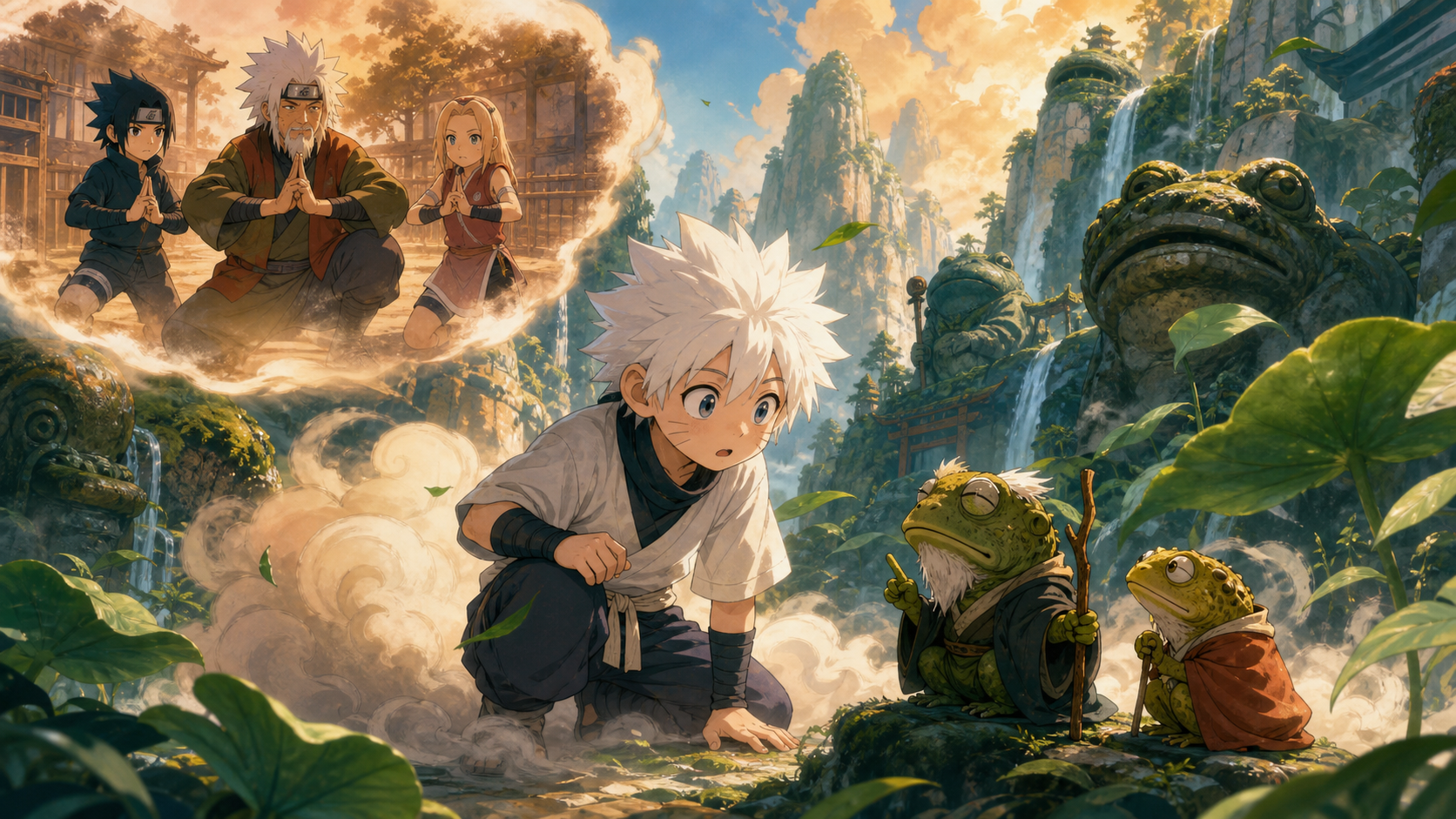
Tales of a Gutsy Ninja: Part 1
A failed summoning opens Mount Myoboku, and an impatient child receives a responsibility that will take a lifetime to understand.
What happens
The story steps backward to Jiraiya's childhood, when he, Orochimaru, and Tsunade train under Hiruzen Sarutobi. They are already recognizable: Orochimaru is precise, Tsunade is forceful, and Jiraiya is loud, impatient, and desperate to prove he belongs beside them.
Hiruzen demonstrates summoning, giving Jiraiya a new obsession. Instead of mastering the contract carefully, the boy throws himself into the transportation technique and accidentally sends himself to Mount Myoboku.
There he meets the toads and begins training in their strange sanctuary. The Great Toad Sage speaks of a prophecy: Jiraiya will travel widely, write a book, and teach a student whose choices could bring either salvation or destruction to the ninja world.
The prediction gives shape to a life that has not yet found direction. Jiraiya leaves the village to search for the person he believes the prophecy describes, beginning the wandering identity that will define his adulthood.
Before the legend, there is a difficult child
Young Jiraiya is funny because his confidence arrives long before his skill. He wants the impressive result without the patient foundation, and embarrassment only makes him perform harder.
That immaturity matters. The adult teacher who asks Naruto to endure repetition once hated being outperformed by his own teammates. His later patience is learned, not automatic.
Orochimaru's early excellence creates an especially sharp contrast. He makes discipline look natural, while Jiraiya's progress is noisy and uneven. Hiruzen can see potential in both, but potential does not promise the same future.
The episode lets us recognize the Sannin without pretending they were born complete. Their familiar adult patterns begin as childhood habits that experience will deepen, challenge, or distort.
Mount Myoboku changes failure into a road
Jiraiya reaches Mount Myoboku because his technique goes wrong. In another story, the failed summoning would be a punchline and nothing more. Here it becomes the doorway to his life's central relationships.
The toad sanctuary feels appropriately larger than ordinary geography. Giant plants, impossible peaks, and old sages make Jiraiya's village ambitions suddenly look small. He wanted a flashy technique; he receives a responsibility measured in generations.
I like that destiny arrives through incompetence rather than perfection. Jiraiya is not chosen because he executed every step correctly. He is available to be changed because he keeps moving after the mistake.
That does not erase work. The accidental arrival opens the door, but training, travel, teaching, and repeated disappointment determine what he does after crossing it.
Prophecy is both purpose and pressure
The Great Toad Sage tells Jiraiya that one of his students may transform the world. The possibility gives him purpose, but it also turns every teaching relationship into a question about destiny.
Jiraiya will spend years trying to identify the promised student. That search can inspire attentiveness, because he takes young people's potential seriously. It can also encourage projection, because he looks for a role they might fill inside a story he was told before meeting them.
Prophecy in Naruto rarely removes choice. It creates a frame around choice. The danger is believing the frame matters more than the people living inside it.
Jiraiya's greatness comes partly from continuing to care after his interpretations fail. He does not always understand his students, but he keeps believing that teaching can interrupt inherited violence.
The future is hiding inside the classroom
Watching Jiraiya, Orochimaru, and Tsunade together carries sadness because we know how far their paths will separate. Hiruzen is teaching three gifted children who will become legends, but power will not protect any of them from grief or bad choices.
Orochimaru's calm ability already attracts attention. Tsunade's certainty already pushes against Jiraiya's showmanship. Jiraiya's hunger to be acknowledged anticipates the student he will eventually recognize in Naruto.
The parallels are useful without making the generations identical. Naruto inherits some of Jiraiya's stubbornness and loneliness, but he lives under different pressures. Jiraiya's task is not to reproduce himself. It is to give the next person more tools than he had.
RaeRae reaction
I love an origin story that does not polish away embarrassment. Young Jiraiya is irritating, insecure, and completely believable. The distance between that child and the adult mentor makes his later wisdom feel earned.
Mount Myoboku brings wonder at exactly the right moment. After several episodes of pursuit, explosions, and narrowing revenge, the world suddenly expands into waterfalls, giant leaves, ancient toads, and a future no child could understand yet.
The prophecy is tempting because it makes Jiraiya's life sound organized. We know it will not feel organized while he lives it. He will make mistakes, lose people, misread students, write imperfect books, and still leave an idea strong enough for Naruto to carry.
Part one works as the beginning of a life rather than a list of famous events. Jiraiya does not become legendary here. He learns that wandering can be a form of responsibility, and that a failed technique can open the road he was meant to travel.
Jiraiya begins as a child who wants the result before the practice
My bottom line is that Episode 127 protects Jiraiya from becoming a marble statue before his death arc. Young Jiraiya is loud, jealous, impulsive, and desperate to close the distance between himself and classmates who seem naturally impressive.
That embarrassment is essential. The adult who teaches Naruto persistence did not begin with calm wisdom. He learned what repetition costs because he once tried to skip it.
Hiruzen teaches three children without knowing which future will win
Orochimaru’s precision, Tsunade’s force, and Jiraiya’s hunger are already visible. Hiruzen can identify talent, correct technique, and offer structure. He cannot guarantee what grief, war, ambition, or loneliness will do to any student.
This is the limit of mentorship the series keeps returning to. A teacher influences a life without owning the result. Love and instruction matter, but students remain people rather than projects.
Orochimaru’s excellence creates the comparison Jiraiya cannot escape
Young Orochimaru makes difficult work look clean. Jiraiya responds by performing confidence more loudly, hoping volume can cover the fear that he does not belong beside his teammates.
That rivalry is funny until we remember where both boys go. One will turn insecurity into wandering and teaching. The other will turn fear of death into possession. Early talent does not announce the healthier adulthood.
Tsunade is present before she becomes somebody’s loss
Origins sometimes use women as emotional landmarks for men. Tsunade deserves to remain a gifted student with her own force, not only the girl Jiraiya fails to impress or the future Hokage who will grieve him.
Her certainty challenges his showmanship in the classroom. Their relationship begins among equals learning under the same teacher, long before tragedy rearranges what they mean to one another.
The failed summoning is consequence, comedy, and doorway
Jiraiya attempts a technique before building the proper contract and control. The mistake could have ended as a gag about impatience. Instead, it removes him from familiar geography and places him inside the relationship that will shape his life.
Destiny does not reward perfection here. It interrupts arrogance with a world larger than the boy expected.
Mount Myoboku expands the scale of possibility
Giant foliage, ancient toads, impossible terrain, and unfamiliar training make Konoha look like one small answer inside a much older world. Jiraiya wanted an impressive summon. He receives culture, discipline, and responsibility.
Wonder works because the place does not exist merely to decorate his power. It has teachers, rules, history, and judgments of its own.
The toads do not need Jiraiya to arrive polished
They meet an intrusive, underprepared child and still recognize that the accident may matter. Acceptance does not mean indulgence. Training at Mount Myoboku requires Jiraiya to work, listen, fail, and change.
This is a generous model of mentorship. Potential is not a compliment handed to the already impressive. It is a reason to invest before the result is visible.
Prophecy gives Jiraiya purpose and a lifelong burden
The Great Toad Sage tells him a student may save or destroy the ninja world. Suddenly every future bond can feel like an examination with history waiting for the grade.
Purpose can keep a person moving. It can also make ordinary relationships difficult to see. Jiraiya may look at students and search for destiny before fully hearing who they are.
A prophecy is information, not consent
No future student agreed to become the answer to a prediction delivered before meeting Jiraiya. Nagato, Minato, and Naruto will each carry hopes shaped by a conversation they did not attend.
Jiraiya’s responsibility is to teach people, not manufacture a foretold role. His best moments come when belief opens possibility. His failures come when the role becomes more visible than the child.
Wandering can be curiosity and avoidance at once
Jiraiya leaves to find the student of prophecy, study the world, gather knowledge, and write. Travel expands his moral imagination beyond one village. It also gives him distance from attachments he does not know how to hold.
A life can be meaningful without being emotionally tidy. Wandering produces insight and sometimes delays the conversation waiting at home.
Writing becomes another form of teaching
The prophecy connects Jiraiya’s travels to a book. He will gather experiences, transform them into a story, and place an idea into the hands of people he may never directly instruct.
That matters for Naruto. A book can carry a teacher’s hope beyond the teacher’s body. It can also contain an imperfect author whose life does not always match the courage on the page.
The gutsy ninja begins as an aspiration
Jiraiya does not write himself because he already embodies every virtue. He imagines a protagonist stubborn enough to keep choosing peace after failure. The character becomes a standard he is still learning to meet.
Fiction can preserve the person someone wants to become. Naruto will later take that aspiration seriously enough to return it to its author as lived possibility.
Jiraiya’s connection to Naruto begins before Naruto exists
The child at Mount Myoboku is insecure, underperforming, noisy, and hungry to prove himself. Those qualities will help him recognize Naruto rather than dismiss him as the village did.
Recognition does not make Jiraiya a perfect guardian. It gives him an entry point. He understands the comedy people use to survive being underestimated.
Adult wisdom should not erase adult failures
Jiraiya becomes brave, observant, loyal, and capable of giving Naruto a future-facing philosophy. He also spends years away, crosses sexual boundaries for humor, and leaves emotional labor unfinished.
Love for a character does not require sanding away those facts. The origin is richer when growth and harm remain part of the same life.
The Sannin share a classroom before ideology separates them
Seeing the three children together makes their later fracture hurt. They begin with competition and familiarity under one teacher. War will give each a different answer to mortality and loss.
Tsunade retreats from attachment, Orochimaru tries to conquer death, and Jiraiya keeps searching for a student who might change the system. None escapes grief. They organize life around it differently.
Hiruzen’s lesson carries institutional contradictions
He teaches teamwork and technique inside a village that will send children into war. His care for students is real, and so is his role in maintaining the structure that harms them.
Naruto is strongest when both truths remain visible. A kind teacher can serve an institution that needs deeper change.
Failure becomes meaningful only because Jiraiya keeps working
The accidental journey opens a door, but accident does not complete the life. Training, travel, teaching, writing, grief, and repeated recommitment give the moment its eventual significance.
Calling everything destiny can erase that labor. Jiraiya receives a direction. He still has to walk it badly, bravely, and for years.
The prophecy creates a dangerous temptation to read every student backward from the future. Once we know Nagato, Minato, and Naruto, it is easy to treat their childhoods as clues in a puzzle whose answer already exists. Jiraiya did not have that certainty. He met young people inside war, loss, ambition, and limited information. His choices mattered precisely because he could be wrong.
Nagato will seem like the promised answer because his eyes and circumstances carry enormous possibility. Minato will seem like the answer because brilliance, discipline, and compassion make leadership look natural. Naruto will seem least convincing to almost everyone except the teacher who remembers what it felt like to be the loud child trailing gifted classmates. Prophecy keeps changing faces because human potential cannot be reduced to one obvious résumé.
I want to be careful with the language of destiny around children. Telling a teacher that one student may save or destroy the world gives urgency to education, but it also places history’s fear inside ordinary mistakes. A child needs room to fail without every failure becoming evidence of catastrophe. Jiraiya’s task should be to expand choice, not monitor a future weapon.
Mount Myoboku offers a counterweight because its teachers begin with practice. The toads do not hand Jiraiya greatness after one prediction. They give him techniques, discipline, relationships, and a place where his mistakes can become instruction. The prophecy is dramatic. Daily training is what makes him capable of serving any version of it.
That distinction follows him into writing. A novel does not change the world because a sage declared that it would. It changes a reader because the story reaches a need, gives language to hope, and remains available when the author is absent. Jiraiya cannot command that response. He can only make the work honestly enough to invite it.
Naruto’s name eventually comes from the protagonist Jiraiya wrote, which creates one of the series’ gentlest forms of inheritance. Minato and Kushina choose a fictional ideal for their child. Naruto later grows into the stubborn promise without being a copy of the character or the author. Art becomes family history without becoming a cage.
The tenderness of that legacy sits beside Jiraiya’s failures of presence. He is connected to Naruto before birth and still does not become a consistent guardian during the boy’s earliest loneliness. War assignments, secrecy, travel, and his own avoidance may explain the absence. Explanation does not give those lost years back.
I can honor what Jiraiya eventually gives Naruto while asking what earlier care might have changed. Fandom love should be strong enough for that question. A mentor can arrive at the right time for one stage and still have missed another stage when the child needed protection rather than training.
Young Jiraiya’s insecurity helps explain why recognition matters so much in his teaching. He knows praise can keep an underperforming student from accepting the world’s low expectation. He also knows comparison can turn admiration into resentment. Whether he always applies that knowledge well is another question, but the emotional source is visible here.
Hiruzen’s classroom adds a generational warning. He sees the children every day and still cannot prevent Orochimaru’s descent, Tsunade’s withdrawal, or Jiraiya’s wandering. Teachers are not gods. Yet institutions often rely on individual mentors to repair damage produced by war and policy. That is too much responsibility for one relationship.
Jiraiya’s prophecy expands that pressure to the whole world. He is told that teaching one person may decide history. I understand why he takes the assignment into his bones. I also understand why a life lived under that expectation becomes restless. Every place might contain the student. Every departure might feel justified by the search.
The episode’s warmth comes from knowing the wandering will not be meaningless even when the interpretation is messy. Jiraiya gathers stories, trains people, makes mistakes, returns, and keeps choosing the possibility that understanding can interrupt violence. He never proves the prophecy through perfect foresight. He proves his character through recommitment after being wrong.
That is the Jiraiya I want this origin to preserve: not a chosen genius walking a guaranteed road, but an insecure boy who receives a possibility and spends decades trying to become useful to it. Sometimes he succeeds beautifully. Sometimes he mistakes movement for responsibility. Sometimes a student carries the lesson farther than the teacher could.
Part one earns its place by leaving the life unfinished. Mount Myoboku provides direction, not absolution. The prophecy opens a question, not an answer. Jiraiya steps onto the road with courage, vanity, curiosity, and no idea which parts of him the journey will strengthen. We know the ending. The child only knows that the world became larger, and he wants to see it.
RaeRae’s final word on the first scroll
I love that the legend begins with a boy who is irritating and unready. Young Jiraiya wants proof of greatness before learning the patience greatness requires. Mount Myoboku gives him a larger horizon, not instant maturity.
The prophecy is both gift and pressure. It tells him teaching will matter while tempting him to turn students into candidates for a role. His life becomes a long attempt to believe in people without controlling their answer.
I refuse to make the origin prettier than the adult. Jiraiya will inspire Naruto, gather vital intelligence, write hope into fiction, and die protecting a future he cannot see. He will also fail people and hide behind travel when intimacy asks more of him.
That imperfection is why the story lands. A failed summoning does not reveal a finished hero. It gives a difficult child a road. The guts comes from continuing after the road proves longer, lonelier, and less certain than prophecy made it sound.
RaeRae’s call
Jiraiya’s legend begins with impatience, failure, and an accidental doorway. Prophecy gives him direction, but decades of imperfect teaching and recommitment give the direction meaning.