
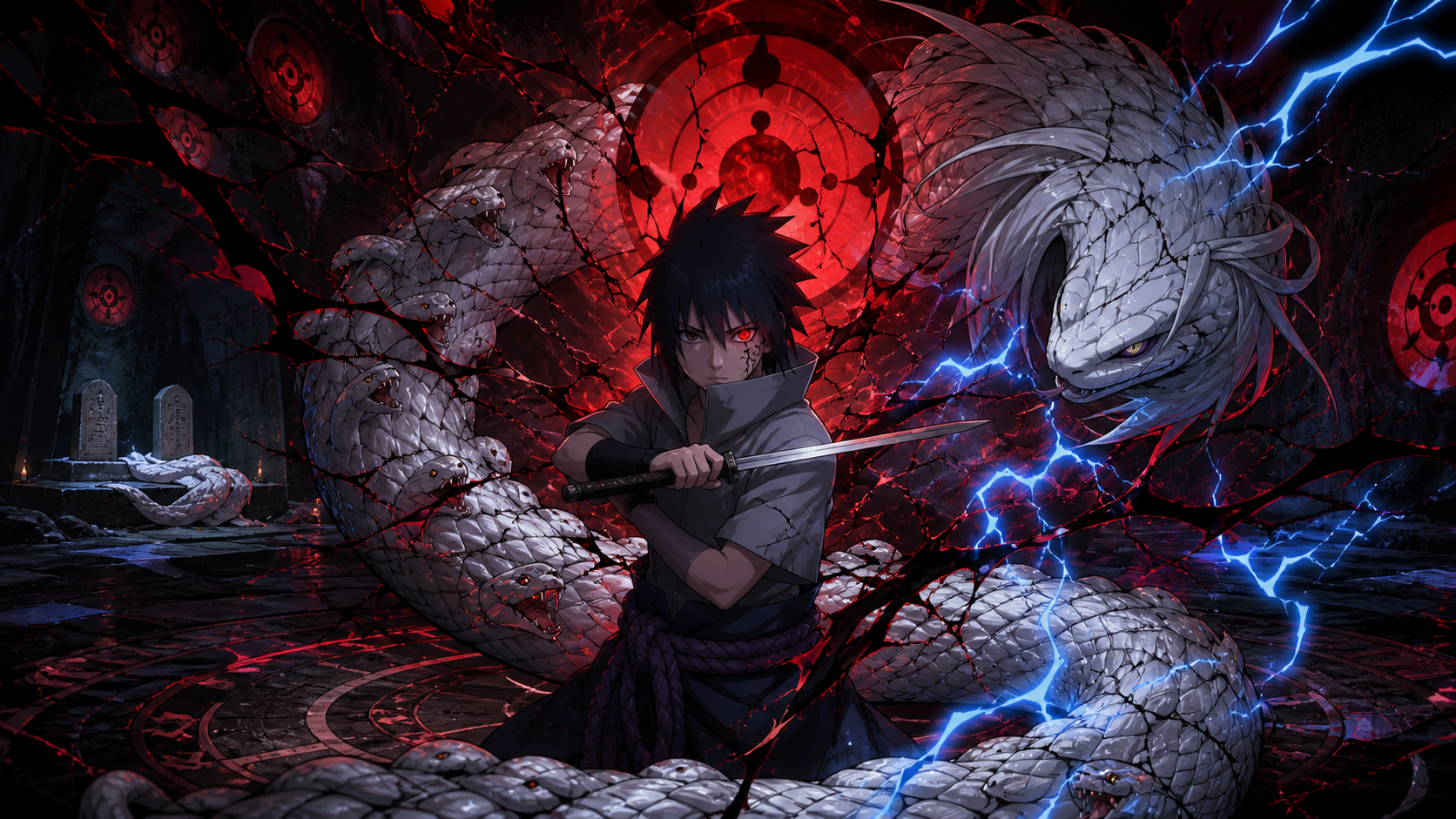
Eye of the Hawk
Orochimaru finally tries to collect Sasuke’s body, and the eye he coveted becomes the weapon that cages him.
What happens
Orochimaru's borrowed body reaches its limit, so he abandons the human shell and reveals the white-serpent form beneath it. The creature is not a single elegant snake. It is a mass of smaller serpents bound into one body, a fitting image for an immortality technique built from stolen lives.
He attacks Sasuke and begins the transference ritual, confident that the Sharingan he has coveted for years will finally become his. The confrontation moves from the physical hideout into Orochimaru's inner ritual space, where previous vessels remain trapped inside the architecture of his continued existence.
Orochimaru remembers finding a shed white snakeskin near his parents' grave. The symbol offered him the fantasy of rebirth and escape from death. Grief did not force him to build a system of possession, but it gave his obsession a beginning he could keep calling destiny.
For a moment, Sasuke appears to lose his freedom inside the ritual. Orochimaru believes the pupil has become the next vessel. The Sharingan changes the balance. Sasuke turns the mental battlefield against him, suppressing the serpent rather than surrendering his body.
Grief is an origin, not an excuse
The glimpse of Orochimaru's parents' grave is useful because it makes his obsession understandable without making it acceptable. A child encounters death, sees a discarded snakeskin, and imagines a form of renewal. That is human. Turning generations of other people into disposable containers is a choice.
Orochimaru repeatedly treats fear of mortality as proof of intellectual superiority. Everyone else accepts death because they lack imagination; he alone pursues every technique. Eye of the Hawk exposes the panic beneath that posture. His empire exists because one bereaved child never learned to tolerate an ending.
The white snakeskin also becomes a lie. A snake sheds skin but remains the same living body. Orochimaru's ritual does something else: it destroys another person's autonomy so his consciousness can continue. Calling possession rebirth launders violence through natural imagery.
The ritual room keeps receipts
The transference space reveals that previous hosts were not empty containers. Their presences remain caught inside Orochimaru's consciousness. His immortality is crowded with the people he erased.
That detail matters more than the spectacle. Orochimaru speaks as though identity transfers cleanly from an old vessel to a new one, but the ritual shows residue, resistance, and accumulated damage. Every stolen body leaves evidence.
Sasuke enters that space with an advantage Orochimaru desired too much to evaluate honestly. The Sharingan does not merely improve physical reactions. It can dominate the perceptual battlefield on which Orochimaru's ritual depends. The eye he wanted becomes the tool that cages him.
Sasuke refuses collection
Sasuke knew the training arrangement had an expiration date. He accepted the curse mark and Orochimaru's instruction because revenge against Itachi consumed every other priority. None of that creates consent to bodily possession.
His refusal is therefore justified even if his broader choices remain dangerous. Orochimaru cannot point to years of training and claim ownership. Mentorship does not become a deed to the student's body.
Sasuke's victory also reveals how badly Orochimaru misread him. He assumed hatred made the boy controllable. Sasuke's hatred made him willing to enter the hideout, but it also made him ruthless about removing anything that delayed the fight with Itachi. Once Orochimaru became weaker than useful, the alliance ended.
The title calls Sasuke the hawk rather than another serpent. He learned inside the nest without becoming the same animal. A hawk watches from distance, identifies vulnerability, and strikes when the opening is real.
RaeRae's reaction
This episode delivers one of the cleanest reversals in Shippuden. Orochimaru spends years staring at Sasuke's eyes as property, then loses inside the very visual power he wanted to steal. The appetite creates the blind spot.
I do not mistake Sasuke's resistance for a complete moral redemption. He trained in a network built on imprisonment and experimentation, and his revenge still outranks nearly every relationship in his life. Defeating one predator does not repair those choices.
But bodily autonomy is not a reward reserved for morally perfect people. Orochimaru had no right to Sasuke's body, full stop. The fact that Sasuke made reckless bargains does not convert attempted possession into a fair consequence.
The white-serpent form is wonderfully ugly. It removes the cultivated voice and theatrical face, leaving an organism assembled from endless consumption. Orochimaru wanted transcendence and built dependency instead: new hosts, medicine, Kabuto's labor, secret facilities, and a ritual crowded with victims.
His childhood memory makes the result sadder because the original wish was so small. He wanted death not to be final. Instead of grieving, connecting, or leaving knowledge for other people, he decided continuity only counted if his own consciousness never stopped.
Sasuke's Sharingan answers that selfishness with another form of control. That is not entirely comforting. He wins by dominating the inner space and absorbing Orochimaru's power into himself, which means the serpent's influence does not simply vanish.
Still, the pupil breaks the teacher's assumption that instruction creates ownership. Sasuke took the lessons, measured the weakness, and refused collection. Orochimaru finally meets a vessel capable of looking back.
Eye of the Hawk earns its title at the instant the predator realizes he chose prey with sharper vision. The victory belongs to Sasuke, but the aftermath will test whether he can use freedom for anything beyond the revenge that led him into the den.
Orochimaru finally becomes the creature his philosophy built
My bottom line is that the white-serpent form tells the truth more clearly than Orochimaru ever does. He wanted viewers, students, and victims to see refinement, knowledge, and transcendence. Under the borrowed face sits a body assembled from consumption. The elegant immortality project is a nest of smaller lives bound around one appetite.
The transformation matters because horror should reveal method, not merely ugliness. Orochimaru survives by taking bodies, stealing techniques, maintaining laboratories, and using other people as supplies. The serpents make that dependency visible. He calls himself singular while physically existing as accumulation.
The parents’ grave explains the fear without pardoning the response
A child standing near his parents’ grave and finding shed snakeskin can reasonably imagine renewal. Grief often searches for a sign that separation is temporary. The episode gives Orochimaru a human beginning, which makes the later choices more disturbing. He experienced loss and decided nobody else’s life could matter more than escaping his own ending.
Plenty of grieving people do not build possession rituals. Pain influences a person without removing responsibility. Orochimaru repeatedly chose secrecy, experimentation, imprisonment, murder, and stolen bodies. The grave is context. The laboratory is character.
The snakeskin metaphor was always dishonest
A living snake sheds an outer layer while the same body continues. Orochimaru’s technique requires another human body, suppression of another consciousness, and destruction of another future. Calling the process shedding makes theft sound natural. The metaphor hides the victim.
Episode 114 breaks that disguise inside the ritual space. Previous hosts remain present. Their faces and consciousness leave residue. Orochimaru did not move cleanly through empty shells. His continuity contains the people he tried to erase.
The ritual space is an archive of unwilling witnesses
The former vessels prove that possession does not become complete simply because Orochimaru controls the body. Something remains, even if the victim cannot return to ordinary life. Their presence turns his inner world into a record of crimes he carries everywhere.
Sasuke enters that archive as the intended next entry. His resistance gives the earlier victims a form of belated recognition because the ritual can no longer pretend every vessel surrendered without consequence. The space fights back through the eye Orochimaru coveted.
The Sharingan exposes an appetite that defeated judgment
Orochimaru knew the Sharingan could control perception and dominate mental exchanges. He still believed desire gave him the advantage. Years of fixation narrowed his evaluation until Sasuke’s eyes became treasure rather than danger. The trait he wanted most was precisely suited to contest the ritual.
That blindness is not bad luck. Obsession changes how people process evidence. Orochimaru watched Sasuke grow stronger, colder, and less dependent. He interpreted every warning as proof that the future vessel was becoming more valuable.
Sasuke’s refusal does not need moral perfection
He deserted Konoha, accepted Orochimaru’s training, ignored prisoners, and placed revenge above relationships. Those choices deserve criticism. None gives Orochimaru a right to erase him. Bodily autonomy does not become available only after a person behaves well enough.
This point matters because stories often frame reckless bargains as consent to unlimited consequences. Sasuke accepted danger and instruction. He did not agree to stop existing. Even if Orochimaru announced the intention from the beginning, a teenager’s desperate calculation cannot make possession ethical.
The student learned the teacher’s weakness along with the techniques
Sasuke spent years close enough to study Orochimaru’s cycles, symptoms, arrogance, and dependence on Kabuto. The hideout gave him power, but proximity also gave him information. Orochimaru believed training would make the vessel ready. Training made the intended vessel capable of identifying the collection date.
The reversal fits the best kind of pupil story. Sasuke does not win because the teacher suddenly forgets every skill. He wins because he watched, prepared, and attacked the assumption under the technique. Orochimaru never imagined the body could become the hunter.
The hawk title marks separation without guaranteeing freedom
A hawk differs from a serpent in movement, distance, and sight. Sasuke claims a new identity because he refuses to remain inside Orochimaru’s category. The title signals independence before he forms Hebi and later Taka, yet a new name cannot automatically remove learned habits.
He may reject physical possession while carrying the teacher’s instrumental logic. His coming team can become partners or tools depending on how he treats their separate goals. Escaping the den is one act. Refusing to reproduce the den takes longer.
Kabuto should not be allowed to call this a medical failure
The current vessel’s collapse and the failed transfer are not technical accidents. The system produced both outcomes. Kabuto kept a stolen body functioning beyond its limits and supported a ritual against an unwilling target. Better dosage would not make the plan humane.
His fascination with the result reveals the problem. Whether Orochimaru wins or Sasuke reverses the ritual, Kabuto receives information. Curiosity gives him a reason to remain close while other people absorb the consequences.
The current host deserves a name even if the story withholds one
Calling the person a vessel repeats Orochimaru’s language. Before possession, the body belonged to somebody with relationships, history, fear, and plans. The episode cannot restore that life, but viewers can refuse the convenient fiction that an empty shell happened to fail.
Sasuke’s successful resistance should deepen that recognition. He survives because he is powerful enough to enforce a boundary. The unnamed hosts deserved the same boundary without needing a Sharingan.
Absorbing Orochimaru creates a different risk
Sasuke suppresses the serpent within himself rather than removing every trace. That victory grants access to power while keeping danger close. The arrangement resembles his earlier use of the curse mark: take the useful part, trust control, and postpone the cost.
Confidence may be justified in the moment, but internal containment is not the same as permanent safety. Orochimaru has survived through patience and hidden mechanisms before. Sasuke needs to understand what remains inside him instead of assuming domination ended the problem.
The victory changes the hideout’s power structure instantly
Prisoners, guards, experiments, and subordinates lived under Orochimaru’s authority. His apparent death creates uncertainty for everyone. Sasuke can leave, free people, recruit selected prisoners, or ignore the system once it no longer serves him. Those choices will reveal what freedom means to him.
A teenager escaping possession does not automatically become responsible for repairing an entire criminal network. He still holds power over people confined nearby. Walking past their cages would continue the selective empathy that revenge has encouraged.
Sasuke and Naruto are fighting different versions of ownership
Naruto just defended Yukimaru from adults who valued a child’s connection to a tailed beast. Sasuke defends his body from a teacher who values the Sharingan. Both conflicts ask whether power inside a young person turns that person into a resource.
The parallel does not make their paths identical. Naruto builds relationships and accepts help. Sasuke isolates himself and turns on the predator when the bargain expires. Their eventual confrontation will carry two different answers to a world that keeps assigning children a use.
The episode’s quiet horror deserves room after the reversal
The exciting part is watching Orochimaru lose inside the eye he wanted. The disturbing part comes afterward. Sasuke now carries some trace of the man who tried to erase him. The former vessels remain gone. Kabuto survives with knowledge. The laboratories still exist.
A clean celebration would hide those consequences. Victory prevents another possession and changes the balance of power. Victory does not restore the people already consumed.
RaeRae’s final word on the hawk
I enjoy the reversal because Orochimaru’s obsession defeats his judgment. He stared at the Sharingan for years and saw property. He should have seen the precise weapon capable of taking control of the inner space where he planned to win.
The childhood grave matters, but I refuse to let grief carry blame for the empire that followed. Orochimaru chose every prison, experiment, body, and ritual. Fear of death explains the hunger. The victims explain why the hunger must be stopped.
Sasuke is not clean because he refuses possession. He ignored too much suffering while taking what he needed from the hideout. He still owns his body completely. Both statements remain true, and the episode is stronger when nobody trades one for the other.
The hawk sees the opening and strikes. The next question is whether Sasuke can build a future that contains more than the target he has watched for years. Killing the teacher ends the collection. Learning not to treat others as equipment will decide whether the pupil truly leaves the serpent behind.
The ritual depends on making the victim feel inevitable
Orochimaru spent years telling Sasuke, directly and indirectly, that revenge required this path. The curse mark, isolation, training, and approaching transfer created a sense that the final encounter had already been decided. Possession works psychologically before the ritual begins when the target believes no alternative exists.
Sasuke breaks that pressure by planning inside the deadline. He never accepts inevitability as consent. The reversal matters for every former host who faced the same room without enough power, information, or preparation to resist.
Power changes the outcome without changing the right
Sasuke survives because the Sharingan gives him an advantage inside Orochimaru’s mental space. That fact can accidentally suggest only a powerful victim deserves freedom. The moral boundary existed before Sasuke activated his eyes. Every intended vessel had the right to refuse, including people whose resistance failed.
The distinction between a right and the power to enforce it matters throughout Naruto. Shinobi institutions often recognize claims only after strength makes ignoring them expensive. The episode can celebrate Sasuke’s victory while remembering the people the system never allowed to win.
Kabuto must decide whether loyalty survives the result
When Sasuke emerges, Kabuto needs to judge whether Orochimaru is dead, suppressed, transformed, or waiting inside the new body. His medical skill cannot provide a simple answer because identity has become entangled with the ritual. Attacking Sasuke might destroy the master he wants to protect. Waiting may give the pupil time to leave.
That uncertainty reveals the cost of serving a person who treats bodies as interchangeable. Kabuto cannot know where loyalty should point once the face, chakra, and consciousness stop aligning cleanly.
Sasuke’s first actions after freedom become evidence
The duel proves that he can resist ownership. The next choices show what he thinks freedom permits. He can kill witnesses, abandon prisoners, demand obedience from recruits, or offer people terms they can refuse. Power over the hideout gives him an immediate opportunity to repeat or reject Orochimaru’s methods.
Suigetsu, Karin, and Jugo will each test that difference. They have their own histories, abilities, fears, and goals. Calling them a team will mean little if Sasuke treats their consent as another obstacle to his revenge.
The eye metaphor includes the danger of tunnel vision
A hawk sees a distant target with extraordinary clarity. That focus helps Sasuke identify Orochimaru’s weakness and move at the correct moment. The same focus can narrow the world until everything outside Itachi becomes background. Vision becomes dangerous when precision about one goal replaces awareness of every consequence around it.
Sasuke needs distance from the serpent, but he also needs a wider field of view. The prisoners, teammates, village, and truth behind the Uchiha massacre will not fit inside a plan built around one brother alone.
The reversal is satisfying because the coveted trait remains personal
Orochimaru talks about bloodlines as collections of functions. The Sharingan represents prediction, copying, control, and access to techniques he wants. For Sasuke, the eyes also carry family, massacre, grief, identity, and the burden of being one of the last Uchiha. The same trait means more than its combat use.
When Sasuke turns the Sharingan against possession, he reclaims that meaning from a collector. Orochimaru cannot separate the power from the person and expect the person to disappear quietly. The eye looks back with a history the buyer never respected.
Orochimaru wanted a perfect container. Sasuke remained a person who watched, planned, remembered, and refused. That difference breaks the ritual because human beings do not ever become empty when another person names them property inside a room built for erasure.
RaeRae’s call
Orochimaru wanted the Sharingan as property and lost inside its gaze. Sasuke’s reckless bargain deserves scrutiny, but no bargain transfers ownership of a human body.