
The Serpent’s Pupil
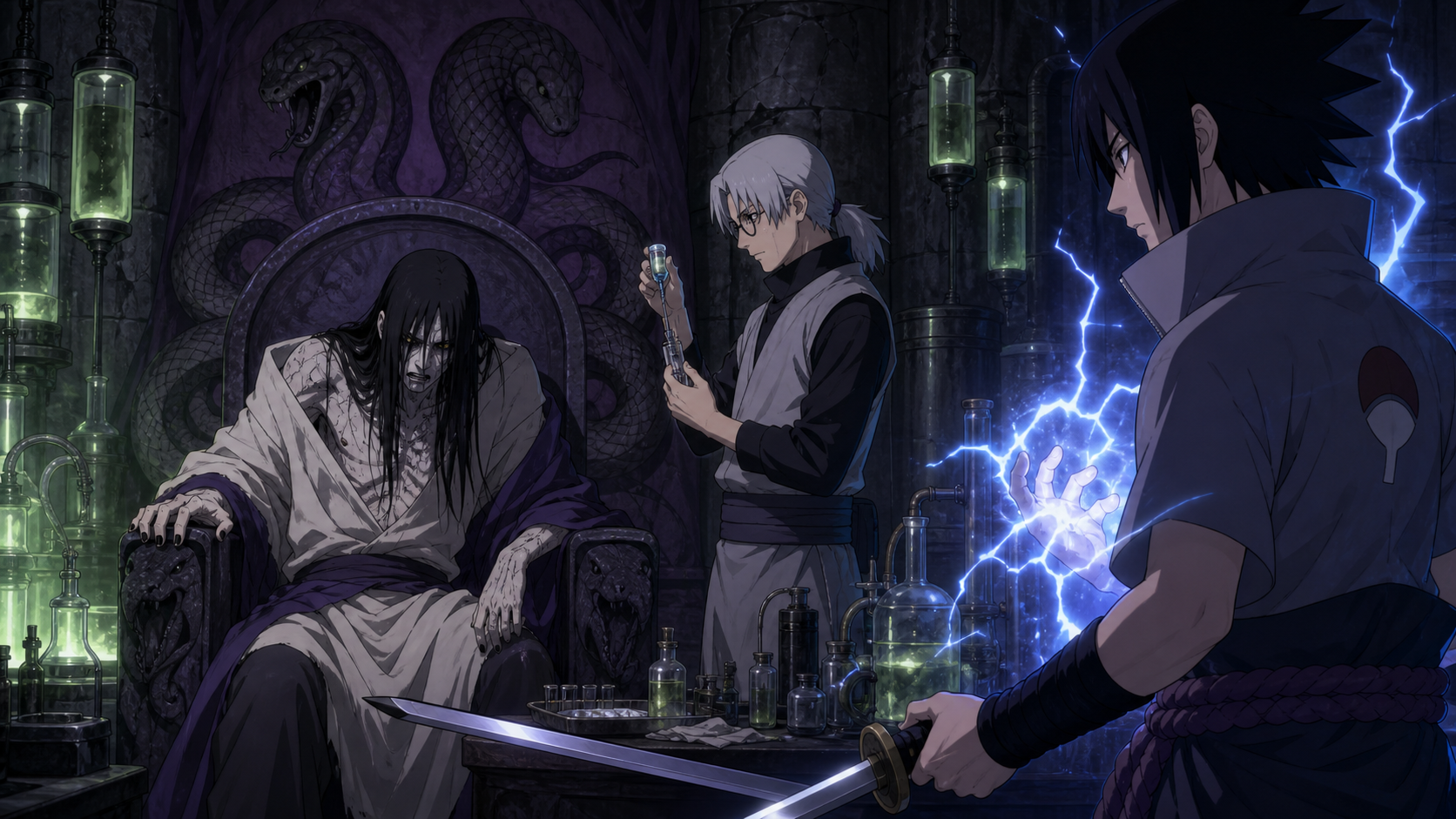
Orochimaru’s borrowed body is collapsing, Kabuto is buying time with extreme medicine, and Sasuke knows the collection date has arrived.
What happens
The story returns to Orochimaru's hideout, where his borrowed body is failing faster than medicine can disguise. Kabuto administers level-ten medication simply to keep him functioning. The treatment does not promise recovery. It buys time for the body-transfer ritual Orochimaru has always intended to perform on Sasuke.
Sasuke notices the change. He has spent years training under a predator while planning never to become obedient prey. Orochimaru's pain makes the deadline visible: if the master wants Sasuke's body, he has to act soon. Sasuke therefore prepares for the confrontation he has postponed while building enough power to survive it.
Kabuto remains fascinated by Orochimaru's potential even while watching the current vessel decay. That devotion says plenty about the hideout's ethics. A body can split, weaken, and require extreme medication, yet the experiment continues because Orochimaru treats identity as something that can be moved into the next container.
The episode shifts Shippuden away from the lake and back toward Sasuke's central bargain. He accepted Orochimaru's training to kill Itachi, but never promised permanent loyalty. The Serpent's Pupil asks whether the pupil has now learned enough to kill the teacher before becoming his next skin.
A body treated as equipment
Orochimaru's suffering is not random illness. It is the consequence of a system built on stolen vessels. His immortality technique promises continuity for the mind by treating other people's bodies as replaceable equipment. The current host is reaching its limit, and the level-ten medicine only maintains the theft until another can begin.
Kabuto's medical skill makes this possible. He is not simply easing pain. He preserves Orochimaru long enough to perform another violation. The distinction matters because clinical competence does not become ethical merely because it keeps a patient alive.
The hideout turns medicine into infrastructure for possession. Vials, monitoring, and precise dosage create an appearance of care, but the entire room serves a man preparing to erase somebody else's bodily autonomy.
Sasuke knew the price
Sasuke was never naïve about Orochimaru's interest. He understood that the curse mark, training, and shelter came with an intended claim on his body. His strategy was to take whatever power he needed and refuse payment when Orochimaru tried to collect.
That plan is dangerous because confidence does not cancel the transference technique. Orochimaru has consumed other hosts and accumulated knowledge across their deaths. Sasuke may be stronger than the current body, but he still has to face the consciousness and methods behind it.
The relationship contains no trust. Orochimaru assumes desire for revenge will keep Sasuke available. Sasuke assumes Orochimaru's arrogance will give him enough time to surpass the master. Every lesson has therefore been part education and part countdown.
The title positions Sasuke as a pupil, but not a disciple. He learned serpent methods without accepting serpent worship. What remains uncertain is how much of the teacher's logic entered him along with the techniques.
Kabuto watches the succession
Kabuto's reaction is one of the episode's most revealing details. He can see Orochimaru deteriorating and still marvel at what may come next. His loyalty attaches to potential, experimentation, and transformation more than to the suffering person in front of him.
That makes him difficult to read through ordinary devotion. If Orochimaru survives through Sasuke, Kabuto gains access to a stronger master and a new experiment. If Sasuke resists, Kabuto gets another crisis to study. Curiosity keeps replacing any moral boundary.
He also understands both men well enough to sense the collision approaching. The physician standing between predator and pupil is not neutral. His medicine keeps the predator alive until the trap can close.
RaeRae's reaction
I love the change in atmosphere after the noisy Three-Tails battles. The danger moves indoors, lowers its voice, and becomes more intimate. Orochimaru can barely sit upright, yet the room still feels built around his appetite.
The level-ten medication detail is nasty in the right way. It tells us how far the body has deteriorated without needing gore. Kabuto is maintaining a collapsing vessel because the next theft is almost ready. That is medical horror with paperwork.
Sasuke's calm is more threatening than a dramatic declaration. He has watched, trained, and measured the weakness. Orochimaru believes revenge made the boy predictable, but Sasuke's hatred was never loyalty. It was a temporary alignment of interests.
I do not romanticize Sasuke's choice to join him. He walked into a laboratory full of prisoners and accepted training from a man who treated human life as supplies. Trauma explains why revenge narrowed his vision; it does not make every consequence disappear.
At the same time, Orochimaru does not own him because the bargain was reckless. Sasuke's body remains his. The planned transfer is not a clever tuition payment. It is attempted annihilation dressed as mentorship.
The episode also exposes the weakness inside Orochimaru's idea of immortality. He calls himself enduring, but his continuity depends on medicine, assistants, stolen bodies, secrecy, and perfectly timed replacement. That is not independence. It is an empire of maintenance built around terror of death.
Sasuke threatens that empire because he learned from it without believing in it. His coming rebellion will not automatically make him morally clean, but it will force Orochimaru to confront a pupil who refuses to remain property.
The Serpent's Pupil works as a hinge. The Three-Tails operation showed Orochimaru's network exploiting vulnerable children at a distance. Now the story returns to the child he selected as his ultimate vessel. The experiment is no longer somewhere else. It is standing in the doorway with a sword and enough lightning to say the lesson is over.
The master planned a harvest, not a graduation
My bottom line is that Orochimaru never trained Sasuke for Sasuke’s future. Every lesson, curse-mark adjustment, and opportunity to test new power prepared a body Orochimaru intended to occupy. Calling the relationship mentorship only describes the surface. The teacher’s final exam is whether the student can be consumed.
Sasuke understood the threat from the beginning, but knowledge does not create consent. A desperate teenager can enter a dangerous arrangement and still retain the right to his body. Orochimaru cannot turn training into ownership by claiming the price was obvious. The transfer ritual remains attempted annihilation.
The borrowed body is evidence, not an unfortunate side effect
Orochimaru’s current vessel is collapsing because another person’s body was forced to carry a consciousness and chakra that did not belong there. The pain, medicine, and physical instability expose the cost hidden beneath his promise of immortality. Somebody else already disappeared so he could occupy that room.
The episode focuses on Orochimaru’s suffering, but the previous host should remain present in the viewer’s understanding. A vessel is a person before the technique erases the name. The body’s failure is not betrayal of Orochimaru. The failure is evidence that the entire process violates living material and calls the damage maintenance.
Kabuto practices medicine without a duty to the vulnerable
Level-ten medication sounds impressive until the purpose becomes clear. Kabuto is not guiding a patient toward recovery. He is keeping Orochimaru functional long enough to seize another body. The treatment serves continuity of power rather than the welfare of the person receiving or losing that power.
Kabuto’s precision makes the scene colder. He watches symptoms, calculates dosage, and understands risk. None of that knowledge produces a boundary. Skill cannot substitute for ethics. A brilliant medic who helps one patient destroy another person’s autonomy is not neutral support.
Orochimaru’s immortality depends on exhausting hidden labor
He presents himself as a genius who defeated ordinary human limits. The hideout tells another story. Kabuto mixes medicine, monitors deterioration, manages experiments, and keeps secrets. Prisoners supply bodies and data. Subordinates defend locations. Stolen vessels absorb the physical cost. Orochimaru’s supposed independence requires an entire system of people doing dangerous work around his fear of death.
That dependency matters because power often hides maintenance. The immortal serpent still needs dosage schedules, clean facilities, assistants, replacement candidates, and perfect timing. Sasuke threatens the system by refusing to arrive as obedient inventory.
Sasuke built his own countdown inside Orochimaru’s deadline
Orochimaru waited for the current vessel to fail. Sasuke waited to become strong enough to kill him. Both men believed time favored their plan. Episode 113 brings those clocks together. Medicine can only delay the transfer, and Sasuke can no longer assume another season of training remains available.
His preparation therefore looks less like sudden rebellion and more like the final stage of a dangerous strategy. He watched Orochimaru’s strength, learned the hideout, tested his own techniques, and kept emotional distance. The plan may still fail because Orochimaru has survived other hosts and collected methods Sasuke has not seen.
Knowing the predator does not remove the harm of living beside him
Sasuke chose the hideout and understood the risk, but the surrounding prisoners did not become irrelevant. He trained inside a system where human beings were confined, altered, and discarded. Revenge narrowed his concern until another person’s suffering could become background. That moral cost belongs in any honest account of his strategy.
Explanation is not absolution. Sasuke was traumatized, manipulated by Itachi’s violence, failed by adults, and convinced power was the only road to justice. Those conditions make his decision understandable. They do not make every choice inside the hideout harmless.
The curse mark remains a claim Orochimaru placed on his body
The mark increased Sasuke’s power while creating pain, dependency, and a visible connection to the teacher who wanted him. Orochimaru could interpret every use as proof that Sasuke accepted the system. Sasuke interpreted the same mark as stolen power he would eventually turn against its source.
Neither interpretation changes the mark’s origin. Orochimaru imposed a dangerous technique on a child during the Chunin Exams. Later choices happened after that violation shaped the available path. Consent given under threat, revenge, and engineered dependency deserves scrutiny.
Sasuke’s calm should not be mistaken for health
He looks controlled because he has compressed nearly every need into killing Itachi. That focus can produce discipline, but the absence of visible panic does not mean the arrangement caused no damage. Living beside a man who plans to steal your body requires constant vigilance. Every lesson carries the question of when the teacher will attack.
The sword and lightning reveal preparation, not peace. Sasuke has built enough control to act when the deadline arrives. What happens after Orochimaru falls remains unresolved because revenge still defines the next destination.
Orochimaru mistakes access for ownership
He gave Sasuke training, shelter, information, and opportunities unavailable in Konoha. Those contributions do not purchase the student. A teacher can be valuable and abusive at the same time. Gratitude never transfers bodily autonomy.
Orochimaru’s mistake reflects the same logic used on Yukimaru. Provide attention, shape dependency, identify desire, and then call obedience the natural return. Guren broke that logic at the lake. Sasuke is about to break it inside the hideout.
Kabuto’s loyalty is tied to possibility more than affection
Kabuto may care about Orochimaru, but his fascination keeps centering the experiment. A successful transfer into Sasuke would create a stronger vessel, new abilities, and more data. The current body’s suffering becomes interesting because the next transformation may be spectacular.
That orientation explains why he can stand near so much pain without demanding an end. Curiosity has replaced the moral question. He wants to see what happens. People become bearable losses when every crisis offers another discovery.
The hideout’s quiet makes the violence harder to avoid
The Three-Tails arc filled the screen with water, barriers, transformed fighters, and explosions. Episode 113 moves danger into a room where breathing, medicine, footsteps, and a drawn sword carry the tension. Nobody can hide possession behind battlefield chaos.
The smaller space also makes the relationship personal. Orochimaru has watched Sasuke grow while anticipating the body as his future home. Sasuke has accepted instruction while planning murder. Their calm conversation sits over mutually exclusive plans.
Sasuke is a pupil because he learned where the teacher is weak
A successful student absorbs more than techniques. Sasuke learned Orochimaru’s habits, arrogance, timing, physical limits, and dependence on Kabuto. That knowledge may be the most valuable part of the training. The teacher believed proximity would deepen control, but proximity gave the intended vessel a map.
The question is what else Sasuke learned. Orochimaru treats people as tools and power as the answer to vulnerability. Sasuke rejects becoming a vessel while still using Karin, Suigetsu, and Jugo strategically in the episodes ahead. Killing the teacher does not guarantee escape from the teacher’s logic.
The coming fight is also a dispute over whose future counts
Orochimaru imagines Sasuke’s future as an extension of his own life. Sasuke imagines a path to Itachi that requires Orochimaru’s death. Neither plan includes mutual survival. The conflict cannot be solved through compromise because one future requires the erasure of the person whose body carries it.
Sasuke’s claim is morally stronger at the point of bodily autonomy. His body is not payment. His larger revenge plan still deserves criticism. The episode can hold both judgments without flattening him into innocent victim or heartless avenger.
The Leaf’s failure helped create the opening Orochimaru used
Konoha knew Orochimaru targeted Sasuke and knew the curse mark placed him at risk. The village offered care and surveillance, but Sasuke remained consumed by a massacre whose truth adults concealed. He saw institutional patience as another demand to wait while Itachi remained free.
That history does not make defection inevitable. The Sound Four, curse mark, and Orochimaru’s promises manipulated his desperation. Still, a village asking why a child left should examine what the child believed was unavailable at home.
RaeRae’s final word on the serpent’s pupil
I love the atmosphere because Orochimaru’s body finally tells the truth his confidence hides. Immortality smells like medicine, requires an assistant, and lives on a deadline. The current vessel is failing under a theft that was never sustainable.
Kabuto can call the treatment advanced all day. He is keeping one man alive so that man can erase another person. Medical skill serving possession is not care. The neat dosage only organizes the violence.
Sasuke deserves criticism for what he ignored inside the hideout. Prisoners and experiments did not stop existing because his revenge felt urgent. He also deserves complete ownership of his body. A reckless bargain with a predator does not authorize the predator to collect a human being.
The title lands because the pupil learned enough to recognize the collection date and enough to resist. Killing Orochimaru will not make Sasuke healthy, healed, or morally clean. The rebellion still matters. The intended vessel stands in the doorway with a sword and tells the immortal teacher that this body already has an owner.
A failing vessel creates danger for everyone nearby
Orochimaru’s collapse is not contained inside his body. Pain may make him impatient, suspicious, or willing to begin the transfer before conditions are ready. Kabuto’s medication may produce side effects. Prisoners and subordinates may face punishment for delays they cannot control. Sasuke understands that the final stage will destabilize the entire hideout.
His plan therefore needs more than confidence in a duel. He should know exits, guard patterns, prisoner locations, and what Kabuto can do if the transfer fails. A victory that leaves him trapped inside a collapsing facility would prove the strategy incomplete.
Kabuto has reasons to fear Sasuke and reasons to watch
Sasuke threatens Orochimaru, the experiment, and Kabuto’s place beside the master. Stopping him early would appear logical. Curiosity complicates the decision. Kabuto wants to see whether the pupil surpasses the teacher and what a struggle reveals about both bodies. Observation keeps him near danger he could try to prevent.
That tension makes Kabuto more than a loyal medic. He protects Orochimaru while preserving access to outcomes that fascinate him. The person on the examination table and the teenager in the doorway become competing research opportunities.
Sasuke’s sword makes the refusal physical
Orochimaru planned to cross the boundary of Sasuke’s body through a ritual. Sasuke answers by drawing a weapon that establishes distance. The sword says the approach will not be passive, private, or disguised as instruction. Any attempt to collect the vessel must pass through resistance.
The visual is satisfying because Sasuke does not need to argue about the original bargain. A person can revoke access. The predator’s investment does not overrule the refusal.
The episode should remember the unnamed vessels
Orochimaru’s current body once belonged to somebody with a history, relationships, preferences, and fear. Earlier vessels did too. The technique encourages viewers to use the villain’s language and see containers rather than erased people. The failing host should interrupt that convenience.
Sasuke’s resistance matters partly because countless others could not resist successfully. His strength does not make his autonomy more valuable than theirs. Strength only gives him a chance to enforce the boundary the others also deserved.
Defeating the teacher will leave the lesson inside the pupil
Sasuke can kill Orochimaru and still carry habits learned in the hideout: secrecy, instrumental relationships, contempt for weakness, and willingness to treat people as steps toward revenge. The next test begins after the duel. He will recruit a team and decide whether those people are partners or equipment.
That consequence keeps the episode from becoming a simple liberation story. Escaping possession is necessary. Refusing the possessor’s worldview requires repeated choices after the immediate threat disappears.
Orochimaru taught Sasuke to distrust every bond. The pupil’s freedom will depend on learning that trust can be chosen without surrendering control of his future.
RaeRae’s call
Orochimaru trained Sasuke as a future vessel, not an independent successor. Sasuke can be responsible for entering the hideout and still retain an absolute right to refuse bodily erasure.