
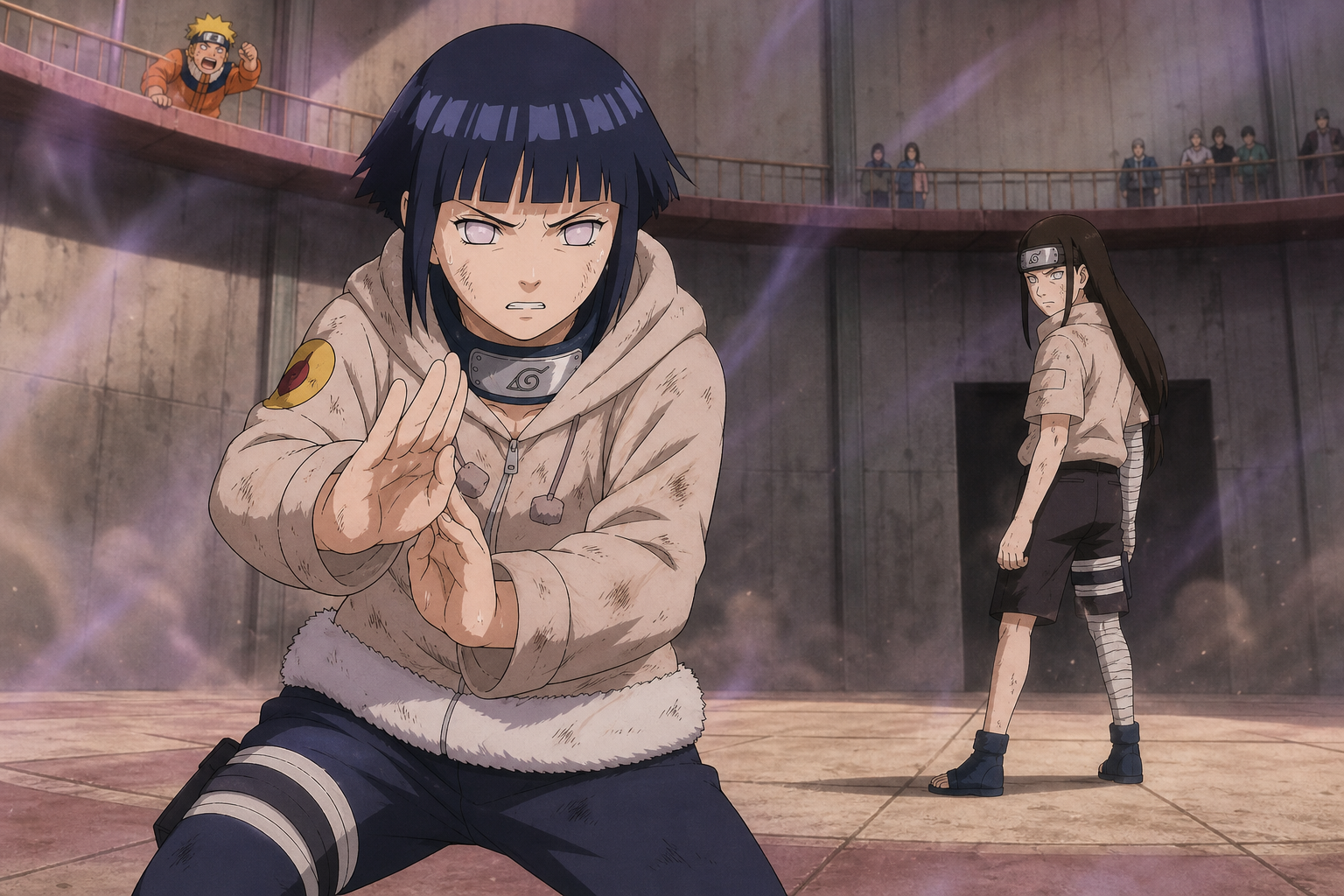
A Failure Stands Tall!
Hinata does not win the match. She does something more dangerous to Neji’s worldview: she keeps standing after his perfect reading says she should stop, then names the fear hiding inside his certainty. The adults finally intervene when family philosophy becomes attempted execution. A little late, babes.
Episode 47 refuses to confuse endurance with victory. Hinata is outmatched by Neji, whose Byakugan and Gentle Fist close her chakra points and place her internal organs at risk. She keeps standing because she wants one decision in her life to belong to her, not because pain has become harmless.
Neji wins the official match and loses control of the story he tells about himself. Hinata recognizes that his fatalism is also a wound. When she says so, his calm breaks and four adults move to stop him. The scene exposes the difference between skill and freedom, between courage and self-destruction, and between adults watching children suffer and adults finally accepting responsibility.
Gentle Fist makes invisible injury the point
Neji uses the Byakugan to see Hinata’s chakra pathway system and targets the tenketsu that regulate chakra flow. His palms do not need to produce the largest external impact. Precision lets him disrupt her from inside.
That difference matters for how the audience reads damage. Hinata can remain upright while her ability to circulate chakra collapses and her organs absorb injury. The absence of a spectacular wound does not make the harm light.
The Hyūga style is elegant because control has been trained into every movement. The consequence is still bodily invasion.
Neji has already mapped the ending he wants
Neji believes he knows Hinata’s capacity, temperament and family position. Each successful strike appears to confirm that she was foolish to resist his diagnosis.
His technical reading is excellent. His moral reading is trapped. He assumes that identifying limits gives him the authority to decide what another person should attempt.
When Hinata rises again, she does not prove the strikes failed. She proves Neji’s interpretation cannot account for a person choosing meaning inside defeat.
Hinata remembers a practice, not a motivational slogan
Hinata draws strength from memories of Naruto refusing to abandon his nindō. She has watched him fail, get mocked and return to the work. His example matters because it contains repetition, not because one sentence magically repairs her.
She recognizes something in his persistence that she wants to build in herself. That is identification before romance. Naruto becomes evidence that humiliation does not have to become obedience.
The memory gives Hinata a model. Her body still pays the invoice.
Standing is an act, not proof she should keep being hit
Anime loves an injured character rising again, and audiences often reward the image without asking whether continuation is wise. Episode 47 needs a stricter reading.
Hinata’s choice carries agency because Neji tried to decide for her. It also places her in escalating danger. Respecting courage does not require cheering every additional injury.
She deserves the right to refuse his verdict and the right to receive protection before refusal becomes fatal. Those rights should not cancel one another.
Naruto’s encouragement changes the social atmosphere
Naruto keeps calling from the balcony while the room watches Hinata exceed the identity assigned to her. His voice does not increase her chakra or undo closed points. It changes what is publicly available to believe.
Neji has filled the arena with one interpretation: Hinata is weak, fixed and destined to withdraw. Naruto creates a competing witness. Somebody sees her effort before the result can erase it.
Recognition cannot replace medical safety. It can prevent failure from becoming the only story the crowd keeps.
Hinata turns the Byakugan back toward Neji
Neji has used perception as dominance. Hinata eventually perceives him in return. She recognizes that his confidence is organized around pain, anger and fear of a fate he claims not to fear.
Her observation reaches somewhere a palm strike did not. Neji’s composure breaks because she separates the person from the doctrine he performs.
The supposedly weaker cousin sees what the prodigy did not want visible. Emotional perception becomes its own counterattack, though it cannot erase the physical skill gap.
Neji’s grievance is real and his target is wrong
The branch-family system controls Neji’s body and binds his labor to main-family protection. His anger has structural receipts. Hinata’s formal status places her on the benefiting side of that hierarchy.
She did not design the seal, choose the family roles or order the adults who shaped Neji’s childhood. Punishing her body cannot liberate his.
Oppression can explain why violence gathers. It does not automatically make the nearest vulnerable person an ethical target.
The adults reveal what they considered tolerable
When Neji moves beyond the concluded match toward a potentially lethal strike, multiple jōnin restrain him. Their speed proves they could intervene. The timing proves how much harm the exam was willing to observe first.
The preliminary is designed to test young fighters, so some injury is built into the institution. That does not remove adult responsibility for thresholds, medical response and family conflict.
The scene is dramatic because four skilled adults move at once. It is also an indictment. The system waits for attempted excess instead of addressing the conditions that made excess predictable.
Kurenai protects the student she has been watching grow
Kurenai Yūhi knows Hinata beyond the clan’s failure label. Her alarm has been present because mentorship includes attention to limits and consequence.
Intervening does not dishonor Hinata’s choice. It acknowledges that a teacher’s obligation continues after a student decides to be brave.
Support is not only cheering agency. Sometimes it is placing an adult body between a child and the next strike.
Hiashi’s watching cannot be separated from clan failure
Hinata’s father and the Hyūga elders belong to the authority structure that defined both children’s positions. Even when they are not directing each palm in the arena, the match carries consequences of their governance.
Hinata’s insecurity and Neji’s resentment did not appear from temperament alone. Family policy taught them what their bodies meant.
The adults may be surprised by what the children reveal. They should not be surprised that the institution produced conflict.
Defeat does not cancel the change Hinata made
Neji wins. Hinata does not advance. Any summary that turns the scene into a secret moral victory must keep the physical result honest.
She still changes the social record. Kiba, Shino, Kurenai, Naruto and the broader room see a teammate who refuses the version of herself Neji declared permanent.
A loss can contain evidence of growth without becoming a win. That distinction protects Hinata from inspirational padding.
Medical consequence follows the inspirational image
Hinata’s internal injuries require treatment. Gentle Fist damage does not disappear because her stand moved the audience.
This is where the series’ body politics matter. Shinobi institutions celebrate willpower and then rely on medical workers to keep the human cost from becoming permanent.
Courage creates meaning. It does not regenerate tissue.
Naruto’s blood vow converts witness into obligation
Naruto takes Hinata’s blood and vows to defeat Neji. The gesture is emotionally potent because he refuses to let the match close as private family business.
It also transfers the conflict into Naruto’s future bracket. He makes himself responsible for answering the worldview that tried to reduce Hinata.
The vow should not replace Hinata’s story with Naruto’s revenge. Its best meaning is solidarity: he witnessed harm and accepts a future duty to challenge the person and idea behind it.
Blood carries memory, not ownership
Naruto’s gesture can look possessive if treated as a hero claiming a fallen girl’s cause. The episode has done too much work on Hinata’s agency for that reading to stand unchallenged.
Her blood is evidence of consequence. Naruto uses it to bind himself to a promise, not to declare that her effort belongs to him.
The ethical test will be whether he remembers what she revealed about Neji rather than using her injury only as fuel for his own cool moment.
Japanese performance makes quiet persistence audible
Nana Mizuki performs Hinata in the original Japanese anime. Her weakened delivery keeps injury present while small returns of firmness mark each decision to stand.
Kōichi Tōchika lets Neji’s controlled tone fracture when Hinata identifies his own suffering. The change reveals that fatalism is not calm acceptance. It is emotional armor.
Junko Takeuchi makes Naruto’s support public, urgent and incapable of polite distance. His volume is useful because the room has normalized too much quiet cruelty.
A Confucian reading asks where family duty broke
Reciprocal family duty should place obligations on those with authority. The Hyūga arrangement demands service from the branch house and excellence from the main heir without supplying enough care, freedom or repair.
Neji responds by directing resentment downward and sideways. Hinata responds by turning judgment inward until this match. Both reactions show hierarchy operating without healthy reciprocity.
The children are asked to honor roles that adults have failed to make honorable.
A Buddhist reading separates pain from permanent self
Neji believes suffering has revealed an unchangeable truth about him and Hinata. Hinata’s repeated rising does not deny suffering. It denies that suffering gets the final word on identity.
Attachment appears in Neji’s certainty and Naruto’s desire to answer injury through victory. Neither feeling is simple. One freezes possibility. The other can become solidarity or another form of ego.
Hinata’s clearest act is present-tense choice. She cannot rewrite the clan in one match. She can refuse to let its verdict make the current decision for her.
Fandom misreadings I am rejecting
“Hinata wins morally, so the defeat does not matter.” The loss and internal injuries matter. Her growth matters too.
“Neji is right because he predicted the result.” Predicting a skill gap does not prove people cannot change or justify cruelty.
“Hinata should have known when to quit.” Safety is real, but Neji was using withdrawal as proof of permanent inferiority. The institution also owed her earlier protection.
“Naruto saved her.” He encouraged and witnessed. Hinata chose to continue; adults physically stopped the lethal escalation.
“The jōnin intervention proves the system works.” It proves a last threshold existed after substantial internal injury was already accepted.
“Hinata exposed Neji, so they are even.” Emotional insight does not equal the bodily harm or erase the branch-house structure.
What Episode 47 changes
Neji defeats Hinata after closing chakra points and inflicting dangerous internal damage. Hinata refuses to let the result validate his claim that she cannot change.
She identifies the fear beneath Neji’s fatalism, breaking his composure and provoking a lethal escalation that jōnin restrain. The adults reveal both their capacity to protect and the lateness of their threshold.
Naruto binds himself to a future challenge against Neji. Hinata leaves the bracket injured, defeated and no longer socially legible as the girl who always withdraws.
RaeRae’s verdict
Neji won the match and still needed four adults to keep his philosophy from becoming a murder charge. That is not serenity, sir. That is pain in a very neat outfit.
Hinata did not need the scoreboard to call her brave. She needed the right to stand, the wisdom to be protected and adults who should have noticed the family fire before two children carried it into an arena.
Standing tall does not require the body to remain unhurt
Hinata continues after Gentle Fist strikes have damaged her internally and closed chakra points. Her posture becomes a declaration because the body is already recording the cost. The courage is real. The harm should not become less urgent because she refuses to fall.
Endurance can reveal agency while hiding how badly intervention is needed. Adults must read both truths at once.
Neji keeps calling the present destiny because history feels immovable
He has lived inside a branch-family system that marks bodies, controls service, and turns birth into obligation. Fatalism gives that injustice an explanation large enough to feel inevitable.
When he applies the same verdict to Hinata, he converts a wound into authority over somebody else’s future. Understanding the origin does not excuse the harm.
Hinata refuses the identity assigned by the main family
She has been judged too gentle, too hesitant, and inadequate as an heir. The match gives those labels a familiar voice through Neji. Every time she rises, she chooses not to let family evaluation become final.
She does not need to win to make that choice true. Agency is visible in deciding what the loss will mean.
Naruto’s recognition changes the emotional audience
Hinata has watched Naruto persist while the village treated him as failure. His encouragement returns that witness. Someone she admires sees the fear and still expects possibility.
The support matters because it contradicts isolation, not because a boy’s approval creates her worth. Hinata supplies the action.
The blood at her mouth is evidence the crowd cannot safely ignore
Gentle Fist damage remains internal until the body forces it visible. Once Hinata coughs blood, persistence can no longer be read as proof that continuing is harmless.
The spectacle of bravery becomes dangerous when observers prefer inspiration to responsibility. Admiring her stand cannot replace stopping preventable injury.
Kurenai sees the student beneath the clan story
She understands how difficult it is for Hinata to choose visible confrontation and recognizes that the match means more than promotion. Her concern carries knowledge of the person, not only the technique.
A teacher’s care must still become action before admiration lets harm escalate beyond the student’s ability to consent meaningfully.
The jōnin intervene when Neji crosses from match to attack
Multiple adults restrain him as the emotional conflict exceeds the bracket. The speed of intervention proves they were capable of acting. The question is why the threshold required such extreme danger.
Rules can protect competition, but adults remain responsible for recognizing when personal history has changed the nature of the fight.
Neji’s rage exposes the emotion beneath his certainty
He presents destiny as objective truth, yet Hinata’s refusal unsettles him. If a person can change, then the family system that defined his suffering may not possess the final authority he granted it.
Anger protects fatalism from hope because hope would reopen grief and responsibility.
Hinata loses the match and defeats the old description
The result removes her from the exam, but the performance disproves the claim that hesitation defines every choice she can make. Loss and growth coexist without canceling one another.
A bracket measures who remains. It cannot measure whether a person has reclaimed the right to describe herself.
Naruto’s promise to beat Neji carries care and risk
He responds to Hinata’s injury by making the conflict his own. The promise honors what he witnessed and prepares his challenge to Neji’s worldview.
It can also redirect attention from Hinata toward a future battle between boys. Her stand should remain central even when Naruto carries its meaning forward.
Failure becomes a word the episode refuses to leave with authority
Hinata has been called failure by family structures that defined success through confidence, combat expectation, and heirship. Naruto knows the same word from the Academy.
Both expose how institutions use results to describe people. A failed match is an event. It is not a complete identity.
RaeRae’s final take
Episode 47 lets Hinata stand tall without pretending standing saved her from harm. She loses, bleeds, and requires adult intervention. She also refuses every person who treated fear as proof that her future was already written.
Neji’s fatalism comes from real oppression and becomes harmful when he uses it to deny her possibility. Naruto’s support matters because he recognizes the violence of being reduced to failure.
Hinata does not need the win for the episode to belong to her. She changes the meaning of the loss by choosing herself inside it.
Chosen endurance does not release adults from responsibility
Hinata wants to continue because the match has become a declaration that her family cannot define every choice. Respecting that agency matters. The adults still control the arena, understand Gentle Fist, and can see that internal damage is accumulating faster than courage can make it safe.
The false choice is between honoring Hinata and protecting her. Responsible intervention should do both. Stopping a match can acknowledge that the decision to stand was real while refusing to let an opponent turn that decision into permission for unlimited harm.
Waiting until Neji makes a final rush allows the spectacle to extract the maximum emotional proof from Hinata’s body. Viewers receive an unforgettable stand. She receives injuries that adults with greater knowledge might have limited sooner.
This is where fandom praise can repeat the institution’s mistake. Calling her inspiring should not require gratitude for every wound. The bravery belongs to Hinata. The preventable portion of the damage belongs to the people who had authority to act and delayed using it.
Her medical crisis continues after the bracket moves on
The match ends, but Hinata’s internal injuries do not obey the tournament schedule. Treatment, recovery, and the emotional consequence of confronting Neji remain part of the episode’s record even when the next names appear on the board.
A failed candidate can disappear quickly from an elimination story. RaeRae is keeping her visible. Hinata’s worth is not measured by how efficiently the narrative moves from her pain to Naruto’s promise.
Receipts and official routes
Episode number, licensed English title and official synopsis: Naruto Official Site. Japanese title and original August 27 broadcast record: TV Tokyo. Streaming availability varies by region; use the official options linked from the episode directory.