
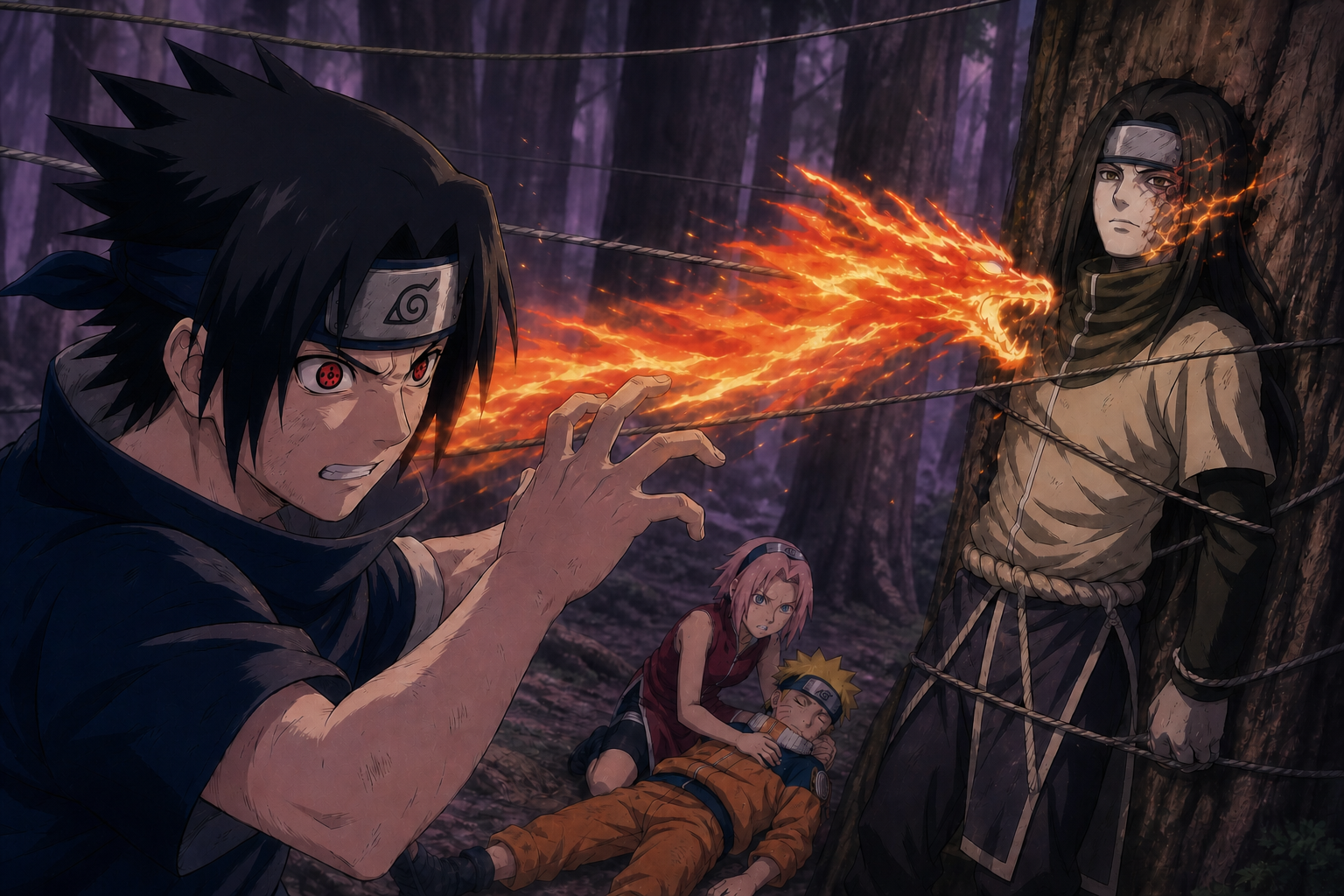
The Sharingan Revived: Dragon-Flame Jutsu!
Sasuke turns Naruto’s courage into a brilliant counterattack. Orochimaru turns that brilliance into a reason to mark a child’s body as future property.
Episode 30 gives Sasuke one of his cleanest early victories and then reveals that skill cannot protect him from an adult who never entered the fight honestly. His Sharingan reads movement, his wires control space, and Dragon Flame Jutsu lands exactly where he planned. Orochimaru is impressed. That is the disaster.
Sasuke believes he is proving that fear no longer owns him. Orochimaru reads the same proof as a product demonstration. The curse mark is not a reward, mystical promotion or sexy villain upgrade. It is an adult predator writing access onto a twelve-year-old’s body without consent.
Naruto collapses, and Sasuke remembers himself
Naruto cannot sustain the counterattack forever. His body has already survived separation, a giant snake and direct interference with the Nine-Tails’ chakra. When his energy runs out, the episode does not pretend determination is an infinite fuel tank. He falls.
Sasuke watches him fall and finally understands what Naruto gave him. Naruto did not defeat the Grass ninja. He broke the paralysis that had made surrender look sensible. Sasuke now has to convert borrowed courage into his own decision.
This is a relay, not a solo showcase. Sasuke protected Naruto in Wave. Naruto returned the courage lesson in the forest. Sasuke now takes the fight because Naruto cannot continue. Team 7 is becoming functional through handoffs, which is less glamorous than destiny and far more useful.
The Sharingan reads movement, not morality
Sasuke brings his Sharingan fully into the fight. He tracks Orochimaru’s movement, anticipates responses and constructs an attack around wire control rather than charging directly. The sequence is a sharp reminder that Sasuke’s talent is not merely inherited eye color. He studies, plans and builds pressure.
The Sharingan gives him information about motion. It does not tell him what Orochimaru wants. It cannot reveal the adult’s full power, history or intention. Fandom sometimes treats a dōjutsu like an answer key. Episode 30 draws the limit cleanly: Sasuke can read the attack in front of him while completely missing the life plan being imposed on him.
That distinction matters across the series. Perception is not wisdom. A person can see more data than everyone else and still lack the context needed to interpret the threat. Sasuke’s eye is extraordinary. Orochimaru’s experience is older, wider and morally empty.
Dragon Flame Jutsu is a real tactical achievement
Sasuke uses wires to bind the enemy against a tree and directs Fire Style: Dragon Flame Jutsu along the lines. The attack joins perception, tool use, chakra control and timing. He does not simply produce a larger flame and hope the episode applauds. He creates a delivery system.
This is why the scene earns its spectacle. The fire is the last step in a chain of decisions. Sasuke reads movement with the Sharingan, limits escape with wire and places the target where the technique can land. Creative combat in Naruto works best when power expresses thought.
For a moment, Sasuke appears to have reversed the entire encounter. The enemy is pinned. The fire hits. The disguise burns. Sasuke has taken the courage Naruto returned and turned it into technical precision. If this were an honest exam fight, that performance could have ended it.
Orochimaru survives because this was never an honest exam fight
The scorched outer appearance does not reveal an injured peer. It reveals the wrongness underneath the disguise. Orochimaru absorbs the attack, discards the stolen identity and introduces himself on his own terms.
The reveal changes the meaning of everything Sasuke accomplished. His attack was effective enough to impress Orochimaru, but not strong enough to end the threat. Orochimaru wanted evidence. Sasuke supplied it. The adult treats a child’s survival performance like an audition the child never agreed to attend.
There is no shame in Sasuke failing to defeat him. Orochimaru is a former Konoha shinobi, one of the legendary Sannin and an adult researcher who has built his life around stealing techniques and bodies. The shame belongs to the system that allowed him inside a youth examination long enough to conduct the evaluation.
“I want you” is not admiration
Orochimaru tells Sasuke that he wants him. The line can sound like recognition to a child starving for power and revenge. That is exactly why it is dangerous. Orochimaru identifies the hunger before Sasuke has language for the manipulation.
He does not offer mentorship with informed terms. He does not ask what Sasuke wants. He places the curse mark on Sasuke’s neck through a bite and leaves the child in pain. Desire becomes violation. Interest becomes ownership. The mark makes the subtext physical.
Calling this a cool power-up without naming the coercion reproduces Orochimaru’s sales pitch. The mark will offer power, but the offer arrives after bodily invasion. Sasuke can later make choices around it. Those later choices do not create consent retroactively.
The curse mark changes the economics of Sasuke’s body
Before this episode, Konoha sees Sasuke as a talented Uchiha survivor and valuable young shinobi. Orochimaru sees a possible vessel, technique archive and future possession. Both institutions place value on his body, though they do not use identical methods.
The curse mark converts that valuation into an embedded claim. It can alter chakra, intensify power and pressure Sasuke toward Orochimaru’s network. It also makes Sasuke’s ambition easier to exploit. The more desperately he wants enough strength to confront Itachi, the more persuasive dangerous access can feel.
This is labor recruitment from hell. Orochimaru identifies a gifted child, bypasses guardians, implants a dependency mechanism and frames future exploitation as opportunity. The forest provides privacy. The exam provides plausible chaos. Sasuke’s grief provides leverage.
Sakura becomes the person left standing
Sakura watches Naruto fall and Sasuke collapse under the curse mark. The episode ends with the team’s strongest physical fighters incapacitated and Sakura carrying the immediate responsibility. That is not decorative concern. It is a transfer of duty.
Early Sakura is often judged only by damage output. The forest is about to ask for endurance, triage, concealment and defense while exhausted. Those are shinobi tasks. They are also care tasks, which fandom routinely undervalues until the person performing them stops and everyone dies.
Her romantic ideal of Sasuke cannot survive unchanged after seeing him terrified, brilliant and violated within the same encounter. He is not an untouchable fantasy. He is a teammate in medical danger. Naruto is not an annoying extra. He is another unconscious child she has to protect.
Anko and the cost of delayed recognition
Anko identifies Orochimaru’s involvement through the stolen Grass identity and the evidence left behind. Her recognition is fast once the facts reach her. The problem is that the forest’s design delayed those facts until Team 7 had already been targeted.
Anko’s own history with Orochimaru makes the breach personal. She knows what his interest can do to a student because she carries her own curse mark. The series is careful here: surviving abuse does not automatically grant the power to prevent its repetition. Institutions can place survivors in authority while leaving the underlying security failure intact.
The village created a test where death could be dismissed as an expected risk. Orochimaru exploits that ambiguity. When violence is normal, abnormal violence gets more time to work.
Fire changes the picture without changing the power gap
The Dragon Flame sequence looks like a decisive finish because the direction gives Sasuke every visual sign of control. The wires draw straight lines through a chaotic forest. The fire follows the route he chose. Orochimaru is fixed against a tree instead of moving wherever he pleases. For several seconds, Sasuke has converted terror into geometry.
Then the body at the center of that geometry refuses to behave like an ordinary body. The burned disguise peels the scene away from tournament logic. Sasuke solved the problem that was visible, but the visible problem was a costume. That is not the story mocking his intelligence. It is showing how an adult manipulator controls the information a child receives.
The fire also matters as Uchiha inheritance. Sasuke uses a clan-associated elemental tradition while fighting for teammates who exist outside the clan he lost. His technique carries family memory, but its purpose in this moment is collective survival. That is a healthier use of inheritance than treating bloodline skill as proof that he owes his whole future to revenge.
The curse mark creates a second exam with no consent form
The official Chūnin Exam measures whether Sasuke can advance inside Konoha’s rank system. Orochimaru’s private exam measures whether Sasuke can survive the curse mark and become useful to him. The two evaluations overlap in the same forest, but only one is publicly acknowledged.
This matters because survival itself becomes part of the trap. If Sasuke endures the mark, Orochimaru can frame endurance as compatibility. Pain becomes evidence that the victim was “chosen.” That logic appears in abusive institutions everywhere: harm is imposed, survival is praised, and the survivor is told the ordeal revealed a special destiny instead of another person’s decision to violate them.
Sasuke’s later attraction to the power does not erase the origin. People can adapt to an imposed condition, use it strategically and even desire what it offers. None of that changes who created the dependency or how the first access was taken.
Japanese performance and the sound of false victory
Noriaki Sugiyama carries Sasuke from shame into concentrated attack. The performance does not need a speech about renewed confidence. The tightened delivery and controlled technique sequence make the change legible through action.
Kujira performs Orochimaru in the original Japanese anime. The crucial contrast is structural and audible in the scene: Sasuke expends effort, breath and urgency while Orochimaru retains the adult calm of somebody evaluating results. The imbalance survives even when Sasuke appears to win.
Chie Nakamura anchors Sakura’s alarm as the consequences land. Junko Takeuchi lets Naruto’s exhaustion close the handoff begun in Episode 29. No one performance owns the sequence because the episode is built around transferred responsibility.
Reciprocity, power and bodily consequence
A Confucian reading highlights the broken teacher-student relationship surrounding Orochimaru. Skill and seniority should carry reciprocal duty toward the young. Orochimaru turns knowledge into private appetite. He wants succession without obligation and authority without care.
A Buddhist lens exposes the danger of attachment to power as identity. Sasuke’s desire for strength is understandable because revenge organizes his grief. Orochimaru offers a path that makes the attachment more consuming. The curse mark promises capacity while narrowing freedom.
The bodily consequence prevents the episode from becoming a clean victory reel. Fire lands. The enemy is impressed. Sasuke still collapses. Naruto repeatedly insists that choices matter, and this arc adds the harder truth that another person’s choice can enter your body and shape the options available afterward.
RaeRae’s verdict
Sasuke is magnificent here. The wires, Sharingan and Dragon Flame Jutsu prove why he is considered a prodigy. Orochimaru’s response proves why prodigy stories need an exploitation analysis. Talent attracts teachers, rivals, institutions and predators. Not every person who recognizes potential intends to protect the person carrying it.
The curse mark is not Sasuke receiving darkness because he secretly wanted it. It is Orochimaru planting a claim and betting that grief will finish the recruitment later. That distinction keeps accountability where it belongs.
Fandom misreadings I am rejecting
“Sasuke beat Orochimaru.” Sasuke executed an excellent attack. Orochimaru survived, revealed himself and completed his real objective.
“The curse mark is a reward for talent.” It is an invasive control mechanism imposed without consent.
“Naruto becomes irrelevant once Sasuke takes over.” Naruto’s refusal restored Sasuke’s agency. The attack is the second half of a relay.
“Sakura only watches.” Sakura becomes the only conscious Team 7 member able to protect two injured teammates.
“Orochimaru is simply impressed.” He is evaluating a possible vessel. Admiration without respect for personhood is appetite.
Receipts and official routes
Episode number, title and official synopsis: Naruto Official Site. Japanese broadcast archive and synopsis: TV Tokyo. Streaming availability varies by region; use the official options linked from the episode directory.