
Departure
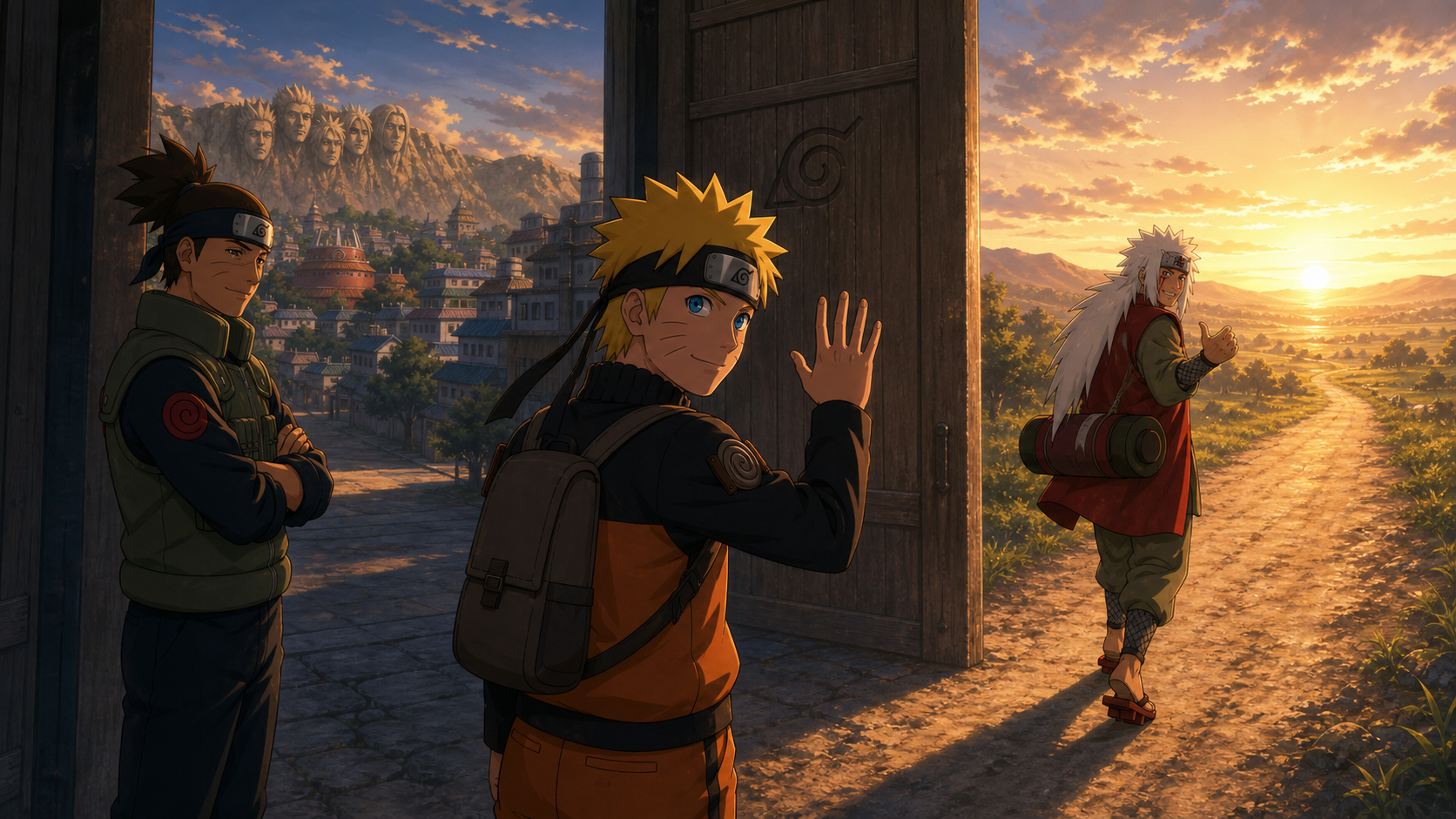
Gaara suppresses Shukaku and defeats Seimei through controlled strength before Naruto shares one last ramen with Iruka and leaves Konoha beside Jiraiya.
Gaara can win faster by surrendering control to Shukaku.
He chooses to become himself again.
Naruto Episode 220, `Departure`, closes the original series by making that choice the answer to Seimei's entire philosophy. Seimei believes emotion weakens shinobi and power creates justice. Gaara suppresses a tailed beast, protects his friends, and defeats Takumi's ultimate weapon with strength he prepared and controlled himself.
Then the series sends everybody toward the person they plan to become next.
Matsuri commits to training under Gaara. Ino asks to study medical ninjutsu. The Leaf genin resolve to grow while Naruto is away.
Naruto eats one last bowl with Iruka and leaves Konoha beside Jiraiya.
Part I ends exactly where it should.
Not with Naruto arriving.
With him finally ready to go.
Gaara Is Still Protecting Matsuri
Moving Matsuri first prevents the rescue target from becoming another source of pressure on Gaara. If she remains inside Seimei's range, every attack can force Gaara's emerging form to react through panic and split attention. Naruto gives him one fewer person to fear hitting.
Sakura's first aid serves the same larger purpose. Naruto cannot support anyone if accumulated injuries remove him from the field. A brief treatment is not a pause from the rescue; it preserves the responder most likely to ignore his own limits.
Neji's reading then establishes that raw chakra comparison favors Seimei. The answer cannot be piling more power into the armor's absorption range. It must change what Gaara supplies and how he fights.
Shukaku begins emerging from Gaara's body.
Naruto gets Matsuri away from the immediate danger and leaves her with Hinata and Sakura. Sakura stops Naruto long enough to give him first aid because he is already badly injured.
Naruto would prefer to solve that condition by continuing to move until his body forgets to object.
Sakura has met him before.
Neji studies the battle with the Byakugan. Seimei's armor now releases more chakra than Gaara's partial transformation because it keeps siphoning Shukaku's power. The same absorption function Suiko used has become part of Seimei's complete system.
Nobody can rush carelessly into that range.
They need Gaara to regain control from inside.
Gaara Remembers Why He Protects People
These bonds do not erase Gaara's earlier crimes or pain. They give him relationships capable of competing with the voice that once said only self-love could keep him alive. Protection becomes chosen conduct rather than sudden personality replacement.
Matsuri's definition of love also describes service, not possession. She does not claim Gaara is strong because people admire him. He becomes stronger through the desire to watch over lives whose choices remain separate from his own.
That principle explains why he entered the trap for a student and why his siblings followed without treating him as village property. Mutual care creates obligations, but it does not turn people into tools.
Seimei expects the Shukaku transformation to finish.
Gaara remembers the people who pulled him out of complete isolation. Naruto understood him. Temari and Kankuro stayed beside him. Matsuri chose him as a teacher when the rest of the class backed away.
They accepted Gaara as a person.
He refuses to let Seimei hurt them.
Matsuri listens and finally names the lesson beneath Gaara's strength. Love is the desire to serve, watch over, and protect someone precious.
This is a remarkable conclusion for the boy who once believed loving only himself was the sole condition for survival.
The change is not that Gaara became harmless.
He tells Seimei he will stop him even if killing him is necessary.
The change is who Gaara's power serves.
Gaara Suppresses Shukaku by Choice
The reversal requires more than calming down. Chakra is already being extracted, Gaara's body has begun changing, and Seimei is deliberately encouraging the loss of consciousness that would weaken control. Gaara forces a process with physical momentum to stop.
Choosing less power also denies Seimei the infinite source promised by the plan. Gaara protects his allies and attacks the weapon's supply at the same time. Self-control becomes a tactical countermeasure.
Seimei mistakes emotion for uncontrolled impulse because that is how he uses grievance. Gaara's care produces restraint, planning, and a narrower use of lethal force. Feeling does not remove discipline. It tells discipline what it must prevent.
Gaara forces the transformation backward.
Matsuri watches the Shukaku form recede and Gaara return toward himself. He deliberately gives up the greater immediate power because he cannot control what Shukaku will destroy.
Seimei calls the decision absurd.
He believes a shinobi should suppress emotion, pursue power, and treat strength as the only justice.
Gaara chooses nearly the opposite.
He suppresses the power that would erase his judgment. He keeps the emotions that tell him who must be protected.
That choice leaves him weaker on paper and stronger in the only way that matters for this fight. Seimei cannot make Gaara attack his own comrades if Gaara refuses to become the monster Seimei needs.
Control beats spectacle.
That feels like a lesson several adults in both villages could stand to write down.
Gaara Was Making Sand Inside the Cage
Seimei assumes Gaara has no chakra and no usable sand left.
Gaara asks whether he thought the prisoner sat idle inside the cage.
While Seimei celebrated his resurrection, Gaara used his remaining chakra to crush valley rock into fresh sand. The water formation ruined the supply in his gourd, so he made another supply from the terrain surrounding him.
He releases Sand Tsunami.
Seimei's armor begins absorbing that chakra too, but Gaara has changed the terms of the fight. The cage did not stop him from preparing. It gave him time and rock.
Gaara of the Desert does not need somebody to pack every grain for him before a mission.
Seimei built an ultimate weapon around countering Gaara's known resources.
Gaara created a new resource while trapped inside it.
Shikamaru Stops Naruto From Interfering
Naruto sees Seimei draining Gaara again and tries to enter.
Shikamaru stops him.
The armor would absorb Naruto's chakra too, and a second target would disrupt Gaara's attack. Shikamaru tells Naruto that their Gaara is strong.
That wording matters.
Gaara is no longer Sand's problem or an ally Konoha assists from political obligation. Shikamaru claims him as part of the group everyone trusts to finish the battle.
Naruto does the difficult thing.
He waits.
For somebody who built his life around charging into other people's pain, trusting Gaara to carry his own fight is growth too.
Shukaku's Pike Pierces the Ultimate Weapon
The pike's name shows Gaara can incorporate the beast's strength without yielding his identity to it. He takes a form associated with Shukaku, constructs it through controlled sand, and directs it at one chosen target.
Giant Sand Burial then uses scale Seimei's armor cannot simply wear or redirect. The founder assembled several specialized tools around one body; Gaara turns the valley itself into the finishing mechanism.
Seimei's failure is therefore technical as well as philosophical. Absorption encouraged him to accept every incoming chakra source, while Gaara used that confidence to prepare mass, position, and a piercing attack beyond the system's safe assumptions.
Gaara concentrates his remaining sand into the Ultimately Hard Absolute Attack: Shukaku's Pike.
The name belongs to the beast, but Gaara shapes and directs the weapon himself. He pierces Seimei's armor, then finishes the revived founder with Giant Sand Burial.
Seimei cannot understand why Gaara wins.
Gaara gives him the answer. Somebody who abandoned humanity to become a ninja tool cannot understand a person drawing strength from bonds.
The line does not mean feelings replace technique.
Gaara planned inside the cage, created fresh sand, suppressed a dangerous transformation, formed a specialized spear, and chose the right finishing attack.
Emotion tells him why to fight.
Discipline lets him win.
Seimei has consumed bodies, weapons, and Shukaku chakra without developing either one.
Gaara Finally Has Someone to Share With
Gaara collapses after the fight.
Sakura confirms that he is alive and profoundly exhausted from releasing so much chakra at once. He suppressed Shukaku completely through his own will.
Gaara reflects on Naruto's influence. He once understood human ties only through hate and murderous intent. Naruto made him want recognition and showed him that suffering, sorrow, and happiness can be shared.
Matsuri has become someone with whom Gaara can share them.
Kakashi and Might Guy arrive after the danger has ended. Guy remarks that the inexperienced fighters have grown a little. Kakashi points out that this is very strict praise.
They did travel all that way to review a completed assignment.
Timing remains a shinobi skill.
Jiraiya Returns With Akatsuki Information
Back in Konoha, Jiraiya finally returns.
Naruto demands to know where his promised teacher has been. He assumes Jiraiya gathered information involving naked women because experience supports the theory.
Jiraiya was tracking Akatsuki.
He has verified that the organization will begin moving seriously in roughly two years. The threat attached to Naruto's Nine-Tails has not disappeared while he completed village missions.
Jiraiya offers the intensive training he promised.
Naruto has been waiting.
He accepts immediately.
The training trip will last roughly two and a half years, taking Naruto out of Konoha and toward the next stage of the fight surrounding Akatsuki, Orochimaru, and Sasuke.
One Mission Changes Several Futures
Ino's decision grows from comparison but not shallow envy. She sees Sakura become essential across separated battlefields because training gave her a reliable role before, during, and after direct combat. Ino wants that breadth for herself.
Medical study also complements rather than replaces her existing techniques. Mind transfer and mental disruption can gather information or control an opening. Medical knowledge would let her support a team when those techniques miss, when a target is unavailable, or when an ally needs immediate care.
Asking Sakura for access to Tsunade acknowledges growth without ending their rivalry. Ino can respect what Sakura built and still plan to surpass her.
The Sand siblings prepare to leave. Temari acknowledges that Shikamaru repaid the debt, though their argument about crying survives the diplomatic exchange.
Matsuri asks Temari to thank Naruto. She understands Gaara's lesson now and will devote herself to training under him.
Tsunade gives Shikamaru a passing grade rather than a perfect score. His reward is more missions so he can build experience.
Naturally, Shikamaru hears the word `overwork` hiding inside the praise.
Ino makes the largest personal decision.
She tells Sakura the mission exposed how unprepared she felt. Everyone depended on Sakura's medical ability, while Ino's attempted technique failed and left her wounded. She asks Sakura to help her seek training from Tsunade.
Sakura agrees, then immediately declares herself Ino's senior.
Their friendship returns to its natural form: mutual support followed by insults.
Everyone Plans to Catch Up
Tenten is furious that she was the only peer absent from the Sand mission because she had another assignment.
The others discuss Naruto's departure. Konoha will become quieter, but nobody treats his absence as permission to coast.
Lee vows to work hundreds of times harder. Kiba and Akamaru refuse to lose. Shino describes friendship as improving by learning from one another.
Neji ends Hinata's training session early because Naruto is about to leave.
He knows she will want to see him.
That quiet consideration says plenty about how far Neji has moved too.
Naruto Says Goodbye to Iruka at Ichiraku
Iruka is the correct final adult at the table because he recognized Naruto before the village did. Jiraiya will shape the next stage, but Iruka made it possible for Naruto to believe a teacher's care could be real.
Their farewell avoids a ceremony. Ramen, practical warnings, a joke about future money, and one quiet wish carry the relationship more honestly than a crowd at the gate. Naruto leaves knowing somebody will notice the empty stool.
Looking at the Hokage Monument closes the distance from vandalism to purpose. The faces once served as a surface large enough to force Konoha's attention. Now Naruto can walk away from them temporarily without fearing the village will forget him.
Naruto shares ramen with Iruka before leaving.
Iruka tells him to train seriously and not goof off. Naruto promises he can be trusted, which is optimistic but heartfelt.
Jiraiya calls from the road.
Naruto tells Iruka he is leaving and jokes that he will repay the ramen after he becomes successful.
Iruka watches him go and wishes him luck.
Naruto pauses beneath the Hokage Monument. He looks at the stone faces and renews the promise that has carried him from the first episode.
Hinata watches from hiding and resolves to work hard enough to catch up.
Jiraiya threatens to leave Naruto behind.
Naruto runs after him.
The boy who once vandalized the Hokage faces for any scrap of attention leaves the village with a teacher, friends waiting for his return, and a future he earned the right to chase.
That is a departure worth 220 episodes.
Gaara’s restraint is the first victory
Shukaku offers more immediate force than Gaara can produce while exhausted, but releasing it would place Matsuri, Naruto, and his siblings inside the same indiscriminate danger as Seimei. Suppressing the transformation means choosing responsibility before the finishing attack exists.
Seimei calls emotion weakness because he recognizes only power that expands. Gaara’s care makes him reduce power, preserve judgment, and deny the armor its promised supply. Restraint becomes both ethical conduct and the move that breaks the enemy’s design.
The fresh sand proves captivity did not equal surrender
Gaara spends his time inside the cage grinding valley rock into a new reserve. The preparation answers the waterlogged gourd without pretending the earlier trap failed. He lost one resource and built another from the terrain available.
That detail protects the climax from becoming a miracle powered by friendship alone. Bonds give Gaara a reason to remain himself. Observation, chakra control, patience, and technical knowledge give him a method for winning once he does.
Shikamaru protects Gaara’s ownership of the fight
Naruto sees chakra being absorbed and wants to intervene. Shikamaru stops him because another chakra source would strengthen Seimei and disrupt the attack Gaara prepared. Help can become interference when it ignores what the person being helped is already doing.
Calling him “our Gaara” does not claim possession. It expands belonging across the village line that once defined him as somebody else’s threat. Shikamaru trusts Gaara enough to let him complete a fight only Gaara can control.
Shukaku’s Pike separates inheritance from domination
The technique carries the beast’s name and strength, yet Gaara shapes it while fully conscious and directs it toward one target. He does not need to deny Shukaku’s presence to remain himself. He needs authority over how that power enters the world.
Seimei gathers tools and bodies by consuming their owners. Gaara incorporates a dangerous inheritance without surrendering his own judgment. That is why the pike represents control rather than another step toward transformation.
Seimei loses because accumulation is not mastery
His armor combines specialized weapons, Hoki’s sacrificed body, and stolen tailed-beast chakra. More inputs create more output, but no discipline governs the appetite. Absorption teaches Seimei to welcome everything Gaara sends until the system faces mass and force beyond its assumptions.
Gaara’s Giant Sand Burial turns the valley itself into the final mechanism. Takumi’s ultimate weapon owns more equipment. Gaara understands the battlefield, the opponent, and the exact purpose his strength must serve.
Matsuri represents a future Sand can choose
She entered the academy afraid that holding a weapon would make her capable of repeating the violence that killed her parents. The mission does not erase that fear. It gives her proof that purpose, instruction, and restraint can shape what training becomes.
Committing to study under Gaara also changes his future. He is no longer only the former weapon learning friendship from peers. He is responsible for passing a healthier definition of strength to someone younger.
Ino turns humiliation into a training decision
She does not pretend her failed technique and injury were secretly a triumph. Watching Sakura remain useful across several battlefields reveals a gap Ino wants to close.
Requesting medical instruction is not surrendering her mind techniques or becoming a copy of Sakura. It adds a reliable way to serve when direct control is unavailable. Their rivalry becomes productive because Ino can respect Sakura’s work without abandoning the desire to challenge her.
Jiraiya’s return reconnects the ending to the larger danger
The Artisan mission closes, but Akatsuki’s timetable reminds Naruto that the Nine-Tails has made him a future target. Two and a half years of travel is not a victory lap. It is preparation for people already organizing around what his body contains.
Jiraiya offers more than techniques. Leaving the village expands Naruto’s world, removes familiar protection, and places his development beside a teacher who understands both the shinobi system and its ugliest appetites.
Iruka receives the farewell the story owes him
The first episode turned on Iruka seeing Naruto as a child rather than a vessel or nuisance. Ending Part I over ramen returns to the adult who made every later bond easier to believe.
The scene stays ordinary because their relationship does not need ceremony. Practical warnings, a joke about paying later, and Iruka watching the road carry more weight than a formal speech. Naruto can leave because he knows the empty seat will matter to someone.
The Hokage Monument changes meaning when Naruto walks away
He once painted those faces to force a village to look at him. Now he pauses beneath them, renews the promise, and continues down the road without needing immediate applause.
Departure is progress because belonging survives distance. Friends plan to train, Hinata watches with her own resolve, Iruka remains behind, and Naruto trusts that leaving to grow will not erase the place he earned among them.
RaeRae’s full take
The original series ends with two boys refusing the futures adults designed for them. Gaara was supposed to become Sand’s obedient terror. Naruto was supposed to remain the village problem nobody wanted to claim. Gaara wins by controlling power for the sake of other people, and Naruto leaves because he finally has people worth returning to.
I love that the finale does not confuse emotion with the absence of craft. Gaara remembers his bonds, yes, and then he suppresses a transformation, manufactures sand in captivity, forms a specialized pike, and chooses the correct finish. Feeling supplies direction. Skill carries it.
One last ramen with Iruka is the quiet heart of all 220 episodes. Before Jiraiya can train the shinobi who will face Akatsuki, Iruka says goodbye to the kid he recognized first. Naruto runs after his next teacher still loud, impatient, and unfinished. That is exactly how Part I should release him.
RaeRae checkpoint: Naruto does not leave because Konoha stopped being home. He can leave because it finally is.
Receipts and official routes
- Episode number, licensed title, Gaara defeating Seimei, the mission aftermath, and Naruto departing with Jiraiya: Naruto Official Site.
- Japanese title, February 8, 2007 broadcast record, and TV Tokyo synopsis: TV Tokyo.