
The Ultimate Weapon Reborn
Hoki combines Takumi’s weapons, drains Gaara to resurrect Seimei and tries to turn Shukaku into a power source while Naruto and Matsuri defend their teacher.
Takumi Village wants to prove that ninja tools matter more than shinobi.
Its ultimate weapon requires four followers, one sacrificed body, a kidnapped child, and Gaara's stolen chakra to function.
That is a lot of human life for a machine meant to make humans unnecessary.
Naruto Episode 219, `The Ultimate Weapon Reborn`, reveals Hoki's complete plan. The Four Celestial Symbols Men did not merely want to defeat Gaara. They wanted Shukaku's power to resurrect Seimei, Takumi Village's founder, as a living weapon capable of challenging the Five Great Nations.
Gaara reaches the trap exhausted.
Naruto reaches him late.
Seimei comes back after a hundred years and immediately starts talking like the world owes him ownership of everybody in it.
Gaara Corners Hoki in a Dead-End Valley
The stillness is evidence because a kidnapping operation should produce hurried movement, defensive noise, or an escape route. Hoki instead waits at the exact place a depleted Gaara will interpret as the end of pursuit. Confidence replaces concealment once the target reaches position.
Neji's caution also prevents the team's two visible victories from becoming a false conclusion. Kujaku and Ryugan fell, but the tools they carried remain part of a coordinated project. Individual defeat may have been an accepted cost from the beginning.
Gaara enters believing he has reduced the problem to one captor and one hostage. Hoki has reduced Gaara to one exhausted power source inside prepared terrain.
Gaara finds Hoki carrying Matsuri into a narrow valley with no visible escape.
He demands his student back.
Hoki says Gaara has misunderstood who is cornered.
Neji and Hinata watch from a distance with the Byakugan. They see no other Four Celestials nearby, but the valley feels unnaturally calm. Neji refuses to declare victory because the previous fights may have been diversions.
He is right.
Kujaku, Ryugan, and Suiko weakened Gaara, waterlogged his sand, and moved him toward Hoki's prepared site. Losing their individual fights did not prevent the larger plan from succeeding.
The enemy spent three people to place one person inside a valley.
Calling that a dead end depends on which direction the trap faces.
Sakura Tells Lee to Stop Fighting
Sakura's prohibition is medical judgment, not a lack of commitment to Gaara. Repaired muscle can tear again under immediate strain, converting a successful field treatment into permanent damage. Lee's debt does not change tissue recovery.
His refusal comes from the same belief that once made Gaara's rescue shocking. Lee remembers the person who nearly crippled him becoming the person who saved him. Leaving that transformed relationship unanswered feels impossible.
The scene holds both truths without pretending determination heals anatomy. Lee has a reason to return. Sakura has a reason to stop him. The mission has already asked its medical support to keep emotion from turning every survivor back into a casualty.
Sakura repairs Lee's damaged muscles and prohibits him from returning to combat.
Lee thanks her, then asks to go anyway.
Gaara saved his life during the Sasuke Retrieval Mission. Lee considers himself part of Team Return the Favor, and he cannot remain behind while Gaara is still in danger.
Sakura has become skilled enough to reconnect damaged muscle under field conditions.
She has not developed a medical technique that makes Lee obey instructions.
Some cases remain beyond science.
The exchange reinforces what this mission means to the Leaf genin. Sand's earlier rescue was not a favor they logged and forgot. Gaara's danger has become personal across a team that once feared him.
Hoki Combines the Four Celestials' Weapons
The collected tools reveal a hierarchy the earlier fighters may not have understood. Kujaku, Ryugan, and Suiko carried specialized parts capable of operating independently, but Hoki can call those functions into one armored system after their battles end.
Their `One Shinobi, One Kill` promise therefore concealed a second use. Each duel weakens Sand and activates or positions a tool, while survival of the wielder is optional. Hoki inherits the hardware even when allies fall.
Gaara's insistence on a one-on-one fight no longer matches the reality in front of him. One body can represent several weapons, several sacrificed comrades, and a plan extending beneath the entire battlefield.
Gaara has almost exhausted the chakra-infused sand stored in his gourd.
He still refuses to lose a one-on-one fight.
Hoki answers by calling the other weapons to him. The Infinite Kujaku Armor, Garian Sword, and Flying Double Edge Swords combine into one system around his body.
The defeated Celestials are gone.
Their tools are still performing their assigned role.
Hoki attacks with the sword forms and wind techniques Gaara's allies just fought separately. He does not need to beat Gaara through one specialty. He switches between several weapon functions while pushing Gaara to spend what little chakra remains.
Then he tells Gaara to use Shukaku.
That request exposes the real target.
Hoki wants the power inside Gaara, not merely Gaara's defeat.
Naruto Learns Why Takumi Hates the Great Nations
Neutral supply becomes dangerous when every customer is also a military power. Takumi's equal trade can look like fairness from inside the village and enemy support from every anxious capital. The artisans carry the risk created by larger nations' distrust while those nations continue valuing their work.
Hoki is right that craft shaped shinobi power without receiving equal political respect. Tools do not appear from nowhere, and the villages using them should not treat their makers as disposable suppliers.
His proposed liberation fails its own standard. Making shinobi obsolete through Seimei requires bodies, stolen chakra, and a planned attack on civilians in Konoha. Takumi would escape subordination by constructing a system with even less regard for human choice.
Naruto reaches Matsuri and tells her to hide.
He confronts Hoki, who explains Takumi Village's grievance.
For years, its artisans supplied exceptional ninja tools equally across the Five Great Nations. Whenever relations worsened, larger villages feared those tools would reach their rivals. Takumi was attacked for maintaining the same trade everybody depended on.
The great villages used Artisan skill, forgot that dependence, and repaid it with suspicion and violence.
That history is ugly.
Hoki's anger did not appear from nowhere.
His solution is to complete a weapon that ends the great nations' control, makes ordinary shinobi obsolete, and begins its new era by destroying Konoha.
He answers exploitation by turning more people into components.
The grievance deserves to be heard.
The hostage cage still needs to be broken.
Gaara Uses His Last Sand to Protect Naruto
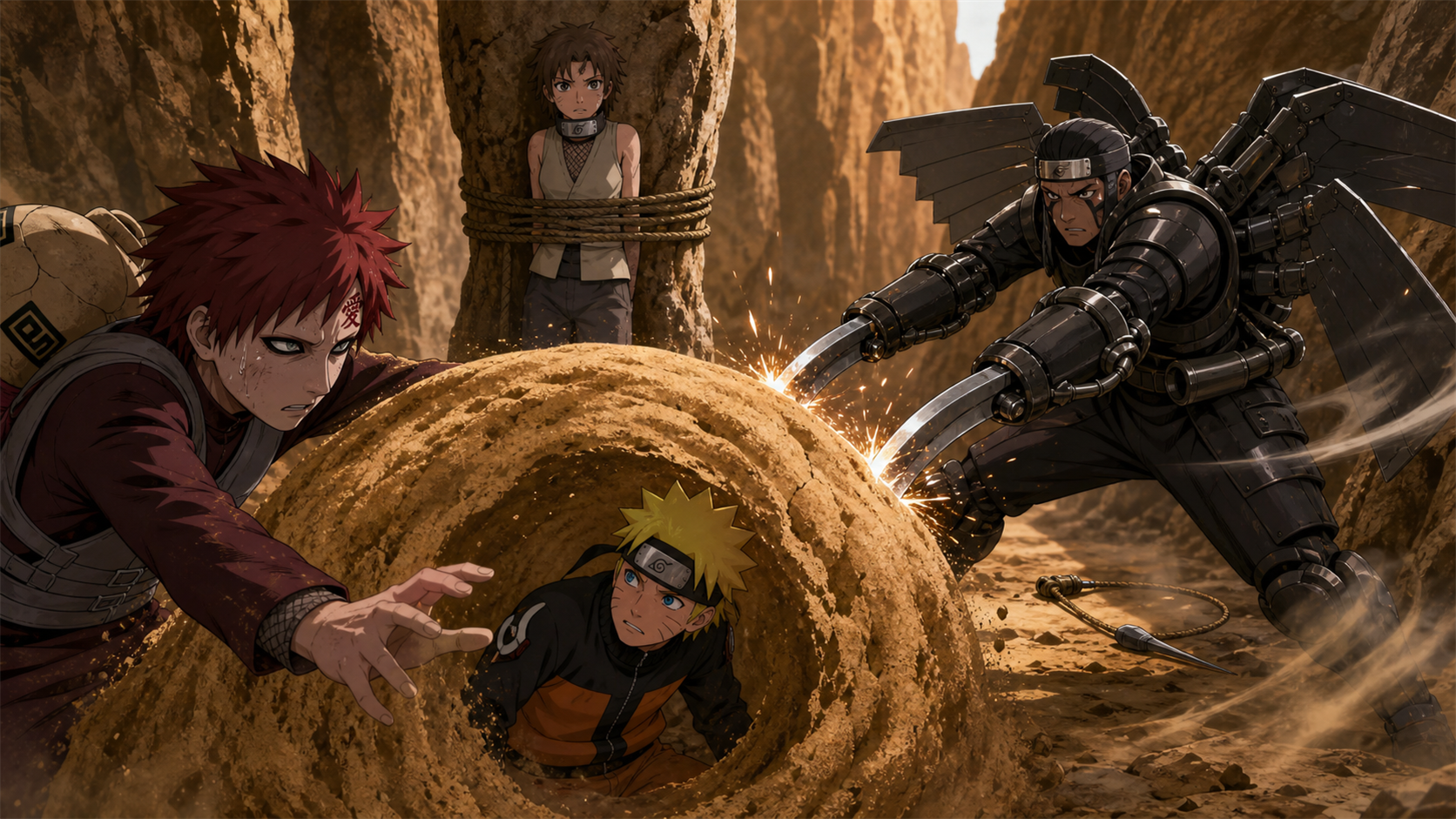
Creating sand from underground minerals is more expensive than drawing prepared material from the gourd. Gaara must break, grind, and control the earth while his ordinary reserves are nearly empty. The dome is not spare capacity Hoki overlooked. It is strength Gaara produces because Naruto is about to be hit.
That makes the protection the clearest possible rejection of the weapon label. An object expends power when an owner directs it. Gaara chooses where his remaining power goes, and he spends it on someone from another village.
Hoki sees waste because the act advances neither escape nor attack. Gaara sees a comrade who must stay alive. Their definitions of power separate completely in that moment.
Hoki attacks Naruto.
Gaara responds with sand he creates from hard minerals beneath the ground. He mixes and grinds them into a defensive dome around Naruto, spending the chakra Hoki has been trying to drain.
Hoki laughs at the contradiction.
Sand once called Gaara its finest creation and terrifying weapon. Now that supposed weapon uses his remaining strength to protect a Leaf comrade.
That is not a contradiction for Gaara.
It is growth.
The label described what his village wanted him to be. His choice describes who he has become.
Hoki exploits the expenditure and completes his preparations. Gaara saved Naruto, but the defense leaves him even closer to collapse.
Protecting somebody costs him.
He does it anyway.
The Empty Village Was an Evacuation
Konoha finally receives direct information from Takumi Village.
The Four Celestial Symbols Men completed forbidden research tied to an ultimate weapon from village legend. Other residents discovered the danger and evacuated, which explains why investigators found Takumi empty.
The missing body from the founder's mausoleum supplies the rest of the answer.
The weapon is Seimei himself.
Takumi's founder died roughly a century ago. Hoki plans to resurrect him.
Tsunade orders Kakashi to stop it and says another person will accompany him. The episode withholds that identity.
At the valley, there is no time to wait for either reinforcement.
Hoki Turns Gaara Into a Chakra Source
The Third Eye keeps Gaara connected to the fight while the sphere restricts his body. He can see Naruto and Matsuri continue resisting, which gives him a reason to fight unconsciousness even as extraction attacks his control.
Pushing for Shukaku is dangerous for Hoki too. The tailed beast is not a passive battery waiting behind Gaara's ordinary chakra. If the seal relationship destabilizes, the power source can attack every person nearby and destroy the apparatus meant to contain it.
Hoki accepts that risk because Seimei's design treats infinite output as more important than controllability. The same obsession that produced advanced tools now confuses maximum power with a functioning weapon.
Hoki encloses Gaara inside a metal sphere that extracts chakra.
Gaara opens his Third Eye so he can see what happens outside. Naruto returns Matsuri's rope javelin and tries to break the cage.
The sphere keeps draining.
Hoki wants Gaara pushed past his ordinary reserves until Shukaku emerges. He believes the tailed beast will provide an effectively endless power supply for Seimei.
Gaara's body becomes a generator in Hoki's design.
This is exactly the treatment Hoki claims Takumi suffered from the great nations. A powerful system takes somebody else's capacity, calls it necessary, and ignores the person carrying the cost.
Hoki did not escape the logic that harmed his village.
He copied it.
Hoki Gives His Body to Seimei
Hoki asks Seimei to take his flesh.
Then Hoki disappears into the resurrection.
Seimei rises using the sacrificed body, the four Celestials' collected weapons, and chakra extracted from Gaara. He identifies himself as Takumi Village's founder and ultimate ninja tool.
The weapon is not one brilliant invention.
It is a stack of consumed people.
Seimei wears the combined tools like spectral armor. He uses wind, fire, blades, and projectiles against Naruto while the cage continues pulling chakra from Gaara.
Naruto cannot reach the sphere.
Seimei does not care whether Gaara remains conscious long enough to survive.
He only cares that Shukaku keeps feeding him.
Naruto Calls Gaara His Comrade
Naruto takes hit after hit and keeps getting up.
Seimei asks why he would go this far for Sand's monster.
Naruto calls Gaara an important comrade.
That answer reaches Matsuri too. She remembers Gaara teaching that a weapon's purpose comes from the person holding it. She also remembers that Gaara fights for people important to him.
Naruto is now doing the same for Gaara.
Seimei has more tools, more stolen chakra, and more destructive range.
Naruto has decided the person inside the cage matters.
The whole episode turns on that difference.
Matsuri Understands Gaara's Lesson
Matsuri picks up the rope javelin.
Weapons killed her parents, and that fact has not changed. She no longer believes refusing every weapon will protect the people she loves.
She uses the javelin to intervene for Gaara and Naruto.
The tool can take a life.
It can also create distance, restrain an attacker, or protect somebody important.
Gaara chose it for her because he understood her fear better than he could explain during their first lesson.
Matsuri finally understands what he was trying to teach.
Seimei knocks her away.
The lesson does not make her stronger than the ultimate weapon. It makes her brave enough to act against it.
Shukaku Begins to Emerge
Neji and Hinata detect an enormous amount of chakra leaving Gaara's cage.
Temari explains the danger. If Gaara loses himself during the extraction, Shukaku will break free and attack everyone, friend or enemy.
Gaara's body begins a partial transformation.
Seimei celebrates the power entering his armor. Naruto keeps trying to reach Gaara. The others remain outside the rock-ringed cage area with no immediate path through.
The Four Celestials wanted Sand's ultimate weapon.
They are close to releasing the part of Gaara that Sand once feared most.
Episode 219 ends before anyone can prove whether the person inside that label still has enough control to answer Naruto.
The dead-end valley is a destination, not a mistake
Hoki stops running because the pursuit has completed its real job. Gaara arrives depleted, separated, and convinced that one captor stands between him and Matsuri. The narrow valley removes escape routes only after the target crosses into it.
Neji’s unease protects the wider team from mistaking two defeated enemies for a dismantled plan. Kujaku, Ryugan, and Suiko may lose their bodies without losing their function. Their weapons, positions, and damage to Gaara continue serving Hoki after the visible fights end.
The combined armor reveals expendable allies
Hoki calls the specialized tools into one system as though the people who carried them were detachable packaging. One Shinobi, One Kill sounded like a pledge of individual mastery. It becomes evidence that each fighter was also a delivery mechanism for hardware and attrition.
This is the first warning that Takumi’s promised liberation has already reproduced the disposability it condemns. Hoki speaks for ignored craftspeople while treating his own comrades as acceptable components in somebody else’s resurrection.
Takumi’s grievance survives Hoki’s hypocrisy
The great nations depended on artisans whose equal trade made every anxious customer suspicious. Military villages wanted access to exceptional tools while denying the makers political security or respect. That imbalance deserves more than a villain speech brushed aside because Hoki commits atrocities.
His answer still fails the village he claims to defend. Kidnapping Matsuri, stealing Gaara’s chakra, sacrificing bodies, and planning Konoha’s destruction do not create freedom from exploitation. They construct a new hierarchy with Seimei at the top and everyone else available for consumption.
Gaara’s mineral sand is an act of authorship
His prepared supply is nearly gone, so raising a dome requires breaking and grinding material from the earth. The defense costs more precisely when Gaara has less. He spends it because Naruto is about to be struck.
Hoki reads that choice as waste from Sand’s ultimate weapon. Gaara proves the label never owned the power inside him. A tool follows its user’s direction. Gaara creates direction for himself and chooses protection even when attacking might preserve more of his remaining chance to escape.
Naruto does not demand a cleaner version of Gaara
Seimei points toward Shukaku and calls Gaara a monster. Naruto knows the danger better than most people present. He fought Gaara’s transformed body, saw the loneliness beneath it, and understands that losing control can harm everyone nearby.
Calling Gaara a comrade is not denial of that risk. It is a refusal to let risk erase personhood. Naruto fights for the exhausted boy inside the cage, not for an imaginary friend without a tailed beast or a history.
The extraction copies the great nations’ worst logic
Hoki argues that powerful institutions took Takumi’s labor for granted and treated artisans as suppliers rather than people. His machine then reduces Gaara to an energy source. Pain, consent, and survival become irrelevant beside the desired output.
The contradiction is structural, not merely personal. When liberation is imagined as possessing enough power to dominate everyone else, the oppressed can inherit the exact habits of the power they opposed. Hoki changes who operates the machine, not what the machine believes human beings are for.
Hoki’s sacrifice does not make the project selfless
Offering his own body to Seimei may look like proof of devotion. It also removes the last person who could answer for the kidnapping, deaths, and planned attack. Sacrifice can demonstrate belief without demonstrating justice.
Seimei’s return makes the cost visible. His body is assembled from Hoki’s flesh, stolen chakra, and tools reclaimed from fallen followers. The ultimate weapon is not independent of shinobi. It is a monument to consuming them.
Matsuri completes the first lesson under impossible pressure
She does not stop fearing weapons or forget how her parents died. She picks up the rope javelin while still carrying that history. Courage here is not the disappearance of fear; it is choosing a protective purpose that fear cannot make for her.
The tool does not transform a new student into someone capable of defeating Seimei. It lets Matsuri refuse passivity and stand for the teacher who designed the weapon around her values. Gaara’s instruction survives precisely because it never required her to become him.
Third Eye keeps Gaara emotionally inside the fight
The cage controls his body and drains his chakra, but Third Eye allows him to witness Naruto and Matsuri refusing to leave. Hoki cannot isolate Gaara completely while those choices remain visible.
That connection also increases the danger. Gaara sees people being hurt for him while control over Shukaku weakens. The enemy expects attachment to accelerate desperation. The same attachment gives Gaara a reason to resist becoming the indiscriminate force Seimei wants.
The resurrection is technological triumph without human success
Seimei can combine wind, fire, blades, projectiles, and stolen tailed-beast chakra. The machine works according to the narrow standard its builders selected. It produces power.
It cannot produce legitimacy, freedom, loyalty, or a future for Takumi’s evacuated residents. Technical success becomes moral failure when the design excludes the lives it was supposedly built to restore.
RaeRae’s full take
I refuse to choose between saying Takumi was exploited and saying Hoki is wrong. Both are true. The great nations built dependence without respect. Hoki answers by making Gaara, Matsuri, his followers, and finally himself disposable. Pain explains the plan; it does not cleanse it.
Gaara’s sand dome is the whole episode for me. Exhausted, trapped, and treated like a battery, he still authors one decision nobody else can own. Naruto lives because Gaara spends power on a friend. That is what Hoki cannot understand about the difference between a weapon and a person.
Matsuri picking up the javelin carries the lesson into the next generation. She does not become fearless or suddenly elite. She becomes someone willing to decide what the object in her hand is for. Seimei rises with more power than anybody in the valley, but Gaara and Matsuri have already defeated the belief his resurrection represents.
RaeRae checkpoint: Seimei’s body is built from people treated as parts. Gaara’s last sand moves because he is still a person making a choice.
Receipts and official routes
- Episode number, licensed title, Hoki’s combined weapons, Seimei’s resurrection, Gaara’s extraction, and Matsuri taking up the javelin: Naruto Official Site.
- Japanese title, February 1, 2007 broadcast record, and TV Tokyo synopsis: TV Tokyo.