
The Anbu Gives Up? Naruto’s Recollection
ANBU searches Naruto’s memories for Gennō’s motive while Shikamaru questions the evidence, the border alarm and a corpse that cannot be the trap specialist.
Gennō leaves Konoha a complete story.
He infiltrated the village. ANBU exposed him. He stole sensitive blueprints, warned that Konoha would fall, and killed himself before capture. Intelligence then connects him to the Hidden Waterfall Village just as its entire force gathers near the border.
Spy identified. Evidence recovered. Enemy approaching.
It is almost considerate.
Shikamaru hears that story and asks the question everyone else missed.
Why would a brilliant trap specialist make every important answer so easy to find?
Episode 198 replaces the hunt for one missing document with a much nastier problem. Gennō may have arranged the investigation itself.
Episode 198 Facts
Episode: 198 of the original Naruto anime
Licensed title: The Anbu Gives Up? Naruto's Recollection
Japanese title: 暗部もお手上げ ナルトの記憶 (Anbu Mō Teage, Naruto no Kioku)
Japanese broadcast: August 23, 2006
Arc: Konoha Plans Recapture Mission
Classification: Anime-original filler
The memory procedure is commonly called the Time Reversal Technique and appears in subtitles as regressive hypnosis or Back to the Past Jutsu. The title jokes about the limits of Naruto's recall; ANBU does not abandon the larger investigation. Episode 198 ends with the coded plans returned at the Academy, before Episode 199 establishes what the village should inspect next.
The substitute corpse remains unidentified here. The episode proves only that the body lacks working hands and a trained chakra network. It does not yet explain how Gennō obtained it or reveal the larger paper-bomb network.
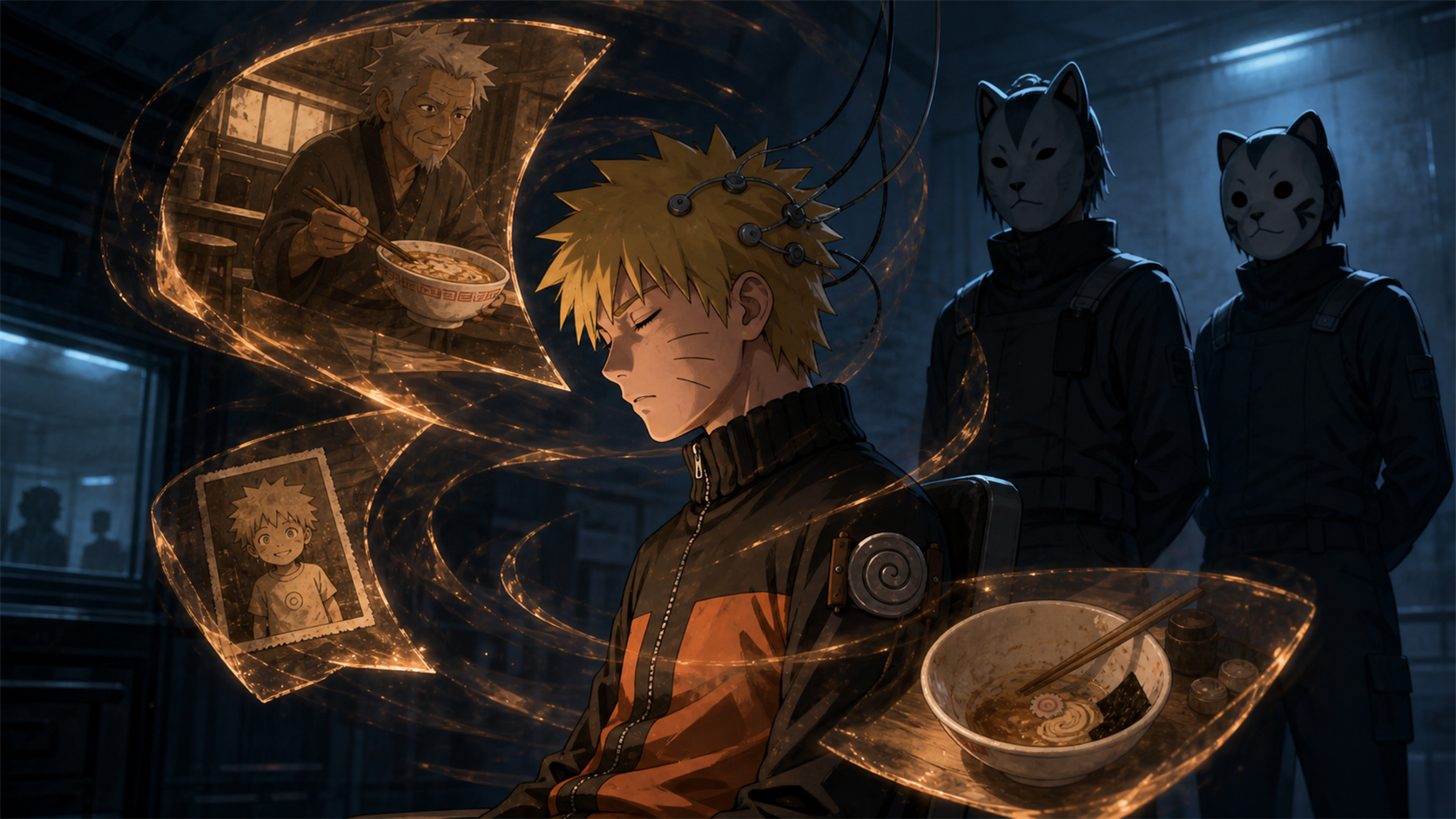
ANBU Searches Naruto's Memory for a Motive
ANBU already knows what Naruto and Gennō discussed during the two weeks of surveillance.
They need everything from before that period, when Gennō might have spoken more freely. Naruto insists he cannot remember every bowl of ramen and every casual conversation. That answer is honest, useless, and extremely Naruto.
The interrogators use the Time Reversal Technique, placing him under regressive hypnosis and guiding him back to the day he met Gennō.
ANBU treats memory as an evidence store that can be reopened when ordinary recall fails. That may be operationally useful, but the episode offers no discussion of consent, error, or the pressure created by leading questions. Naruto is a young shinobi inside a security emergency, surrounded by masked interrogators who have already decided the friendship may have been cover.
The technique retrieves sensory detail without supplying interpretation. Naruto can remember where Gennō stood, what he said, the photograph, the scar, and the unfinished ramen. ANBU still decides which details count as intelligence and which belong to an old man's harmless persona.
Naruto had been training alone and headed to Ichiraku for lunch. Gennō stood outside, unsure whether the restaurant was worth trying. Naruto informed the outsider that every Leaf resident knows Ichiraku serves the best ramen and took him inside.
Gennō could not finish his portion.
Naruto could.
The old man gave him the rest, and a friendship began with the easiest possible way into Naruto's confidence: food with no lecture attached.
The Grandson Story Gives Naruto a Place
Under hypnosis, Naruto remembers another meal.
Gennō showed him a photograph of a boy around his age. When Naruto asked why the old man treated him so kindly, Gennō said he had a grandson who looked about the same age. He claimed they spent days off treasure hunting together, so Naruto did not feel like a stranger.
Naruto also noticed a scar on Gennō's hand. Gennō blamed an old accident with a saw.
ANBU checks the known record and finds no relatives. They treat the grandson as another lie and end the hypnosis. Gennō was too disciplined to leak meaningful information to a genin.
That conclusion makes operational sense.
It does not answer why Gennō chose Naruto.
Naruto did not merely receive free toppings. He received an explanation for the affection. The old man gave him a family-shaped role without requiring him to ask whether the relationship was real.
For an orphan who understands exactly how much a shared meal can mean, that was not a small gift.
If it was manipulation, it was precisely aimed.
The alleged grandson gives Gennō a socially acceptable reason to care for Naruto while preventing Naruto from asking for more. He can receive attention without wondering why an unrelated adult chose him, and Gennō can discuss family without offering a name ANBU can verify.
The photograph complicates the lie because it is a physical object carried into the relationship. If Gennō invented the boy entirely, he prepared a prop with unusual emotional specificity. If the boy existed, the absence of known relatives may show the limits of the Bingo Book rather than the limits of Gennō's truth. Episode 198 correctly leaves that question open.
The Search Finds Nothing, Which Is Something
The rest of the Konoha 11 checks every practical route.
Hinata and Neji inspect buildings with the Byakugan. Lee helps search the work sites. Every structure matches its plans, and they find no hidden traps.
Kiba examines Gennō's escape route and discovers odor-neutralizing material in the smoke screen. Gennō prepared against tracking by scent, yet ANBU still caught him in the Western Forest.
That bothers the team.
A famous trap specialist planning a serious escape should have prepared more than one trick. If he knew Konoha's ANBU were capable, why did his escape end exactly where they could watch him die?
At the forensics center, Sakura remains while medical workers reconstruct the badly damaged corpse. Ino would very much like to be anywhere else. Sakura stays because becoming a medical ninja means facing the body in front of her, not the body she wishes had arrived intact.
No group finds the stolen plans.
No building contains a visible trap.
No restaurant offers a useful clue.
The absence begins to look organized.
Hidden Waterfall Supplies the Perfect Enemy
Tsunade receives an emergency report.
The Hidden Waterfall Village has moved its entire force into battle formation near Konoha's border. Its official explanation is a large training exercise, but military exercises have served as cover for invasions before.
Intelligence adds one more convenient fact. Gennō stayed in Hidden Waterfall before entering the Leaf.
Tsunade cannot ignore that connection. She shifts most of Konoha's deployed forces toward the border and orders Shikamaru's unit to join them.
Shikamaru refuses.
He is not dismissing the danger. He is doing the arithmetic. Ten genin and one chūnin will not decide a battle between mobilized villages. Those eleven investigators can still decide whether Konoha understands the threat inside its walls.
More importantly, Shikamaru no longer trusts the sequence that brought everyone to Hidden Waterfall.
Refusing Tsunade during an S-Level alert carries risk. Shikamaru does not challenge her authority for drama. He explains comparative value: his squad adds little mass to a border army and holds nearly all accumulated knowledge about the internal investigation. Moving them would discard specialization exactly when the enemy may want the village looking outward.
Tsunade listens because command includes revising deployment when a subordinate supplies better reasoning. She does not punish the refusal or defend her first order out of pride. The exchange shows why Shikamaru leads the eleven despite holding the lowest numerical rank among many more experienced adults.
Gennō's Bad Ending Is Too Bad to Believe
Shikamaru describes Gennō's cover with genuine professional respect.
His carpentry was average. He made no serious mistakes. He never stood out, inspired strong affection, or created enemies. If he vanished, most coworkers would stop thinking about him by the following day.
That is elite undercover work.
A man capable of maintaining such a precise low profile should not be exposed easily. A trap master who prepares scent-neutralizing smoke should not stumble into a weak escape. A shinobi who understands ANBU should not improvise his death at the first place they corner him.
The contradiction gives Shikamaru his theory.
Gennō wanted ANBU to identify him. He wanted them to follow. He wanted them to witness an explosion and report him dead. He may even have predicted that the Hidden Waterfall exercise would pull Konoha's defenders toward the border.
If so, the village is not disrupting his plan.
It is following directions.
This is the point where Gennō's specialty becomes larger than hidden wire and paper bombs. A trap controls movement by making one route seem necessary. His apparent exposure pushes ANBU to the forest. His supposed death pushes investigators toward a missing employer. The Hidden Waterfall coincidence pulls the military to the border. Each response looks reasonable in isolation.
Shikamaru searches for the person selecting the sequence. Once he sees that Gennō benefits from every “failure,” the investigation stops measuring whether the old man escaped well and starts asking where he wanted Konoha to stand.
Tsunade lets Shikamaru's team remain in Konoha.
The Blast Site Tells a Different Story
The team returns to the Western Forest.
ANBU collected the remains, but the trees still hold the shape of the explosion. Several trunks are burned on both sides.
One body covered in paper bombs should blast outward from one central point. Burns on opposing surfaces require multiple detonations.
The team reconstructs the sequence. Gennō planted bombs around the clearing first, then triggered a larger explosion in the center. Set close enough together, the separate blasts would sound and look like one event.
ANBU had to retreat from the fire. Nobody watched Gennō at the exact moment the central explosion went off.
The place where he supposedly became trapped was itself a prepared trap.
He did not fail to escape.
He arrived where he intended to disappear.
Ino Reads the Hands Everyone Else Ignored
The corpse provides the second contradiction.
Ino admits she is not a medical ninja and does not know how to conduct an autopsy. Then she looks at the dead man's hand.
It is too clean.
Ino grew up helping in her family's flower shop. She knows that regular physical work changes a person's hands. A carpenter's palms should be rough. A trap specialist's hands should carry their own wear. The corpse has neither.
Hinata uses the Byakugan to inspect the chakra network and confirms the deeper problem. The dead man never trained his chakra pathways. He was not a shinobi.
That one observation destroys the official identity of the body.
Ino does not need Sakura's medical training or Shikamaru's strategic analysis to solve it. She brings knowledge from a flower shop into a forensics room and notices what the specialists missed.
The Konoha 11 work because useful intelligence does not always arrive wearing a uniform.
Ino's contribution also corrects the assumption that civilian labor sits outside shinobi expertise. Flower stems, soil, tools, thorns, water, and shop work teach her what repeated use does to skin. That knowledge becomes more decisive than the reconstruction equipment because it gives her a baseline for the life the corpse supposedly lived.
Hinata then tests a different layer. Smooth hands might belong to an unusual carpenter, but an undeveloped chakra network cannot belong to a veteran trap shinobi. Two independent observations turn suspicion into a firm contradiction.
Naruto Finally Questions the Ramen
After ANBU releases him, Naruto returns to Ichiraku and remembers something painfully ordinary.
He never saw Gennō finish a bowl.
The old man always gave food away. Naruto wonders whether he disliked ramen and, if so, why he kept returning to the restaurant.
That question reaches further than ANBU's hypnosis did.
They searched his memory for names, locations, and signs of an employer. Naruto notices a repeated act. Ichiraku may not have been Gennō's favorite restaurant. It may have been the place he knew Naruto would appear.
The affection can still be real. The contact can still be deliberate. Episode 198 refuses to make those possibilities cancel each other.
The Plans Return to the Academy
Hidden Waterfall's force reaches the border and retreats.
It truly was a training exercise. Konoha nearly treated it as an invasion because Gennō's trail made coincidence look coordinated.
Inside the village, accounting records reveal that the Academy paid for repairs the previous month. The master carpenter cannot find the plans for that job. Naruto notices something above the building and climbs toward the roof.
Then the stolen blueprints appear at the Academy.
They are intact and encoded, the documents Konoha mobilized an army to recover.
Their return should end the emergency.
Instead, it creates the episode's worst question.
Why would Gennō steal the plans, stage his death, empty the village, and then give them back?
Shikamaru has already supplied the only safe answer.
When a trap specialist hands you exactly what you wanted, check what he made you stop watching.
The code prevents immediate relief. Konoha possesses the paper but not yet its usable meaning, and the Academy placement links the return to a building Gennō recently accessed through repair work. A recovered object can still function as bait, timing signal, or distraction.
Naruto's movement above the Academy supplies one more reminder that informal observation matters. The official teams search records and borders. The person Gennō befriended notices the physical change that puts the plans back into the case.
Regressive hypnosis retrieves detail, not objective truth
ANBU can guide Naruto back to an earlier memory and recover sensory information he could not summon on command. That does not turn the procedure into a recording. A remembered photograph, hand scar, or bowl of ramen still passes through Naruto’s attention, the interrogator’s prompts, and the assumptions everyone brings into the room.
The technique therefore creates leads rather than verdicts. Gennō’s grandson story may be a cover, a partial truth, or a way to explain genuine affection without revealing the person behind it. ANBU checks the file, finds no relatives, and closes that branch too quickly. An intelligence record failing to contain a family member proves the record is incomplete or the story is false. It does not tell them which.
Naruto’s lack of formal observation becomes a different advantage
He did not meet Gennō while searching for a suspect. He noticed the old man as a hungry person outside Ichiraku, then built a routine around meals. That means Naruto failed to catalogue details an operative might record. It also means Gennō behaved around him without the same pressure produced by surveillance.
ANBU wants names and destinations. Naruto eventually asks why a supposed ramen lover never finishes his bowl. The question sounds smaller, but repeated behavior often exposes purpose more clearly than one dramatic statement. Gennō may have chosen Ichiraku because Naruto would be there, not because he wanted lunch.
Shikamaru audits the story before chasing its villain
Everyone receives a neat sequence: exposed spy, stolen plans, suicide, foreign military movement. Shikamaru studies how conveniently each fact pushes Konoha toward the next response. He does not need to prove a complete alternative before refusing the route. He only needs to show that the official explanation contains contradictions too large to treat as settled.
This is disciplined suspicion. He is not declaring every report false because Gennō is clever. He compares the level of skill required to maintain the cover with the clumsy escape supposedly ending it. When the same man appears meticulous for months and careless for minutes, the change itself becomes evidence.
Tsunade proves authority can absorb correction
Ordering the team to the border is defensible while Hidden Waterfall appears mobilized. Shikamaru’s refusal is also defensible because eleven young investigators add little to a village-scale military confrontation and possess nearly all the active knowledge about the internal case.
Tsunade listens. She does not turn disagreement into a loyalty test or insist that rank makes her first allocation perfect. That decision keeps the only team questioning Gennō’s route inside the place his route has emptied. Good command is not never revising an order. It is revising before pride consumes the useful objection.
Ino’s flower-shop knowledge breaks the corpse story
The forensics room is built to make Ino feel unqualified. Sakura has medical training, reconstruction staff have equipment, and Hinata can inspect the chakra system. Ino contributes the observation that actually opens the case because she knows what repeated manual work does to hands.
That expertise came from civilian labor, not a shinobi technique. Her family shop taught her to recognize wear produced by tools, stems, soil, and constant handling. Smooth palms do not match the life assigned to the corpse. Hinata then supplies an independent test: no developed chakra network means no veteran trap shinobi. Two different forms of knowledge overturn the impressive explosion.
The staged blast turns ANBU witnesses into part of the mechanism
Gennō does not merely escape observation. He arranges multiple charges so trained operatives will witness the conclusion he wants them to report. Fire and smoke force them back, the substitute body supplies remains, and the clearing’s burn pattern hides separate detonations inside one apparent blast.
The trick works because eyewitnesses trust a continuous sequence: suspect enters, bombs ignite, body remains. Shikamaru looks at the physical space after the story has settled and asks whether one center could have burned opposing sides of several trees. The forest answers more honestly than the spectacle did.
Hidden Waterfall is useful precisely because it is innocent
The military exercise creates a genuine fact that can support a false conclusion. Gennō’s past stay in the village and its current troop movement make invasion look plausible without requiring Hidden Waterfall to participate. Konoha supplies the accusation itself.
A fabricated army would leave communications, conspirators, and logistical traces. A real exercise needs no maintenance from the trapper. He only needs intelligence to notice it and fear the worst. The cleanest misdirection borrows an event that would have happened without the person exploiting it.
Returning the plans is not restitution
The encoded documents appear at the Academy after Konoha has moved forces, spent time, and reorganized attention. Their physical return does not restore the security lost when Gennō copied or studied them. It also does not explain why he wanted investigators to find them at a building he recently repaired.
A recovered object can be bait. It can mark a location, start a clock, or persuade defenders that the emergency has contracted to the paper in front of them. Shikamaru’s best contribution is refusing relief before the team understands what the return is meant to make them do next.
RaeRae’s full take
Episode 198 lets the smartest kid in the room say the least comforting thing: Konoha may be investigating exactly as Gennō planned. Every professional response remains reasonable, and that is the trap. He does not force people down a path. He builds a path their training tells them to choose.
Naruto’s memories matter even when they fail to produce a confession. The old photograph, the grandson story, the unfinished ramen, and the hand scar show how much intimacy can exist without clarity. I do not need the episode to declare the affection fake just to prove the espionage real. Human beings carry contradictions much more dangerous than a clean disguise.
Ino earns the sharpest win. The room treats her like the squeamish non-medical member until ordinary work experience exposes the impossible hands. The Konoha 11 are useful because no single institution owns every kind of truth. Sometimes a flower shop catches the lie ANBU carried home.
RaeRae checkpoint: If a master trapper leaves a perfect trail, the trail is not kindness. Ask where following it places you, what it makes you ignore, and who benefits when you finally arrive.
Receipts and official routes
- Episode number, licensed title, Naruto’s regressive hypnosis, Gennō’s staged death, the substitute corpse, and the returned plans: Naruto Official Site.
- Japanese title, August 23, 2006 broadcast record, and TV Tokyo episode synopsis: TV Tokyo.