
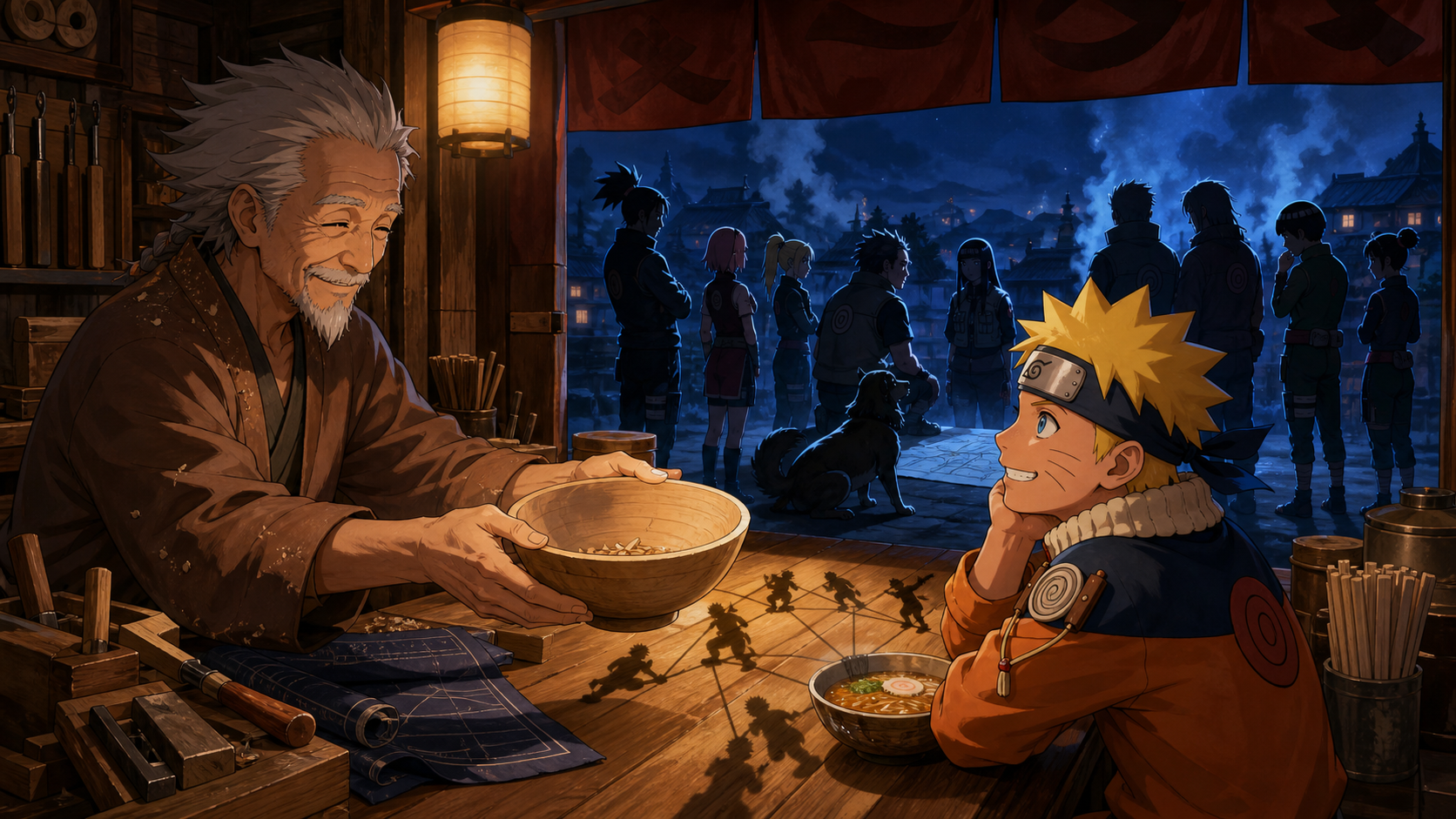
Crisis: The Hidden Leaf 11 Gather!
A trusted old carpenter steals Konoha’s strategic blueprints, forcing the Hidden Leaf 11 to investigate whether ordinary kindness was part of his cover.
Gennō knows how to disappear without hiding.
He takes a carpentry job during Konoha's construction boom. He pays his rent on time. He drinks with coworkers, does average work, and stays out of trouble. At Ichiraku, he gives Naruto the ramen he cannot finish.
Ayame thinks they look like a grandfather and grandson.
Then Gennō steals blueprints for the village's most important facilities, escapes under a smoke screen, and apparently blows himself up before ANBU can question him.
Episode 197 opens the Konoha Plans Recapture Mission by turning ordinary kindness into evidence.
The village does not know whether Gennō passed the plans to an enemy. Naruto does not know whether the old man ever cared about him. Both questions begin in the same uncomfortable place.
Everyone trusted what looked harmless.
Episode 197 Facts
Episode: 197 of the original Naruto anime
Licensed title: Crisis: The Hidden Leaf 11 Gather!
Japanese title: 大ピンチ! 木ノ葉の11人全員集合 (Daipinchi! Konoha no Jūichinin Zen'in Shūgō)
Japanese broadcast: August 16, 2006
Arc: Konoha Plans Recapture Mission
Classification: Anime-original filler
This episode opens a five-part investigation running through Episode 201. Gennō's connection to Kagerō Village, the full purpose of the stolen plans, and later conclusions about his relationship with Naruto do not belong at this stage. Episode 197 ends when ANBU takes Naruto for questioning, before the next episode's regressive hypnosis.
The Konoha 11 here are Shikamaru, Naruto, Sakura, Ino, Chōji, Kiba, Hinata, Shino, Neji, Lee, and Tenten. Sasuke is absent. The name describes the young shinobi still available inside the village, not a formal permanent unit with its own command structure.
Konoha's Construction Boom Opens the Door
Naruto and Sakura notice how many new houses are going up around the village.
Local construction crews do not have enough workers, so companies have begun hiring carpenters from beyond the Land of Fire. That detail sounds like background chatter until Naruto spots Old Man Gennō.
Naruto introduces him as a carpenter from the Land of Sand and a fellow Ichiraku regular. The three sit down for ramen, where Gennō quietly gives Naruto the portion he cannot finish.
Their comfort is immediate. Naruto accepts the bowl without ceremony. Gennō absorbs Sakura's irritation with the patience of someone who has watched this argument before. Ayame says the two act like family.
The scene is warm because nobody has to explain the relationship.
It is also a nearly perfect cover.
An outside carpenter does not look unusual during a labor shortage. An older man who keeps to himself does not look secretive if he works hard and causes no problems. Regular meals at a busy ramen stand make him visible without making him suspicious.
The labor shortage weakens more than background checks. Supervisors need enough hands to meet construction demand, so “competent and available” becomes a strong reason to stop asking questions. Gennō's forged recommendation fails verification only after a genuine letter exposes the handwriting mismatch. By then, months of ordinary behavior outweigh the original deception in everyone's judgment.
That is a policy failure shaped by real pressure. The master carpenter does not knowingly give a trap specialist access. He decides that removing an adequate worker over a suspicious letter feels wasteful when crews are already short. Gennō builds his cover around the decision a reasonable overworked employer is most likely to make.
Gennō does not avoid the village's attention.
He teaches the village how to see him.
Gennō the Carpenter Becomes Gennō the Trapper
Gennō leaves Ichiraku after saying he has business to handle.
That night, a smoke screen rolls through Konoha. Naruto notices it, assumes it might be fog, and goes back to sleep. ANBU has been watching the old carpenter for two weeks, and he has finally made his move.
The current Bingo Book offers no answer. An older volume does.
The outdated record creates another gap. Gennō is dangerous enough to have earned a known title, yet the identification sits outside the reference ANBU checks first. Institutional memory exists, but retrieval depends on somebody deciding to search farther back than the current threat list.
Two weeks of surveillance show that ANBU eventually connected the carpenter to a concern. The operation still lets him choose the time of movement, deploy smoke inside the village, reach the Western Forest, and apparently destroy both himself and the chance for questioning. Watching the suspect does not equal controlling the risk.
The quiet laborer is Gennō the Trapper, a shinobi whose specialty makes every part of his escape more dangerous.
ANBU corners him in the Western Forest and demands the item stolen from the master carpenter's house. Gennō claims he no longer has it. He says he regrets that he will not live to see Konoha's end, then surrounds himself with paper bombs.
The explosion denies ANBU the interrogation they need.
It also denies them the stolen blueprints.
Gennō's apparent death is not the end of the attack. It is the moment Konoha realizes it cannot see the attack at all.
A Blueprint Can Be a Weapon
The stolen documents map important facilities throughout the village.
Naruto initially does not understand why that creates an emergency. Shikamaru gives him two examples.
Plans for the fortifications around Konoha could reveal the most efficient route through its defenses. Plans for Tsunade's residence could show an assassin how to reach her room.
Walls protect only what the enemy does not know how to bypass.
Tsunade cannot assume the plans remain inside the village. Gennō may have transferred them before ANBU caught him, and his final words suggest a larger attack. She declares an S-Level Emergency Security Alert and sends nearly every available shinobi to secure the border.
The decision creates a strange division of labor.
The experienced forces guard Konoha from an army that may be coming.
The youngest shinobi search for the information that could guide it inside.
Tsunade's response protects against the most catastrophic interpretation: an external force already waiting for the plans. It also empties the village of many people best qualified to inspect a top trap specialist's work. She accepts that tradeoff and assigns Shikamaru because border defense and internal recovery must happen at the same time.
The alert demonstrates how stolen information changes terrain without moving a single soldier. Every gate, wall, office, and emergency route becomes less trustworthy once an enemy may know its design. Konoha cannot simply replace the paper. It must assume the knowledge has already escaped.
The Konoha 11 Finally Gather
Tsunade leaves Shikamaru behind to lead a special recovery mission.
He assembles Naruto, Sakura, Ino, Chōji, Kiba, Hinata, Shino, Neji, Lee, and Tenten. With Shikamaru, they form the Konoha 11 named in the title.
The gathering offers a quick reminder of how differently these ninja read their surroundings. Shino's insects reacted to the smoke screen. Neji and the others recognized that ANBU was involved and stayed clear. Naruto thought he saw fog. Chōji did not notice anything at all and is briefly horrified when that places him below Naruto's awareness.
The jokes do not weaken the emergency. They establish why Shikamaru needs the whole group.
No one member can investigate every kind of clue. Hinata and Neji can inspect structures with the Byakugan. Kiba and Akamaru can trace a route by scent. Sakura's medical training prepares her to examine a body. Shikamaru can divide the problem before panic turns it into noise.
This is not a battle formation.
It is a village-wide search team built from eleven different ways of noticing what other people miss.
Shikamaru also has to manage relationships, not just abilities. Naruto personally knows the suspect. Ino resists the body examination. Lee is recovering. Neji and Hinata share a visual tool but bring different field experience. Good assignment means placing each person where skill outweighs discomfort without pretending the discomfort does not exist.
The group name can sound celebratory, but the episode uses them as the force left behind during an emergency. Their gathering reflects necessity more than ceremony.
Naruto's Ramen Defense Is Funny Until It Is Not
Shikamaru reveals the suspect's photograph.
Naruto recognizes Gennō immediately and refuses to believe it. His argument is absurdly simple: anyone who loves Ichiraku ramen cannot be a bad person.
Chōji agrees.
For a few seconds, Shikamaru has two food-based witnesses and no useful testimony.
The comedy works because Naruto is doing something painfully familiar. He is using the detail that made Gennō feel safe as proof that Gennō must be safe.
Shikamaru answers with the colder possibility. A spy would never show his worst side while trying to lower people's guard. Every pleasant interaction could have been part of the role.
Naruto cannot accept that conclusion either.
He does not have evidence that Gennō is innocent. He has bowls of ramen, easy conversation, and the memory of an old man who shared food with him.
Those memories are not proof.
They still matter.
Emotional testimony can be unreliable without being useless. Naruto remembers tone, habits, favorite places, and repeated choices no surveillance summary may contain. The problem begins when he treats affection as a character clearance rather than one category of evidence.
Shikamaru risks the opposite mistake if he treats every kind act as automatic tradecraft. A cover can contain real feeling. A guilty person can care about somebody. Episode 197 keeps both possibilities open because the investigation has not earned a clean answer yet.
The Team Investigates an Ordinary Life
Shikamaru assigns the search according to each person's strengths.
Hinata, Neji, and Lee inspect the construction sites where Gennō worked. The master carpenter says he never allowed outsiders near projects involving village security. Gennō worked only on residences, and the Byakugan search finds no visible traps.
Kiba and Akamaru retrace his escape route in case he hid the plans before reaching the Western Forest.
Sakura and Ino receive the least appealing job: inspect Gennō's body for clues. Ino recoils. Sakura accepts because training as a medical ninja means she cannot let fear of a corpse stop the investigation.
The first round produces no dramatic discovery.
Instead, it produces a portrait of someone designed to leave no sharp edges.
Gennō arrived about three months earlier with a recommendation letter supposedly written by a respected carpenter from the Land of Sand. His work was neither excellent nor poor. He was serious enough to keep during a labor shortage and unremarkable enough not to remember closely.
Later, the master carpenter discovered that the letter was forged because its handwriting did not match an older, authentic recommendation. Nobody removed Gennō. He had not caused trouble, and the village needed workers.
That choice is understandable.
That is exactly why it is dangerous.
Average Was Part of the Disguise
At Gennō's rented room, the same pattern continues.
He paid on time. He sometimes drank with coworkers. He never disturbed the landlord. His cupboards hold little beyond instant udon, which fits a man who ate frequently at Ichiraku.
There is no secret shrine, obvious map, or villain's confession waiting under the floorboards.
Even his carpentry was average.
Exceptional skill attracts scrutiny. Bad work creates complaints. Average work lets a person remain inside a crew for months while everyone remembers him as dependable enough.
The trap specialist's most effective trap may be the identity that never feels worth examining.
Konoha had pieces that could have changed the picture. ANBU had begun surveillance. The master carpenter knew the recommendation was false. Naruto knew Gennō's habits. His coworkers knew his schedule. His landlord knew where he lived.
No single piece looked urgent until the blueprints vanished.
The failure is distributed. The forged recommendation belongs to the employer's records. The older Bingo Book belongs to shinobi intelligence. Rent and drinking habits sit with civilians. Naruto's friendship lives outside formal reporting. Nobody owns the combined picture until the emergency forces Shikamaru to build it.
Gennō benefits from those boundaries. He does not need every institution to fail completely. He needs each one to see only the harmless fragment assigned to it.
Naruto Is the Clue Gennō Left in Plain Sight
The landlord remembers one personal detail.
Gennō rarely spoke about himself, but he happily mentioned befriending a child in the village. The team wonders where to find that child.
Naruto wonders too.
It takes everyone else to explain that the child is him.
ANBU arrives almost immediately and asks Naruto to come with them.
The episode ends before the questioning begins, leaving Naruto in the position Gennō created for him. His friendship is now intelligence. Casual conversations may contain operational clues. A shared meal may reveal where Gennō went, what he watched, or what he wanted Naruto to notice.
Naruto wanted his memories to prove the old man was good.
Konoha needs those same memories to determine how he planned to destroy it.
Episode 197 does not tell us which version of Gennō is real.
It asks whether Naruto ever met the real man at all.
A village emergency begins with boring paperwork
The forged recommendation is not flashy enough to feel like the opening move of an attack. It is one letter inside a labor shortage, attached to a worker who performs adequately and causes no trouble. That is why it works. Security failures often arrive disguised as decisions too ordinary to deserve escalation.
The master carpenter notices the handwriting mismatch and keeps Gennō because the village needs hands. ANBU identifies the old Bingo Book entry only after suspicion has already formed. Neither system holds a complete picture. The episode understands that a skilled infiltrator does not need everyone to be careless. He needs each person to possess one harmless-looking fragment and no reason to compare it with the others.
Tsunade responds to uncertainty, not confirmed invasion
She does not know whether the blueprints remain with Gennō, whether an accomplice received them, or whether an army waits beyond the border. The S-level alert looks extreme only if the missing information is treated as reassuring. It is not. Uncertainty expands the number of attacks Konoha must be ready to survive.
Sending experienced ninja outward protects against the largest external threat. Keeping Shikamaru and the younger team inside protects the investigation. The split is uncomfortable because both jobs deserve the same specialists, but Tsunade cannot leave the border open while everyone searches one rented room. Command here means accepting an imperfect allocation before the enemy explains the plan.
Shikamaru turns eleven personalities into an evidence system
The title promises a reunion, but Shikamaru does not gather the young ninja for a group pose. He assigns sensory ability, medical knowledge, tracking, structural vision, and local memory to different questions. Even the episode’s jokes about who noticed the smoke establish observation baselines that matter during an investigation.
He also recognizes that evidence has emotional weight. Naruto knew the suspect. Ino fears examining the body. Lee is still recovering. A capable leader cannot pretend those facts disappear when orders begin. He must use skill without confusing discomfort with disobedience or affection with proof.
Naruto’s bias is useful once it stops acting like a verdict
“He likes ramen” is not a defense against espionage. Shikamaru is right to reject it. Naruto’s memories still contain details nobody else collected because nobody else sat beside Gennō without treating him as a target. Informal relationships notice routines, jokes, food habits, and changes in mood that official surveillance can miss.
The problem is not that Naruto cares. The problem is using care to close the investigation before it starts. Once he accepts that friendship creates questions instead of automatic innocence, his personal knowledge becomes one of the team’s strongest sources. Emotional proximity produces bias and access at the same time.
Kindness does not have to be fake to coexist with guilt
Shikamaru warns that a spy presents a pleasant face to lower suspicion. Correct. That does not prove every bowl Gennō shared was calculated. People are capable of completing harmful plans while holding genuine affection for someone caught inside them. The later investigation will have to deal with that contradiction rather than selecting one clean version of the old man.
Episode 197 earns tension by refusing to answer early. If the kindness was entirely false, Naruto was selected as camouflage. If it was real, Gennō accepted a mission that could destroy the home of a child he cared about. The second possibility is not softer. It demands an explanation for choosing the plan anyway.
Average performance is elite concealment
Gennō avoids the suspicion attached to both incompetence and brilliance. He works well enough to remain hired and poorly enough that nobody builds a story around his talent. His room follows the same strategy: rent paid, a few drinks with coworkers, little personal property, nothing dramatic enough to become memorable.
A trap specialist knows attention is a resource. Every complaint forces somebody to inspect him. Every exceptional result gives somebody a reason to remember him. Average work leaves no hook. The disguise succeeds because ordinary institutions reward stability and move on.
The apparent suicide controls what Konoha can know
By detonating paper bombs in the Western Forest, Gennō appears to destroy the suspect, the testimony, and the chance to recover the plans in one move. ANBU can report what they saw, but the blast decides where questioning ends. A dead infiltrator invites investigators to search for accomplices while treating his personal motives as inaccessible.
The episode wisely makes the missing blueprints more important than the body. Even if Gennō died, copied information may already be moving. Konoha cannot declare safety because the person who stole the paper is gone. Knowledge does not return to a locked drawer when its thief disappears.
RaeRae’s full take
Episode 197 is a security story that understands why “harmless old man” is not a meaningful clearance level. Gennō enters through labor demand, stays through average work, and becomes familiar through routines everybody reads as proof that nothing interesting is happening.
Naruto’s hurt matters because he is not only a witness. He may be the one relationship Gennō talked about with pride. That could mean affection, cover, a planted clue, or all three. The investigation should not bully Naruto out of caring. It should make his memories precise enough to test.
And the Hidden Leaf 11 gathering works because this is not another contest about who hits hardest. Konoha needs noses, eyes, medical judgment, structural inspection, local memory, and Shikamaru’s ability to stop eleven partial answers from becoming eleven separate investigations. The village trusted a surface. The kids now have to reconstruct the person underneath it.
RaeRae checkpoint: Gennō’s strongest disguise is not his age or his carpentry. It is the collection of reasonable little decisions that lets everybody postpone one more question.
Receipts and official routes
- Episode number, licensed title, stolen blueprints, Gennō’s apparent death, and the Hidden Leaf 11 investigation: Naruto Official Site.
- Japanese title, August 16, 2006 broadcast record, and TV Tokyo episode synopsis: TV Tokyo.