
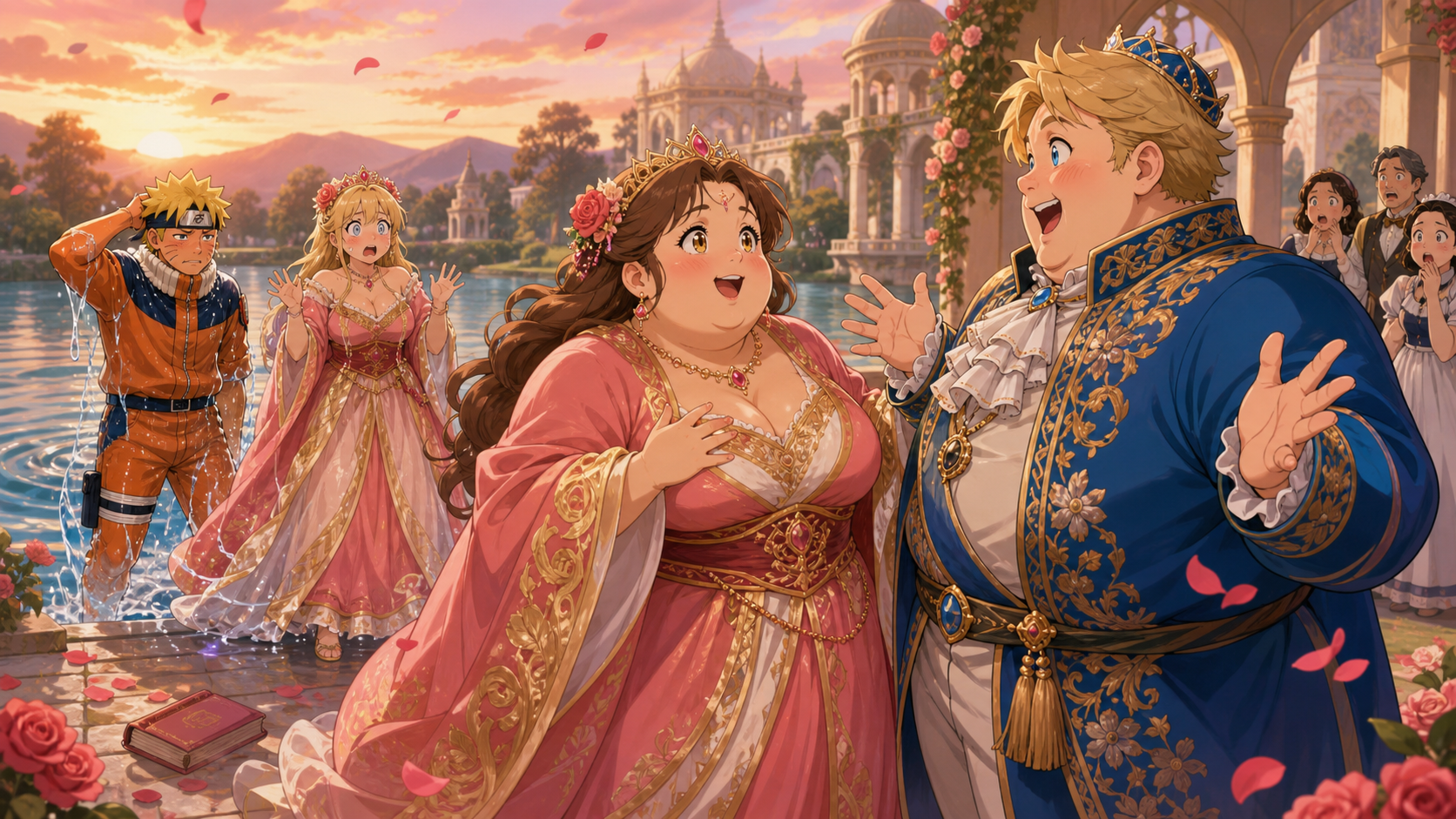
Ino Screams! Chubby Paradise!
Fuku hires Ino to impersonate her for a matchmaking visit, only for Chikara to adore the real princess and expose every assumption behind the deception.
Princess Fuku hires a ninja body double because she assumes the man she loves could never want her current body.
Ino accepts the job because she assumes the same thing.
Naruto turns it into a three-princess disaster involving Jiraiya's romance books, mind control, a lake, and the worst possible place to take an emergency bathroom break.
Prince Chikara ends the entire deception by looking at the real Fuku and declaring her perfect.
Episode 192 has a sharp idea buried under a pile of dated fat jokes. Attraction is personal. Nobody gets to decide which body another person must prefer. The episode lands that point, then lets Ino spend the ending refusing to learn it.
Comedy with a lesson, apparently optional.
Episode 192 Facts
Episode: 192 of the original Naruto anime
Licensed title: Ino Screams! Chubby Paradise!
Japanese title: いの絶叫! ポッチャリ♥パラダイス (Ino Zekkyō! Pocchari Paradaisu)
Japanese broadcast: July 5, 2006
Story placement: Standalone anime-original mission
Classification: Filler
The episode sometimes gets called the Matchmaking Proxy Mission, which describes the assignment more clearly than the licensed title. It also introduces “Pinocchio” as the original series' ending theme. Neither detail turns the story into canon material, but both locate it precisely in the late Part I run.
That placement matters because Ino has already proved herself as a shinobi with sensory judgment, clan technique, and the nerve to take control under pressure. The mission does not fail because she lacks competence. It fails because the job asks her to use that competence in service of a lie nobody tested against the simplest available evidence: Chikara's actual preference.
Ino Gets the Least Dangerous Body-Double Mission Ever
Tsunade tells Ino that a feudal lord's daughter requested her by name.
The princess needs a double, and an old portrait shows a startling resemblance between them. Ino reasonably assumes somebody is targeting the royal family.
Nobody is trying to kill Princess Fuku.
She is trying to date.
Fuku has an arranged meeting with Prince Chikara of the neighboring Land of Udon. She fell for his portrait and became increasingly anxious as the meeting approached. Sleeplessness led to stress eating, her body changed, and a miracle slimming product failed to perform the miracle printed on its package.
Fuku now believes she cannot appear before Chikara.
Her solution is to send Ino under her name and ask a stranger to secure her marriage through fraud.
This is not a sound foundation for romance, diplomacy, or basic conversation.
It also creates a political problem the episode barely acknowledges. Fuku and Chikara are not arranging a private dinner between two ordinary teenagers. Their families represent neighboring territories. If Chikara agrees to a marriage after meeting Ino, Fuku must either continue the impersonation or disclose that the courtship began with a substituted body. The servants surrounding both heirs make secrecy even less believable.
Tsunade accepts the assignment without challenging that premise. Naruto and Ino receive mission ranks, travel under Leaf authority, and help a client deceive another political household. No assassin threatens Fuku. No security emergency requires a decoy. Konoha has rented out transformation and clan techniques to solve a confidence crisis through fraud.
That is the quiet institutional joke beneath the loud body comedy. The village can classify almost any request as shinobi work if a feudal client pays for it.
Ino calls it major because a girl's heart is involved.
Naruto calls it what it is: a fake date with too many servants.
The Mission Begins With a Shared Bad Assumption
Fuku does not hate Chikara.
She is already infatuated. The deception comes from fear that he will hate her.
Ino validates that fear by stating that men prefer slender girls. She sees her own body as the obvious version of Fuku that Chikara will accept.
Neither girl knows what Chikara likes.
That missing fact should stop the plan before it begins. Instead, everyone treats one beauty standard as if somebody carved it into the Hokage Monument.
The problem is not that Fuku wants to feel confident. She deserves support after stress has changed her habits and left her miserable.
The problem is that confidence gets reduced to becoming thinner or hiding.
The failed slimming product makes the point even uglier. Fuku bought something promising to erase the consequences of eating without changing anything else, then blamed herself when marketing nonsense did not rebuild her body on schedule. Nobody asks whether she is sleeping, managing stress, or feeling well. They only ask whether she can fit the portrait before Chikara arrives.
The portrait has become a contract Fuku thinks her current body violates. It records a real earlier appearance, but Chikara's feelings are directed toward a person he has never met. Fuku treats the picture as proof that he purchased one exact version of her. The adults around her reinforce that fear by arranging a replacement instead of letting her ask what he wants.
The so-called slimming product makes money from that uncertainty. It promises to block entire categories of food with no meaningful change in health, appetite, rest, or stress. Fuku becomes the person blamed when the promise fails. The seller disappears from the story with the money and none of the embarrassment.
Ino arrives prepared to perform the version of femininity everyone assumes a prince ordered.
Then the prince walks in.
Chikara Arrives With His Own Weather System
Prince Chikara does not enter a room.
He happens to it.
Servants scatter petals. Music announces him. His hair, sideburns, poses, and delivery channel an Elvis impersonator who has never encountered the concept of lowering the volume.
Naruto thinks he is more intense than Guy.
That is an achievement.
Chikara is also heavy, which shocks Ino and Naruto because Fuku's description emphasized a famously handsome prince. Their reaction exposes the same assumption governing the disguise. They cannot imagine fatness and desirability occupying the same person.
Fuku can.
She watches from hiding and remains completely enchanted. Chikara is exactly the passionate, theatrical man she wanted.
The episode could stop judging both of them and let two dramatic weirdos find happiness.
It is not ready to behave that well.
Ino Cannot Flirt With Someone She Does Not Want
Ino tries to conduct the meeting with royal restraint.
Chikara offers flowers, music, poses, and relentless attention. Every new display makes her recoil harder. When she escapes to consult with Fuku, the princess orders her to keep pushing until Chikara falls for her.
Ino objects because she finds him physically unattractive.
That feeling is allowed. Nobody owes attraction to anybody, and completing a mission should not require unwanted kissing.
The hypocrisy sits elsewhere.
Ino treats her lack of attraction as proof that Chikara is objectively undesirable while treating Fuku's attraction as some baffling error. She wants her own preferences respected and refuses to believe anyone else's can differ.
Her disgust also shapes how well she can perform the assignment. A body double can reproduce Fuku's face and clothing, but she cannot reproduce desire she does not share. Every flinch tells Chikara that the woman before him does not want his attention. Fuku keeps demanding a better performance because she can see her own attraction clearly and assumes Ino can manufacture it on command.
That request crosses a consent line before Chikara reaches for a kiss. Ino agreed to impersonate the princess, but the mission keeps expanding toward physical intimacy. Fuku wants the result without entering the room, and Chikara cannot consent to touching Ino because he believes she is someone else. Nobody has enough honest information to agree to what the scene demands.
Fuku is not asking Ino to fall in love.
She is asking her to counterfeit love convincingly enough to obtain a fiancé.
That is also a terrible request.
The mission is now two bad ideas arguing over professional standards.
Naruto decides it needs a third.
Naruto Consults the Worst Possible Training Manual
Naruto transforms into Princess Fuku and enters the meeting.
His romantic strategy comes from one of Jiraiya's books, which should disqualify it before he opens his mouth. Naruto-as-Fuku asks Chikara to loosen the sash and launches an aggressive advance that terrifies everyone who knows what is happening.
Ino uses Mind Destruction Jutsu to seize control long enough to remove him.
They argue over who handled the meeting better.
The correct answer is neither.
Ino cannot hide her disgust. Naruto treats seduction like a prank with mission clearance. Fuku keeps issuing orders from another room while refusing to let Chikara meet the person he may marry.
Every participant except Chikara knows the meeting is false.
He is the only person behaving honestly, even when that honesty arrives with flower petals and pelvic choreography.
Naruto's intervention reveals another limit. Transformation Jutsu changes what Chikara sees, not Naruto's experience, judgment, or understanding of Fuku. Jiraiya's fiction supplies a script built for adult fantasy, and Naruto performs it without grasping its sexual meaning or the diplomatic consequences. The scene treats his ignorance as comedy, but Ino is right to stop him immediately.
Mind Destruction Jutsu solves the immediate danger by overriding Naruto's body. That is a familiar clan technique used here for slapstick containment, yet it repeats the episode's larger problem: people keep taking control of other bodies to avoid a direct conversation. Ino uses it defensively, but the pattern is hard to miss.
Three Fukus Are Two Too Many
Ino returns to the meeting.
Naruto interferes again. Chikara glimpses another princess outside the room, and Ino convinces him that his powerful feelings produced a vision.
Somehow, that works.
When Chikara tries to kiss the transformed Ino, the real Fuku becomes jealous and interrupts. She wants a substitute to win his love but cannot tolerate the physical intimacy required to maintain the lie.
That boundary is human.
It is also proof the plan cannot succeed. A marriage cannot be transferred like mission paperwork after Ino secures the signature.
Ino throws Naruto into a lake during the ensuing fight. Still wearing Fuku's appearance, a soaked Naruto cannot find a bathroom and relieves himself outside.
The real Fuku catches a duplicate of herself urinating on the grounds.
Privacy, dignity, and operational security leave together.
The chase crashes into the courtship, placing Fuku, Ino-as-Fuku, and Naruto-as-Fuku in one visible mess.
The disguise is over.
Chikara Wanted Fuku the Whole Time
Fuku admits that she is the real princess.
Chikara looks past the thinner doubles, sees her actual body, and becomes ecstatic. She is the woman he imagined. He asks her to marry him immediately.
Fuku accepts.
The happy ending works because Chikara does not say her personality compensates for her appearance. He does not nobly overlook her size. He likes her body.
That distinction matters.
Fuku spent the episode assuming attraction followed a universal ranking in which Ino automatically beat her. Chikara was never using that ranking.
The deception, humiliation, fake flirting, and outdoor plumbing catastrophe were unnecessary.
One honest meeting could have solved everything.
Chikara's preference does not retroactively make the plan harmless. He spent the day directing affection toward two shinobi he believed were Fuku. Fuku watched, instructed, and became jealous without giving him the information required to choose. A happy match removes the feared rejection. It does not erase the deception that preceded it.
The episode rushes from exposure to proposal because Chikara's attraction supplies a clean comic release. Real trust would require another conversation after the servants leave. Fuku would need to explain why she hid, Chikara would need room to respond to being misled, and both families would need to decide whether an honest courtship can follow the staged one.
Their mutual delight makes that repair possible. It does not make it unnecessary.
Ino Misses the Point at Full Volume
Ino is furious.
She forced herself through a courtship with a man she did not desire, only to watch him choose Fuku without giving Ino a second glance. Her pride takes the rejection personally even though she spent the day insulting him behind his back.
Naruto points out the obvious.
The clients are happy. The mission succeeded. People like what they like.
Ino refuses to accept it. She insists men must prefer slender women and announces another diet so she can become more feminine.
That ending weakens the episode's own reversal. Fuku learns that hiding was unnecessary. Chikara never needs correcting. Ino, the character most committed to policing everybody's body, receives no growth.
Maybe that is honest. One surprising couple does not instantly dismantle a beauty standard someone has treated as fact for years.
Ino's reaction also protects her pride. If Chikara's taste is simply different, then her thinner body never guaranteed victory. She performed discomfort, judged both clients, and still misunderstood the assignment. Declaring another diet lets her preserve the belief that she occupies the superior category even after the evidence refuses to cooperate.
Naruto understands the result more quickly because he has lived outside other people's definitions of acceptability. He does not need to share Chikara's attraction to recognize it as real. The same directness that made him disastrous as a romantic substitute makes him the only teammate willing to state the obvious once the disguises drop.
It still leaves the final laugh pointed at the wrong person.
Fuku and Chikara are not the joke because they are heavy.
The joke is that the thin body double worked all day to solve a problem neither client had.
The portrait becomes a beauty contract nobody signed
Fuku treats an older image as the version Chikara was promised, even though they have never met. Her current body feels like a breach she must hide. The adults around her reinforce that fear by arranging a substitute instead of asking whether the prince’s interest depends on one photograph. A portrait can introduce a person. It cannot freeze her body or dictate another person’s attraction.
The Leaf accepts deception where no security emergency exists
A body double can protect a threatened royal from assassination. Here the mission uses transformation and clan skills to mislead a prospective fiancé during a political courtship. Tsunade should have required an honest meeting or at least clear limits on what Ino was expected to perform. Payment and status do not turn romantic fraud into routine village service.
Fuku’s anxiety deserves care beyond a slimming product
She describes sleeplessness, stress eating, shame, and panic before an important meeting. Nobody asks about rest, health, pressure, or whether she wants the match apart from her fear of rejection. The miracle product sells certainty, fails, and leaves Fuku carrying the blame. The seller profits from insecurity while the client is told her body created the crisis.
Ino confuses her preference with a universal rule
She is allowed not to desire Chikara. The problem begins when she treats that reaction as objective evidence that nobody else should desire him and assumes every man must prefer her thinner body. Personal attraction needs no defense. Turning it into a ranking system for everybody else does. Fuku and Chikara know their own preferences better than Ino does.
The assignment crosses consent boundaries in both directions
Ino agreed to impersonate Fuku, not to accept escalating physical intimacy. Chikara believes he is courting Fuku and cannot consent to touching a different person hidden behind transformation. Fuku wants the result while avoiding the encounter, then becomes jealous when the performance reaches the intimacy required to maintain the lie. The mission has no honest participant agreement because identity is its central deception.
Naruto’s romantic manual makes the fraud more dangerous
Jiraiya’s fiction gives him an adult script without adult understanding. Transformation changes Naruto’s appearance, not his judgment or knowledge of Fuku. His aggressive performance exposes how absurd it is to outsource desire as though any actor wearing the correct face can produce the same relationship. Ino is right to stop him, even if the scene solves one bodily takeover with another.
Three visible Fukus finally return choice to Chikara
The collapsing disguises create maximum humiliation, but they also end the informational imbalance. Chikara can finally see the real person whose name governed the meeting. Fuku must speak for herself, and Ino no longer has to counterfeit attraction. Honesty arrives through disaster because nobody was willing to choose it at the beginning.
Chikara’s attraction is not noble tolerance
He does not overlook Fuku’s body in favor of some hidden inner worth. He likes what he sees. That matters because the episode’s entire plan assumes one body type automatically wins. His preference does not need to be universal to prove the assumption false. It only needs to belong to him, the person whose desire everybody else tried to predict.
A happy proposal does not erase the deception
Mutual delight removes the feared rejection and makes repair possible. Chikara still deserves to know why two shinobi appeared under Fuku’s identity, and Fuku deserves a courtship that is not rushed from exposure to engagement because the joke needs an ending. Trust after a successful reveal remains work. Compatibility does not retroactively create informed consent.
RaeRae’s full take
Episode 192 has one good point buried under enough fat jokes to require excavation equipment: attraction is personal. Ino’s body does not automatically beat Fuku’s, and Chikara’s body does not make Fuku’s desire a mistake.
The mission exists because everybody except Chikara acts like his preference is public law. Nobody asks him. Nobody lets Fuku test reality. They hire ninja, stage romance, seize bodies, and nearly start a three-princess incident to avoid one honest hello.
Fuku and Chikara are not the punch line. The punch line is Ino working all day to solve a rejection that never existed, then refusing to update the theory after the evidence walks past her throwing rose petals.
RaeRae checkpoint: Nobody needed a thinner princess. They needed an honest meeting. Chikara’s preference belonged to Chikara, and the entire palace learned that after choosing every harder option first.
Receipts and official routes
- Episode number, licensed title, Fuku’s request, changed body, and matchmaking substitution: Naruto Official Site.
- Japanese title, direct request for Ino, proxy premise, and July 5, 2006 broadcast record: TV Tokyo.