
Forecast: Death! Cloudy with Chance of Sun!
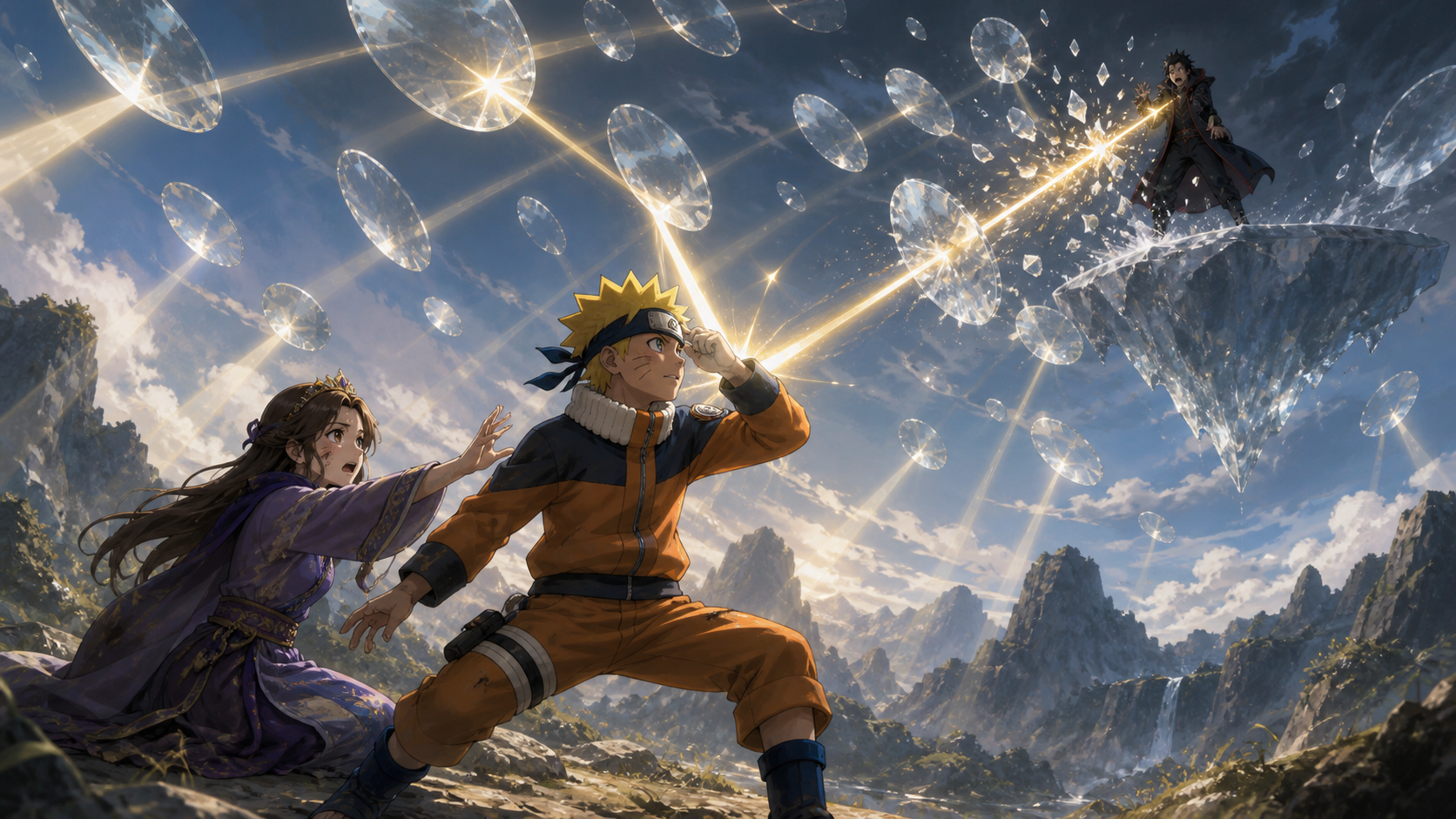
Renga turns ice and sunlight into an invisible weapon, but Naruto reflects the attack with his forehead protector as Haruna chooses not to repeat his logic.
Renga offers Naruto a hostage exchange.
Give him Haruna, and Hinata, Choji, and Yurinojou will live.
Naruto refuses because the promise comes from a man who admits he planned to murder his own brothers.
That is not recklessness. It is the most rational decision anyone makes in Episode 191.
Renga believes every relationship is a transaction between the person doing the using and the person getting used. Haruna has spent this mission dangerously close to the same belief. The finale forces her to decide whether surviving her father's choices means repeating them.
She finally chooses differently.
Episode 191 Facts
- English title: Forecast: Death! Cloudy with Chance of Sun!
- Japanese title: 死の宣告「くもり時々晴れ」
- Original Japanese broadcast: June 28, 2006
- Story position: Fifth and final episode of the Peddlers Escort Mission
- Renga's technique: Transparent ice formed from atmospheric moisture and used to focus sunlight
- Naruto's counter: Reflect the heat beam with his forehead protector's metal plate
- Succession: Neighboring countries receive notice naming Haruna the next feudal lord
- Haruna's pledge: Rebuild the Land of Greens without sacrificing its people
The finale places Haruna between two inheritances. Renga offers the user-versus-used logic she already practiced. Her father offers a belief in people that coexisted with the decision that wounded her most. She cannot make the past consistent. She can decide which part becomes policy.
Renga Offers a Deal Nobody Should Trust
Naruto and Haruna are almost through the valley when Renga blocks the route.
He has already captured the three people Naruto left behind. Hand over the princess, he says, and they will be spared.
Haruna fears Naruto may abandon her too. Renga enjoys placing both of them inside his worldview. Haruna has sacrificed people to preserve her claim. Naruto now has friends whose lives can be weighed against hers.
Then Renga explains what family means to him.
He thanks Naruto's group for defeating Ruiga and Jiga. Renga planned to remove his brothers anyway. Three men cannot all claim one throne and divide one country's wealth, so one brother would eventually have to kill the others.
Naruto hears the confession and rejects the exchange.
A man who abandons his own siblings will not keep his word to an enemy.
Renga confirms it without embarrassment.
The hostage bargain was never a rescue plan. It was only a faster route to Haruna.
Naruto's refusal is evidence-based rather than blindly heroic. Renga has just admitted that kinship and prior partnership do not constrain him. A promise to spare captured enemies carries less weight than his demonstrated willingness to kill allies for profit.
The Weather Forecast Is a Threat
Naruto attacks with shadow clones and finds an invisible barrier around Renga.
It feels hard, but he cannot see what stops him. The same problem affects Renga's projectiles. Transparent shapes strike before Naruto can identify their direction.
Renga condenses moisture from the air into ice.
He can form clear shuriken, defensive disks, platforms that hold him above the battlefield, and linked structures that let him observe distant targets.
Then he asks Naruto for the forecast.
Cloudy with periods of sun.
The clouds supply moisture. The sun supplies the weapon.
Renga shapes ice into a lens and concentrates sunlight into a heat beam. Trees and stone burst apart under the focused ray. He boasts that once he controls the Land of Greens, the same technique can burn the surrounding countries.
His coup is not only a grab for money. It is a plan to turn a vulnerable neutral country into a firing position.
The weather dependency gives the technique scale without making it magic from nowhere. Moisture supplies material, clear ice supplies concealment, and sunlight supplies destructive energy. Partly cloudy conditions hand Renga all three in alternating abundance.
Naruto Cannot Hide Haruna
Naruto uses smoke and terrain to move Haruna away from the attack.
Renga sees them anyway.
His ice network can search across vast distances, which makes ordinary hiding useless. Every new lens relocates the beam. Naruto cannot reach Renga through the defenses, and he cannot outrun an attack guided from above.
He covers Haruna with his body.
She asks why he keeps protecting her after everything she has done.
Naruto does not produce a polished moral argument. He does not even claim he understands his own impulse completely. He knows that Hinata asked him to protect Haruna, he gave his word, and someone in front of him is about to die.
That is enough.
Renga treats the absence of personal profit as stupidity.
Naruto treats it as a promise.
Shielding Haruna is tactically poor if survival is the only measure. It is morally coherent because Naruto refuses the premise that her past choices cancel her right to live. He protects her while continuing to reject the worldview she used against the merchants.
Haruna Hears Her Father's Last Words
Renga calls Naruto a good-natured fool like the former feudal lord.
Haruna stops.
She has spent years believing her father valued the country more than his daughter. He sent her away as a hostage, left her isolated in a foreign court, and allowed politics to take her childhood. Whatever pressure shaped the decision, Haruna lived with its consequences.
Renga reveals the part she never heard.
Her father begged the Janin not to torment the people. The Land of Greens was small and surrounded by stronger countries. Its strength came from people, so a ruler had to treat every one of them as family and refuse to sacrifice their lives.
He also spoke about Haruna.
Sending her away had been a bitter decision. She mattered more to him than his own life. He knew she might never forgive the father who sacrificed his daughter for peace.
Then Renga admits killing him.
The truth does not erase what Haruna suffered.
It destroys the belief that her father felt nothing while she suffered.
Regret does not undo the hostage decision. Haruna still lost safety, health, and childhood because adults chose national survival over her consent. Learning that her father loved her changes the emotional record, not the material history.
Renga Wants the World Divided in Two
Renga says there are only two kinds of people.
Those who use others and those who get used.
He intends to reach the top by exploiting parents, brothers, allies, and subjects. Compassion is merely a defect that makes people easier to consume.
This is the argument Haruna has been making in less honest language.
She called the merchants disposable decoys. She treated Kikunojou's death as the expected cost of ninja service. She insisted her survival justified every body left behind because the rightful successor could rebuild the country later.
Renga shows her where that logic ends.
There is no protected class. Once human worth becomes usefulness, the ruler can spend anyone. Family does not restrain the system. Neither does loyalty, grief, or law.
Haruna has every reason to hate what happened to her.
She now has to decide whether hatred will make Renga correct.
That choice is political as well as personal. If Haruna inherits power while accepting Renga's categories, the coup will change the ruler without changing the country built around disposable lives. Succession matters only if it changes what rule requires.
Haruna Steps Between Naruto and Death
Naruto keeps standing until his body no longer cooperates.
He tells Renga that Haruna is the person who will succeed her father and protect the country. Renga prepares another strike.
Haruna moves in front of Naruto.
She tells Renga to kill her instead. Naruto has nothing to do with the coup, and her death would fulfill the Janin's goal.
This does not cancel her earlier choices. Kikunojou remains dead. The merchants were still endangered by her plan. Hinata was still knocked unconscious when Haruna fled alone.
The moment matters because Haruna finally refuses to purchase her own future with somebody else's life.
She once assumed every protector was a resource assigned to die for her.
Now she protects one.
Haruna's intervention is not repayment calculated against Naruto's help. She acts before knowing whether either of them can survive. For the first time in the mission, she places her own body where she previously placed uninformed civilians.
The Forehead Protector Answers the Sun
Naruto does not accept Haruna's sacrifice.
He studies the attack Renga has repeated across the battlefield. The ice lens gathers sunlight and sends it along a line Renga believes he controls.
Light can be redirected.
Naruto positions himself above Renga's line of fire and turns the metal plate of his forehead protector toward the beam. The concentrated sunlight strikes the plate and reflects back into Renga's shoulder.
One of the simplest tools a Leaf ninja wears defeats the most elaborate technique in the fight.
The forehead protector also carries the promise Naruto made to Hinata. She returned it after defeating Jiga, and Naruto swore on it that he would protect Haruna.
He fulfills that promise with the same object.
The counter also follows the arc's pattern of ordinary observation defeating resource spectacle. Naruto cannot overpower the lenses, but he recognizes that a directed beam remains light. The metal plate already on his forehead becomes enough reflective surface to return Renga's own line of attack.
Renga falls, wounded and unable to continue.
The forecast was accurate.
He chose the wrong person to die beneath the sun.
The Leaf Arrives Before the Country Is Carved Apart
Renga claims his defeat comes too late.
Without a feudal lord, the neighboring powers will fight over the Land of Greens and tear it apart.
Shizune and Shikamaru arrive with the answer.
Leaf reinforcements have already rescued Hinata, Choji, Yurinojou, and the other captives. Tsunade dispatched them after receiving news of the coup. Shizune also remembers the kindness Haruna's father showed her and Tsunade.
An announcement has gone to the surrounding countries naming Haruna as the next feudal lord.
The succession is no longer an empty hope carried by one injured girl on a mountain path. It is recognized political fact backed by allies who arrived in time to stop the territory from becoming a prize.
Haruna has survived.
Now survival becomes responsibility.
External recognition stabilizes succession, but it does not rebuild roads, restore trust, or revive the dead. The diplomatic announcement prevents neighboring states from treating the Land of Greens as unclaimed territory. Haruna still has to earn the authority it preserves for her.
Haruna Refuses the Easiest Revenge
Renga lies defeated at Haruna's feet.
He invites her to kill him. Revenge would be understandable, immediate, and completely consistent with his view of humanity.
Haruna raises a kunai.
Then she lowers it.
She is not like him.
The refusal is more important than any declaration that she has become kind. Renga killed her father and helped destroy her country. Haruna does not deny her anger. She refuses to let him define what justice must look like.
Later, she apologizes at Kikunojou's grave. Yurinojou tells her that Kikunojou can watch over the country from there.
Haruna cannot restore the lives spent protecting her.
She can govern in a way that stops treating the next life as expendable.
A Country Where Nobody Becomes the Price
Before the Leaf group leaves, Haruna asks for Naruto's help rebuilding the Land of Greens.
She wants the village to lend him to her.
Naruto declines.
He must return to his friends, continue training, and become stronger. There are things he still has to do for the people precious to him. The answer keeps Naruto's unfinished promise to Sasuke at the center of his life.
Haruna understands.
She promises to carry forward her father's wish and build a peaceful country where nobody is sacrificed.
The promise does not solve every contradiction. Her father believed in protecting each person and still sent his daughter away as a hostage when the country neared collapse.
Haruna's task is not to pretend the contradiction never happened.
It is to build a country that never asks another child to pay the same price.
That promise closes the mission without pretending leadership can eliminate every sacrifice. Haruna commits to rejecting sacrifice as the first convenient tool of policy, especially when the person paying has no voice in the decision.
Renga destroys his own bargain before Naruto answers
He offers Hinata, Chōji, and Yurinojou in exchange for Haruna, then casually admits he planned to kill his brothers for larger shares. That confession establishes how he treats prior agreements, family, and useful allies. Naruto does not reject the exchange because he refuses all negotiation. He rejects it because the speaker supplies direct evidence that his promise has no value.
The ice technique turns ordinary weather into infrastructure
Moisture provides material, clear ice provides concealed surfaces, and sunlight provides energy. Renga has not invented power detached from the world around him. He has assembled a system from atmospheric conditions and positioned himself to control its angles. Naming those inputs matters because every spectacular technique in this arc has depended on a resource its user hoped opponents would mistake for personal infinity.
Transparent weapons complicate defense without becoming unknowable
Naruto cannot easily see barriers, projectiles, observation disks, or the lens directing the heat beam. Yet the attacks still leave evidence: impact points, shadows, refraction, damaged terrain, and repeated lines between Renga and the target. Invisible does not mean causeless. Survival depends on reading effects until the hidden geometry becomes useful.
Naruto shields Haruna without forgiving her choices
He still knows she used merchants as decoys, lied about mission rank, struck Hinata, and tried to run alone. None of that makes Renga’s execution just. Protecting Haruna now preserves the possibility of accountability and change later. Naruto refuses the lazy moral equation where a person who acted badly loses every claim to rescue.
Hinata’s request keeps the promise from depending on gratitude
Naruto swore on his forehead protector after Hinata returned it and asked him to protect Haruna. He does not need Haruna to become pleasant, apologize correctly, or prove future leadership before honoring that word. The commitment rests on Naruto’s identity and Hinata’s trust. That makes it durable when the protected person gives him no emotional reward.
Haruna’s father can love her and still have harmed her
Renga’s account changes the emotional record by revealing the former lord’s regret and affection. It does not return the childhood Haruna lost as a political hostage. Love does not make coerced sacrifice painless, and regret does not become consent on the child’s behalf. Haruna is allowed to receive the truth without being ordered to declare the original decision harmless.
His final plea defines rule as protection of people
The former lord asks the Janin not to torment the citizens because the country’s strength lives in them. That belief stands against Renga’s plan to squeeze wealth from the land and against Haruna’s earlier willingness to spend civilians for succession. A country is not territory waiting for an owner. Its people are the reason political continuity has value.
Renga gives Haruna the endpoint of her own arithmetic
He divides humanity into users and used. Haruna used softer language, but her decoy plan rested on the same categories. Renga shows there is no safe ruling class inside that worldview. Brothers, parents, allies, subjects, and hostages all become expendable when somebody else controls the calculation. Haruna can inherit the throne or reject that logic. She cannot sustainably do both.
Stepping before Naruto is a beginning, not erased history
Haruna’s choice matters because she places her body where she previously placed uninformed civilians. It does not revive Kikunojou, restore abandoned merchandise, or cancel the fear she caused. Growth is not retroactive innocence. It is the moment a person stops repeating the harm while remaining responsible for what came before.
The forehead protector completes Hinata’s handoff
Naruto reflects the concentrated beam with the metal plate on the object Hinata protected, returned, and used to anchor his promise. The counter is mechanically simple and emotionally exact. He does not summon a larger sun or overpower the lenses. He recognizes that directed light can be redirected and fulfills the promise using its physical symbol.
External recognition prevents a succession vacuum
Shizune and Shikamaru arrive with rescued captives and notice sent to neighboring countries naming Haruna as successor. That diplomatic action matters as much as defeating Renga. It reduces the chance that surrounding powers will treat the Land of Greens as unclaimed territory and start another conflict before residents can rebuild their government.
Refusing revenge separates justice from Renga’s worldview
Haruna has every reason to want him dead. Lowering the kunai does not deny anger or guarantee leniency. It refuses his invitation to make killing the first proof of authority. Renga should face documented charges for coup, murder, hostage-taking, and attacks on civilians. A process can name those crimes without turning Haruna into the person he insists everyone becomes.
Rebuilding requires restitution as well as a peaceful promise
The merchants lost safety and goods. Kikunojou lost his life. Yurinojou lost his senior. Haruna’s pledge not to sacrifice people must become compensation, public records, corruption trials, secure institutions, and support for everyone harmed. A new value becomes credible when budgets and procedures carry it after the emotional finale ends.
RaeRae’s full take
Episode 191 makes Renga useful for one thing: he says the rotten logic out loud. People use or get used. Family is a temporary profit-sharing arrangement. Promises last until murder pays better. Naruto hears that and correctly refuses to trade anyone on Renga’s word.
Haruna’s change works because it does not pretend her father’s love fixes her childhood. She learns he regretted sacrificing her, then decides she will not keep building policy out of the same wound.
And yes, Naruto defeats a solar death beam with the shiny plate on his forehead. Perfect. The entire arc has been about arrogant men calling borrowed resources limitless. Renga borrows the sun and gets the receipt bounced directly back at him.
RaeRae checkpoint: Haruna cannot undo being sacrificed or the people she later endangered. She can refuse to make sacrifice the first tool of her own government. That is where rebuilding starts.
Receipts and official routes
- Episode number, licensed title, Renga confrontation, captured allies, and demand for Haruna: Naruto Official Site.
- Japanese title, atmospheric-water lenses, sunlight attack, Haruna shielding Naruto, and June 28, 2006 broadcast record: TV Tokyo.