
Hidden Jutsu! The Price of Ninja Art: Kujaku
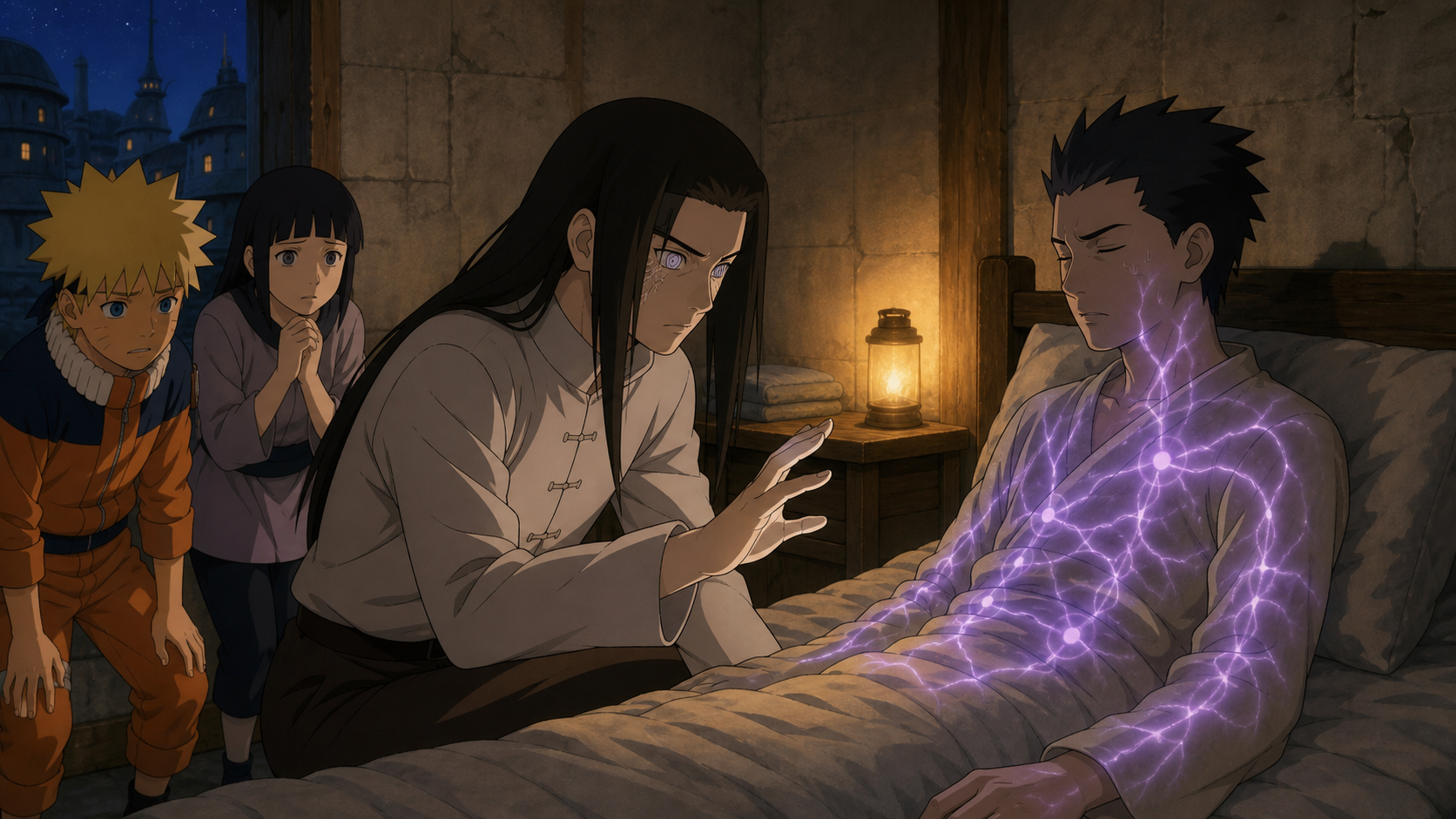
Neji confirms star chakra is destroying Mizura’s body while Akahoshi kidnaps Sumaru, frames Natsuhi and treats children as acceptable losses.
The star training can kill children.
Akahoshi knows.
He restarted it anyway.
Episode 180 stops treating Hidden Star's danger as a rumor. Mizura's own chakra is destroying his body while he rests. The Third Hoshikage ended the program because too many trainees died. Akahoshi brought it back because he believes enough powerful survivors can make his village unbeatable.
Then he kidnaps Sumaru, blames somebody else, and asks the Leaf team to help complete the trap.
This is not leadership making one difficult choice.
This is ambition deciding which children count as acceptable losses.
Episode 180 Facts
- English title: Hidden Jutsu! The Price of Ninja Art: Kujaku
- Japanese title: 秘術 孔雀妙法の代償
- Original Japanese broadcast: April 12, 2006
- Story position: Third episode of the six-part Star Guard Mission
- Medical finding: Star-amplified chakra remains active enough to destroy Mizura's resting body
- Two-mask discovery: The star thief and Sumaru's kidnapper have different chakra
- Named star thief: Lady Natsuhi
- Cliffhanger: Akahoshi knocks Naruto and Natsuhi into the Valley of Death
The title promises a technique's price, but the episode refuses to describe that price as an unfortunate natural fee. The meteorite creates the physical damage. Akahoshi creates the policy that keeps placing children beside it after the deaths are known. Biology explains the injury. Leadership decides who must suffer it.
Akahoshi Kidnapped His Own Trainee
The masked ninja who carried Sumaru into the Valley of Death was not the star thief.
It was Akahoshi.
He placed Sumaru into suspended animation before entering the poison gas, so the kidnapping was controlled rather than careless. That detail does not make it humane. It proves planning.
Akahoshi intends to use Sumaru as bait for the person who stole the meteorite. He and his associates will tell the Leaf team that the thief took the boy, recover the star, and leave the visiting shinobi to handle whatever remains.
His accomplice hesitates at using a child from their own village. Akahoshi reminds him that they have already dirtied their hands.
That is how corruption protects itself. The argument is no longer whether a new act is right. It is that previous wrongdoing makes moral restraint pointless.
The accomplice's discomfort shows that another choice remains possible. Akahoshi answers conscience with sunk-cost logic: because they crossed a line before, stopping now would only waste the damage already done. In reality, every refusal would prevent another victim. He needs his followers to believe retreat is impossible because his authority depends on their continued complicity.
Akahoshi does not see Sumaru as a student entrusted to his care. He sees a weakness belonging to somebody stronger than him.
If putting the boy in danger makes that person appear, the plan works.
The Third Hoshikage Turned Grief Into Duty
A memory shows young Sumaru mourning his parents.
The Third Hoshikage tells him they died admirably while protecting the star and village. He directs the child toward the sky, then tells him to become strong like them.
The comfort and the burden arrive together.
Sumaru receives a story that gives his loss meaning. His parents were not simply taken. They became heroic examples. If he wants to honor them, he must protect the same meteorite and serve the same village.
That message explains his loyalty without proving the history behind it. Sumaru has built his identity around an account given to him by the village leader after he was orphaned.
He sings a lullaby about a parent searching for a distant child, yet consciously believes both parents died defending Hidden Star.
The contradiction has lived inside him for ten years.
Akahoshi understands how powerful that loyalty is.
He uses it to keep Sumaru training and then uses Sumaru himself as leverage.
This is what makes the heroic parent story politically useful. Sumaru does not merely admire two dead shinobi. He inherits an unfinished obligation to the star. Any fear, illness, or doubt can be measured against parents who supposedly gave everything without hesitation.
Mizura's Chakra Is Killing Him While He Rests
Neji examines Mizura with the Byakugan.
The boy's chakra remains activated at its highest limit even while he lies still. If it continues, his own chakra will kill him.
Hokuto finally explains the mechanism. The meteorite amplifies chakra, but many bodies cannot control the increase. They break down under the strain, and some trainees die.
The Third Hoshikage ended star training because the casualty count became impossible to ignore.
Akahoshi restarted it six months ago.
That timeline removes every possible excuse. This is not a newly discovered side effect. Leadership already investigated the cost, stopped the program for ten years, and left behind a direct warning.
Akahoshi did not miscalculate the risk.
He rejected the previous decision because it interfered with his military goal.
Mizura is not a statistical possibility in a policy debate. He is a sick child trying to stand because the village taught him that rest during crisis is failure.
The program has trained his loyalty more successfully than his body.
Neji's Byakugan provides evidence Hidden Star's rhetoric cannot soften. Mizura is not weak because he lacks devotion, and his damage is not a vague possibility in some distant future. His chakra system remains under assault while he obeys instructions to rest. The treatment cannot work while the source of strain remains active inside him.
“They Would Be Satisfied” Is Not Consent
Naruto wants to confront Akahoshi and stop the training.
Mizura and Hokuto resist.
They say people born in Hidden Star do not fear the program. If they complete the training, give everything to the village, and destroy their bodies in the process, they would be satisfied.
The sincerity makes the statement worse, not better.
These are young shinobi raised in a village where strength is presented as the path to legitimacy, dead trainees become examples of sacrifice, and questioning the star is treated like betraying home. Their willingness did not develop in a neutral environment with honest medical information and safe alternatives.
They love their village.
Akahoshi has arranged the culture so that love demands self-destruction.
Naruto understands wanting strength quickly for precious people. He would risk himself without hesitation to protect the Leaf or bring Sasuke home. The difference is that Naruto's most important teachers keep telling him his life matters too.
Akahoshi needs children who believe becoming useful matters more than remaining alive.
Calling that satisfaction does not turn it into informed consent.
Consent requires more than a sincere yes. The trainees need accurate information about mortality, freedom to refuse without disgrace, and alternatives that do not erase their place in the village. Hidden Star withholds the history, glorifies sacrifice, and ties national recognition to their participation. The answer may be heartfelt, but the conditions producing it are coercive.
Neji Draws a Mission Boundary and Keeps Investigating
Neji reminds the team that their mission is to recover the star.
Hidden Star's internal policy comes afterward. Foreign shinobi cannot simply enter an allied village and dictate how it trains its people, even when the practice is horrifying.
That boundary is disciplined and incomplete.
Akahoshi has already made the training relevant to the mission. He concealed the thief's connection, kidnapped Sumaru, fabricated a story for the Leaf team, and plans to use them as cleanup. The client is manipulating the people he hired.
Neji keeps looking.
He compares the chakra signatures and realizes the star thief and Sumaru's kidnapper were different people. Two masked shinobi entered the case with different techniques and goals.
That observation breaks Akahoshi's narrative. The same person did not steal the star and carry Sumaru away. Somebody created a second crime to look like part of the first.
That is the episode's decisive investigative break. Appearance encouraged everyone to combine two masked figures into one culprit. Chakra analysis separates them. Once the kidnapping becomes a staged parallel event, Akahoshi's control of information moves from suspicious to operationally dangerous.
Neji sends Lee and Tenten back toward Akahoshi's residence.
Mission scope no longer means accepting the mission briefing as truth.
Neji distinguishes jurisdiction from evidence. He cannot arrive as a foreign genin and rewrite Hidden Star's laws. He can investigate lies that endanger his team, obstruct recovery of the star, and conceal the real kidnapper. Restraint does not require becoming a tool for the client.
Akahoshi Calls the Star Thief Natsuhi
Akahoshi releases chakra as a signal.
The star thief appears, and he addresses her as Lady Natsuhi.
Natsuhi asks for Sumaru. Akahoshi demands the meteorite in exchange. She refuses to trade before seeing the boy, so he attacks.
Akahoshi boasts that he and several followers continued star training in secret after Natsuhi left. He thinks this private practice places him near her level.
It does not.
Natsuhi's Mysterious Peacock Method overwhelms his. Akahoshi responds by calling his associates and arranging for the Leaf team to enter the fight under false pretenses.
He later tells Natsuhi why he resumed the program. Her chakra is proof of what trained Hidden Star shinobi can become. If he had even ten fighters like her, he believes the Five Great Villages could not defeat them together.
He sees her objection to suffering as wasted potential.
She sees the screaming trainees he intends to manufacture.
Akahoshi's fantasy of ten fighters like Natsuhi erases the bodies that failed to become one. Survivorship becomes his recruitment poster. He looks at an exceptional result and treats it as proof the process works, while the sick and dead become acceptable production loss.
Lee and Tenten Find the Truth in Akahoshi's House
While Naruto and Neji rush toward the staged confrontation, Lee and Tenten search Akahoshi's residence.
Lee announces “Phantom Jutsu” before revealing his technique is simply pressing himself badly against a wall. Tenten has to explain that this is not ninjutsu and is barely concealment.
The comedy delivers real evidence.
They find Sumaru unconscious in a medical room.
The discovery proves Akahoshi lied. The star thief did not carry Sumaru away. Hidden Star's acting leader abducted a trainee, hid him in his own residence, and sent allied shinobi after somebody else.
Lee and Tenten can now rescue the hostage, but Naruto and Neji do not have that information yet.
Akahoshi controls the battlefield by controlling which truth reaches which team member.
Lee and Tenten's discovery also validates Neji's decision to divide the investigation. Naruto and Neji receive the client's story under combat pressure. Lee and Tenten inspect the physical location and find the hostage. One team hears an accusation; the other finds evidence.
Naruto Wins the Fight Akahoshi Designed
Akahoshi's associates tell Naruto and Neji that the star thief is attacking their leader.
Naruto responds exactly as expected. He rushes to help.
Neji supplies a smart plan. He will interfere with the enemy's chakra while Naruto uses Shadow Clones to reach the less-protected main body. Naruto gets through and punches the masked woman.
For one moment, the Leaf team succeeds at the task it was given.
Akahoshi decides to kill Natsuhi while she is vulnerable.
Naruto is standing beside her.
He attacks anyway and knocks both into the Valley of Death.
That choice exposes his full calculation. Naruto was useful while weakening Natsuhi. Once positioned between Akahoshi and his ambition, the allied genin became expendable too.
Akahoshi cannot dismiss the attack as ordinary crossfire. He chooses a finishing blow with Naruto visibly inside its path. The Leaf alliance, the commissioned mission, and a child's life all rank below removing the person capable of stopping his program.
Sumaru whispers “Mother” as the two fall.
Episode 180 leaves the direct explanation for the next chapter, but the emotional truth has reached him before the public history does.
The price of Mysterious Peacock Method is not only damaged chakra pathways and dying trainees.
It is a village leader willing to burn every relationship around the star until nothing remains except power he can command.
Akahoshi’s suspended-animation precaution proves planning, not care
He protects Sumaru from immediate poison exposure because a dead hostage cannot draw out the star thief. That calculation does not make the kidnapping humane. It shows Akahoshi understood the valley’s danger, prepared the technique, selected the child, and built a false narrative for the Leaf team. Every step turns a trainee into operational equipment.
Using a child from his own village destroys the loyalty defense
Akahoshi claims every sacrifice serves Hidden Star, yet Sumaru is Hidden Star. A policy that preserves an abstract future by endangering the children meant to inhabit it has already reversed its stated purpose. His accomplice’s hesitation is the last honest institutional signal in the room. Akahoshi answers it by treating prior wrongdoing as permission for more.
The accomplices still carry individual responsibility
Fear, hierarchy, and shared secrets explain why they follow orders. They do not eliminate choice. An accomplice can release Sumaru, alert the Leaf team, preserve records, or refuse another attack. “We have already dirtied our hands” is surrender disguised as inevitability. Past participation raises the need to stop, document, and cooperate. It does not create a debt to continue.
Neji sees injury continuing during rest
Mizura is not merely exhausted after strenuous practice. Star-amplified chakra remains active enough to damage his body while he lies still. That finding destroys any claim that ordinary recovery time makes the training safe. The exposure may continue after leaving the chamber, meaning every trainee needs assessment beyond the moment a technique ends.
The Byakugan produces a finding that needs clinical follow-through
Neji can observe abnormal chakra flow and ongoing internal damage, but diagnosis and treatment should not rest on one shinobi’s visual report. The team needs symptom history, vital monitoring, exposure dates, comparison with other trainees, and consultation with medical specialists. His evidence justifies immediate cessation. It also shows why Hidden Star must stop relying on internal assurances.
Willingness to die is not informed consent
The trainees say they would sacrifice themselves for the village because leaders tied the star to recognition, usefulness, and belonging. Children raised inside that story cannot freely evaluate a risk adults refuse to describe honestly. Consent requires accurate medical information, alternatives, the right to withdraw, and a future in the community after saying no.
Akahoshi mistakes survivor selection for strength
If many trainees die and a few emerge powerful, the program has not proven national greatness. It has concentrated damage until only bodies able to endure remain visible. Counting survivors while excluding the dead and disabled is not evaluation. It is a propaganda method that hides the denominator.
Different chakra proves two masked operations
Neji’s observation separates the meteorite thief from Sumaru’s kidnapper. That distinction breaks Akahoshi’s story before the team knows his full role. Investigators should preserve the finding, compare movement and technique details, and stop repeating the convenient assumption that one intruder caused every event. A false unified suspect lets the actual kidnapper control the rescue.
Natsuhi’s identity does not settle her motive
Naming the thief as Lady Natsuhi gives the team a person to question, not permission to accept Akahoshi’s framing. She uses the village technique and removes the star, but that act may connect to the old training ban and sick children. The team needs to ask what she knows, whom she is protecting, and why official channels were unavailable before deciding recovery equals return.
Holding Sumaru in Akahoshi’s residence is an enormous receipt
Lee and Tenten find the supposedly abducted child inside the acting leader’s controlled space. That evidence should trigger immediate protection of Sumaru, detention or isolation of implicated guards, preservation of the room, and warning to Naruto and Neji. The location is not a misunderstanding. It ties the public rescue story to the person directing it.
Information delay makes Naruto part of Akahoshi’s trap
Naruto confronts Natsuhi before learning that Sumaru is already secured by the man claiming she took him. His effort weakens the wrong target because the client controls the briefing. Field teams need rapid channels for new evidence, especially when separated. A correct discovery that cannot reach the person acting on old information may arrive functionally too late.
Akahoshi exploits Naruto’s rescue instinct
He knows Naruto will move aggressively when a child appears endangered. That instinct is morally useful and tactically predictable. Naruto needs confirmation steps that do not become indifference: establish the hostage’s last verified location, compare independent chakra evidence, and maintain contact with teammates searching the client’s premises. Urgency should accelerate verification, not replace it.
Natsuhi’s fight with Naruto occurs under a manufactured premise
Both may believe force protects Sumaru, yet Akahoshi arranged the misunderstanding. That is a classic benefit of controlling information: opponents spend strength on one another while the planner keeps the hostage and authority. Once contradictory evidence appears, the Leaf team should create space for communication rather than assuming combat intensity proves guilt.
Akahoshi attacking beside Naruto exposes his endgame
He no longer needs the Leaf shinobi once Natsuhi is weakened and the star is within reach. Knocking both into the poison valley attempts to remove the outside witness and the insider who knows the training history. The act converts suspicion into direct evidence that his priority is control, not Sumaru’s safety or village protection.
The Valley of Death is used as an execution mechanism
Natural poison lets Akahoshi make disappearance look environmental, especially when targets already entered a dangerous combat zone. Rescue requires immediate exposure management: air protection, rapid extraction, decontamination, and observation even if Naruto and Natsuhi appear conscious. Surviving the fall does not establish that inhalation caused no delayed injury.
The episode’s “price” is assigned by leadership
The meteorite produces hazardous chakra effects, but Akahoshi decides who must encounter them, what information they receive, and whether illness interrupts training. Calling death the price of Kujaku makes harm sound natural and unavoidable. Policy converts a known hazard into repeated injury. Leaders remain responsible for that conversion.
The Leaf mission must formally change scope
Guarding and recovering property no longer describes the case. The client has kidnapped a trainee, misled allied shinobi, concealed medical harm, and attacked witnesses. The team now needs hostage rescue, hazardous-object containment, medical evacuation, evidence preservation, and notification to authorities outside Akahoshi’s control. Returning the star to him would deepen the emergency.
RaeRae’s full take
Episode 180 finally lets Mizura’s body speak louder than Hidden Star’s slogans. Neji sees damage continuing while the boy rests. Akahoshi knows children die, restarts training anyway, and calls the survivors proof of progress. That is not ambition. That is a selection process with funerals hidden from the brochure.
Sumaru becomes bait because Akahoshi loves the idea of the village more than the people who make it a village. Natsuhi steals the object. Akahoshi steals a child and controls the rescue story. Those are not equivalent acts, and Neji’s chakra evidence begins separating them before Lee and Tenten find the hostage.
The Leaf team should not return the meteorite to the person who engineered the kidnapping. Rescue Naruto and Natsuhi, secure Sumaru, stabilize Mizura, contain the star, and open the records. Akahoshi has forfeited the privilege of calling secrecy protection.
RaeRae checkpoint: The star damages bodies. Akahoshi turns that hazard into policy, hides the deaths, kidnaps Sumaru, and manipulates the Leaf team. Recovering the object without removing his control would repeat the crime.
Receipts and official routes
- Episode number, official English display title, Akahoshi kidnapping premise, and synopsis: Naruto Official Site.
- Japanese title, synopsis, and April 12, 2006 broadcast record: TV Tokyo.