
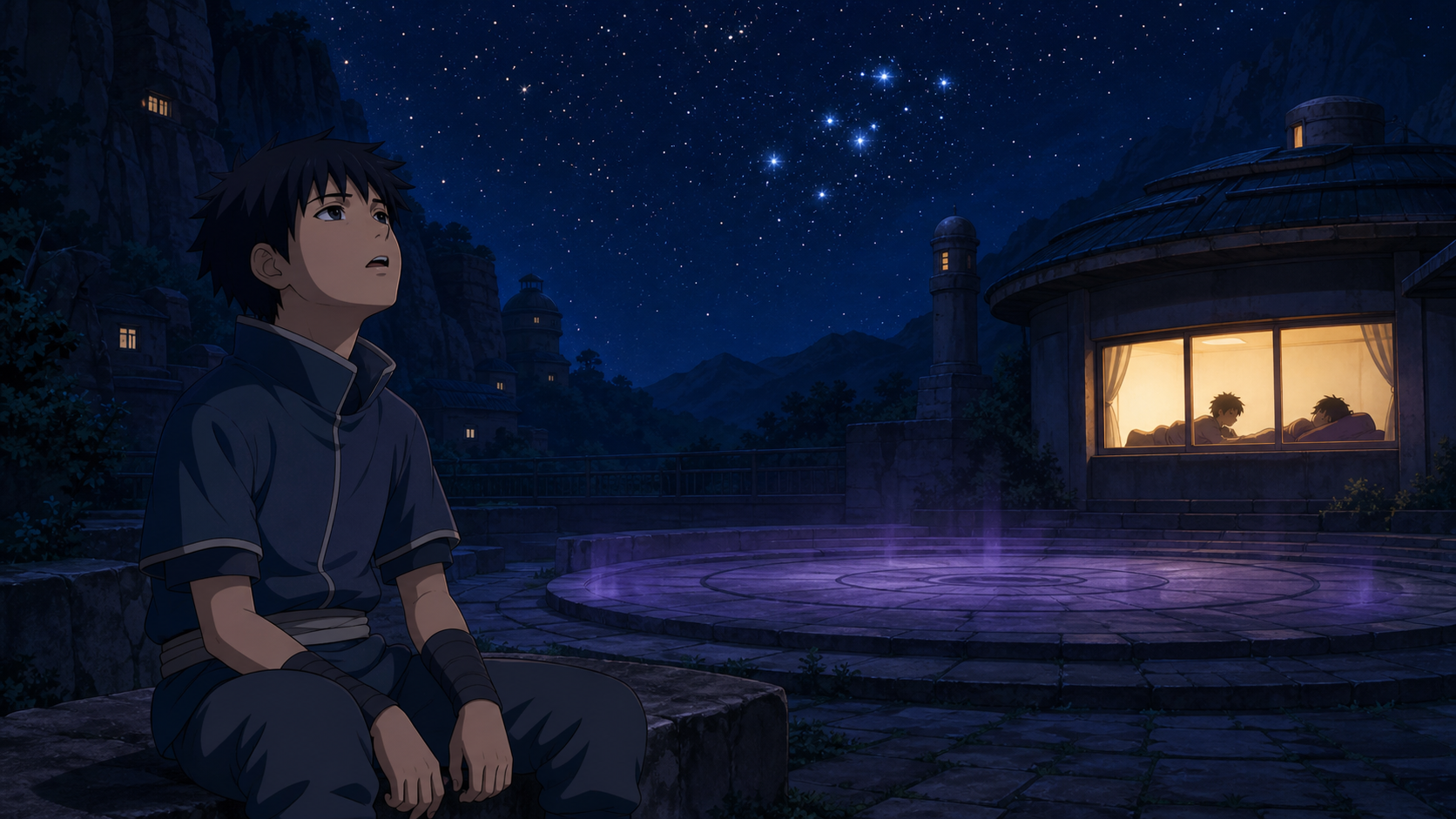
The Remembered Lullaby
Sick trainees, a prohibited training history and Sumaru’s remembered song turn the stolen meteorite into an investigation of Hidden Star itself.
Hidden Star has a stolen meteorite, a flying thief, and no shortage of secrets.
It also has children getting sick from the training adults restarted.
Episode 179 turns the Star Guard Mission into an inside investigation. The thief used a technique only trained villagers should know. Akahoshi reacts like he recognizes the possibility, then orders Sumaru away from the search. Leaf records reveal that the previous Hoshikage stopped star training after rumors of death.
The village keeps calling secrecy protection.
The people being protected keep collapsing.
Episode 179 Facts
- English title: The Remembered Lullaby
- Japanese title: ナツヒボシ 思い出の子守唄
- Original Japanese broadcast: April 5, 2006
- Story position: Second episode of the six-part Star Guard Mission
- Historical discovery: The Third Hoshikage prohibited star training ten years earlier
- Current medical evidence: Mizura's health declined after training began
- Cliffhanger: A masked ninja carries Sumaru into the poison-filled Valley of Death
Episode 179 does not solve the theft. It changes which questions deserve priority. Recovering the meteorite remains the commissioned mission, but every useful lead points toward a history Hidden Star's current leadership does not want examined. The object is missing. The institutional failure has been sitting in plain sight.
The Third Hoshikage Stopped the Training
Neji cannot find the flying thief with the Byakugan, so the team begins with records.
The First Hoshikage discovered that training beside the meteorite strengthened chakra. That discovery gave Hidden Star its unusual position among small shinobi villages and produced Mysterious Peacock Method.
The records also contain a ten-year gap.
The Third Hoshikage prohibited star training. It resumed about a year ago, after his sudden death.
Nobody gives the Leaf team an official reason for the ban. Rumors say most shinobi who trained died. Neji offers the obvious medical possibility: the meteorite forcibly increases chakra and may damage the body.
That is no longer an abstract rumor. Mizura collapsed in the previous episode. His health deteriorated after he began training.
Hidden Star's leadership knows the program was stopped. It knows children are becoming ill. It restarted the process anyway and keeps the explanation classified from the allies hired to defend its source.
Resuming a prohibited program after the leader who stopped it dies demands more than an appeal to ambition. What evidence changed? What safeguards were added? Who reviewed the casualties? The episode offers no sign that Akahoshi answered any of those questions before placing another generation beside the meteorite.
The mystery is not merely why the Third Hoshikage ended training.
It is why Akahoshi believed his death made the danger acceptable again.
Akahoshi Knows More Than He Says
Sumaru confirms that the thief used Mysterious Peacock Method.
Only somebody who mastered star training should possess that technique. When Sumaru begins explaining it, Tenten stops him. Village-secret ninjutsu should not be discussed casually with outsiders.
Her restraint matters. The Leaf team can investigate suspicious leadership without acting entitled to every guarded technique. Respecting a legitimate secret does not require ignoring evidence of danger.
Neji notices Akahoshi's expression change when Sumaru identifies the jutsu. He suspects the deputy Hoshikage already understands the thief's connection to Hidden Star.
Akahoshi assigns the recovery mission to the Leaf team but orders Sumaru to remain with the injured students. Sumaru argues that local shinobi know the village better. Akahoshi shuts him down with rank rather than explanation.
That order could be sensible. Sumaru is young, emotionally invested, and responsible for injured comrades.
It also removes the person most likely to recognize a trained Hidden Star shinobi.
Neji does not accuse Akahoshi without proof. He divides the team. He surveys the village, sends Lee and Tenten to watch Akahoshi, and tells Naruto to investigate through Sumaru.
Quiet suspicion is doing more work than official cooperation.
Neji's leadership is careful here. He does not announce a conspiracy and hand Akahoshi an excuse to remove the Leaf team. He turns one reaction into a testable investigation: inspect the village, watch the officials, and speak with the trainee who possesses local knowledge. Suspicion becomes assignments, not gossip.
Sumaru Sings to the Star That Watches Him
Naruto finds Sumaru alone beneath the night sky.
Sumaru sings the Natsuhiboshi lullaby. It asks why the summer star is red, answers with tears from a sad dream, and describes searching for a child who has gone far away.
He says the red star watches over him.
The song gives Sumaru a language softer than the ambition he shows everyone else. During the day, he declares that Hidden Star will rival the great villages and that he will become Hoshikage. At night, he sings about separation, grief, and somebody looking for a lost child.
Naruto does not yet know who taught him the lullaby.
Sumaru does not offer the memory.
That silence feels different from Akahoshi's secrecy. Akahoshi withholds information that affects a mission and public safety. Sumaru protects a private grief from an outsider he only met yesterday.
Naruto respects neither boundary elegantly, but he understands loneliness better than formal investigators ever could.
He follows the human clue instead of interrogating the song.
The lullaby matters because private memory can survive beneath an official history without directly contradicting it. Sumaru has been told his parents died as heroes protecting the star. The song preserves longing that does not fit neatly inside that patriotic ending. Naruto cannot prove anything from it, but he can recognize that Sumaru's ambition shares space with grief.
Bean Jelly Opens the Door Secrecy Closed
Naruto brings roasted chestnut bean jelly to the injured trainees.
Hokuto senses chakra from somebody outside the village and attacks before Mizura stops her. Naruto introduces himself, rescues what remains of the dessert, and shares it anyway.
Food accomplishes what mission credentials could not.
Hokuto apologizes. Mizura admits the thief put the trainees to sleep rather than seriously injuring them. Naruto notices Mizura is unwell, and Hokuto reveals that his health began declining after star training.
Mizura immediately tells her not to discuss the star with somebody from another village.
The children have learned that protecting the village means protecting information, even when that information concerns their own bodies. Mizura can barely sit up, yet the violation that alarms him is Hokuto naming the cause.
That makes meaningful consent impossible to evaluate. A trainee who believes reporting harm betrays the village cannot freely weigh the risk of continuing. Silence becomes part of the training requirement even if nobody writes it on the wall.
Naruto calls them cold.
Hokuto explains why Sumaru is especially hostile. Ten years ago, his parents supposedly died protecting the meteorite from foreign shinobi who came to steal it.
From Sumaru's perspective, outside interest in the star already took his family. Then another outsider arrives immediately after a new theft and asks questions about secret training.
His suspicion makes sense.
That does not make the story he was given complete.
Naruto's food-based approach works because it does not demand trust before offering care. He arrives with a ridiculous dessert, survives Hokuto's suspicion, and pays attention to Mizura as a sick person rather than a source. The conversation opens after Naruto behaves like somebody safe enough to answer.
Neji Investigates the Story, Not Just the Thief
Neji's team accepts shared responsibility for losing the star even though Hidden Star denied them access to the training room.
That is mature mission discipline. It does not mean accepting Akahoshi's version of events without examination.
Lee and Tenten follow two of Akahoshi's associates. The men speak as if they know who stole the meteorite. They describe the culprit as the final shinobi fully trained in the star's power and claim they already possess that person's weakness.
They also know Lee and Tenten are watching.
Lee is built for honest confrontation, not discreet surveillance. He keeps announcing that sneaking violates his ninja way while Tenten begs him to stop saying “secretly” out loud. Their targets eventually confront them and accuse the Leaf shinobi of following the wrong people.
Tenten gives the fair answer. With the star stolen and no open leads, anybody connected to the village could be transformed or involved.
The men say Hidden Star will recover its own property and order the Leaf team not to interfere.
Once again, the village requested help and resents the investigation required to provide it.
Their claim that they possess the culprit's weakness is especially ugly. If they truly know the thief and have leverage, withholding that information obstructs the recovery mission they requested. It also suggests they plan to control a person rather than secure an object.
Sumaru Disobeys for the Same Reason Naruto Would
Akahoshi orders Sumaru to stay with his injured friends.
Sumaru and the other trainees search anyway.
They join hands, synchronize their star chakra, and track the target. The method shows why Sumaru objected to being excluded. The local trainees possess knowledge and abilities the Leaf team does not.
It also puts children directly in the path of a shinobi strong enough to overpower Naruto.
The tracking formation proves the trainees are operational assets, not merely students waiting safely in a clinic. Akahoshi wants their technique when it serves village power but denies their judgment when it complicates his control. Sumaru responds by choosing loyalty to the star over obedience to the deputy Hoshikage.
Sumaru's disobedience is reckless, loyal, and completely recognizable. Naruto would make the same decision before Akahoshi finished the sentence. A leader who offers no explanation should not be surprised when frightened young shinobi trust their own urgency instead.
The trainees find a masked figure and bind the person with a chakra rope.
Their apparent success lasts seconds.
The masked ninja breaks free, knocks them unconscious, and carries Sumaru toward the Valley of Death.
The star was already stolen.
Taking Sumaru serves another purpose.
That is the moment theft becomes leverage. The masked figure could have fled with the meteorite and avoided another confrontation. Carrying Sumaru into the deadliest terrain in the region invites pursuit while making ordinary rescue nearly impossible.
The Kidnapping Changes the Question
Naruto, Neji, Lee, and Tenten detect a massive chakra presence near the poison valley.
They find the masked figure carrying Sumaru. Naruto attacks and tries to pursue when the kidnapper retreats into the gas. Neji stops him because entering without a protective mask would kill him within seconds.
Naruto nearly repeats the mistake Sumaru prevented when they met.
Neji asks the important question. Why kidnap Sumaru after obtaining the meteorite?
The answer is not available in Episode 179, and the article should not steal it from the next chapter. The kidnapping proves only that Sumaru matters to somebody connected with the star.
The village's story says his parents died defending it ten years ago. His lullaby speaks of a parent searching for a distant child. Akahoshi's associates believe they know the thief and hold a weakness that can draw that person out.
Those pieces do not yet form a public truth.
They do make Sumaru look less like a trainee who wandered into the case and more like the point around which the hidden history turns.
Neji prevents Naruto from charging into the poison because the mission needs analysis more than another body in the valley. Sumaru saved Naruto from this exact hazard one episode earlier. Naruto's urgency is emotionally correct and tactically useless without a mask.
Hidden Star keeps asking who took its meteorite.
Neji's team is beginning to ask what happened ten years ago and who benefits from keeping the children ignorant.
That is the investigation Akahoshi did not commission.
It is the one the village needs.
Recovering the star without confronting that history would only restore the same arrangement that produced sick trainees, secret suspects, and a child used as bait. Episode 179 has not proven who deserves the meteorite. It has proven that possession alone cannot make Hidden Star's leadership trustworthy.
The ten-year training ban is the first hard institutional receipt
Rumors of death are serious, but a former leader formally stopping the program proves Hidden Star once recognized enough danger to change policy. Restarting training after his sudden death requires a documented review, new medical evidence, and public explanation. Akahoshi offers none. The gap is not ancient trivia. It is the decision trail behind Mizura’s current collapse.
A sudden leadership death should strengthen scrutiny, not erase policy
If the Third Hoshikage died unexpectedly, records around his medical findings, orders, and succession deserve preservation. Reversing his prohibition soon afterward creates an obvious conflict requiring independent examination. The question is not whether Akahoshi personally disliked him. The question is what evidence justified exposing children again and who had authority to accept that risk.
Mizura’s body is current evidence against official reassurance
He is not a hypothetical case from a disputed archive. He is a young trainee whose condition worsened after star practice resumed. Neji and the Leaf team should record symptoms, training dates, exposure duration, and who observed the decline. Immediate care outranks protecting the program’s reputation. A village cannot call illness rumor while a child is visibly failing in front of visitors.
The trainees have learned that reporting harm resembles betrayal
Young shinobi minimize symptoms because the star represents village pride, leadership ambition, and their own hope of becoming useful. That social pressure makes silence predictable. Medical monitoring must include private interviews away from instructors, permission to stop training without punishment, and adults whose careers do not depend on proving the program successful.
Sumaru’s lullaby carries information outside Akahoshi’s archive
The remembered song links family, the night sky, and a history he was told ended with his parents’ deaths. Memory does not automatically solve the case, but it identifies emotional and factual questions official records leave unanswered. Who sang it? Who else recognizes it? When did Sumaru last hear it? Personal memory becomes an investigative lead when institutions restrict the formal record.
A child’s grief should not be treated only as usable intelligence
Naruto and the team may need the lullaby to identify the masked figure or reconstruct Sumaru’s family history. They also owe him care while asking. Questions should allow uncertainty, pauses, and refusal. Extracting every detail because the mission needs it would repeat Hidden Star’s habit of valuing children mainly for what their bodies and memories can produce.
Akahoshi ordering Sumaru away increases concern
A leader may reasonably protect a trainee from pursuing an armed thief. The order becomes suspicious because Akahoshi also withholds the training history, knows the thief used a local technique, and resists outside scrutiny. Safety instructions should include an explanation, protected supervision, and a plan for using Sumaru’s knowledge without sending him into danger. Silence creates the vacuum children fill themselves.
The young trainees combine chakra because adults exclude them
Their tracking attempt demonstrates skill and loyalty, but it also shows a governance failure. Children organize an unsanctioned pursuit because they believe official channels will not act honestly. Punishing them afterward would miss the cause. Leaders need a reporting route where trainees can share observations and receive truthful updates without having to prove devotion through another hazardous technique.
Collective chakra use may multiply the same exposure risk
If star training already damages bodies, combining techniques while distressed could place several trainees in danger at once. Neji should assess who is stable, stop anyone showing respiratory or neurological symptoms, and avoid admiring coordination without counting its cost. Effective power can still be medically unsafe. That is the exact lesson Hidden Star keeps refusing.
The masked figure defeats them because concern is not preparation
The children know local terrain and technique, yet they pursue without adult backup, extraction planning, or protection against poison exposure. Their motive is understandable. Their plan leaves the thief able to control the encounter and take Sumaru. Courage does not make an unsupported group ready for an adversary who already penetrated the village’s most guarded site.
Carrying Sumaru into the Valley of Death weaponizes the border
The poison ravine that protects Hidden Star from outsiders now protects the kidnapper from rescue. Any pursuer must solve environmental exposure before reaching the child. This is why natural defenses need emergency access plans. A barrier is not secure when residents can be taken inside it and rescuers possess no safe route.
Neji’s investigation is strongest when it connects records to bodies
The written ban, Mizura’s illness, Akahoshi’s evasiveness, the local technique, and Sumaru’s abduction form a pattern. None alone proves the full conspiracy. Together they justify widening the mission beyond simple recovery of property. The team must protect witnesses, preserve records, and investigate leadership decisions while still locating the meteorite.
The stolen star may be safer away from the training hall
That does not make theft legitimate or the masked figure trustworthy. It does mean recovery cannot automatically equal immediate return to uncontrolled exposure. Once retrieved, the meteorite should enter secure containment pending medical and political review. Restoring the exact prior arrangement would place the object back beside the children already showing injury.
Hidden Star’s prestige depends on keeping the cost private
Akahoshi wants the technique to prove equality with major villages, so evidence of sickness threatens more than one program. It threatens the story legitimizing his leadership. That conflict of interest makes independent review essential. The people deciding whether training is safe cannot be the same people whose authority depends on declaring it successful.
Naruto should hear the difference between shared dreams and shared systems
He recognizes Sumaru’s wish to become Kage and wants to support it. Naruto’s own village has harmed him, but it also contains institutions, mentors, medical specialists, and political checks Hidden Star may lack. Encouragement should not become approval of every method attached to Sumaru’s dream. Friendship includes helping someone question the path adults presented as the only one.
The episode changes the mission’s priority order
The meteorite remains missing and potentially dangerous. Sumaru is now abducted, Mizura is ill, and a leadership history has surfaced. Human safety must come first: locate Sumaru, stabilize trainees, secure exposure zones, then recover and contain the star as evidence. Property protection cannot remain the top line when the protected object may be injuring the people assigned to worship it.
RaeRae’s full take
Episode 179 takes the shiny centerpiece away and finally makes Hidden Star look at what remained. A dead leader prohibited training. A current leader restarted it. Children are sick. The village calls questions disloyal because ambition sounds cleaner when nobody reads the medical file aloud.
Sumaru’s lullaby matters because family memory survives outside the official story. That makes it a clue, but he is not evidence storage with a pulse. The Leaf team needs his knowledge and owes him protection at the same time. Hidden Star forgot the second half of that sentence.
Recovering the meteorite cannot mean returning everything to normal. Normal produced Mizura’s collapse and taught children to hide pain. Bring Sumaru home. Secure the star. Then make Akahoshi explain why a ten-year safety order vanished before the symptoms did.
RaeRae checkpoint: A stolen meteorite is urgent. A restarted youth program with a dead leader’s prohibition and sick trainees is the larger case. Hidden Star needs Sumaru rescued and its records opened.
Receipts and official routes
- Episode number, licensed title, insider-theft premise, and official synopsis: Naruto Official Site.
- Japanese title, synopsis, and April 5, 2006 broadcast record: TV Tokyo.