
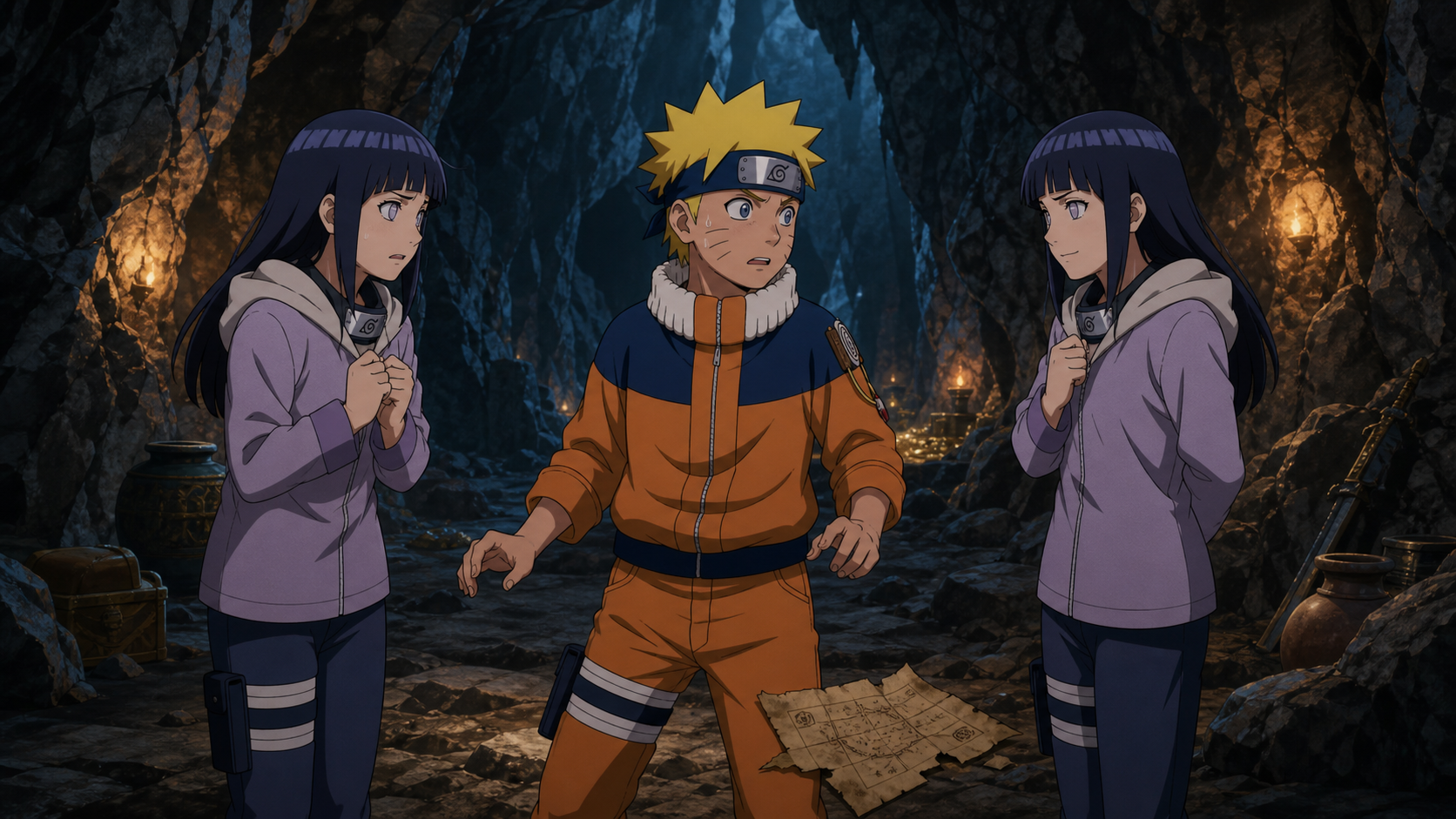
The Treasure Hunt Is On!
A treasure mission exposes Naruto, Kiba and Hinata’s teamwork failures before face-copying enemies turn their familiar identities into weapons.
Tsunade gives Naruto, Kiba, and Hinata a map to buried treasure.
They spend most of the trip proving they do not have a map to one another.
Episode 175 opens a two-part mission with an absurd punishment, a suspiciously simple prize, and three teammates who should already know how to work together. Tsunade threatens to send all of them back to the Academy if they fail. Her point is collective responsibility.
Naruto and Kiba hear an invitation to decide which one is the problem.
By the time the enemy steals their faces, the team has already done most of the separating for them.
Episode 175 Facts
- English title: The Treasure Hunt Is On!
- Japanese title: ここ掘れワンワン! 埋蔵金を探せ
- Original Japanese broadcast: March 8, 2006
- Story position: First half of the Buried Gold Excavation Mission
- Assigned team: Naruto, Kiba, Hinata, and Akamaru
- Apparent objective: Recover treasure worth several hundred million ryo within three days
- Actual cliffhanger threat: The Kedouin Clan plans to enter the Leaf using the team's faces
The episode builds its mystery from behavior before it introduces the copying technique. Naruto and Kiba treat teamwork as a ranking contest. Hinata supplies warnings neither values until the cave falls. Kiba then notices the impostors behaving impossibly, only to distrust his own judgment when Akamaru's nose disagrees.
Every failure comes from having useful information and refusing to combine it.
Tsunade Threatens the Academy
Naruto finds Tsunade buried under bills and asks for permission to search for Sasuke.
She tells him to train.
Soon Naruto, Kiba, and Hinata are standing in front of her with no assignment. Shino is helping another team with Kurenai, so this particular trio is available when Tsunade's acquaintance Agari Kaisen requests help finding buried treasure.
The map promises several hundred million ryo hidden in difficult mountain terrain. They have three days to retrieve it, and Tsunade hints at a special reward if they succeed.
Then she adds the consequence.
If they fail, all three go back to the Academy.
The threat is ridiculous. These are active shinobi, not children who forgot how to throw kunai. It is also aimed at a real weakness. Tsunade cites Naruto's recent mission record and specifically recalls the failed Bikochu search with Kiba and Hinata.
She does not say Naruto alone will be punished. The whole team owns the result.
Collective responsibility does not mean pretending every mistake belongs equally to everyone. Naruto chooses the unsafe cave after Hinata warns him. That decision is his. The team-level problem is that their working structure makes the mistake more likely and leaves everyone exposed to its consequences.
Tsunade wants them to stop using individual blame as the end of the analysis. Knowing who caused a problem matters. Knowing why the team could not prevent, correct, or recover from it matters too.
That is the lesson she wants them to understand. A mission cannot become three private performances where everyone accepts credit and assigns failure somewhere else.
Naruto and Kiba immediately demonstrate why she chose the threat.
Each argues that the other caused their previous failures.
The treasure hunt has not started, and they are already competing over who deserves the least blame.
Naruto and Kiba Turn Teamwork Into a Race
Kiba understands mountain terrain better than Naruto.
That should help the team. Instead, it becomes fuel for a race.
Kiba chooses the correct routes while Naruto charges after him, desperate to prove he can arrive first. Hinata tries to keep pace and calm both boys. Neither makes room for her judgment because each is too busy measuring himself against the other.
Naruto treats Kiba's advantage as a personal insult. Kiba treats every correct turn as evidence that Naruto is dead weight. Their skills do not combine. They sit beside one another like two arguments.
Agari, meanwhile, tells an unseen companion that this easy-looking mission will not go easily.
The audience knows the treasure hunt is a setup before the team does. That suspense works because nothing supernatural is required to steer them into trouble. Naruto and Kiba are already making careless choices on their own.
The map gives them a shared destination.
Their pride keeps turning it into separate journeys.
Kiba's navigation skill should reduce everybody's risk. Hinata's caution should catch what speed misses. Naruto's persistence should keep the group moving after a setback. Instead, Kiba and Naruto use competence as proof of rank, while Hinata's input becomes background noise.
The team does not lack the right abilities. It lacks a way to let those abilities cooperate.
Hinata Pays for Being Ignored
Hinata sees the safer route.
Naruto does not listen.
He enters the wrong limestone cave, and the ceiling begins to collapse. Kiba has to pull Naruto and Hinata out of the danger. During the escape, falling rock injures Hinata's ankle.
The injury matters because it is not random bad luck. Hinata warned Naruto. He was more interested in beating Kiba than hearing the teammate beside him.
Kiba is right to be angry.
He is less useful when he turns that anger into another declaration that Naruto ruins everything. Blame identifies who made the immediate mistake, but it does not repair the team's larger habit. Kiba and Naruto have spent the mission treating Hinata as somebody who follows behind their rivalry. Her caution becomes important only after ignoring it costs her.
Hinata is often described as quiet, which can make characters around her mistake softness for uncertainty. Here she is the person reading the danger correctly. She does not need to shout louder. The others need to stop treating volume as authority.
The cave punishes Naruto's decision.
Hinata's body pays part of the price.
That imbalance is why a quick apology would not be enough. Naruto gets the lesson through embarrassment and Kiba's anger. Hinata receives an injury that changes the rest of her mission. Listening after the collapse cannot restore the safer option she already offered.
Her injury also makes later identity verification easier in theory. A real teammate should remember that she cannot cross rough ground at full speed. The episode puts physical consequence directly in front of the boys, then tests whether they retained it as knowledge about her.
Kiba Goes Alone for the Team
The route ahead is too rough for Hinata's injured ankle.
Kiba decides to continue alone with Akamaru while Naruto stays with her. He knows the terrain, carries the map, and has the best chance of reaching the treasure before the deadline.
It is a sensible field decision wrapped around the team's central failure.
Kiba does not abandon responsibility. He promises to succeed so all three avoid the Academy. That promise shows he understands the collective stakes better than his earlier blaming suggested.
At the same time, the split gives their hidden enemy exactly what it needs. One teammate is isolated in the mountains. Two are stationary and vulnerable. Nobody can verify what happens to the others.
Good teamwork does not require everyone to remain physically attached in every situation. Shinobi divide tasks constantly. The problem is that this group has no strong shared plan beneath the separation. Kiba leaves with frustration still controlling the conversation, while Naruto and Hinata remain where an attacker can reach them.
The decision is both competent and dangerous.
That tension makes it more interesting than a simple mistake.
Kiba cannot carry the entire team through the remaining terrain, and waiting may cost all three their status. Continuing is reasonable. What is missing is a verification plan: a rendezvous point, a challenge only the team can answer, or a rule for treating unexpected contact as hostile until confirmed.
Shinobi work makes separation inevitable. Trust cannot mean accepting any familiar face that appears afterward.
Two Hinatas and One Bad Security Question
Naruto and Hinata are ambushed.
When Naruto wakes, two identical Hinatas stand in front of him.
He tries to expose the copy by asking for Hinata's father's name. Both answer Hiashi.
Naruto then admits he did not know the answer.
It is a perfect joke about a serious problem. Naruto designs an identity test that can only work if he knows the real answer. The impostor has studied Hinata more carefully than her teammate has.
The scene also exposes the limit of using trivia as intimacy. A name can be memorized. So can a birthday, favorite food, or mission record. Knowing facts about somebody is not the same as noticing how that person behaves, what frightens them, or how they move while injured.
Naruto's question fails at both ends. He cannot judge the answer because he never learned it, and the answer itself proves nothing because both candidates possess it. Security theater has arrived in the Land of Fire, and it is wearing a forehead protector.
Naruto has spent the day failing to listen to the real Hinata. Once there are two of her, he has no reliable memory of attention to guide him.
Agari reveals that the attackers never cared about the gold.
They wanted Naruto and Hinata's faces.
The Copies Know the Facts, Not the Team
Kiba reaches the buried treasure with suspicious ease.
Then Naruto and Hinata appear without the map.
For a moment, Kiba sees every reason not to trust them. Naruto has terrible direction sense. Hinata injured her ankle. Neither should have crossed the terrain that quickly. Their arrival contradicts what Kiba knows happened.
Akamaru smells no difference.
Kiba abandons his correct reading of the situation.
That choice is understandable because Akamaru's nose is usually better evidence than human sight. Their partnership depends on scent. If a disguise can fool Akamaru, it has defeated the team's strongest ordinary test.
Still, Kiba lets one trusted signal erase several contradictions. He knows the route. He saw Hinata's injury. He knows Naruto's limitations. The people in front of him match the expected scent, so he stops believing his own experience.
Good verification uses independent signals. Appearance, voice, and scent feel independent, but the jutsu has copied all three through one mechanism. Kiba's route knowledge and memory of Hinata's ankle come from different evidence. Those are the observations he should weigh more heavily when the familiar identifiers arrive attached to impossible behavior.
The enemy's Face Copying Jutsu is not an ordinary Transformation. It can reproduce appearance, voice, scent, and enough personal knowledge to survive questions. The target must remain nearby while the copying takes place, but once it is complete, familiar identifiers become weapons against the people who trust them.
The copies know what Naruto, Kiba, and Hinata know.
What they have not yet proven is whether information can reproduce a relationship.
That distinction gives the cliffhanger its bite. The copies do not need to become perfect people. They only need to pass long enough for the village to extend the trust earned by the originals. A shinobi identity is not merely a face; it is an access credential backed by years of shared missions and recognition.
The Treasure Was Their Faces
The attackers capture Kiba and copy him too.
They identify themselves as members of the Kedouin Clan. Their plan is to return to the Hidden Leaf wearing the team's identities and cause damage from inside the village.
The episode ends before explaining every layer of the assignment. That cliffhanger should remain intact. What matters here is that the mission's apparent prize was never the most valuable thing in the mountains.
The team brought identities trusted by the village.
They allowed rivalry, injury, and isolation to separate those identities from the people who could defend them.
Tsunade wanted them to understand shared responsibility. Their enemies teach the harsher version. If one teammate ignores a warning, everyone enters danger. If one teammate splits away without a secure way to verify contact, everyone becomes vulnerable. If one person can be replaced, the copy inherits the trust surrounding the whole team.
Naruto and Kiba begin the hunt arguing over who is responsible for failure.
By the end, strangers are preparing to carry all three of their names into the Leaf.
The gold is almost beside the point.
The Kedouin Clan found something more useful because the team was too busy competing to guard it.
Tsunade’s threat identifies a real problem through a ridiculous punishment
Sending experienced genin back to the Academy over one failed treasure hunt would waste training and ignore why the team failed. Her larger point is legitimate: Naruto, Kiba, and Hinata cannot keep treating coordination as optional. A serious review should identify communication errors, decision authority, injury response, and verification gaps instead of using humiliation as the only corrective tool.
The team hears collective responsibility as personal accusation
Naruto and Kiba immediately start proving the other one causes failure. That argument protects each boy from examining his own habits while leaving Hinata responsible for absorbing the tension. Collective responsibility does not mean blame gets spread until nobody owns a decision. It means each person reports what they observed and how their actions affected everyone else’s safety.
Hinata’s warning has operational value before anyone agrees with it
Her Byakugan and caution should trigger a pause, route check, or alternate entry plan. Naruto and Kiba treat hesitation as weakness because momentum feels more heroic than assessment. The cave collapse demonstrates the cost. A team does not need unanimous fear before responding to a specialist’s warning. It needs a protocol for testing credible risk without shaming the person who noticed it.
The ankle injury changes the mission plan
Once Hinata cannot move normally, the original timetable and formation are obsolete. The team should assess swelling, stabilize the joint, confirm whether she can bear weight, and decide whether treasure retrieval still outranks extraction. Pushing forward without that reset turns deadline pressure into permission to gamble with a teammate’s mobility.
Kiba continuing alone creates two vulnerable units
His tracking skills may make him the best person to follow the map, but solo movement removes redundancy and leaves Naruto protecting an injured teammate without a reliable contact plan. If separation is necessary, they need rendezvous times, recognition signals, fallback routes, and a threshold for aborting. “I will be back” is not a field procedure.
The enemy attacks trust rather than the strongest body
Face Copying Jutsu does not need to overpower Naruto, Kiba, and Hinata in a fair fight. It turns appearance, voice, scent, and private knowledge into access credentials. The technique is frightening because the team has relied on familiarity without defining how to authenticate it. A copied face becomes useful only when everyone assumes recognition is enough.
Akamaru’s nose becomes a dangerous single point of trust
Kiba correctly notices behavior that does not fit his teammates, but Akamaru appears to confirm their scent. That contradiction should increase caution rather than erase observation. Strong security combines independent signals. Scent, shared memories, movement habits, chakra patterns, agreed phrases, and current mission knowledge should support one another. No single channel deserves unlimited authority when the enemy knows it exists.
Behavior is evidence even when the body looks correct
An impostor can reproduce facts gathered through surveillance and still miss how a person applies them under pressure. Naruto’s impatience, Hinata’s speech, Kiba’s handling of Akamaru, and the team’s evolving mission knowledge create patterns harder to copy perfectly. Kiba’s discomfort is not proof by itself, but dismissing it because visual evidence looks stronger is a preventable mistake.
Naruto needs a verification plan before choosing between two Hinatas
A personal question pulled from old memory may fail if the enemy has observed long enough or extracted information. The team needs a fresh shared fact created after separation, a physical signal established before entry, or a question whose answer includes emotional context rather than trivia. Authentication should be planned while everyone is trusted, not improvised after two identical faces appear.
Hinata’s quietness should not make her the easiest identity to overwrite
Because Naruto and Kiba often speak over her, they may know less about her judgment than they assume. That gap benefits the copy. Teammates who treat someone as background lose the behavioral detail needed to recognize when the person is missing. Listening is not only courtesy. It builds the knowledge that makes impersonation harder.
The easy treasure is a warning, not a reward
A map promising enormous value, a severe deadline, dangerous terrain, and a prize sitting conveniently within reach should trigger suspicion. Kiba’s urgency makes confirmation feel like wasted time. Good field discipline asks who prepared the route, why the treasure remained unclaimed, what protects it, and whether the apparent objective exists mainly to pull the team into predictable positions.
Agari Kaisen’s request needs basic verification
Tsunade’s acquaintance and the written map provide some institutional legitimacy, yet the team still needs scope, ownership, recovery authority, and a known contact route. Treasure missions invite disputes over who owns what and why armed strangers want it. The later infiltration threat makes the original briefing even more important. A trusted referral should begin verification, not replace it.
The three-day deadline distorts judgment
Naruto and Kiba treat every pause as movement toward Academy punishment. That pressure rewards speed, silence, and individual heroics while penalizing injury care and route review. Mission leaders should recognize when consequences create concealment. A team afraid to report trouble will keep advancing until a manageable problem becomes a rescue operation.
The Kedouin plan targets the Leaf’s social perimeter
Trusted young shinobi can pass gates, approach instructors, enter homes, and carry explanations that receive sympathy rather than scrutiny. Copying them weaponizes the village’s care. Gate security should verify returning teams against mission records, current countersigns, and chakra or medical checks without treating every survivor as guilty. Trust works best when verification protects it from exploitation.
Capturing all three originals creates an accountability emergency
The enemy now possesses faces, voices, equipment, and time to question the captives. The Leaf may not know the team is missing until the deadline expires. Mission tracking must include scheduled check-ins and escalation when a team goes silent. Waiting three full days because that was the assignment window would hand infiltrators an unnecessary lead.
The cliffhanger works because every earlier failure matters
The team argues, ignores Hinata, enters the cave, splits, trusts one sensory channel, and reaches an easy prize. None of those errors alone guarantees capture. Together they remove the safeguards that could expose the copy technique early. The enemy’s jutsu is impressive, but the operation succeeds because the team makes itself legible and isolated.
RaeRae’s full take
Episode 175 turns teamwork into a security system. Naruto, Kiba, Hinata, and Akamaru possess useful but different information. They lose because Naruto and Kiba keep competing over who gets to be right instead of combining what each person knows. Hinata’s warning arrives. Kiba notices behavioral mismatch. Akamaru reports matching scent. Those signals needed investigation, not a popularity contest.
The Face Copying Jutsu lands because the team never agreed on how to prove identity after separation. Familiarity feels sufficient until an enemy can reproduce the familiar. The answer is not permanent suspicion. It is planned authentication, routine check-ins, and enough attention to teammates that personality becomes evidence rather than decoration.
Tsunade is right that this group needs correction. Sending them back to class is funny television. A proper debrief is better shinobi work. The cave did not merely trap three careless genin. It exposed a village security problem wearing their faces.
RaeRae checkpoint: The Kedouin Clan copies faces, but Naruto’s team supplies the access. Ignored warnings, a split formation, no check-in schedule, and no identity protocol turn a treasure hunt into an infiltration route.
Receipts and official routes
- Episode number, licensed title, and official synopsis: Naruto Official Site.
- Japanese title, synopsis, and March 8, 2006 broadcast record: TV Tokyo.