
Impossible! Celebrity Ninja Art: Money Style Jutsu!
Naruto teaches a wealthy child that money can purchase labor but cannot replace courage, loyalty, practice or the choice to help a friend.
Kunihisa can buy help.
He cannot buy the ability to help.
Episode 174 gives Naruto the wealthy son of a jeweler who believes throwing cash counts as ninjutsu. People pull him from mud, test bridges, fight animals, and pretend his fake hand signs caused it all.
Then kidnappers offer those same people more money.
The joke is not that money never works. It works constantly. The problem is that Kunihisa mistakes a successful payment for skill, loyalty, friendship, and personal value.
Naruto is paid too.
He is the one person Kunihisa cannot buy away from himself.
Episode 174 Facts
- English title: Impossible! Celebrity Ninja Art: Money Style Jutsu!
- Japanese title: ありえねーってばよ! セレブ忍法・金遁の術
- Original Japanese broadcast: March 1, 2006
- Story position: A standalone anime-original episode
- Naruto's assignment: Guide Kunihisa through one day of shinobi work
- Kunihisa's signature move: Throw money and rename somebody else's labor
This episode sits between two multi-part missions and wisely makes no attempt to imitate their scale. There is no hidden laboratory, stolen village identity, or war-level threat. One wealthy child has confused purchasing power with personal power, and Naruto has one day to make that confusion hurt less than the consequences eventually will.
Tsunade Sells Naruto a Fancy Babysitting Job
Kunijiro, one of the richest jewelers in the Land of Fire, brings his son to Tsunade.
Kunihisa wants to experience a day as a ninja. His father has another reason for the visit. The boy sees the world through price tags. If something has no monetary value, he assumes it has no value at all.
Tsunade assigns Naruto as his guide.
She presents the job as protection for an important person, which lets Naruto imagine elite guard duty for about one glorious minute. The truth is a day of D-rank work with a spoiled child attached.
Kunijiro deserves some credit here. He recognizes that unlimited access has not taught his son judgment and asks somebody outside the household to intervene. He does not solve the parenting problem by buying Kunihisa a shinobi costume and calling the fantasy complete. He puts the boy near work, discomfort, and a guide who will tell him no.
Naruto complains, but Tsunade's choice makes sense. He built his identity through effort nobody initially respected. He knows the difference between wanting the title of ninja and doing the humiliating, repetitive work behind it.
Tsunade also understands that Naruto will not flatter the client. A more polished escort might complete every task around Kunihisa, accept the fee, and return the boy exactly as entitled as he arrived. Naruto gets irritated, argues back, and insists that Kunihisa participate. For this assignment, his lack of diplomatic polish is the qualification.
Kunihisa knows the title.
He has invented the performance.
His hand signs include whatever animal names sound impressive, and his “Money Style” consists of throwing bills until somebody nearby solves the problem. Kunihisa interprets the result as proof that his technique worked.
It is outsourcing with sound effects.
Money Style Makes the Marsh Worse
Kunihisa steps into a bottomless marsh and announces that ninjutsu will save him.
He performs Money Style: Help Me Jutsu.
Cash flies. People rush toward it. Instead of organizing a safe rescue, they pile into the danger and create more victims for Naruto to extract.
The scene captures the limit of Kunihisa's method. Money can motivate movement. It cannot guarantee judgment, coordination, or competence. If the incentive rewards grabbing bills faster than helping the trapped child, people will grab bills.
That is an incentive-design failure, not proof that every paid worker is selfish. Kunihisa never defines the job, checks ability, or takes responsibility for the outcome. He releases cash and assumes his desired result will somehow emerge from the scramble. The marsh turns his worldview into a physical pileup.
Kunihisa never asks who these people are or whether they know what they are doing. He sees a crowd respond and calls the system successful.
His personal bodyguards receive the same treatment. When the group reaches an uncertain bridge, Kunihisa sends guards across as disposable tests. Their safety matters only as information about whether he can proceed.
Naruto recognizes the problem before Kunihisa does. A shinobi leader can assign risk, but the assignment carries responsibility. Kunihisa wants the power to command without accepting any duty toward the people obeying him.
That is not leadership with extra money.
It is entitlement wearing a headband in its imagination.
The Money Clone Leaves Naruto Holding the Boar
A D-rank task sends them after a wild boar that looks capable of eating the entire mission form.
Naruto uses Shadow Clones.
Kunihisa answers with Money Clone Jutsu, meaning he pays a crowd to charge the animal while he stands back and takes credit.
The hired attackers provoke the boar, lose control, and tell Naruto that Kunihisa forced them into it. Naruto handles the danger and gets blamed for the arrangement.
Kunihisa responds to Naruto's anger with another attempted payment.
Naruto finally says it plainly. Not everything can be resolved with money. Sometimes Kunihisa has to use his own power.
The boy insists that money has solved everything so far. He can even buy friends. Give people enough cash and they will call him whatever he wants.
That claim lands harder than the boar.
Kunihisa is surrounded by people but cannot imagine affection without a fee. He also insults rural shinobi as cheap and poor, revealing how quickly wealth becomes a story about deserving more than everyone else.
His Money Clone is the perfect fake technique because it produces the appearance of numbers without any shared discipline. Naruto's Shadow Clones carry his intent, training, and risk. Kunihisa's hired crowd has its own motives and leaves him untouched by the consequences. The visual resemblance collapses as soon as the boar pushes back.
Naruto grew up with no parents, no social protection, and very little money. The bonds he fought to build are the one thing Kunihisa treats as a retail product.
No wonder Naruto hates the attitude.
Naruto Teaches Him to Catch One Fish
Two kidnappers have been watching.
They see a wealthy child, loose cash, and one genin doing most of the real protection. An initial trap uses fish as bait, but Naruto catches the attempt before Kunihisa wanders into it.
Kunihisa still wants food and tells Naruto to find a store.
There is no store.
Naruto catches fish himself, then gives Kunihisa a turn. He teaches the boy to watch how the fish move, wait for the drop after a jump, and throw at the right moment.
Kunihisa misses.
Then he asks to try again.
That small request is the first real ninja behavior he shows. No crowd can transfer observation into his eyes. No employee can make his hand understand timing. He has to fail, adjust, and throw again.
The fish matters because Kunihisa feels the difference between possessing a result and developing an ability. Buying lunch can solve hunger. Catching one fish teaches him something money cannot deposit into his body.
Naruto does not demand instant excellence. He shows Kunihisa where to look, lets him miss, and allows another attempt. That patience matters because effort is not morally valuable only when it succeeds on schedule. Kunihisa begins changing when failure stops being something he can pay another person to absorb.
His Guards Accept a Better Offer
The kidnappers use money Kunihisa scattered to bribe his bodyguards.
Kunihisa offers to pay double.
He has run out.
The guards say they are tired of his selfish behavior and move to the kidnappers' side. Their choice is not noble. They are helping criminals abduct a child. It does prove the danger in the relationship Kunihisa created.
The guards remain responsible for that betrayal. Kunihisa being unbearable does not excuse selling a child to kidnappers. The episode uses their decision as a brutal demonstration of his system, not as a moral reward for exploited employees. Everyone involved has accepted his premise that the largest payment settles the question.
If payment is the entire bond, the highest bidder owns the next decision.
The kidnappers try the same tactic on Naruto. They offer more than his mission pays and promise they only want ransom.
Naruto refuses every increase.
He is still a paid shinobi. The episode does not pretend his labor floats above economics. The difference is that accepting a mission creates duty, and spending the day with Kunihisa creates care. Naruto cannot be purchased into betraying both because another pile is larger.
Kunihisa finally sees a relationship that includes money without being defined by it.
Naruto's mission fee does not make his loyalty fake. Payment establishes the assignment; character determines what he does when the contract becomes dangerous and a rival buyer appears. That distinction is the piece Kunihisa has never learned. A transaction can begin a relationship without exhausting everything the people in it owe one another.
Kunihisa Jumps While He Is Scared
Naruto carries Kunihisa while escaping, but the terrain forces them to separate.
The boy has to jump a gap under his own power.
He is terrified.
Naruto does not tell him fear is fake. He tells him he can make the jump. Kunihisa moves while afraid, reaches the other side, and watches Naruto stay behind to fight.
Then the ground gives way beneath Naruto.
Kunihisa could wait for a bodyguard, throw money, or decide rescue belongs to somebody more qualified. He remembers the fishing lesson and Naruto's demand that he use his own power.
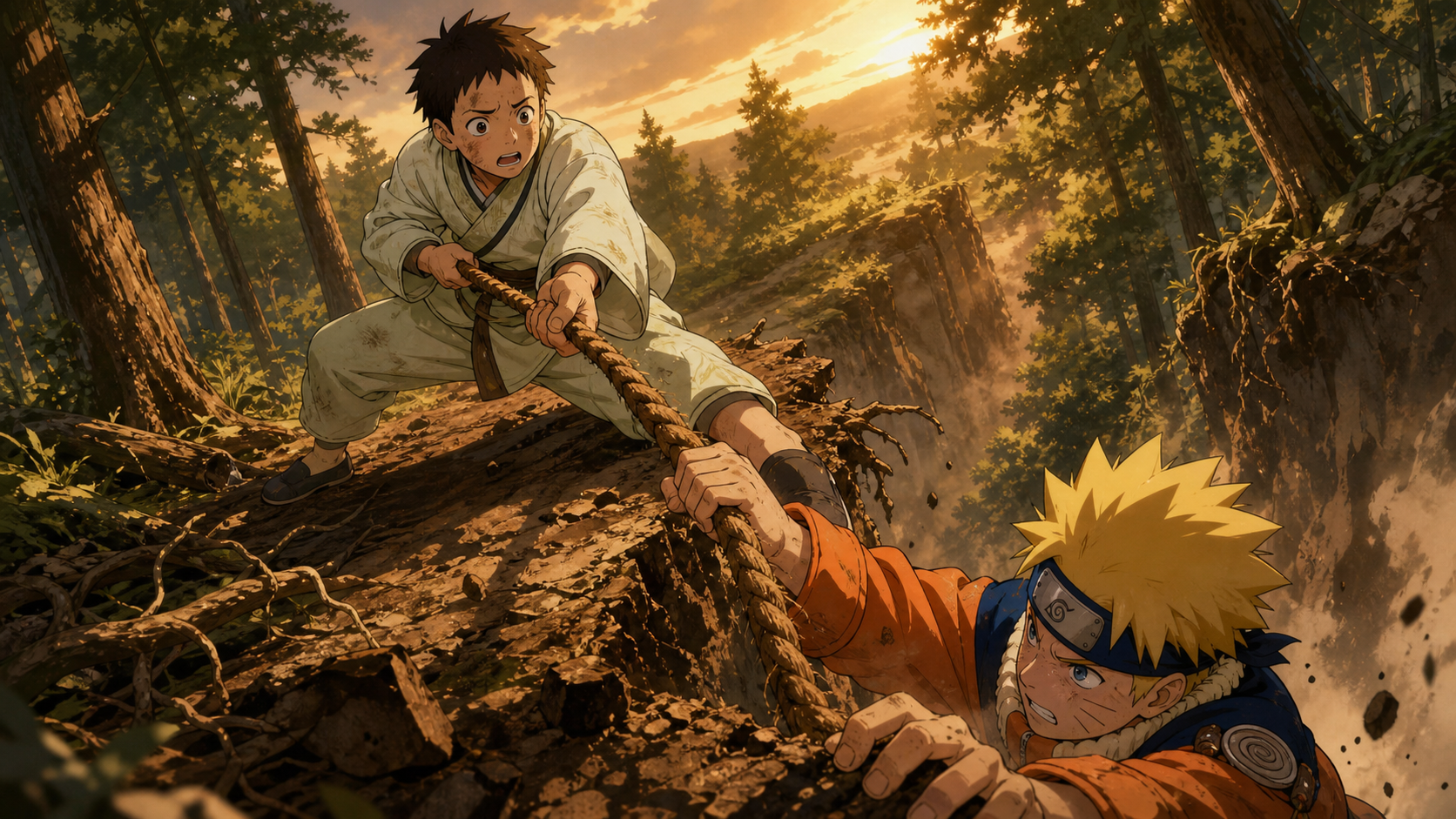
He returns with a rope.
The effort hurts. He is still scared. He reaches anyway and helps pull Naruto to safety.
That is the first technique Kunihisa earns.
No fake hand signs. No crowd rushing for bills. No credit taken from somebody else's work.
The rescue also clarifies what friendship costs. Naruto does not need Kunihisa to perform perfectly. He needs the boy to care enough to try when helping is difficult. Kunihisa finally contributes something nobody can purchase on his behalf: his own decision to come back.
He is useful before he is skilled. That is important. If the episode required Kunihisa to become a competent ninja in one afternoon, it would merely replace wealth with talent as the entry fee for human value. The rope rescue works because courage, attention, and effort let an inexperienced child contribute.
He sees a friend in danger and acts.
The Marble Was Always Valuable
Kunihisa thanks Naruto and invites him to visit.
Back with his father, he notices a sparkling marble. Kunijiro says it is pretty but has no value.
At the beginning of the episode, that judgment ended the conversation.
Now Kunihisa disagrees.
If the marble is beautiful, its lack of market value does not make the beauty disappear.
That is the real lesson. Money has value. It can pay workers, buy food, fund missions, and provide security. It cannot define every other kind of value without flattening people into services and beauty into resale price.
The marble closes the argument without pretending Kunihisa has rejected his life. He has learned to perceive one thing his wealth cannot measure. That sounds small until we remember how he treated guards, strangers, rural shinobi, friendship, and even his own ability at the start of the day.
Kunijiro's repeated observation provides the test. The marble has not changed. Its market price remains nothing, and nobody has secretly revealed it as a rare jewel. Kunihisa is the part that changed. He can now hold price and worth as separate ideas without assuming one cancels the other.
That lesson applies to him as well. His value does not come from the fortune attached to his family name. It appears when he watches, learns, fails, returns, and pulls on the rope while Naruto is in danger.
Kunihisa does not become poor, and the episode does not need him to. He learns that wealth is something he has, not proof that everything and everyone around him has a price.
Kunijiro identifies the problem without pretending money is innocent
He knows his son treats price as a complete theory of value and asks Tsunade for help. That recognition matters, but the household surrounding Kunihisa did not appear by magic. Adults repeatedly turned cash into instant obedience, insulated the boy from ordinary consequences, and let paid applause imitate achievement. One instructional day can interrupt the pattern. Parenting must change what waits at home.
Tsunade chooses Naruto because he cannot perform deference
A polished escort might preserve Kunihisa’s fantasy and call every purchased stunt charming. Naruto complains loudly, refuses fake technique names, and knows what unglamorous beginner work feels like. His bluntness gives the boy something wealth has screened out: an adult-adjacent guide who will distinguish wanting recognition from earning competence.
D-rank labor is the correct curriculum
Fishing, crossing rough ground, and handling inconvenience look unimpressive beside combat techniques. They teach observation, patience, bodily coordination, frustration tolerance, and responsibility for the result. Kunihisa wants the identity of a ninja without the repetition beneath it. Naruto does not need to shame the fantasy. He needs to attach the fantasy to work the child cannot outsource.
Money Style succeeds at payment and fails as ninjutsu
Kunihisa throws cash, adults act, and the desired outcome appears. The cause is real. The interpretation is wrong. He did not learn rescue, test the bridge, or defeat the animal. He purchased another person’s action and renamed the transaction as his ability. Wealth becomes dangerous when access to outcomes is mistaken for ownership of everyone’s competence.
Paid crowds teach the wrong lesson twice
They perform enthusiasm because payment rewards it, then disappear when a larger offer arrives. Kunihisa reads the first response as loyalty and the second as betrayal because nobody taught him the terms clearly. Workers are allowed to work for money. The failure belongs to an environment that sold a child temporary service while encouraging him to call it friendship.
Dangerous tests make purchased obedience ethically worse
Sending other people onto uncertain bridges or toward wild animals transfers risk away from the person claiming the achievement. Payment does not erase the need for informed consent, appropriate protection, and a right to refuse. Kunihisa is still a child, but the adults accepting cash should not help him learn that poorer bodies exist as disposable equipment for his adventures.
Naruto teaches fishing through attention
A fish cannot be bribed into cooperating with Kunihisa’s performance. He must watch the water, hold the line, wait, adjust, and accept failed attempts. The task gives him direct feedback money cannot flatter. When effort finally changes the result, he experiences competence as a relationship between observation and practice rather than the speed with which assistants arrive.
The kidnappers understand Kunihisa’s world perfectly
They do not defeat the guards through superior strength. They offer a better price. The betrayal works because every relationship around the boy has already been framed as a transaction. If loyalty is only purchased, then a competing buyer is not violating the system. The kidnappers are using its most honest rule.
Naruto is paid and still cannot be auctioned away
His mission carries compensation, so the episode does not claim money contaminates every duty. Naruto accepts payment within an obligation defined by the village, then refuses bribes because protection is not a minute-by-minute sale to the highest bidder. Professional commitment includes terms that continue after somebody waves a larger number. That boundary is what Kunihisa has never seen.
Refusing the bribe gives Kunihisa evidence of nonmarket value
Naruto does not win the argument through a speech about friendship. He stays when leaving would be profitable. The choice proves that another person can value Kunihisa without calculating the next payment. For a child surrounded by purchased attention, that refusal may be more emotionally disruptive than the kidnapping itself. It reveals how thin the earlier applause was.
Kunihisa’s fear at the gap is real
The episode should not mock him for lacking skills nobody required him to practice. Crossing demands balance, judgment, and willingness to risk embarrassment. Naruto can model movement and insist the boy try without pretending fear is laziness. Courage begins when Kunihisa acts while afraid, not when the script magically removes fear because the moral lesson has arrived.
Returning with the rope is his first unpurchased rescue
Kunihisa could run toward safety or wait for adults. Instead, he secures help and pulls because Naruto needs him. The action matters precisely because it is small, physical, and incomplete without effort. He does not become a shinobi in one afternoon. He becomes someone who can contribute rather than purchasing a substitute and claiming the credit.
The rescue changes who gets to be capable
Earlier, wealth made Kunihisa the center while other people supplied every useful action. At the ravine, Naruto’s vulnerability creates room for the boy to practice responsibility. Good mentorship sometimes means refusing to make the learner permanently passive. Naruto protects him throughout the danger, but he also allows Kunihisa’s effort to matter when the moment arrives.
The marble separates beauty from market price
A cheap object can still hold color, memory, and personal meaning. Naruto’s marble does not prove material conditions are irrelevant or that poverty is spiritually superior. It proves price measures one kind of exchange, not every form of worth. Kunihisa needs a larger vocabulary capable of naming usefulness, affection, craft, courage, history, and beauty without converting each into a bid.
Wealth is not the villain; unaccountable insulation is
Money can pay workers fairly, fund safety, purchase tools, and support medical or educational access. The episode becomes sharper when it criticizes how Kunihisa uses wealth, not wealth’s mere existence. He has been protected from effort while encouraged to command risk. The repair is accountability, honest relationships, and participation in work, not a theatrical rejection of every resource he has.
The adults need to stop rewarding the performance
Kunihisa will regress if guards resume cheering whenever banknotes appear. Kunijiro should define duties that money cannot transfer, require truthful feedback from staff, and protect employees from pressure to validate dangerous play. Naruto creates one clean counterexample. The family system must make that lesson normal enough to survive after the shinobi leaves.
RaeRae’s full take
Episode 174 knows the joke is not that cash has no power. Cash works so reliably that Kunihisa mistakes purchased outcomes for personal skill and paid proximity for loyalty. The kidnappers expose the flaw by bidding higher. Naruto breaks it by refusing to enter the auction at all.
The best scene is not a grand fight. Kunihisa returns with a rope and uses his own body, judgment, and courage to help someone. That act cannot be bought because the point is not merely getting Naruto out. The point is that Kunihisa chooses responsibility when escape would be easier.
The marble closes the lesson without pretending money is useless. Price can tell you what somebody will charge. It cannot tell you who will stay, which effort belongs to you, or why a beautiful worthless object becomes precious after a real day with a friend.
RaeRae checkpoint: Money Style works as payment and fails as character. Kunihisa’s first real victory arrives when he returns with a rope and contributes his own courage, effort, and loyalty without hiring a substitute.
Receipts and official routes
- Episode number, licensed title, and official synopsis: Naruto Official Site.
- Japanese title, synopsis, and March 1, 2006 broadcast record: TV Tokyo.