
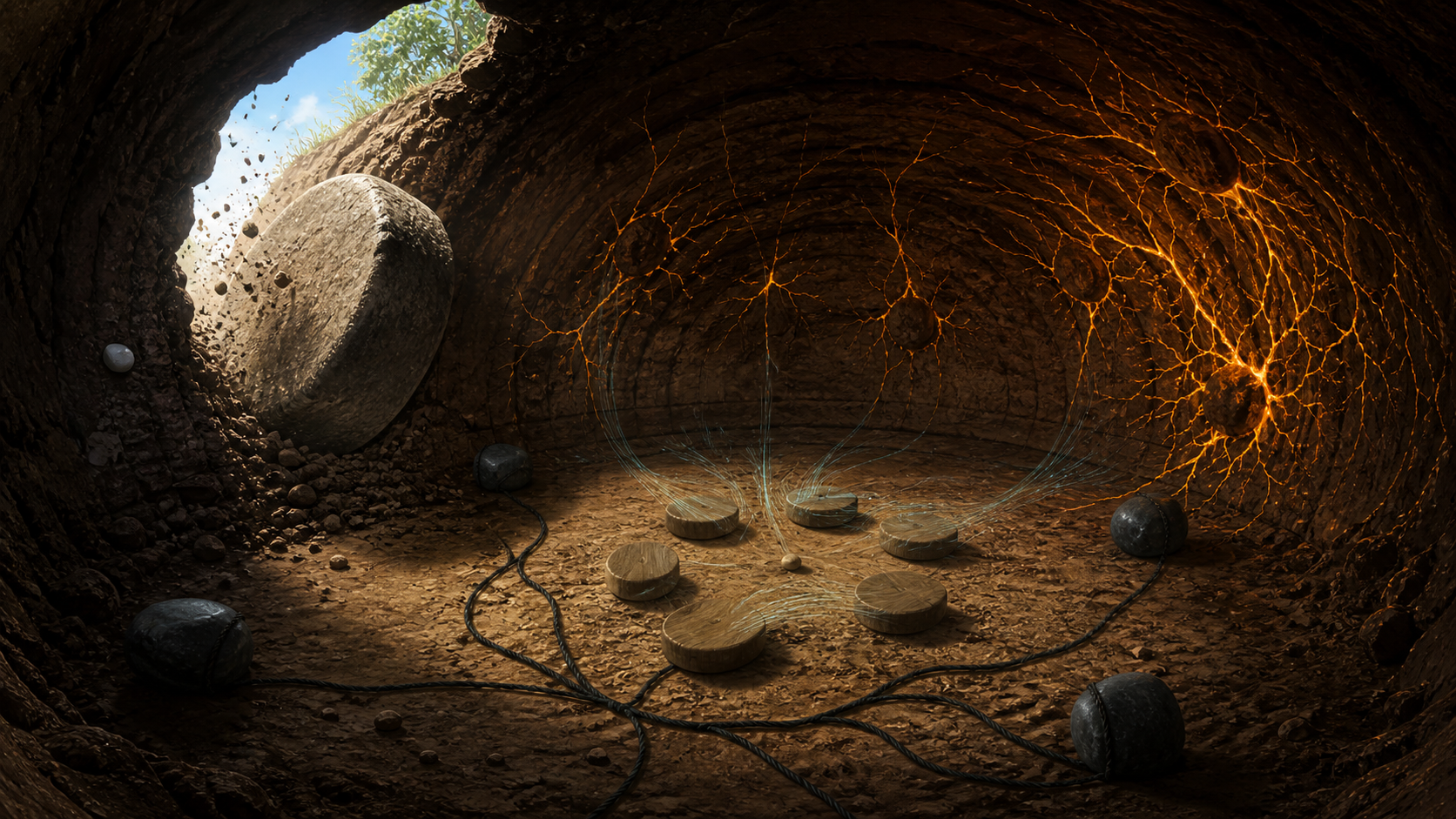
Squad Mutiny: Everything Falls Apart!
A chakra-eating prison makes Shikamaru sound like a traitor, but the squad escapes by trusting the leader’s pattern instead of his performance.
RaeRae Reacts
Episode 112 traps the entire retrieval squad inside a chakra-draining rock dome and asks one nasty question.
Do you trust your leader when his plan sounds exactly like betrayal?
Shikamaru's attempted ambush collapses when the Sound Four attacks first. Kidomaru catches the squad in webs, Shikamaru answers with Shadow Imitation, and Sakon breaks the enemy formation free.
Then Jirobo drops a prison around everybody.
The walls heal. The captives weaken. Brute force keeps failing because the dome steals the chakra needed to break it.
Shikamaru offers to abandon Sasuke.
Then he asks Jirobo to release him alone.
Naruto and Kiba hear cowardice. Neji and Choji hear a leader saying something that does not match the man who accepted responsibility for every life on the team.
That difference becomes the escape route.
Shikamaru Lets the Trap Close
The Sound Four's opening attack catches the retrieval team in explosive tags and Kidomaru's webs.
It looks like Shikamaru has lost control immediately.
He has not.
Shikamaru deliberately allows himself to be caught so he can connect the enemy through his Shadow Imitation Technique. Once the Sound Four believes the Leaf squad is pinned, he turns its confidence into position.
This is the first proof that field leadership will not look tidy.
Shikamaru cannot explain every step before he takes it. The enemy is listening, time is short, and a counterattack depends on surprise.
His teammates have to function inside a plan they only partly understand.
The shadow bind works, but Sakon forces the Sound Four free before Shikamaru can convert control into victory.
Good tactics create an opening.
They do not make the opponent cooperative.
Jirobo Builds a Prison That Eats Its Captives
Jirobo seals the Leaf squad inside the Earth Prison Dome of Magnificent Nothingness.
The name is excessive. The technique earns it.
The barrier surrounds the team with earth, repairs damage and drains chakra from everyone trapped inside. Jirobo does not need to enter and fight five opponents directly. He can stand outside, feed the structure and let the prison weaken them for him.
It is containment as combat.
The squad cannot pursue Sasuke while enclosed. It cannot conserve strength because the dome actively steals it. Every failed escape attempt spends more of the resource Jirobo is taking.
That design punishes panic.
The more desperately the team attacks without understanding the mechanism, the easier the captives become to finish.
Jirobo has turned time itself into an enemy.
Kiba and Akamaru Test the Wall
Kiba and Akamaru use Passing Fang against the barrier.
They create serious damage.
The wall closes again.
That failure still gives Shikamaru useful information. The dome is not indestructible stone. It is a chakra-maintained system capable of repairing breaches.
There is a difference between an attack being too weak and an attack hitting a structure designed to regenerate.
Kiba's instinct is direct because Sasuke moves farther away. He has no time to admire the engineering.
Yet repeated force against the same reinforced point will drain the squad faster than it drains Jirobo.
The attack proves a breach is physically possible.
Now the team needs the correct location.
Neji Sees the Chakra Mechanism
Neji uses the Byakugan to study the barrier.
He confirms that chakra runs through the dome and that Jirobo is drawing chakra from the captives.
This is why Shikamaru recruited abilities rather than a collection of impressive punches.
Kiba and Akamaru test the material. Neji sees the energy maintaining it. Shikamaru interprets the enemy's behavior. Choji carries the force required for the final breach.
No single member holds the complete solution.
The squad survives by combining partial answers.
Neji's observation also changes the emotional temperature. The weakness spreading through the team is not fear or lack of resolve. Jirobo is literally taking the chakra they need to act.
They have limited attempts left.
Shikamaru needs information without letting Jirobo realize which information matters.
So he starts talking like the worst possible version of himself.
Shikamaru Offers to Abandon the Mission
Shikamaru asks Jirobo to let the squad go in exchange for abandoning the pursuit of Sasuke.
Jirobo refuses.
Then Shikamaru asks him to release only the leader and leave the others trapped.
Naruto and Kiba are furious.
They should be, based on the words alone.
Naruto joined because he promised Sakura he would bring Sasuke back. Kiba accepted Shikamaru's command with the expectation that a Leaf leader would protect the mission and the squad. Hearing that leader trade both for personal survival sounds disgusting.
Shikamaru needs the disgust to sound real.
If everybody instantly winks and praises the clever plan, Jirobo knows it is a performance.
The anger helps sell the lie.
That does not make it pleasant for the people who have not identified the tactic yet.
Neji and Choji Read the Leader, Not the Performance
Neji and Choji recognize that Shikamaru's offer does not fit his earlier commitment.
Before departure, Shikamaru accepted responsibility for the mission and the lives of his teammates. A leader prepared to sacrifice himself does not suddenly beg an enemy to save him alone without a reason.
Choji knows Shikamaru more personally than anyone in the squad.
He has watched people mistake laziness for indifference and blunt honesty for lack of loyalty. He knows Shikamaru complains constantly and still shows up when somebody needs him.
Neji reaches the same conclusion through observation.
They do not trust the sentence.
They trust the pattern of decisions behind it.
This is what team cohesion actually requires. Blind obedience would accept the betrayal. Blind suspicion would attack the leader. Understanding asks why his current behavior contradicts everything established before it.
Choji keeps eating and conserving what strength he can while Naruto and Kiba rage.
He is not ignoring the danger.
He is waiting for Shikamaru's answer.
The Betrayal Is a Measurement
Shikamaru uses the negotiation to study how Jirobo reinforces the dome.
The barrier does not receive equal chakra everywhere. The section closest to Jirobo has the strongest support. The opposite side repairs more slowly and offers the weakest point.
Shikamaru could not see the chakra network as Neji can.
He could observe repair speed, listen to Jirobo's position and provoke enough interaction to confirm the pattern.
The fake surrender buys time and turns the enemy's control into data.
Jirobo believes the chakra drain is breaking the squad apart.
Shikamaru lets him believe it because arrogance makes people careless with information.
The supposed mutiny is not the team failing.
It is the team communicating under surveillance, imperfectly but effectively.
Naruto and Kiba supply believable outrage. Neji confirms the mechanism. Choji understands that his power will matter when the target is marked.
Everybody contributes, including the people who do not yet know how.
Neji Marks the Weak Point
Once Shikamaru identifies the least reinforced section, Neji marks it with a kunai.
Precision comes before force.
That order is the entire lesson of the episode.
Kiba's earlier attack showed the team could damage the dome, but striking a heavily supported area allowed Jirobo to erase the result. Neji gives Choji a location where damage can outpace repair.
The mark converts Shikamaru's deduction into something the whole team can use.
Leadership does not mean performing every task personally.
It means turning different abilities into one successful action.
Shikamaru finds the weakness. Neji confirms and marks it. Choji supplies the impact.
The plan belongs to the squad.
Choji Breaks the Team Free
Choji uses Human Bullet Tank against the marked section and smashes through the dome.
The escape answers every cheap joke aimed at him.
His appetite did not make him unserious. His body did not make him a punchline. His friendship with Shikamaru did not earn him a courtesy position on the roster.
Shikamaru recruited Choji because Choji could do this.
When the team needs concentrated force against a precise target, he becomes the difference between escape and collapse.
The moment also proves why trust must travel both directions.
Choji trusts that Shikamaru has not abandoned them. Shikamaru trusts Choji to deliver the breach after chakra drain has weakened everybody.
Neither man needs a speech in the middle of the trap.
They know what the other can do.
The dome breaks, and the pursuit can continue.
What Changes After Episode 112
Shikamaru deliberately uses Kidomaru's web trap to catch the Sound Four with Shadow Imitation.
Sakon breaks the enemy group free.
Jirobo traps the Leaf squad inside a chakra-draining earth dome.
Kiba and Akamaru prove the wall can be damaged but also reveal its regenerative defense.
Neji identifies the chakra system maintaining the barrier.
Shikamaru stages a betrayal to study Jirobo's reinforcement pattern.
Naruto and Kiba believe the apparent mutiny, while Neji and Choji recognize the ruse.
Shikamaru locates the weakest section of the dome.
Neji marks it.
Choji breaks the squad free with Human Bullet Tank.
The retrieval mission survives its first containment battle.
Jirobo’s prison turns delay into physical depletion
The earth dome does more than trap the retrieval squad. It drains chakra while the Sound Four continues carrying Sasuke toward the border. Every failed escape attempt costs the team strength and gives the enemy distance.
The technique attacks time, energy, and morale at once. A prison does not need to kill immediately when it can make rescue impossible by degrees.
Shikamaru allows the trap to close because information has a price
Charging blindly against the barrier would waste chakra without revealing how it works. Shikamaru studies Jirobo’s confidence, the dome’s regeneration, and his teammates’ reactions. The pause looks dangerous because it is.
Leadership sometimes requires tolerating a controlled amount of disadvantage to learn where the real opening sits. The calculation becomes ethical only if the leader keeps monitoring how much the team can afford to lose.
Naruto reads stillness as surrender
Naruto’s body tells him to attack, break, and keep moving toward Sasuke. Shikamaru’s observation feels like delay at the exact moment delay threatens the mission. Their conflict grows from two necessary instincts operating without shared explanation.
Urgency keeps a team from freezing. Analysis keeps urgency from becoming repeated impact against a wall that heals.
Kiba and Akamaru test the barrier through contact
Kiba searches for changes in density and response while Akamaru helps map what ordinary sight cannot explain. Their attempts provide evidence even when they do not create an exit.
Failed tests are useful when the team records what each failure teaches. They become waste only when frustration repeats the same method without adjustment.
Neji sees the chakra mechanism behind the earth
Byakugan reveals that Jirobo is drawing chakra through the dome and replenishing damaged sections. The wall is not a passive object. It is an active system connected to the enemy outside.
That information changes the problem. The team no longer needs the strongest random strike. It needs the point where the flow is least effectively maintained.
Seeing the system does not automatically identify the exit
Neji can describe chakra movement, but the dome regenerates and the squad is weakening. Information must be combined with Shikamaru’s behavioral reading and Choji’s force.
Specialized vision becomes mission success when teammates translate it into coordinated action rather than treating perception as an individual achievement.
Shikamaru stages disloyalty because Jirobo is listening
He talks about abandoning Sasuke and questions whether the mission deserves further risk. The performance targets the enemy’s assumptions while testing how his own squad interprets command.
Deception can create an opening, but using teammates as an unwitting audience is dangerous. A leader who performs betrayal must trust the group to read history and context beneath the words.
The false mutiny works because the Sound Four expects weak bonds
Jirobo believes Leaf loyalty will collapse under pressure. Shikamaru feeds that belief because arrogance can reduce vigilance. The enemy hears confirmation that Konoha’s formation was superficial.
The strategy turns the Sound worldview against itself. People who understand relationships only as leverage become easier to deceive about genuine trust.
Naruto’s anger helps sell the performance
Naruto reacts with real outrage because abandoning Sasuke violates the promise driving him. The emotion convinces Jirobo precisely because Shikamaru does not need to manufacture it.
Using a teammate’s authentic pain as tactical cover may be effective. It also carries relational cost if the explanation comes too late.
Neji and Choji read the leader through prior knowledge
They know Shikamaru is lazy in presentation and fiercely loyal in practice. His words conflict with the person they have observed across years. That contradiction tells them to look for a plan.
Trust is not blind obedience. It is judgment built from repeated evidence strong enough to survive one alarming performance.
Choji understands Shikamaru because their bond predates rank
Shikamaru is now the formal commander, but Choji knows him from childhood. He can distinguish tactical cruelty from actual contempt because he remembers who sat beside him when others reduced him to his body.
Personal history becomes operational intelligence. The friendship lets Choji keep faith when a newly assembled squad might fracture.
The escape requires distributed expertise
Shikamaru identifies the psychological opportunity. Neji maps the weak flow. Kiba and Akamaru help test the structure. Choji provides the force needed to break through. Naruto supplies urgency and immediate counterattack.
No single member solves the prison. The formation works because different kinds of knowledge converge on one point.
Choji’s strength is precise, not merely large
Breaking the dome requires hitting the weakness Neji locates with enough power before Jirobo restores it. Choji does not smash everything indiscriminately. He applies force where the team’s analysis gives force meaning.
Reducing him to “the strong one” misses the control and trust required to execute that role.
The wall regenerates because Jirobo expects isolated effort
Individual attacks create damage he can repair. Coordinated pressure on the weakest section overwhelms the cycle. The technique is built to defeat people who act separately while believing activity equals progress.
The retrieval squad escapes when it behaves like the formation Shikamaru described at departure.
Getting free does not restore the chakra already stolen
The squad exits weaker while the Sound Four has gained distance. Tactical success prevents mission collapse; it does not reset conditions. Every remaining encounter begins with debt.
Stories often treat escape as full recovery. Bodies and chakra reserves keep the account.
The squad must decide who continues and who holds Jirobo
Jirobo remains capable of pursuit. If everybody fights him, Sasuke crosses farther toward Orochimaru. If nobody stays, he attacks from behind. The mission now demands separation.
Shikamaru’s formation was designed for five members and Akamaru. Its real test begins when success requires making the group smaller.
Leaving someone behind is command’s cruel arithmetic
A rear guard gives the rest of the squad time and carries concentrated danger alone. Shikamaru must weigh the target, teammate capability, enemy strength, and the possibility that help will not arrive.
No diagram makes that choice emotionally clean. Leadership means owning the decision without pretending the selected person is expendable.
Choji volunteers from loyalty and from a need to be trusted
He knows his physical power matches Jirobo’s role and understands that the squad must keep moving. Volunteering lets him protect Shikamaru’s first command and prove what friends already know about him.
The decision is courageous. It also grows inside a culture where children earn recognition through extreme bodily risk.
Shikamaru’s confidence in Choji must include responsibility for his return
Trusting Choji to hold the enemy is not permission to forget him once the mission advances. A commander owes contingency planning, reinforcement if possible, and an honest account of the risk assigned.
Belief becomes hollow when leaders celebrate sacrifice more than survival.
The “mutiny” title hides a squad learning how to trust command
Everything appears to fall apart because voices rise, chakra drains, and Shikamaru speaks like he has abandoned the objective. Underneath the performance, the members are learning to interpret one another under pressure.
The team survives because disagreement does not automatically destroy loyalty. Conflict can reveal how deeply people understand the bond.
The episode refuses to make leadership look comfortable
Shikamaru must deceive an enemy, frustrate Naruto, depend on Neji’s vision, rely on Choji’s strength, and prepare to split the squad. None of those decisions resembles the relaxed promotion dinner.
Rank becomes real when another person’s body carries the consequence of your judgment.
RaeRae’s full take
Episode 112 traps the retrieval squad inside a wall that eats chakra and then gives us the smartest fake argument in the arc. Shikamaru lets Jirobo believe the Leaf formation is breaking because the Sound Four cannot imagine loyalty surviving disagreement.
Neji sees the weak flow, Choji supplies exact force, and the squad escapes through connected work. The victory costs energy and immediately demands a worse decision: somebody must stay behind.
Choji’s role is not a courtesy assignment for Shikamaru’s friend. He is the person whose strength, precision, and trust make continuation possible. The danger is that Konoha keeps asking children to prove their value by standing alone against threats adults should be carrying with them.
RaeRae checkpoint: The squad escapes because Shikamaru reads the enemy, Neji reads the chakra, and Choji turns both readings into one precise strike.
RaeRae's Verdict
“Squad Mutiny: Everything Falls Apart!” is not about a team falling apart.
It is about how ugly teamwork can look when the enemy is listening.
Shikamaru cannot announce his plan. Naruto and Kiba cannot read his mind. Neji and Choji have to judge whether one terrible offer outweighs everything their leader has already shown them.
They decide it does not.
Jirobo builds a prison that heals itself and eats chakra. The squad escapes because Kiba tests it, Neji sees it, Shikamaru reads it and Choji breaks it.
Nobody solves the trap alone.
That is not mutiny.
That is a team learning how to trust under pressure.
Receipts and official routes
- Episode number and licensed title: Naruto Official Site.
- Japanese title, synopsis, and December 1, 2004 broadcast record: TV Tokyo.
- Streaming availability varies by region; use the licensed route maintained in the episode directory.