
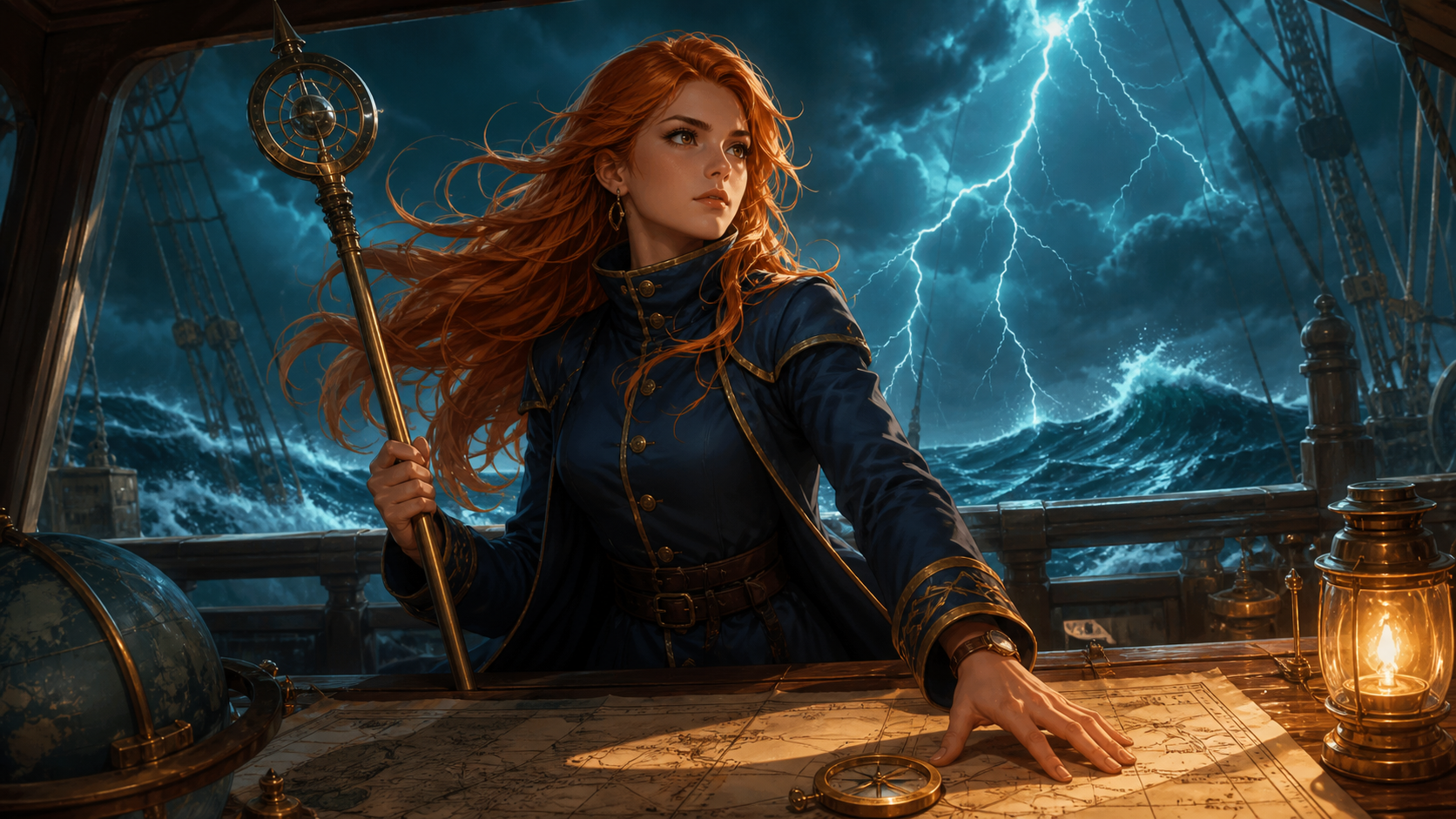
Nami: One Piece Character Profile
Quick profile
Full name: Nami
Known as: Cat Burglar Nami
Role: Navigator of the Straw Hat Pirates
Origin: Cocoyashi Village, East Blue
Age: 20 after the time skip
Birthday: July 3
Specialties: Navigation, cartography, meteorology, negotiation, and theft
Weapon: Clima-Tact, later upgraded with Zeus
Current bounty: 366 million berries
Japanese voice: Akemi Okamura
Bottom line
Nami is the reason pirate freedom does not end at the bottom of the sea. Luffy can choose a horizon. Nami reads the pressure, current, wind, cloud formation, temperature, and route that can carry the crew there alive. One Piece regularly calls physical strength power, then hands everybody’s survival to a woman holding a chart.
Her money fixation is not shallow decoration. Arlong turns money into a ransom, a deadline, and a false promise that keeps a child working for the man who murdered her mother. Nami learns that a number can mean safety until a stronger person changes the rules. The jokes about debt and greed grow from a history where financial control was violence.
Bellemere, Nojiko, and the home Arlong occupied
Bellemere finds Nami and Nojiko after war and raises them in Cocoyashi Village with very little money. Their household has affection, arguments, tangerines, patched clothes, and hard choices. Bellmere refuses to deny that the girls are her daughters when Arlong demands payment for every resident. That declaration costs her life.
Arlong then forces Nami to map for his crew and offers a bargain: buy back the village for 100 million berries. The agreement is designed to exploit hope. Nami steals from pirates for years while villagers pretend to reject her so she can keep functioning. When corrupt Marines seize the money, the system reveals the truth. Arlong never planned to let honest labor purchase freedom.
Asking for help is the turning point
Nami’s request for help works because dependence is not framed as weakness. She has planned, worked, stolen, lied, calculated, and endured. The bargain fails because an abuser controls the contract and the enforcement. Luffy does not rescue a passive woman from a problem she never fought. He joins a fight after her solitary strategy has been deliberately destroyed.
The straw hat on her head matters because Luffy treats the hat as precious. He gives Nami temporary custody of a promise before attacking Arlong Park. The scene says trust can move in both directions even when the immediate work is different.
Navigation is authority
Nami reads weather patterns that ordinary sailors cannot survive. The Grand Line breaks familiar compass logic. Log Poses, strange currents, sudden cyclones, sky routes, sea trains, Knock Up Streams, and New World conditions require observation plus judgment. She does not merely announce directions after the adventure begins. Her decisions determine whether an adventure can begin at all.
The crew respects that authority inconsistently for comedy, but the practical rule remains: when Nami gives an emergency sailing order, stronger fighters follow. Expertise creates situational command. A captain does not lose status by listening to the navigator. He proves the crew has a real division of labor.
Cartography, memory, and the unfinished world map
Nami wants to draw a map of the entire world. The dream connects childhood talent to a future Arlong cannot own. Maps in One Piece are never neutral pieces of paper. Governments hide islands, currents decide trade, borders decide who can leave, and pirates use charts to raid or escape.
Her goal requires time, records, instruments, travel, and the freedom to preserve knowledge for herself. The series could show more of that labor. Nami’s dream should not survive only as a line in a character summary while every island gives the men a visible training milestone.
Money, negotiation, and material survival
Nami tracks costs because ships need food, repairs, clothing, medicine, tools, port fees, and replacement supplies. One Piece often turns her collection attempts into slapstick, yet somebody has to understand that a treasure haul is not the same as spendable security. Adventure consumes resources.
She also understands leverage. Nami bargains, lies, reads greed, spots a scam, and recognizes when politeness will not protect the crew. Those skills come from surviving pirates and corrupt authorities before she had anybody strong enough to back her refusal.
Clima-Tact mechanics and growth
Usopp creates the first Clima-Tact from performance tools, and Nami turns the strange equipment into a weather weapon. Heat Balls, Cool Balls, and Thunder Balls let her manipulate local conditions, create mirages, and build electrical attacks. The weapon rewards setup and environmental reading rather than raw force.
Later upgrades incorporate Weatheria knowledge and stronger climate effects. Zeus adds a sentient storm cloud who can carry lightning, change shape, and interact with the Clima-Tact. The partnership increases Nami’s destructive power, but Zeus also brings a history of coercion and shifting loyalty that should not be reduced to ownership language.
Combat limits and why preparation matters
Nami does not have the durability of the crew’s primary fighters. She wins through distance, deception, timing, weather knowledge, and willingness to exploit an opponent’s assumptions. Miss Doublefinger forces her to learn a dangerous tool during combat. Kalifa requires Nami to analyze an unfamiliar Devil Fruit effect while trapped inside a bad matchup.
Ulti exposes the cost when an enemy closes the distance. Nami’s refusal to deny Luffy’s dream is emotionally powerful and physically reckless. Zeus later gives her enough force to finish the confrontation, but help does not cancel courage. The sequence works because bravery and vulnerability remain visible together.
Relationships and accountability
Luffy gives Nami unconditional trust at Arlong Park and endless administrative headaches afterward. Zoro trusts her navigation while making every ordinary route harder. Usopp is an inventor, fellow planner, and partner in fear-based realism. Sanji feeds her, protects her, and repeatedly turns attraction into behavior she has to manage. Chopper shares curiosity and emotional openness. Robin gives Nami another adult woman whose competence does not compete with hers.
Bellemere and Nojiko remain the center of her family history. Genzo represents community protection without replacing her mother. Vivi becomes a friend through shared responsibility for a country under manipulation. Nami can be controlling, opportunistic, and quick to use debt as leverage. Those flaws should inconvenience people without erasing the survival history behind them.
The camera keeps interrupting her work
Nami is one of the franchise’s most technically essential characters. The anime also repeatedly frames her body as a product through costumes, angles, reaction shots, and exaggerated proportions. Competence does not cancel objectification, and surviving the camera does not make the camera harmless.
Fan service becomes especially lazy when a scene about navigation, fear, grief, or physical danger pauses to sell her body. Nami can be sexy and still deserve control over when sexuality defines the frame. Those ideas are not enemies.
Design chronology
Early Nami has short orange hair, practical tops, skirts or trousers, sandals, and the Arlong tattoo she later replaces. The pinwheel and tangerine tattoo honors Genzo and Bellmere while marking her body as her own again. Her Log Pose and navigation tools remain important visual cues.
After the time skip, longer hair and a larger wardrobe change the silhouette. Arc outfits can reflect local settings, but recurring sexualized designs sometimes hide the professional tools that make her recognizable as a navigator. The best designs preserve weather gear, maps, staff, or movement alongside fashion.
Akemi Okamura’s Japanese performance
Akemi Okamura gives Nami authority, panic, calculation, grief, and comic fury without collapsing those emotions into one scolding voice. Her anger changes according to the subject. Money trouble, reckless sailing, betrayal, and danger to a child do not sound identical.
Arlong Park requires a performance that lets control fail in stages. Later scenes use sharper confidence without erasing the memory underneath. Okamura protects Nami’s practical intelligence while letting fear remain part of her survival system.
Anime, films, games, and continuity
Nami appears throughout the television anime, theatrical films, specials, OVAs, games, crossovers, and promotional projects. Different productions may change her tools, clothing, relationships, or knowledge according to their place in release history. Those appearances do not automatically share the manga’s main continuity.
The numbered television route remains the primary animated adaptation. Film and game feats belong to their stated versions unless official material connects them more directly. The profile keeps those works discoverable without pretending every adventure happened between two manga chapters.
RaeRae’s verdict
Nami makes freedom material. Somebody has to read the storm, ration the money, record the route, and tell a reckless captain that the sea does not care about his confidence. She is not less adventurous because she understands the bill.
I want One Piece to keep giving her dream visible progress and stop treating expertise as background service. The world map should feel as real as the world’s greatest swordsman title. Nami has been drawing freedom longer than most of the crew has known how to name their own.
The navigator is already doing the impossible work
Nami’s dream is often summarized as drawing a map of the world, then quietly placed behind everybody else’s battles. The dream is happening every time she reads weather nobody else understands, turns scattered observations into a route, or tells a captain drunk on possibility that the sea still has rules. Navigation is not the pause between adventures. Navigation is the labor that makes an adventure survivable.
That labor also changes after the Grand Line. East Blue lets viewers imagine that expertise means memorizing stable patterns. The Grand Line makes climate irrational, Log Poses necessary, and certainty temporary. Nami succeeds because knowledge for her is active. She watches, revises, calculates, and admits when conditions have moved beyond the available information. I wish more stories understood that competence is not knowing everything before the scene begins. Competence is knowing how to respond when the world refuses the plan.
Her money fixation belongs to the same history. Money once represented the only imaginable route to buying back her village. Arlong turned every coin into a countdown, so Nami learned to measure safety through resources that could be hidden, counted, and defended. The joke survives after Arlong because trauma does not politely leave when the villain loses. The crew gives her relationships that are not transactions, but she still understands how quickly idealistic men spend supplies somebody else must replace.
Anger, fear, and the right to remain fully human
Nami is allowed to be terrified and still brave, greedy and still generous, furious and still loving. Those combinations matter because women in adventure stories are often asked to earn seriousness by giving up messiness. Nami never becomes respectable enough for that bargain. She screams, negotiates, hits her crewmates, comforts children, steals from pirates, and makes decisions while every emotion is still present.
Her relationship with Luffy works because he does not need her to imitate his courage. At Arlong Park, he cannot understand cartography as a prison or repair the years stolen from her. He can believe her request. Later arcs keep showing the reverse exchange: Luffy can charge toward the horizon because Nami handles the systems his freedom depends upon. Food, weather, schedules, money, and routes are not glamorous until they fail. She keeps them from failing.
I remain angry at the camera whenever the series treats her body as though fandom access matters more than her point of view. Fan service does not erase Nami’s writing, but viewers should not have to pretend the framing is neutral. Her intelligence, labor, and political instincts deserve attention without an unnecessary visual negotiation first. The best Nami scenes trust her face, voice, hands, maps, and judgment. That woman can command a ship through a storm. She does not need the story to apologize for letting her lead.
Nami’s relationship with children makes the same politics visible at a smaller scale. She recognizes frightened kids who have been told adults own every available choice, whether the threat comes from Arlong, Caesar, or a ruler who treats dependence as permission. Her protection is not sentimental innocence worship. She knows children lie, panic, make reckless promises, and still deserve adults who will not exploit those vulnerabilities. That recognition comes from surviving a childhood where the people she loved had almost no power to shield her. When Nami becomes the adult standing between a child and an institution, the world map gains another meaning. She is charting routes toward places where returning home might be safe.
Sources and official routes
ONE PIECE.com: Nami official character profile
ONE PIECE.com: anime staff, cast, and broadcasters
Watch One Piece on Crunchyroll
Return to the One Piece anime hub
Browse One Piece character profiles