
Mystogan
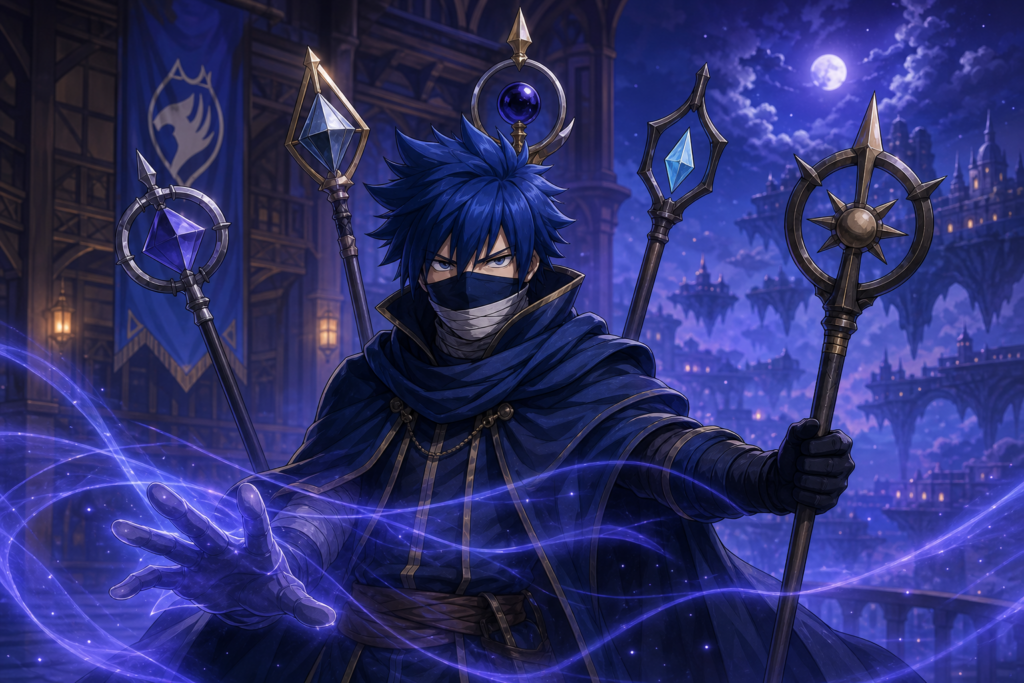
CVM Sekai character profile
Mystogan saves two worlds while keeping nearly everyone he protects on an information diet. That is not mysterious-prince decoration. That secrecy is the central cost of his heroism.
Bottom line
Mystogan spends years protecting Earth-land from his father’s kingdom, joins Fairy Tail, helps Wendy survive and eventually gives Edolas a future without stolen magic. He also keeps nearly everybody he protects on a strict information diet.
That is why he works. He is not simply “good Jellal,” and he is not a masked prince waiting for a face reveal to become interesting. Mystogan is a separate person from Edolas whose choices keep colliding with the same question: when does secrecy protect people, and when does it quietly take their agency?
He closes Anima portals before Earth-land communities can be drained into Edolas. Good. He hides his identity from Fairy Tail so thoroughly that he puts guildmates to sleep when he visits. Less good. He protects young Wendy and finds her a home. Necessary. He also leaves another child living with an explanation she cannot fully evaluate. That consequence does not cancel the rescue. The consequence makes the rescue human.
Then Edolas forces the biggest choice. Mystogan ends the magic system his world depends on because that system survives by taking from others. Ending the system is ethically defensible and socially explosive. His answer includes political theater, a staged enemy and a new kingship. My verdict: he chooses the right direction, but “trust me, I planned the public lie for everyone’s benefit” remains a dangerous way to found a government.
Mystogan is a responsible man with a habit of making responsibility private. His best growth begins when saving people is no longer enough. He has to stay visible and govern among them.
Design: the disguise tells us how he thinks
Mystogan’s design hides almost everything that could invite recognition. Deep-blue hair remains visible, but cloth covers much of his lower face. A layered dark mantle obscures his body. Multiple staffs rise behind him, making the silhouette look larger and harder to approach.
The disguise is practical. The disguise keeps people from connecting him to Jellal’s face and protects an Edolas political identity in Earth-land. The disguise also becomes psychological architecture. Mystogan does not merely withhold a name. He builds a system around not being known.
That system includes sleep magic. When he enters Fairy Tail, guildmates lose consciousness so they cannot look at him. The scene is funny because a room full of loud mages drops around one quiet man. The power dynamic is not neutral. Mystogan protects secrecy by controlling other people’s awareness.
The red marking around Earth-land Jellal’s right eye must not appear on Mystogan. Their resemblance is already narratively complicated. Adding the tattoo would turn a parallel-world face into a false shared identity.
His staffs do the opposite of the mask. They announce specialized skill. He may hide the man, but he makes the mage impossible to overlook.
Appearance and design evolution
Mystogan’s first Earth-land silhouette is built from concealment: deep-blue hair, layered navy cloth, a covered lower face and five distinct staffs carried behind him. The number matters because his staff formations are part of his combat grammar, not random fantasy decoration. He looks prepared before he speaks.
The Battle of Fairy Tail face reveal removes the audience’s easy distance. Beneath the wrapping is the face associated with Jellal Fernandes, but without Jellal’s red marking around the right eye. The story uses resemblance as a mystery and later explains it through Edolas counterparts. The resemblance does not merge their guilt, magic or romantic history.
Once the Edolas identity becomes public, clothing shifts from masked traveler to prince and ruler. The change is not a magical power-up. The clothing change marks the end of Earth-land anonymity and the beginning of visible political responsibility. After Edolas loses ambient magic, the staffs no longer mean what they meant in Earth-land. His authority has to survive without the visual proof of spell power.
The prince who leaves Edolas
Mystogan is born into Edolas royalty as Faust’s son. That gives him proximity to the state’s magic crisis and responsibility for what the kingdom does about it.
Edolas lacks the self-renewing magical environment Earth-land takes for granted. The shortage is not imaginary. People build institutions around scarcity, and fear turns extraction into policy.
Faust’s government uses Anima to draw magic, places and living beings from Earth-land into Edolas. The political sales pitch is survival. The moral reality is theft at world scale.
Mystogan rejects the policy. He leaves the role that could have made him a comfortable beneficiary and works in Earth-land to close Anima portals.
That choice deserves credit. That choice also shows the limits of the lone-resister model. Earth-land communities are protected by somebody who rarely tells them the threat exists. Edolas citizens are not invited into a public argument about the cost of their magic. Mystogan becomes the person privately managing a crisis created by royal authority. He opposes his father’s harm, but he inherits the royal habit of deciding for everybody.
Panther Lily: duty before the crown gets to define it
Panther Lily finds and protects Mystogan when the prince is injured and young. The relationship forms through vulnerability before formal politics can define them.
Lily’s care matters because he is also a soldier of Edolas. Later, the crown demands obedience to policies that endanger other worlds and Exceeds. His loyalty to Mystogan helps expose a basic difference between service to a person and service to a harmful order.
Mystogan does not simply recruit Lily into rebellion. Their histories develop along separate tracks before meeting again in the Edolas crisis. That preserves Lily’s agency. He rejects Faust because he judges the policy, not because the prince activates an old friendship coupon.
For Mystogan, Lily is evidence that duty can survive disagreement. A person may oppose the king and still care about the kingdom. That distinction becomes essential when Mystogan later takes the throne.
Wendy: protection without a complete explanation
Mystogan travels with Wendy after Grandeeney disappears. Wendy is a child who has lost the dragon who raised her. He protects her during a period when she has no stable home. He later leaves her at Cait Shelter.
The choice gives Wendy community and safety. Roubaul’s guild is later revealed as an illusion sustained so she would not be alone. The primary reveal establishes Roubaul as the creator of Cait Shelter’s illusion for Wendy. The episode does not establish that Mystogan knew the whole construction when he left her there, so this profile does not give him retroactive omniscience.
Even without total knowledge, the relational pattern is clear. Another caring older figure decides where Wendy will live and then leaves before she has full context.
Mystogan is not cruel. He is operating under danger and responsibility that a child cannot carry. He still creates abandonment pain.
Adults love to treat explanation and consequence as enemies. “He had a good reason” gets used as if it erases what the child experienced. A good reason does not erase what the child experienced. Wendy can be safer because of Mystogan and hurt by his departure at the same time.
That tension follows her into Fairy Tail, where chosen family becomes partly a response to homes other people selected for her.
Fairy Tail: a member nobody is allowed to know
Mystogan becomes an S-Class mage of Fairy Tail. His rank confirms power and trust, but his participation is unusually distant. He takes jobs, protects the guild and remains hidden even from guildmates. This is chosen family with an asterisk.
Fairy Tail makes room for secrets because many members arrive carrying dangerous histories. The guild’s strength is that belonging does not require a clean résumé. Mystogan takes that tolerance to an extreme. He accepts the protection of membership without offering enough truth for the guild to understand what it is protecting.
The sleep spell makes the imbalance visible. Nobody consents to being knocked unconscious so a colleague can cross the room anonymously. The scene does not turn him into a villain. The moment shows how a protective habit can become casual control.
From a Buddhist angle, Mystogan clings to separation as if distance can prevent suffering. Mask, sleep and solitary work reduce immediate exposure. They also strengthen the identity of “the one who must handle this alone.” The self he protects becomes another prison.
Chronology: the masked guild member before Edolas
Mystogan enters the series early, but the story uses absence as part of his construction. Chapter 24 and Episode 10 establish the sleeping guild hall, the S-Class rank and his refusal to be observed. During Phantom Lord, Makarov’s side treats his absence, like Gildarts’s, as the absence of major combat power; Mystogan does not swoop in and retroactively claim the guild’s defense.
His next major public participation comes during the Battle of Fairy Tail. The Laxus fight reveals his face, demonstrates the five-staff system and makes the Jellal resemblance impossible to ignore. Wendy’s later history supplies the child-rescue and Cait Shelter connection. The Edolas arc finally unites those fragments: prince, Anima opponent, Fairy Tail mage and absent son of Faust.
After the Edolas resolution, he stays behind. That cleanly limits his role in Tenrou Island, the seven-year disappearance, the Grand Magic Games, Tartaros, Avatar and Alvarez. Those arcs may remember him or echo Edolas, but Mystogan is not an active Earth-land combatant in them. A complete profile should say that plainly instead of padding his résumé with other people’s battles.
Anima: resistance work nobody sees
Mystogan spends years closing Anima portals. This is the quiet center of his heroism. The work requires technical knowledge of dimensional magic, awareness of Edolas operations and the willingness to oppose his father’s state from another world. Each closed portal prevents people and magic from being treated as supply.
That labor is also thankless by design. Mystogan cannot receive public trust for a threat he will not explain. He builds protection without shared preparedness.
That choice may be necessary in individual moments. As a long-term model, it is fragile. If one exhausted masked mage fails, who knows enough to continue?
Creative structure turns Anima into more than a portal device. Anima represents extraction disguised as need. Edolas does not generate enough magic, so the kingdom externalizes the cost. Earth-land becomes the colony whose resources can be taken because the center has named itself desperate. Mystogan’s resistance is anti-extractive. His secrecy is less democratic than the cause deserves.
Laxus and the Battle of Fairy Tail
During the Battle of Fairy Tail, Mystogan confronts Laxus. The clash places two S-Class mages with very different relationships to power in the same space.
Laxus turns guild conflict into coercive spectacle. Mystogan has spent years avoiding spectacle altogether. Both men decide that their private understanding justifies controlling what others experience.
Their fight exposes Mystogan’s face and deepens the Jellal resemblance mystery. That reveal is not proof that he has become Earth-land Jellal. The reveal becomes a continuity question the Edolas arc later answers.
His multiple staffs allow structured, large-area techniques rather than a single weapon exchange. Against Laxus, the licensed continuity names Five-Layered Magic Circle: Sacred Song and the illusion technique Skyscraper. Sacred Song layers five staff circles into a major attack. Skyscraper attacks perception rather than proving that every apparent wound is physical. Later, Three-Layered Magic Circle: Mirror Water uses a smaller formation defensively. Those named techniques should not be inflated into a limitless spellbook. The important character fact is that Mystogan can meet Laxus at a high level while still prioritizing containment over public status.
The confrontation also cracks his isolation. Once somebody sees him, secrecy cannot return to its earlier purity. Good. That purity was never sustainable.
Edolas: the private war becomes public
When Fairy Tail and Magnolia are drawn into Edolas, Mystogan’s hidden conflict becomes everybody’s crisis. Faust’s government has made Earth-land people part of the resource plan. Exceeds are caught inside political and religious manipulation. Earth-land Fairy Tail confronts counterparts, soldiers and a society structured around scarce magic.
Mystogan chooses to end the extraction system and remove Edolas magic rather than keep feeding it through stolen lives. Kodansha’s Volume 23 material describes his choice as one that will destroy the world he grew up in. The wording captures the emotional scale even though the planet continues: the magical social order Mystogan knows cannot survive unchanged.
This is where consequence has to stay in the analysis. Ending an unjust system is correct. People dependent on that system still experience fear, loss and disorientation. “The old system was harmful” and “the transition needs care” are not competing claims.
Mystogan cannot simply flip the ethical switch and leave citizens to figure out food, transport, work and identity in a magicless world. Kingship turns the moral decision into administrative responsibility.
The staged villain and the problem with useful lies
Politically, it is clever. The population faces sudden magical loss. A shared enemy and visible hero create a simple story during chaos.
Ethically, it is dangerous. Mystogan founds new legitimacy through managed perception. He may be a better ruler than Faust. The method still tells citizens what to believe before giving them enough truth to judge.
This is not a reason to throw out the whole ending. The flaw is a reason to keep the satire alive. Fairy Tail understands that crowds respond to theater. The joke is broad, but state narratives often are. A government can use spectacle to stabilize people and train them not to ask what happened. RaeRae’s verdict: understandable emergency tactic, terrible permanent civic curriculum.
Kingship after magic
Mystogan remains in Edolas as ruler. The choice ends his Earth-land guild life and begins the job he has avoided by working from exile. He can no longer protect people anonymously. Citizens need policy, explanation and material transition. A mask cannot run agriculture.
This is the right consequence for his arc. He spent years making decisions alone because visibility felt dangerous. Now responsibility requires visibility every day.
Confucian leadership again sharpens the reading. A ruler’s legitimacy comes from moral conduct and care for the people, not bloodline alone. Mystogan inherits royal status, but his opposition to extraction gives him an ethical claim Faust lost. The staged-villain plan complicates that claim because right rule cannot rest forever on a false public story. His growth therefore remains unfinished. Becoming king is not the reward screen. Kingship is the harder level.
Magic and the five-staff discipline
Mystogan fights through multiple magical staffs. He plants and combines them into formations, producing effects that include sleep, illusion, barriers and large-area attacks where primary scenes establish them.
The visual system suits him. Each staff is separate, but power emerges through arrangement. Mystogan, the man who divides his life into hidden compartments, uses magic by placing distinct tools into controlled relation.
The staffs also prevent the character from becoming “Jellal with a scarf.” Earth-land Jellal’s Heavenly Body Magic uses celestial speed and geometry. Mystogan’s identity is built through implements, preparation and layered effects.
Limits remain important. He needs tools, placement and opportunity. Anima closure is specialized resistance work, not unrestricted command of dimensions. Sleep magic can control a room, but using it on allies creates a trust cost no mana gauge measures.
Relationship atlas
Wendy Marvell: Child he protects and later leaves at Cait Shelter. His care helps her survive; his departure reinforces a life pattern in which adults decide her home without full explanation.
Panther Lily: Soldier who protects him as an injured prince and later joins the break from Faust’s policy. Their bond separates love of Edolas from obedience to its ruler.
Faust: Father, king and architect of extraction policy. Mystogan’s opposition is both political resistance and family rupture. A filial relationship cannot excuse state violence.
Jellal Fernandes: Parallel-world counterpart in appearance only. They share a face and Japanese performer, not guilt, magic or biography. Their resemblance creates a mystery, but the story keeps their choices and accountability separate.
Laxus Dreyar: S-Class guildmate whose Battle of Fairy Tail confrontation forces Mystogan’s concealed identity into view. Laxus does not expose the entire Edolas history, but the encounter makes Mystogan’s isolation harder to maintain.
Earth-land Fairy Tail: Chosen guild he protects and leaves. Their acceptance gives him belonging, while his secrecy limits how mutual that belonging can become.
Edolas citizens: The people whose lives he changes by ending magic and whose trust he seeks through staged political theater. Kingship makes their material welfare his continuing responsibility.
100 Years Quest: returning to the world after the ending
Kodansha’s official 100 Years Quest Volume 8 description confirms that Natsu’s team returns to Edolas and meets old friends. That return matters because the original arc ends with a promise of irreversible change.
Kodansha’s Volume 8 places the reunion inside the White Mage and Selene sequence. Mystogan appears as Edolas’s ruler when Natsu’s team returns, and the visit functions as a consequence check rather than a promotion into the Dragon God team. He does not regain an Earth-land S-Class job, join the quest or acquire a new celestial power because the audience missed him. The official English series page currently lists twenty volumes; claims beyond that licensed boundary stay out of this profile.
The sequel should not be used to pretend he joins the Dragon God mission. Edolas is a reunion and consequence check, not permission to promote Mystogan into every later plot.
Adaptation and Japanese performance
The anime benefits Mystogan because concealment depends on sound and timing. A room falling asleep, staffs striking into formation and a familiar voice emerging from an unfamiliar silhouette all help sustain the mystery. The television version can hold a pause on covered eyes or delay the face reveal in a way a still panel cannot.
Daisuke Namikawa voices Mystogan in Japanese, confirmed by TV Tokyo’s official Bye-Bye Edolas page. The same performer also voices Jellal, so the casting turns parallel-world resemblance into an audible design choice. The official public pages establish the credit without pretending to provide a scene-by-scene transcript of every vocal choice.
The manga and television anime carry his principal biography. No film, OVA or game claim is needed to make that biography complete, and the accessible official rosters used here do not justify assigning him a major supplementary-media arc. Shared character design, a promotional image or a database cameo would not settle continuity.
Final verdict
Mystogan makes the correct moral choice at the scale of worlds: Edolas cannot survive by stealing people and magic from Earth-land.
His smaller choices remain messier. He protects Wendy but leaves her with another unanswered absence. He joins Fairy Tail but controls what guildmates can perceive. He stops Anima but keeps the resistance dependent on one hidden man. He frees Edolas from extraction and stabilizes the transition through a public lie.
That is not hypocrisy. The pattern is a consistent flaw. Mystogan trusts his own burden more than shared knowledge. Kingship gives the story the right answer. He cannot keep saving people from behind a mask. He has to live with the population affected by his decision, explain a future without magic and earn legitimacy after the emergency theater ends.
Mystogan is not good Jellal. He is a prince learning that ethical power requires more than choosing the less harmful outcome. Ethical power requires letting other people see, question and participate in the world that choice creates. The mask protected him while he resisted. Taking responsibility means knowing when to put it down.
Source ledger and publication boundaries
- Kodansha Fairy Tail Volume 23 feature and official volume page: Edolas climax and Mystogan’s world-changing choice.
- TV Tokyo official `Bye-Bye Edolas` episode page: Mystogan and Daisuke Namikawa credit.
- Kodansha official Fairy Tail: 100 Years Quest Volume 8 page: Edolas return and old-friends reunion.
- Primary narrative record: Hiro Mashima’s Fairy Tail volumes and published sequel volumes.
Publication boundaries: no merger with Jellal Fernandes or Siegrain; no red eye tattoo on Mystogan; no unsourced age or height; no unsupported staff names; no claim that sleep magic is ethically neutral; no assumption that he knew Cait Shelter’s entire truth; no uncritical treatment of the staged-villain plan; no English-dub performer; and no anime-original, film, OVA, game or sequel inflation without official receipts.