
Jellal Fernandes
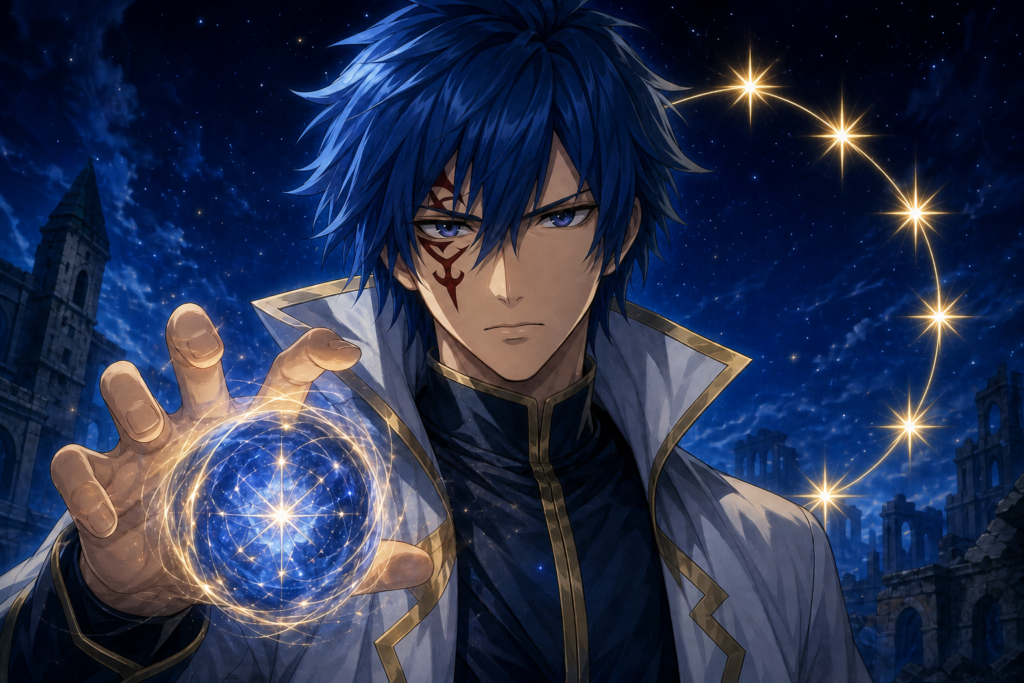
CVM Sekai character profile
Jellal Fernandes is not compelling because the story gives him a sad past and calls the bill paid. He matters because Fairy Tail keeps asking what accountability looks like after coercion, power and real harm all occupy the same body.
Bottom line
Jellal Fernandes is not compelling because Fairy Tail asks us to forget what he did. He works because the story keeps asking what accountability looks like after manipulation, power and real harm collide. Ultear used a traumatized enslaved child. That fact matters. That manipulation explains the false voice of Zeref and the machinery that shaped him. The explanation does not make Simon less dead, Erza less violated or the Tower workers less betrayed.
That is the line this profile will not play hopscotch with. Jellal was harmed. Jellal also became an authority who harmed other people. Both sentences belong in the same room.
His better years begin only when he stops treating death as a shortcut to moral cleanliness. Prison, Crime Sorcière and repeated action against dark guilds do not erase the Tower of Heaven. They show him learning that atonement is work done among living people, not a dramatic exit that leaves those people holding the bill. And no, Erza is not his parole officer with red hair.
Design: a face the story keeps making us reread
Jellal’s core design is built for recognition: deep-blue hair, a sharp red marking around his right eye and a controlled expression that can read as calm, distant or dangerous depending on the scene. His clothing changes with his position. Council authority, Tower rule, imprisonment and Crime Sorcière do not carry the same silhouette. That evolution matters because Fairy Tail repeatedly changes the institution around his body before it changes the face.
The eye marking is not decoration that an artist can casually flip. The marking sits around his anatomical right eye. In a frontal image, that means the viewer sees it on the left. His later white, high-collared outerwear over a darker base also helps separate the wandering atonement period from the grander visual authority of the Tower years.
The creative trick is simple but effective. Jellal looks composed even when his identity is fractured. Erza’s armor puts choice on the outside. Jellal’s design hides conflict behind one steady face. That contrast gives their scenes more tension than a pile of romantic sparkles ever could.
The Tower of Heaven: victimhood does not cancel governance
Jellal’s story begins in child slavery. He is imprisoned at the Tower of Heaven with Erza, Simon, Shô, Wally and Millianna. They are children forced to build a resurrection system for adults chasing Zeref. Their first moral world is already upside down: cruelty calls itself purpose, captivity calls itself sacred labor and survival depends on children protecting one another.
He gives Erza the surname Scarlet because of her hair. The surname is a tender act of naming inside a place designed to strip identity away. Later, that memory hurts precisely because tenderness did exist. The Tower did not create a simple villain and a simple victim. The system took a child capable of care and made that capacity easier to weaponize.
Ultear reaches him through a false presentation of Zeref and manipulates his fear, anger and magical potential. That manipulation is causal evidence, not a moral delete button. Once Jellal gains command, he oversees the Tower, deceives the people who once trusted him and turns their shared liberation into another system of control. The former captive becomes the person assigning meaning to everyone else’s captivity. That is the structural horror.
This is also where the story tests Confucian ideas about role and authority. A title does not make leadership ethical. Authority becomes legitimate through right conduct and responsibility to the people under it. Jellal has command, knowledge and charisma, but his rule violates every relational duty that could make those tools honorable. He treats old friends as pieces in a plan. Power without right relationship is not leadership. That power becomes organized betrayal.
Siegrain, the Council and the R-System
Jellal projects Siegrain into the Magic Council and uses that identity to influence institutional decisions while continuing the Tower project. The projection lets one person occupy two centers of authority at once. The projection is clever magic, but the tactic is also a political warning. The Council believes it is deliberating with a member. In reality, the target of its power is helping shape the vote.
His plan involves the R-System and Etherion. The important point is not merely that the scheme is big. The harm grows because he can turn public institutions, private loyalty and magical technology toward the same secret objective. That is why reducing the arc to “Jellal was possessed” does the writing a disservice. Ultear’s manipulation explains how the obsession takes hold. Jellal’s sustained administration explains how the obsession becomes a machine.
Natsu ultimately defeats him, but a battle win does not restore the people used to reach that point. Simon dies protecting Erza. His death belongs to Simon’s choices, love and courage. Simon’s death cannot become soft-focus set dressing for Jellal and Erza. Kagura’s later anger also grows from this loss. Consequence keeps traveling after the Tower falls.
Erza: love is not absolution labor
Erza and Jellal share childhood, trauma, trust, betrayal and an attachment neither can neatly dismiss. Their bond is real. So are her boundaries.
The worst way to read them is to make Erza’s love proof that Jellal has been forgiven by the universe. Erza is one harmed person with her own choices. She can understand his manipulation without surrendering judgment. She can want him alive without promising romance. She can remember the boy who named her and still confront the man who used the Tower.
Jellal’s early self-denial around her often looks noble because he believes he is protecting her. The posture also keeps him in control of the decision. He decides what she deserves, what contact is allowed and what punishment counts. That is guilt still behaving like authority. His growth requires more than backing away dramatically. He has to respect Erza as an adult who can set her own terms.
Their relationship works best when the series allows mutual feeling without assigning Erza the unpaid job of repairing him. Love can motivate ethical action. Love cannot substitute for ethical action.
Memory loss, Nirvana and arrest
After the Tower, Jellal returns during the Oración Seis conflict with severe memory loss. He intervenes in the struggle around Nirvana, a magic tied to reversals of light and darkness. His actions help oppose the immediate threat, but memory loss complicates responsibility rather than solving it. A person who cannot recall his crimes may still face consequences from people who remember them very well.
The Magic Council arrests him. The series does not frame one useful intervention as automatic clearance. That matters. Fairy Tail often believes fiercely in chosen family and second chances, but this sequence admits that personal sympathy and public accountability are different systems.
There is also a Buddhist reading here, if we keep it grounded. Jellal suffers because he clings to a fixed idea of himself as irredeemably stained. Yet abandoning that fixed identity does not mean pretending the past is unreal. Karma is action and consequence, not a cosmic opinion poll. His path changes when he accepts that new action can matter without making old action disappear.
Crime Sorcière: atonement becomes a practice
Jellal later forms Crime Sorcière with Ultear and Meredy. The independent guild hunts dark guilds and works against threats connected to Zeref. This is not a certificate marked REDEMPTION COMPLETE. Crime Sorcière is a structure designed to keep action pointed outward, toward preventing more harm.
Ultear’s presence makes the group morally complicated in the right way. She manipulated Jellal, carries her own history of violence and also chooses to fight the systems she once served. Meredy enters with grief and bonds shaped by Grimoire Heart. None of them arrives clean. Crime Sorcière is powerful because it does not require clean hands before useful work begins.
But useful work still needs accountability. Atonement can become self-flattering if the person doing it only chooses dramatic enemies and never faces injured relationships. Jellal’s strongest development happens when the story lets him fight danger while remaining answerable to Erza, Kagura, the Tower survivors and his own companions.
The guild also rejects the neat inspirational ending. These people do not wake up healed because they picked a better logo. They travel, investigate and intervene while carrying consequences. That is closer to real repair: repetitive, incomplete and usually less glamorous than the original damage.
Grand Magic Games: a borrowed face and an exposed past
During the Grand Magic Games period, Jellal operates under Mystogan’s appearance while investigating suspicious magical activity. The disguise protects his fugitive status and uses an established resemblance, but the continuity stays clear: Jellal is not Mystogan.
This arc puts him near Erza and the wider Fairy Tail cast without pretending his legal history vanished. The arc also returns Kagura and Millianna to the consequence map. Kagura’s grief over Simon cannot be negotiated away because Jellal now fights on the useful side. Millianna’s Tower history belongs to her too. The people from that prison are not supporting documents in his rehabilitation application.
When truth comes forward, the confrontation matters more than a tidy verdict. Jellal has to be seen by people whose pain he cannot manage. That loss of control is part of the repair.
Magic: speed, geometry and terrifying reach
Jellal’s signature discipline is Heavenly Body Magic. Its visual language uses stars, trajectories and celestial scale. Meteor emphasizes extreme movement and speed. Grand Chariot forms a seven-point celestial pattern and releases a concentrated strike. The magic suits him because it makes distance look controllable. He can cross space, arrange points and bring force down from above.
That visual order mirrors his personality. Jellal plans. He reads fields, hides positions and uses high-level magical knowledge. Even when he is emotionally unstable, his magic looks organized. The danger is not wild power alone. The danger comes from power with geometry.
Still, he is not unlimited. Strong opponents can interrupt, counter or endure his techniques. Large spells require opportunity and control. His projection and disguise strategies also depend on circumstance. The stable licensed technique shelf includes Thought Projection through Siegrain, Meteor for extreme movement, Grand Chariot’s seven-point strike, Altairis, the large-scale Sema and Jellal’s knowledge of combination magic such as Abyss Break. Different translations may style individual names differently, and anime visual flourishes do not automatically create additional manga techniques.
Across Oración Seis, Tartaros and Alvarez, he works inside coalition battles, confronts former enemies and supports forces resisting Zeref and Acnologia. Those remain shared campaigns. Assistance is not a solo victory just because the animation gives somebody a beautiful close-up.
Relationship atlas
Erza Scarlet: Childhood friend, Tower survivor, betrayed confidante and mutually loved adult with her own boundaries. Her understanding of his manipulation does not erase what happened or make her responsible for completing his atonement.
Simon: Simon is not merely the man who dies in Jellal’s arc. He is a fellow Tower survivor who loves Erza, sees danger clearly and chooses to protect her. His death establishes a debt that Jellal cannot repay directly. The only ethical response is to stop making Simon’s sacrifice about Jellal’s feelings.
Shô, Wally and Millianna: They shared captivity and then lived under Jellal’s deception. Their relationships show why shared trauma does not guarantee shared interpretation. Survivors can love the same childhood companions and reach different judgments about the person who betrayed them.
Ultear: Ultear is both manipulator and later comrade. Jellal does not need to deny what she did in order to recognize her later choices. Their Crime Sorcière partnership tests whether people with interlocking harm can work together without rewriting the record.
Meredy: Meredy helps turn Crime Sorcière from Jellal’s private punishment project into an actual collective. Her grief and moral agency matter. She is not a junior witness hired to certify his goodness.
Natsu: Natsu defeats Jellal at the Tower and later fights in a world where Jellal can become an ally. Their history shows Fairy Tail’s practical ethics. Cooperation against a present threat does not require pretending the earlier fight was a misunderstanding.
Kagura: Kagura embodies consequence through Simon. Her anger is not an obstacle placed in front of Jellal’s romance. Her anger is a valid response to loss. Any reconciliation must preserve her agency rather than reward him for being sad in her vicinity.
Later wars and proportional importance
Jellal and Crime Sorcière continue opposing dark-guild and Zeref-linked threats through the later main-series conflicts. The Tartaros and Alvarez material confirms that he remains a powerful independent ally, but he does not become the secret center of Fairy Tail’s story. Crime Sorcière’s members join the wider resistance, and the royal pardon after the Alvarez war changes their legal position without rewriting the harms that made atonement necessary.
That proportionality protects the character. Inflating every appearance turns atonement into a superhero résumé. The more interesting record is conduct over time: he keeps showing up against systems resembling the ones that once controlled and empowered him.
100 Years Quest: accountability keeps moving
The official 100 Years Quest anime story pages place Jellal in the investigation surrounding the White Mage during Episodes 2 through 4. Episode 12 brings him into direct conflict with Erza under the arc’s controlling magic, while Episode 17 gives him the battle with Gears. Those receipts support concrete sequel participation without inventing ownership of the larger Dragon God mission.
The White Mage investigation fits his established role. He watches for coercive magical organizations and threats operating through identity, belief and control. That does not make him uniquely pure. His experience becomes useful.
His clash with Erza is also a cruel structural echo. Their history already contains manipulated agency, divided identity and violence between people who care about one another. The sequel can revisit those pressures without declaring the original wounds finished.
This profile follows the officially licensed English continuity through the twenty volumes Kodansha currently lists. The profile does not import unlicensed scan claims or pretend later guild-status rumors are settled facts.
Adaptation and Japanese performance
The anime has an extra visual problem to solve: it introduces faces and identities whose resemblance is supposed to confuse viewers without permanently confusing the biography. Siegrain must read as Jellal’s Council projection. Mystogan must eventually read as a distinct Edolas character. Direction, color and performance carry much of that separation.
Daisuke Namikawa voices Jellal in Japanese, as confirmed by TV Tokyo’s official cast material and its early recording interview crediting him as Siegrain. Those official pages establish the performer and early identity framing but do not document scene-level pitch, breath or timing. This profile therefore confines itself to the verifiable adaptation challenge: one actor and one face must separate Council projection, Tower authority, memory-loss disorientation and the steadier Crime Sorcière period without collapsing Mystogan into the same person.
Jellal appears across the franchise’s animated and game ecosystem, but promotional inclusion is not automatically a new canon event. Films, OVAs and games remain supplementary media unless an official roster and the work itself establish his role. Anime-original material stays labeled as adaptation continuity rather than quietly entering the manga chronology.
Final verdict
Jellal’s story succeeds when it refuses the cheap choices. He is not innocent because someone manipulated him. He is not permanently useless because he caused terrible harm. He is responsible, wounded, dangerous, capable and unfinished.
The Tower teaches him the wrong lesson about power: control the structure before it controls you. Crime Sorcière slowly teaches the better lesson: use power to reduce harm, accept other people’s judgment and keep working even when nobody owes you emotional release.
That is why Erza cannot be the prize at the end of his redemption route. She is a person with her own scars, leadership and desires. If they choose each other, the choice has to stand beside accountability, not replace it.
Jellal does not need a spotless ending. He needs honest conduct. For once, the man who once controlled every piece of the board has to live in a world where other people get to decide what his actions mean.
Source ledger and publication boundaries
- TV Tokyo official cast page: Daisuke Namikawa credit.
- TV Tokyo official character archive: Erza and Jellal’s Tower history.
- TV Tokyo original cast interview: early Siegrain presentation and credit context.
- Kodansha’s official Fairy Tail and Fairy Tail: 100 Years Quest catalogs: licensed series and volume framework.
- Official Fairy Tail: 100 Years Quest story pages: Episodes 2, 3, 4, 12 and 17 for the White Mage investigation, Erza confrontation and Gears battle.
- Primary narrative record: Hiro Mashima’s Fairy Tail volumes and published 100 Years Quest volumes.
The boundaries are firm: no unsourced age or height, no English-dub performer, no merger of Jellal with Mystogan, no claim that manipulation cancels later agency, no romance used as absolution and no supplementary-media scene passed off as main-manga canon.