
Memory, Sorrow, and Thorn · Canonical Character Profile
Earl Mylin-sa-Ingadaris
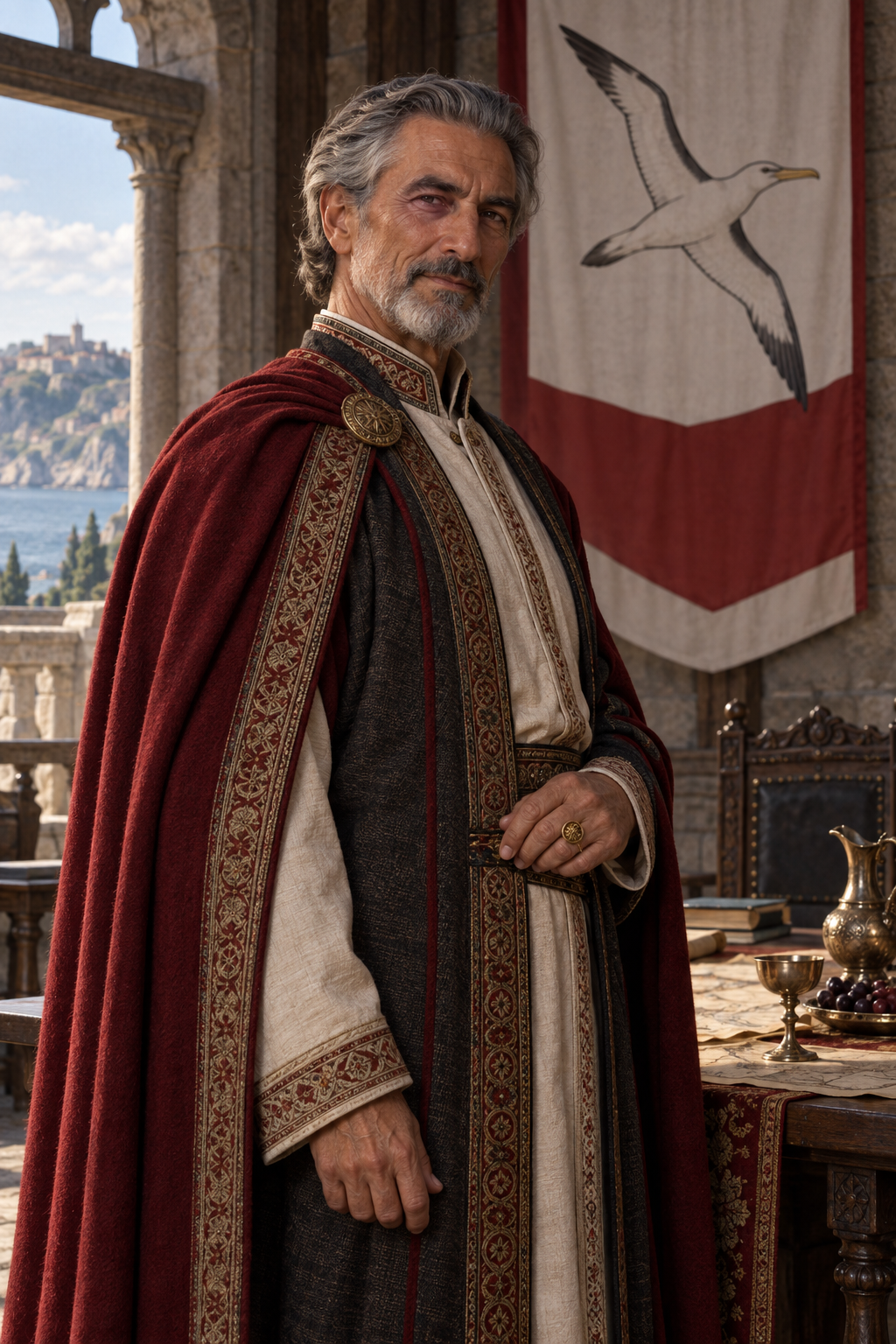
Mylin-sa-Ingadaris is the old Nabbanai earl who receives Duke Leobardis at Crannhyr beneath a white-and-red albatross banner. He is a cordial longtime enemy, which is exactly the kind of relationship epic politics needs more of: rivalry sturdy enough to survive into wine, hospitality, and a military council when the realm is burning.
At a Glance
The old earl whose hospitality turns an old rivalry into wartime cooperation
- Full name
- Mylin-sa-Ingadaris
- Title
- Earl
- Culture
- Nabbanai
- Book 1 location
- Crannhyr
- Heraldry
- White-and-red albatross banner
- Connection to Leobardis
- Cordial longtime enemy
- Confirmed actions
- Receives the ducal party, hosts Leobardis and Varellan, serves Ingadarine wine, and provides space for military discussion
- Status
- Alive at Crannhyr; later fate unconfirmed
The Reception at Crannhyr
Mylin enters already mustered, banner raised, and prepared to receive a ducal army
Duke Leobardis reaches Crannhyr aboard Emettin’s Jewel with a large Nabbanai force.
The arrival is not a casual family visit. Roughly two thousand troops disembark while Varellan organizes the landing, Benigaris arrives with Aspitis Preves, and the campaign’s next move remains unsettled.
Old Earl Mylin-sa-Ingadaris receives the party beneath a white-and-red albatross banner.
The banner is the clearest visual fact attached to him. It marks household identity, assembly, and public presence before the text gives any facial description.
Mylin’s age is confirmed as old. Exact years are not.
His reception indicates standing sufficient to host the duke and contribute a local base for deliberation. The record does not specify whether he owns Crannhyr, commands its entire garrison, controls the port, or supplies troops beyond the people mustered beneath his standard.
He is not scenery beside Leobardis’s campaign. His hospitality is part of how the campaign becomes operational on land.
A Cordial Longtime Enemy
The relationship contains rivalry without requiring permanent hatred
Mylin is described as Leobardis’s cordial longtime enemy.
Every word matters.
“Enemy” confirms durable political, personal, territorial, military, or factional opposition of some kind. “Longtime” gives it history. “Cordial” shows that history has not eliminated manners, communication, or cooperation.
The book does not identify the origin of their rivalry. We do not know whether they competed over land, trade, office, family allegiance, court influence, ducal policy, or older campaigns.
We also do not know whether “enemy” is used humorously between respected peers or describes serious past conflict now managed through ritual politeness.
The scene supports complexity rather than a tidy backstory.
Mylin receives Leobardis instead of exploiting the duke’s vulnerability. Leobardis accepts his hospitality. They share wine and military discussion while a larger threat reorganizes old relationships.
That does not prove reconciliation. Wartime cooperation can coexist with unresolved rivalry.
Ingadarine Wine
The drink marks place, house, and political hospitality without becoming a personality shortcut
Mylin hosts Leobardis and Varellan for Ingadarine wine.
The name connects the drink to Mylin’s house or region, giving the meeting a local material signature.
The text does not specify grape, vintage, color, sweetness, strength, vessel, vineyard, price, ritual, or whether Mylin personally pours it.
What matters is hospitality. An old enemy’s wine creates the social space in which strategy can be discussed.
The scene should not be rewritten as comic drunkenness. No intoxication receipt defines the council.
Nor should the wine be treated as proof of friendship. Diplomatic and aristocratic hospitality often allows rivals to occupy the same room without pretending their history has vanished.
For future visual work, a wine service can appear as contextual detail, but the albatross banner and Mylin’s own face must remain stronger identity anchors.
The Military Discussion
Mylin hosts the room where Benigaris steers the campaign away from Skali
Inside the Crannhyr meeting, Benigaris argues against attacking Skali first.
He warns that the Rimmersmen can withdraw into defensible mountains while Elias moves against Naglimund. Leobardis accepts the strategic logic.
The duke is also grateful that war appears to have brought his resistant eldest son back to his side.
Mylin’s confirmed role is host. The ledger does not preserve his own recommendation, vote, objection, silence, or knowledge of Benigaris’s private loyalties.
That distinction prevents the page from crediting him with the adopted strategy merely because the conversation occurs under his roof.
His importance lies in enabling the council and receiving the allied force beneath an established banner.
The absence of quoted counsel should not be converted into passivity. Hosting an army and its ducal command is already consequential. It simply is not the same as originating Benigaris’s plan.
The Last Calm Before Benigaris’s Betrayal
The cordial enemy behaves like an ally while the beloved son prepares to become the murderer
The Crannhyr scene gains retrospective weight because Benigaris later murders Leobardis.
During the meeting, Leobardis reads his son’s apparent military cooperation as a restored relationship. That hope is false.
Mylin, the named longtime enemy, is the man offering welcome and wine. Benigaris, the son, carries betrayal inside the appearance of unity.
The contrast is brutal without requiring Mylin to know the future.
The record does not say he suspects Benigaris, witnesses the later murder, joins the retreat, or learns the truth.
We should not turn him into a missed-warning prophet.
What the sequence reveals is thematic: declared rivalry can be safer than counterfeit loyalty. Mylin’s enmity is legible enough to become cordial. Benigaris’s filial performance remains deadly because it is hidden.
Old Age and Political Continuity
Mylin represents a rivalry old enough to become a working institution
Mylin and Leobardis are both older political figures.
Their relationship has lasted long enough to acquire form: banner, title, welcome, wine, and conversation.
The text does not romanticize age as automatic wisdom. Nor does it depict Mylin’s old age as incapacity.
He is mustered and hosting during wartime.
Future art should therefore avoid both frailty caricature and implausible youth. Attractive older character design means dignity, specificity, and age-correct presence—not digitally erasing every year.
The profile also should not assign him Leobardis’s appearance. The duke has long white hair, pink cheeks, and mild blue eyes; none of those details transfer to Mylin.
The Albatross Standard
Heraldry gives Mylin visual identity where the narrator withholds his face
Mylin’s banner is white and red and bears an albatross.
The record does not specify the exact field division, bird posture, border, stitching, pole, household motto, or historical origin.
That means the site can preserve the known palette and bird while labeling any detailed reconstruction as interpretation.
The albatross also distinguishes Mylin from Leobardis’s golden kingfisher and Aspitis’s Prevan osprey.
Nabbanai politics becomes visually legible through multiple birds without turning them into interchangeable “southern eagle” imagery.
Once Mylin receives approved art, the albatross treatment should remain stable across his profile, Crannhyr scene art, directories, and Nabban 101 pages.
Connections
The duke, sons, strategist, and campaign gathered under Mylin’s banner
Duke Leobardis
Mylin’s cordial longtime enemy and honored wartime guest at Crannhyr.
Prince Varellan
Leobardis’s anxious younger son, hosted with his father over Ingadarine wine.
Benigaris
Leobardis’s eldest son, whose strategy is accepted in Mylin’s council before his later betrayal.
Count Aspitis Preves
Arrives with Benigaris as part of the ducal campaign; no direct exchange with Mylin is preserved.
Crannhyr
The landing and council location where Mylin receives the Nabbanai force.
The Ingadaris household
Represented by the white-and-red albatross and Ingadarine wine; fuller family structure is unconfirmed.
Why Mylin-sa-Ingadaris Matters
He shows that political maturity can make room for cooperation without rewriting history
Mylin matters because his cordial enmity is more honest than the false reconciliation destroying Leobardis.
He does not need to become Leobardis’s secret best friend. The scene allows rivalry and hospitality to coexist.
He also anchors Crannhyr as a political place rather than a neutral shore. Armies land into somebody’s jurisdiction, beneath somebody’s banner, and around somebody’s table.
Finally, his limited but concrete record demonstrates how a complete fandom profile should handle supporting nobles. It can organize heraldry, place, relationship, hospitality, and scene consequence without fabricating a dynasty or campaign history.
Mylin is old, mustered, politically legible, and alive when last confirmed. The rest remains open.
Character Image Continuity
An attractive elderly Nabbanai earl with his own face and albatross identity
CVM’s approved editorial reconstruction gives Mylin one devastatingly handsome elderly identity without erasing age: a tall lean aristocratic build, long olive-toned face, amber-brown eyes, swept-back iron-gray hair still streaked with black, and a closely trimmed beard and mustache.
His commanding Nabbanai presence is carried through ivory, deep-oxblood, charcoal, and antique-gold layers beneath one stable white-and-red albatross standard.
Canon supplies no exact age, face, hair, eyes, height, build, facial hair, clothing, armor, weapon, scars, or jewelry, so those choices remain disclosed reconstruction. Do not borrow Leobardis’s long white hair and blue eyes or Velligis’s round body and gold robes.
Do not make a wine cup his entire personality. The hero must read as a senior political host first.
Preserve this exact face, visible age, body, hair/beard map, albatross reconstruction, and wardrobe logic across the directory card, hero, Crannhyr council, Leobardis connections, and Nabban history imagery.
On the Record
Book 1 only, one political scene, every limit visible
This is Mylin-sa-Ingadaris’s one canonical, full-spoiler character profile. His confirmed appearance belongs to The Dragonbone Chair.
The record confirms he is an old Nabbanai earl, a cordial longtime enemy of Duke Leobardis, present at Crannhyr beneath a white-and-red albatross banner, and host to Leobardis and Varellan for Ingadarine wine and military discussion.
The surrounding scene confirms Benigaris advises against attacking Skali first and Leobardis accepts the strategy. It does not confirm Mylin proposed, approved, opposed, or understood that plan.
The record does not confirm Mylin’s appearance beyond age category, family, title origin, territory, military strength, rivalry’s cause, political faction, knowledge of Benigaris’s betrayal, actions after the council, or final fate.
Status: alive at Crannhyr; later fate unconfirmed.
Visual state: approved editorial reconstruction. The same canonical attachment powers featured image, hero, directory card, and social metadata; all unsupported facial, heraldic, costume, architectural, and hospitality details remain disclosed rather than presented as textual canon.