
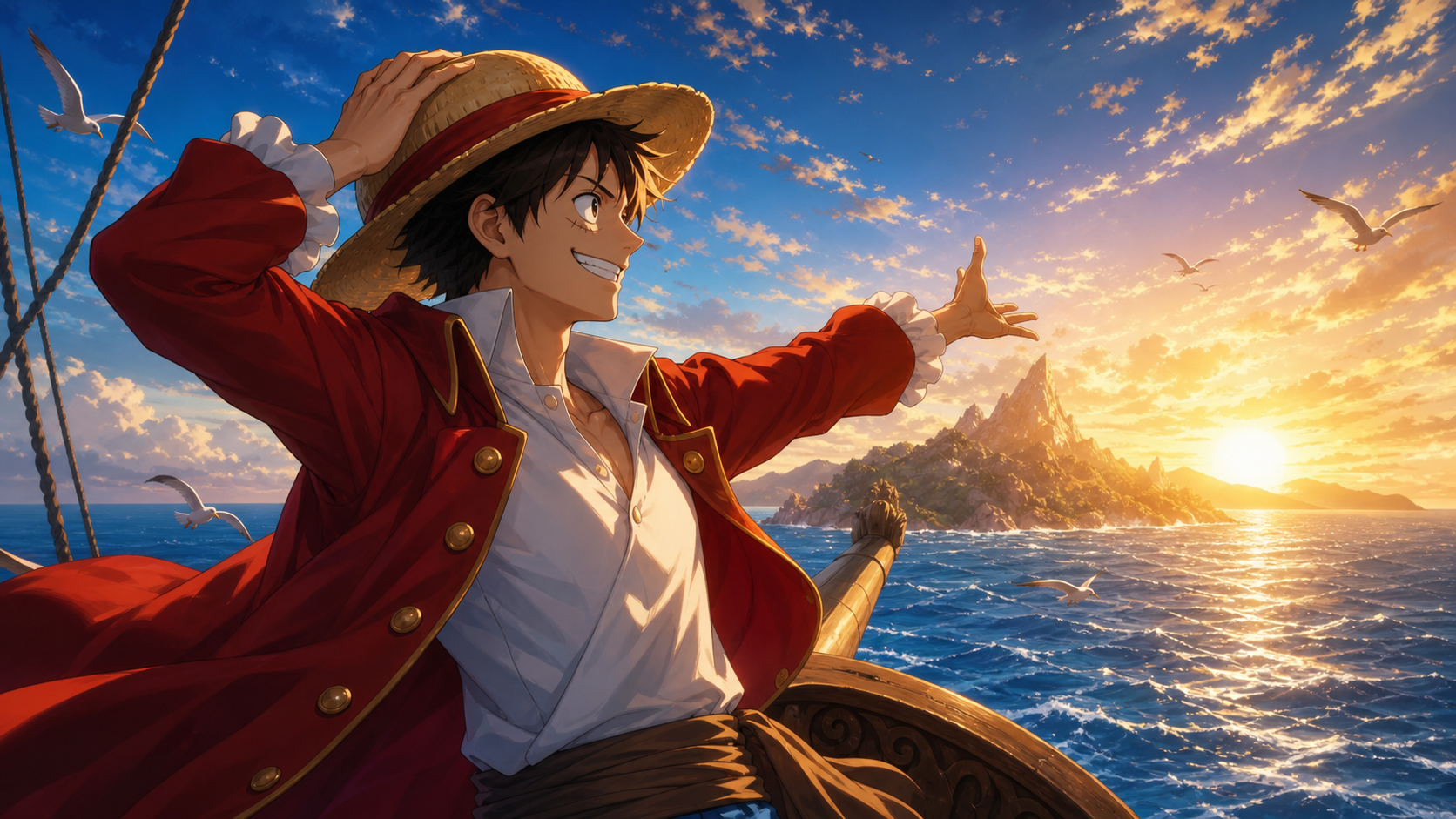
Monkey D. Luffy: One Piece Character Profile
Quick profile
Full name: Monkey D. Luffy
Known as: Straw Hat Luffy
Role: Captain of the Straw Hat Pirates
Origin: Foosha Village, East Blue
Age: 19 after the time skip
Birthday: May 5
Devil Fruit: Human-Human Fruit, Mythical Type, Model: Nika, long known as the Gum-Gum Fruit
Haki: Observation, Armament, and Conqueror’s
Current bounty: 3 billion berries
Japanese voice: Mayumi Tanaka
Bottom line
Monkey D. Luffy works because freedom never stays a decorative slogan around him. Freedom becomes food, movement, laughter, safety, and the right to make a choice without a king, pirate, parent, noble, or government writing the answer first. Luffy can be selfish, reckless, and exhausting. He can also spot captivity faster than people with far more education. The contradiction gives One Piece a captain who is emotionally simple without being morally empty.
Luffy is not a complete political program. He rarely plans the government that comes after a tyrant falls. He is the person who notices the locked door, asks who benefits from the lock, and punches through the wall when the answer is ugly. Communities still have to rebuild after the party. One Piece becomes strongest when the story remembers both halves.
From Foosha Village to the open sea
Luffy grows up in Foosha Village under the distant pressure of Monkey D. Garp and the immediate influence of Red-Haired Shanks. Shanks does not recruit the child. The pirate saves Luffy, loses an arm, leaves the straw hat behind, and makes reunion conditional on Luffy becoming a great pirate. That boundary matters. Luffy receives a promise and an example, not a free position on somebody else’s ship.
Ace and Sabo turn childhood loneliness into brotherhood. Their bond also teaches Luffy that chosen family can be real without being painless. Sabo’s presumed death leaves one wound. Ace’s death later tears open every belief Luffy has about effort, loyalty, and rescue. The Marineford failure is not a temporary sad scene. Luffy learns that determination cannot replace preparation, power, timing, or help.
Captaincy without pretending he can do every job
Luffy does not navigate, cook, practice medicine, repair the ship, read poneglyphs, budget supplies, or maintain the crew’s weapons. Nami, Sanji, Chopper, Franky, Robin, Usopp, and the rest perform those jobs. The division does not weaken Luffy’s leadership. The division proves leadership is different from universal competence.
His strongest skill is recognizing what a person actually wants after fear, shame, duty, or abuse has buried the answer. Luffy waits for Nami to ask for help. He hears Robin say she wants to live. He recognizes Sanji’s refusal as coercion rather than consent. He also trusts specialists in moments when his own knowledge is useless. A captain who cannot sail survives because the navigator’s authority becomes real at sea.
The limitation never disappears. Luffy’s appetite for danger becomes everybody else’s working condition. Crew members repair the damage, locate the food, treat the injuries, and explain the political situation he ignored. Loyalty does not erase that labor. The comedy lands best when the story remembers who cleans up after the captain’s impulse.
Freedom is relational, not solitary
Luffy says the Pirate King is the freest person on the sea, yet his version of freedom keeps creating obligations. He cannot reach the Grand Line alone. He does not experience chosen bonds as cages because the crew can disagree, leave, return, and keep separate dreams. Their loyalty is reciprocal even when the power inside the group is not perfectly equal.
The captain becomes most dangerous when an institution calls domination protection. Arlong claims order while extracting money and labor from Cocoyashi Village. Crocodile manufactures civil war while presenting himself as Alabasta’s defender. The World Government calls Robin dangerous because she can read the history the state buried. Kaido turns Wano’s bodies and land into industrial inputs. Luffy responds to each system through specific people whose lives make the argument visible.
The Devil Fruit truth and what the reveal changes
For most of the story, Luffy and the audience know his power as the Gum-Gum Fruit. His body stretches, rebounds, resists ordinary blunt force, and supports techniques that would destroy a normal fighter. Wano reveals that the World Government concealed another name: the Human-Human Fruit, Mythical Type, Model: Nika. The awakened form produces Gear Five and connects Luffy to a figure associated with liberation.
The mythology expands the political stakes, but the new name should not erase years of craft. Luffy learned range, angles, momentum, inflation, blood flow, Haki application, and the limits of his own recovery through repeated failure. A legendary fruit did not invent every move for him. The power becomes meaningful because Luffy already treated imagination as a combat method.
Gear progression, mechanics, and limits
Gear Second accelerates circulation and trades bodily strain for speed. Gear Third inflates bone to create giant-scale force, with early use causing a temporary size reduction. Gear Fourth combines muscle inflation and Armament Haki in forms built for different jobs. Boundman emphasizes force and movement, Tankman turns defense and stored impact into a counter, and Snakeman prioritizes speed and changing attack paths.
Gear Five gives Luffy far greater freedom over his rubber body and affects the environment around him. The form looks joyful, but the cost remains visible through exhaustion and temporary aging. Comedy does not mean invulnerability. Luffy still needs timing, recovery, allies, and a battlefield where his imagination can solve the actual problem.
Haki and the difference between force and authority
Luffy develops Observation Haki for awareness, Armament Haki for defense and contact, and Conqueror’s Haki as an expression of overwhelming will. Later training adds advanced applications, including projecting Armament power and coating attacks with Conqueror’s Haki. Those upgrades matter because stronger opponents cannot be defeated by stretching farther.
Conqueror’s Haki can look like royal permission, yet Luffy does not want a throne in the normal sense. His authority comes from people choosing to act beside him. The Straw Hat Grand Fleet makes that tension explicit. Luffy refuses a conventional command structure, while the allied captains choose connection anyway. Freedom keeps producing organization whether he likes the paperwork or not.
Major battles and what each one teaches
Arlong Park establishes that Luffy will attack the structure holding a friend captive, not only the person standing in front of him. Alabasta teaches that defeating Crocodile requires repeated failure, information, and help. Enies Lobby makes private rescue a declaration of war against the World Government. Sabaody and Marineford prove that conviction cannot close every power gap.
Dressrosa tests his ability to carry a population’s hope without understanding every part of the country’s history. Whole Cake Island forces him to wait, listen, and recognize Sanji’s violence as a performance shaped by threats. Wano turns a duel with Kaido into a fight over hunger, forced labor, weapons production, and stolen national memory. The best battles are never only power rankings.
Relationships and accountability
Zoro gives Luffy discipline and a standard for what captaincy requires. Nami supplies navigation, boundaries, and practical survival. Usopp exposes the emotional damage created when strength becomes the measure of belonging. Sanji connects care to food and unpaid labor. Chopper makes medical limits impossible to ignore. Robin links the crew’s journey to censored history. Franky and the Sunny make movement material. Brook carries grief across decades. Jinbe brings political experience and restraint.
Luffy protects his crew fiercely, but protection does not make every decision good. His recklessness can remove other people’s ability to assess a risk before joining. His refusal to explain can force friends to trust a plan that exists only in his instincts. The crew’s pushback is not disloyalty. Their disagreement keeps the captain’s freedom from becoming another form of domination.
Design chronology and the straw hat
The early design is deliberately plain: straw hat, red vest, shorts, sandals, scar, and an elastic body that turns simple shapes into motion. The post-time-skip open shirt, sash, longer sleeves, and larger scar mark physical change without replacing the silhouette. Arc-specific clothing lets Luffy enter local visual systems while the hat keeps his identity readable.
The straw hat is not a generic pirate accessory. The object carries Shanks’s trust, Roger’s history, and a promise about the future. Luffy protects the hat because the object belongs to a relationship. The symbol works because One Piece lets a cheap-looking item hold more emotional weight than royal treasure.
Mayumi Tanaka’s Japanese performance
Mayumi Tanaka voices Luffy in the Japanese television anime. Her performance moves from appetite and childish irritation to command without pretending those voices belong to separate characters. Luffy can sound ridiculous while eating, blunt while making a promise, and frightening when somebody’s freedom has been taken.
The quiet choices matter as much as the famous shouts. Marineford needs shock and collapse, not another heroic declaration. Whole Cake Island needs stubborn waiting rather than swagger. Tanaka protects Luffy’s lack of polish while giving his emotional certainty real weight.
Anime, films, games, and continuity
Luffy appears throughout the television anime, theatrical films, television specials, OVAs, games, crossovers, and promotional projects. Not every appearance belongs to the manga’s main continuity. Film characters and events should be labeled according to the production’s stated relationship to canon rather than folded into one timeline because Luffy wears the same hat.
The television anime remains the main animated route for the manga story. Movies can explore spectacle, alternate conflicts, or supervised character ideas without automatically becoming events the core timeline must remember. The profile keeps those versions connected while preserving the boundary.
RaeRae’s verdict
Luffy is compelling because he turns abstract oppression into a personal question: who cannot eat, leave, speak, remember, grieve, or choose? His answer is often a fist, which is useful when the problem is a tyrant and incomplete when the problem is everything the tyrant built. One Piece earns its politics when the celebration follows liberation and the next island reminds us that freedom still needs labor.
I love Luffy most when the story lets his simplicity expose everybody else’s polished excuse. He is not stupid because he refuses respectable language. He is dangerous because he can hear a lie after powerful people have wrapped the lie in law, tradition, destiny, or manners.
The captain who keeps asking people what they want
Luffy gets flattened into “freedom” so often that the word can start sounding like a decorative flag. His version of freedom is much more demanding. He does not decide what freedom should look like for Nami, Robin, Sanji, or Momonosuke and then congratulate himself for rescuing them. He keeps forcing the real question back into the room: what do you want? That distinction matters. Arlong Park only moves once Nami asks for help. Enies Lobby turns on Robin saying she wants to live. Whole Cake Island cannot end with Luffy dragging Sanji home while ignoring every frightened, furious reason Sanji gives for staying. Luffy can be impatient, reckless, and spectacularly bad at explaining himself, but he understands that a person must be allowed to name the life being defended.
I love that his emotional intelligence arrives sideways. He will miss a social cue sitting directly on his face, then recognize the exact second somebody has been cornered into performing consent. He hears the falseness in Nami dismissing him, Sanji kicking him away, and Robin calling herself a burden. He does not always know the whole history. He knows the answer in front of him is being produced by fear. For a captain whose public reputation depends on chaos, Luffy pays startling attention to coercion.
That does not make him morally spotless. His appetite can become entitlement, his plans routinely transfer risk onto friends, and his confidence sometimes assumes everybody can survive the consequences of following him. The crew pushes back, complains, negotiates, and occasionally knocks sense into him. One Piece works because captaincy is not framed as a magical exemption from accountability. Luffy leads a crew full of specialists who tell him no, correct his ignorance, and save him from disasters he created. His authority becomes believable because dependence is visible.
Joy does not cancel the political argument
Gear Five makes the argument louder. The transformed body laughs, stretches, rebounds, and turns a battlefield into something that looks almost unserious. Meanwhile, the stakes remain slavery, famine, erased history, and rulers who treat human lives as inventory. The joy is not an escape from politics. Joy is the refusal to let power dictate the only available emotional language. Kaido wants domination to feel inevitable and grim. Luffy answers with a body that will not obey ordinary limits or the mood demanded by a tyrant.
My favorite Luffy victories are rarely the cleanest fights. They are the moments when a community realizes the monster standing over them can bleed, when somebody who stopped imagining tomorrow starts making plans again, or when food returns to a table that power deliberately emptied. Luffy is not a policy maker, and the series should never pretend punching the correct ruler completes reconstruction. Still, he breaks the performance of inevitability. He makes room for other people to rebuild.
That is why the straw hat carries more than inherited legend. Roger, Shanks, and the promises surrounding the hat matter, but Luffy keeps making the object answer to present relationships. The hat sits with Nami during a crisis. The crew protects the hat because they understand what Luffy entrusted to them. Symbols can become cages when lineage tells a character who he must be. Luffy keeps turning lineage into an invitation instead. Whatever the world expects from Joy Boy, the Will of D., or the next Pirate King will still have to pass through the stubborn person who wants his friends fed and free.
Sources and official routes
ONE PIECE.com: Monkey D. Luffy official character profile
ONE PIECE.com: anime staff, cast, and broadcasters
Watch One Piece on Crunchyroll
Return to the One Piece anime hub
Browse One Piece character profiles