
CVM Sekai Character File · Evangelion
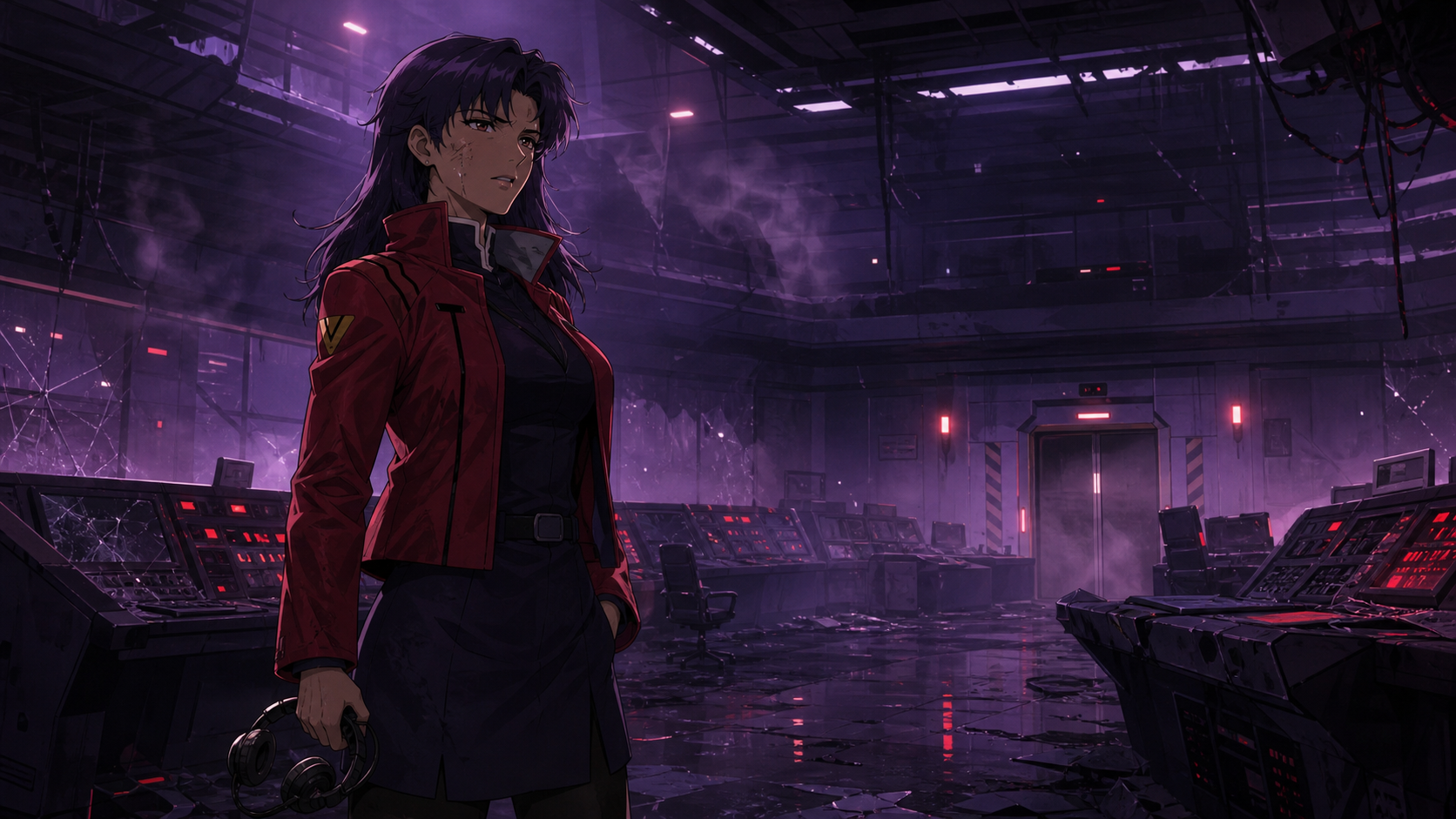
Misato Katsuragi
Misato wants to protect children inside an organization that survives by using them. Her tragedy is not that she never cared. Her tragedy is that care and command keep sharing the same mouth.
Misato Is the Adult Who Actually Shows Up
Misato Katsuragi meets Shinji during an emergency, gets him through a collapsing city, argues for his survival, brings him home, feeds him, and tries to create ordinary life around a child who has barely received any. Those actions matter. Evangelion contains plenty of adults who treat pilots as equipment. Misato keeps reaching for the person inside the job.
Her apartment becomes a place where military hierarchy loosens enough for meals, chores, school complaints, teasing, and Pen Pen. The domestic comedy does more than relieve tension. The routine shows what Shinji and Asuka should have been allowed to have: a messy home where mistakes do not affect humanity’s survival.
Misato also arrives with authority. She does not simply rescue Shinji from NERV. She works for NERV and commands battles that require his participation. Guardian and operations director remain inside the same person. Every caring gesture therefore lives beside the possibility of another order.
The Apartment Is a Home and an Extension of NERV
Taking Shinji into her home is generous, impulsive, and ethically complicated. Misato understands that the boy needs more than barracks. She also knows that NERV needs access to him. Housing, supervision, emotional care, and operational readiness become one arrangement without clear boundaries.
Shinji cannot easily tell when Misato speaks as family and when she speaks as command. Misato cannot always tell either. She praises him after battle because she genuinely values him and because praise can keep a pilot functional. The institution benefits from affection even when the affection is sincere.
Asuka’s arrival makes the house louder and exposes how little one exhausted adult can provide. Two traumatized teenage pilots need stable therapy, honest information, separate support systems, and adults who do not control their military usefulness. Misato gives them food and attention, but individual warmth cannot replace institutional protection.
Second Impact Never Stopped Happening to Her
Misato survived Second Impact and watched her father die saving her. The catastrophe shapes her career, relationships, anger, and pursuit of the Angels. She carries survivor guilt into every operation while presenting competence to the room. A command center has no useful field for the part of her that remains a terrified child.
Her relationship with her father was complicated before his death. The rescue does not erase neglect, and neglect does not erase the rescue. Misato inherits a wound that cannot be resolved through simple gratitude or hatred. Her drive to defeat the Angels becomes tangled with revenge, public duty, and a need to make survival mean something.
The cross she carries turns private grief into a visible object. The symbol follows her through battles and into the final film. Misato rarely has space to stop and ask what she would choose without the catastrophe. NERV offers a mission large enough to organize the pain, but a mission is not recovery.
Competence Does Not Make Her Institution Good
Misato is an excellent tactical commander because she can read unstable conditions, take calculated risks, and understand that rigid procedure may fail against unfamiliar enemies. Her plans often work because she treats the battlefield as a living problem rather than a checklist. The confidence makes her fun to watch and easy to trust.
That competence can hide the ethics of the underlying system. A brilliant plan still sends children into machines that transmit pain. Winning does not answer whether the pilots could consent, whether refusal was truly available, or whether adults disclosed the risks. Misato can improve how NERV fights without making NERV humane.
Her strongest leadership moments come when she accepts responsibility rather than hiding behind orders. Her weakest moments arrive when urgency becomes permission to pressure a child. Evangelion refuses to separate those versions into hero and villain. Misato can save lives, love Shinji, and participate in exploitation during the same episode.
Misato and Shinji: Care Cannot Survive Without Boundaries
Misato sees Shinji’s fear more clearly than Gendo does because she recognizes survival trauma. She offers encouragement instead of contempt. Yet she also becomes frustrated when his withdrawal threatens an operation. Her empathy has a limit imposed by the countdown clock.
The relationship often resembles a family without the stable authority family requires. Misato is guardian, older sister figure, commander, roommate, and wounded adult seeking connection. Shinji is dependent, employee, soldier, and child. Those roles pull intimacy in incompatible directions.
The elevator scene in The End of Evangelion makes the collapse visible. Misato is wounded and desperate to move Shinji toward Unit-01. She kisses him and promises adult intimacy later. The moment should not be cleaned into romance. An adult uses sexualized motivation on a fourteen-year-old because every healthier route appears closed. Her love is real. The boundary violation remains real.
Kaji, Desire, and the Fear of Repeating Her Parents
Ryoji Kaji gives Misato a relationship outside direct guardianship, though their history carries its own evasions. She wants him and fears what wanting him reveals. His resemblance to parts of her father complicates attraction with memory, anger, and unresolved grief.
Misato can use sex, humor, alcohol, and work to approach connection without naming vulnerability. Kaji recognizes the performance because he carries his own secrets. Their intimacy feels adult precisely because desire does not solve distrust. Both people know how to keep a room lively while withholding the information that could change the relationship.
Kaji’s investigation and death push Misato further toward the truth about NERV. Grief becomes evidence, mission, and unfinished conversation. She receives information without receiving closure. The pattern repeats: catastrophe gives her another reason to keep moving before she has processed the person who vanished.
Misato and Ritsuko Are Friends Inside Competing Loyalties
Misato and Ritsuko share history, intelligence, professional respect, and increasing mistrust. Ritsuko knows secrets that Misato needs. Misato values her friend while recognizing that scientific loyalty to NERV keeps producing omissions. Their conflict is not a simple battle between emotion and reason.
Ritsuko understands systems Misato cannot access. Misato understands human consequences Ritsuko sometimes compartmentalizes. Both women serve an organization structured by Gendo’s private goal. Their friendship has to survive men, secrecy, dead parents, institutional power, and different methods of coping.
Their later fracture shows why personal loyalty cannot repair classified abuse. Ritsuko cannot disclose everything without destroying the structure that gives her identity. Misato cannot remain loyal once the hidden cost becomes visible. They become opponents because NERV makes honesty professionally dangerous.
The End of Evangelion Removes the Illusion of Control
During the attack on NERV, Misato finally confronts the scale of adult betrayal around the pilots. The command structure collapses. SEELE treats staff as disposable. Gendo pursues Instrumentality. Shinji remains immobilized while violence closes every route.
Misato moves through the facility while wounded because protecting Shinji and getting Unit-01 into position are still the only actions available. The two goals remain inseparable. She needs the child safe and needs the pilot active. That contradiction has defined their entire relationship.
Her death arrives before she can know whether Shinji moved forward. The cross passes to him, but the gesture cannot become a clean inheritance of wisdom. Misato leaves love, pressure, memory, and an unfinished ethical mess. The explosion ends her life without resolving which role spoke last.
Why Her Death Is Not a Noble Escape Clause
Misato acts bravely. Heroism should not prevent criticism of the conditions that required the bravery. She spends the film repairing failures created by Gendo, SEELE, NERV, and years of secrecy. A competent woman becomes responsible for moving a traumatized child through the final corridor while the architects of the disaster pursue private goals.
The audience may want her sacrifice to redeem every mistake. Evangelion does not make redemption that simple. Misato cannot undo the orders she gave, the truths she withheld, or the boundary she crossed. She can still choose to protect Shinji with the time remaining.
Accountability and compassion belong together. Misato deserved support after Second Impact. Shinji deserved boundaries and informed care. The fact that both people were wounded does not make their power equal. Misato remained the adult, which means responsibility stayed with her even during panic.
Kotono Mitsuishi Finds the Human Under the “Cool Woman”
Kotono Mitsuishi has explained that she initially tried to perform Misato as an older, impressive woman. The approach felt strained. Once she stopped manufacturing distance and used emotional truth closer to her own age, the character began to breathe.
That shift explains why Misato can move from tactical command to bad jokes, anger, grief, flirtation, and exhausted quiet without feeling assembled from unrelated parts. Mitsuishi does not protect the character’s dignity at the expense of mess. Misato sounds like someone performing adulthood while still learning what adulthood requires.
Mitsuishi has also described Evangelion recording as demanding and innovative, with direction seeking human timing rather than mechanical obedience to mouth movement. That process fits Misato. Her authority matters because a living, uncertain person speaks through the rank.
RaeRae’s Verdict
Misato is one of Evangelion’s most important adults because she proves that caring is not enough when power remains unexamined. She loves the pilots. She also gives orders they cannot safely refuse. Both statements remain true.
Her failures should not be flattened into hypocrisy. She is trying to build family inside a workplace designed around sacrifice. The arrangement places every boundary under pressure. Alcohol, humor, sex, work, and command help her move forward while postponing the grief underneath.
The bottom line is that Misato needed a role where protecting Shinji did not require deploying him. Shinji needed a guardian who was not responsible for mission readiness. NERV needed adults willing to stop the program rather than manage the damage more kindly. No amount of affection could make the original structure safe.
Sources and further reading
- Official Evangelion character relationship guide
- GKIDS, The End of Evangelion official film page
- Kotono Mitsuishi on the Evangelion recording process
- Movie Walker interview with Kotono Mitsuishi and Yuriko Yamaguchi
Profile reviewed August 17, 2026. Spoilers cover Neon Genesis Evangelion and The End of Evangelion.