
The End of Evangelion
Instrumentality does not heal loneliness. The film deletes every boundary that makes love, refusal, recognition, and change possible, then asks whether living separately deserves another attempt.
Story Overview
The apocalypse begins after the television story runs out of safe places to hide.
The End of Evangelion is the 1997 theatrical conclusion to the original Neon Genesis Evangelion television continuity. The film begins after episode 24 and dramatizes the external collapse surrounding the psychological ending presented in television episodes 25 and 26. New viewers should watch the original twenty-six episodes first. Evangelion: Death (True)² can refresh the earlier story, but the recap film cannot replace the series.
SEELE sends military forces into NERV headquarters after the Angels are gone because control of Human Instrumentality has become the final conflict. Gendo Ikari intends to use Rei and Lilith to reunite with Yui. SEELE intends to erase individual boundaries under an elite plan imposed on humanity. Shinji, Asuka, Rei, Misato, and Ritsuko enter the final crisis carrying years of grief, secrecy, coercion, and failed care that no machine can repair for them.
The central conflict concerns the right to remain a separate person. Instrumentality promises relief from loneliness by dissolving every body and mind into one shared existence. The promise removes rejection, but the same promise also removes consent, privacy, recognition, disagreement, and change. The final beach does not offer a healed world. The beach restores the dangerous freedom required for any real relationship to begin.
Format Guide
What this movie is and where the movie belongs.
The film has two named parts: Episode 25’, Air, and Episode 26’, Sincerely Yours. The structure deliberately echoes the television episode numbers. Calling the movie a replacement for the television finale makes the relationship too simple. The series shows Instrumentality through interior experience, while the movie shows the military assault, ritual, bodies, and decisions surrounding the same broad crisis from another route.
As checked on August 17, 2026, Netflix lists the film for U.S. streaming, while GKIDS lists Blu-ray and digital purchase routes that include Apple TV and Prime Video options. Rights and language tracks can change. Readers should confirm the current U.S. listing, subtitle track, dub, region code, and included version before subscribing or buying.
Characters
The final battle belongs to children carrying decisions adults made for them.
The movie depends on character history more than explanation. Every person enters the film after trust has already broken. The profiles below focus on the role each character plays in this ending, not a complete series biography.
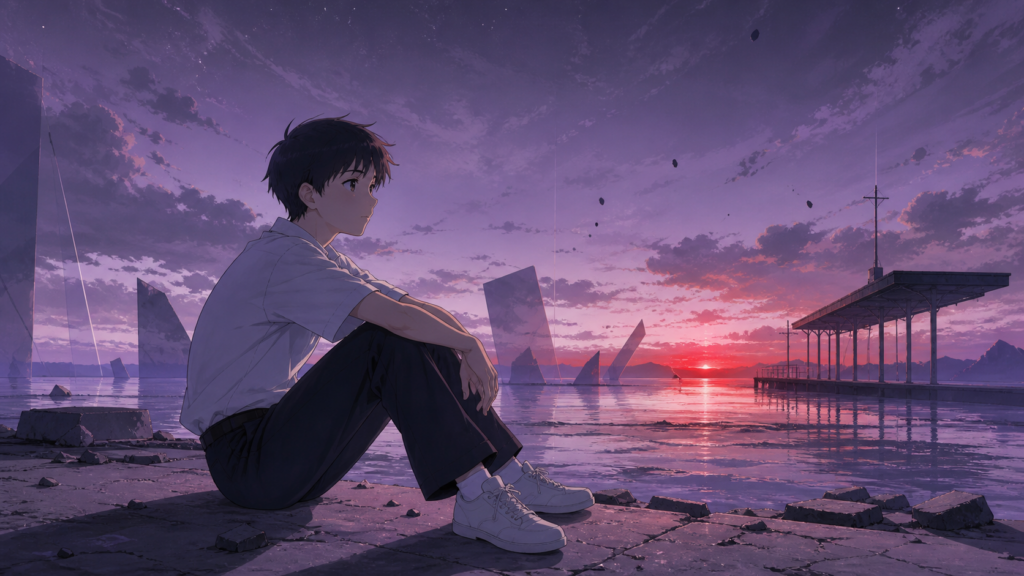
Shinji Ikari
Shinji begins shut down by grief, guilt, fear, and the belief that every relationship ends in pain. Cosmic power does not make him wiser. Instrumentality magnifies a damaged teenager’s wish until the wish becomes a species-level disaster.

Asuka Langley Soryu
Asuka reconnects with the maternal presence inside Unit-02 and fights with the confidence she spent the series trying to perform. Her defeat exposes how the adults built a war around children, while her return on the beach restores another person who can judge Shinji.
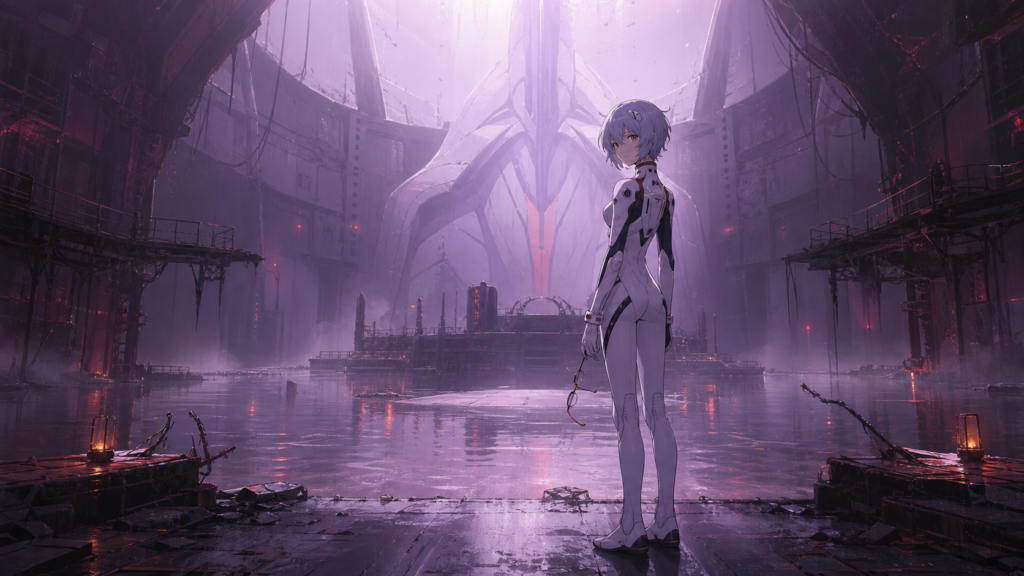
Rei Ayanami
Rei refuses Gendo when he assumes that creation means ownership. Her choice returns control of Instrumentality to Shinji, but her giant form also shows how a girl treated as replaceable can become the image through which every human boundary collapses.
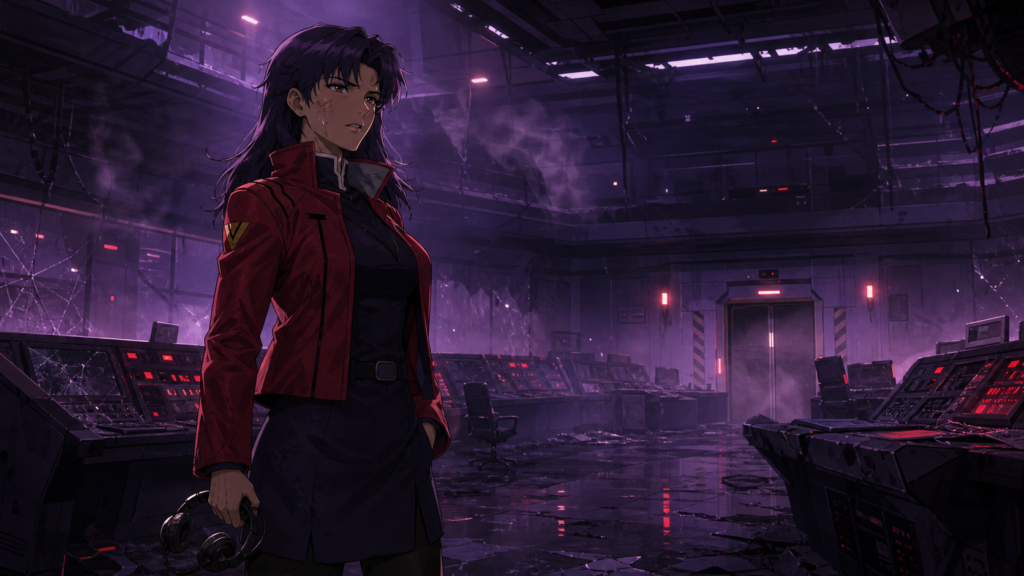
Misato Katsuragi
Misato understands the operational crisis and the emotional danger better than the other surviving adults. Her final effort gets Shinji to Unit-01, yet her care remains tangled with command, secrecy, sexuality, and the same institutional pressure she wants to resist.
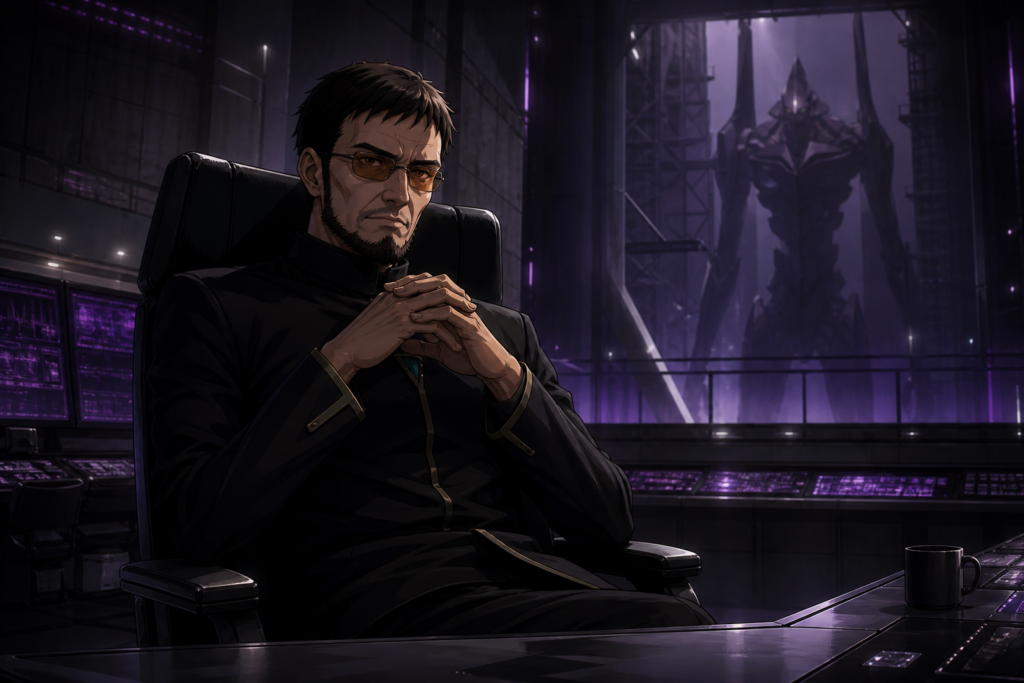
Gendo Ikari
Gendo converts grief into a private plan that consumes employees, children, clones, and the world. His wish sounds personal, but the method depends on domination. Rei’s refusal proves that intimacy cannot be rebuilt through ownership.
Ritsuko Akagi
Ritsuko understands NERV’s machines and family inheritance without escaping either system. The MAGI rejection preserves her mother’s divided loyalties inside the institution, showing that advanced technology can carry old damage forward.
Reviews
The complete RaeRae review and rewatch file.
The first viewing can feel like an assault because military violence, intimate violation, ritual imagery, live action, pop music, and mass death arrive without a polite pause. Rewatching exposes the structure beneath the shock. Doors, screens, hands, ceilings, boundaries, and refusals keep preparing the final choice long before Giant Rei fills the sky.
The movie remains difficult because clarity would weaken the experience Anno designed. NERV falls through ordinary military force before giant ritual imagery takes over. Asuka reaches a fierce understanding of her mother and still loses. Misato performs leadership while bleeding to death. Rei refuses Gendo at the moment he assumes ownership over her body. Shinji receives cosmic authority when he has the least emotional ability to use power responsibly. Every major institution treats a wounded child as a tool, then acts surprised when the child’s wish becomes catastrophic.
The ending does not declare that pain makes life beautiful. Pain remains pain. The final beach offers no restored city, reunited family, or clean moral reward. Shinji and Asuka return because individual existence makes choice possible, not because individual existence guarantees kindness. Their first interaction contains violence, care, disgust, recognition, and uncertainty. Survival opens a future. Survival does not finish the work.
The movie begins after every adult system has already failed.
SEELE launches a conventional assault on NERV because angels are gone and rival human plans now threaten control of Instrumentality. Soldiers enter hallways, execute staff, burn rooms, and seize command centers. The sequence removes the comforting scale of robot combat. NERV personnel trained to monitor supernatural attacks face rifles, explosives, and bureaucratic orders. Their technology cannot protect them from the political organization that financed the base.
Gendo has spent the series treating parenthood, employment, science, and grief as parts of one private project. SEELE treats civilization as raw material for a collective transformation chosen by elites. Misato understands enough to know that neither faction offers public consent. Ritsuko understands the machinery and still cannot overcome the pattern her mother built into the MAGI. Institutional intelligence exists everywhere, while accountable power exists nowhere.
Shinji begins nearly motionless because the film refuses to mistake exhaustion for suspense. He has killed Kaworu, lost friends, witnessed Asuka’s breakdown, and learned that adults repeatedly conceal the purpose of his labor. Asking him to pilot again does not become reasonable because an attack has started. NERV created dependence, withheld truth, demanded sacrifice, and offered affection mainly when performance became necessary. His refusal has consequences, but those consequences belong to the institution that built its defense around traumatized children.
Asuka's final battle is triumph and exploitation at once.
Asuka awakens inside Unit-02 when she recognizes that her mother’s protective presence remained within the Eva. The discovery restores a bond she believed had ended through rejection and death. Her confidence returns because she no longer experiences the machine as an empty test of worth. She fights the invading forces with skill, speed, anger, and joy. The sequence gives her agency after episodes of collapse without pretending recovery erases danger.
The Mass Production Evas turn victory into ritualized execution. Their bodies move like manufactured angels, their smiles strip violence of human emotion, and their regeneration defeats ordinary combat logic. Asuka can destroy each visible opponent and still lose because SEELE designed redundancy, imitation, and remote power into the system. Excellence cannot beat an institution that controls the terms of survival.
The brutality deserves honest criticism. The film makes Asuka’s mutilation one of animation’s most unforgettable assaults, which risks using a teenage girl’s pain as fuel for another character’s crisis. Her perspective remains strong during the battle, yet the narrative later centers Shinji’s reaction. Admiration for the filmmaking should not erase discomfort with a pattern where women suffer spectacularly so a male protagonist can reach revelation.
Misato dies while doing the job every adult abandoned.
Misato crosses a collapsing facility to reach Shinji because command has become personal care under impossible conditions. She explains the stakes, fights soldiers, hides her injury, and forces movement from someone who cannot produce motivation on demand. Her leadership works because she does not pretend the institution deserves loyalty. She asks Shinji to choose a future after admitting adult responsibility for the world he inherited.
The kiss remains one of the film’s most troubling choices. Misato uses sexual promise to move a minor toward the elevator because she believes no other language will work. Desperation explains the act without making the boundary violation harmless. The scene exposes how adults around Shinji confuse intimacy, manipulation, duty, and care. Misato loves him and still reaches for a method shaped by her own unresolved relationship with sexuality.
Her death happens out of Shinji’s sight. The elevator closes, she collapses, and an explosion consumes the corridor. Heroic labor receives no public ceremony. The cross necklace becomes the object that carries her effort forward. Shinji reaches Unit-01 too late to save Asuka, which turns Misato’s sacrifice into another example of care that cannot control the outcome.
Rei's refusal breaks Gendo's fantasy of ownership.
Gendo approaches Rei as though creation grants permanent authority. He expects her body, Lilith’s body, Adam, and Instrumentality to serve his reunion with Yui. His grief has become a political program built through clones, secrecy, child labor, and planned extinction. Personal suffering does not reduce the scale of that abuse.
Rei chooses Shinji instead of Gendo, but her choice should not be reduced to transferring loyalty between men. She recognizes herself as a will capable of refusal. Returning to Lilith gives her power beyond the identity Gendo assigned. The giant form reflects different faces because Instrumentality reaches people through desire, fear, and remembered attachment rather than one stable divine image.
Gendo finally admits that he avoided Shinji because closeness risked pain. The confession explains his cruelty without repairing the years of abandonment. Yui’s image rejects him, and Unit-01 consumes him in a vision of judgment. The father who used everyone as an instrument discovers that fear does not excuse making a child carry the cost.
Instrumentality solves loneliness by deleting the person who feels lonely.
Human Instrumentality promises an end to rejection because every soul loses the barrier separating self from other. The proposal sounds merciful when presented to people whose deepest wounds come from abandonment. Shinji wants connection and fears the judgment that connection makes possible. Asuka demands recognition and cannot tolerate dependence. Misato seeks intimacy while expecting betrayal. Gendo sacrifices the world to recover one lost relationship. Each character treats separation as both necessary and unbearable.
The Anti-AT Field turns that emotional problem into physics. Bodies dissolve into LCL when the barriers around individual selves collapse. The transformation is not a simple death. People encounter comforting faces before losing form, which suggests that surrender arrives through the image of whoever could make disappearance feel safe. The apocalypse becomes intimate long before the sky fills with crosses.
SEELE calls collective existence completion because elite projects often rename coercion as healing. No public vote authorizes the end of humanity. No ordinary person receives enough information to refuse. A small group converts private doctrine into species-wide policy through control of military, religious, and technical systems. Universal happiness becomes tyranny when every person must accept the same cure.
Shinji initially accepts dissolution because a world without boundaries appears to remove the risk of being hurt. That wish carries anger as well as despair. If nobody remains separate, nobody can reject him, but nobody can truly choose him either. Recognition requires another person whose response cannot be controlled. Instrumentality supplies perfect access by making relationship impossible.
The hospital scene makes the audience confront Shinji without protecting him.
The opening hospital sequence is sexual violation. Shinji exposes Asuka’s body while she is unconscious and uses her vulnerability for his own gratification. The scene cannot be defended as harmless honesty about adolescence. Asuka cannot consent, and the movie frames his action through shame rather than romance. Viewers must carry that knowledge through every later request to understand his pain.
Anno refuses the familiar bargain where a protagonist’s suffering automatically makes his behavior sympathetic. Shinji remains traumatized, neglected, manipulated, and capable of harming another person. Those truths coexist. Trauma explains why his judgment and boundaries have collapsed, but explanation does not transfer responsibility to the victim.
The scene also changes how viewers read the final beach. Shinji’s later violence toward Asuka does not appear from nowhere. His relationship with her has already mixed desire, resentment, dependence, humiliation, and refusal to recognize her autonomy. Instrumentality gives him access to her inner life, yet information alone does not teach respect. Knowing another person’s pain cannot replace the decision to stop causing harm.
Criticism should also reach the filmmakers. The production uses Asuka’s exposed body to implicate Shinji and the audience, but the image still circulates within a commercial culture that sexualizes teenage characters. Self-awareness does not erase exploitation. A responsible reading can recognize the scene’s narrative purpose and reject the way a minor’s body becomes the visual tool used to deliver that purpose.
The live-action sequence turns spectatorship into part of the crisis.
The film eventually breaks from animated space into live-action streets, theaters, buildings, and crowds. The shift refuses the safety of treating Shinji’s collapse as something sealed inside fantasy. Images of ordinary life enter a story about the desire to escape ordinary relationships. Cinema itself becomes one more place where viewers can seek connection without accepting another person’s unpredictable response.
The theater imagery does not prove that the movie hates fans. Such a simple accusation would repeat the same contempt that the film directs at institutions. Evangelion depended on audiences, merchandise, television networks, theaters, animators, and intense fan investment. The sequence asks what happens when a work becomes a substitute for living rather than one part of life. That question targets creators and consumers together.
Letters and hostile reactions associated with the franchise appear inside a montage, but reducing the entire film to Anno striking back at critics ignores the larger structure. The movie spends too much time examining institutional violence, depression, sexuality, parental failure, and the ethics of escape to function as one long insult. Anger exists. Anger becomes material within a broader argument about the demand that art repair people without their participation.
Live action also makes animation newly visible when the film returns to drawings. Lines, paint, compositing, photographed reality, and blank surfaces become different levels of representation. Shinji’s world can be rebuilt because images are constructed, but construction does not make emotion false. A drawn hand can carry care. A photographed theater can feel empty. Medium and reality do not divide cleanly.
Unit-01 becomes a god because adults designed a child-shaped trigger.
Unit-01 contains Yui and responds to Shinji through a relationship that NERV concealed from him. The Eva is weapon, parent, prison, biological body, religious symbol, and corporate asset. Those roles overlap until piloting becomes impossible to separate from family trauma. Shinji enters the machine seeking approval from Gendo and physical connection with a mother he barely remembers.
When Unit-01 rises, SEELE converts the Eva into the center of a ritual. The Mass Production units arrange themselves around a child who cannot consent to the role assigned. Giant power does not create agency when every surrounding system has prepared the choice. Shinji receives control over humanity only after Asuka’s death breaks his remaining emotional stability.
The Spear, wings, crosses, Tree of Life imagery, and giant bodies create religious scale without forming a tidy theological code. Evangelion borrows symbols for visual and thematic force, then mixes traditions beyond doctrinal consistency. Viewers can explore Kabbalistic, Christian, Buddhist, psychoanalytic, and science-fiction associations, but no single key unlocks every image. The film’s deeper meaning lives in relationships between power, fear, selfhood, and escape rather than a secret glossary.
That distinction matters because Easter-egg culture can turn analysis into symbol matching. Naming a cross does not explain why a military institution surrounds a traumatized child with ritual machinery. Recognizing the Tree of Life does not answer whether collective salvation chosen by elites can respect human freedom. References open questions. References do not replace them.
Komm, süsser Tod makes apocalypse sound like surrender.
The cheerful melody and English lyrics create one of the film’s sharpest contrasts. Humanity dissolves while a bright arrangement gives despair the shape of a pop song. The sequence refuses the heroic musical language usually attached to the end of the world. Mass death arrives as relief, regret, and emotional exhaustion.
The song externalizes Shinji’s wish to erase the damage he believes he caused. Repetition makes self-condemnation feel automatic, like a thought loop that has outlived evidence. Images of death and reunion pass through that rhythm until private shame becomes planetary action. The score therefore connects depression to power without claiming that depressed people are dangerous by nature. Shinji becomes catastrophic because institutions gave his crisis a machine capable of acting on everyone.
Silence elsewhere remains equally important. Gunfire inside NERV feels brutal because music does not constantly instruct viewers how to respond. Asuka’s battle builds through mechanical sound, breath, impacts, and rising score. The final beach strips the world down to wind, water, touch, and speech. Sound design moves from institutional noise to the unbearable closeness of two survivors.
The final beach is not reconciliation.
Shinji wakes beside a red sea under the remains of a giant body. Asuka lies near him. The world appears empty, but Instrumentality has not permanently trapped everyone. Yui explains that people can return if they can imagine themselves within their own hearts. Return requires a desire for separate form. No rescuer forces humanity back, and no deadline guarantees that most people will choose embodiment.
Shinji reaches for Asuka’s throat. The action repeats violence from their shared Instrumentality sequence, where his demand for care becomes rage after she refuses to become an object made for his comfort. On the beach, he confronts a separate person again. Her existence means she can reject, judge, or leave him. His hands attempt to destroy the boundary he just chose to restore.
Asuka touches his face. The gesture resembles Yui’s earlier touch, but Asuka remains herself rather than becoming a replacement mother. Her hand does not forgive the hospital assault, the strangling, or the history between them. The touch recognizes another living body during violence. Shinji stops and cries because recognition reaches him without granting control.
Asuka’s final words carry disgust, physical discomfort, emotional knowledge, and refusal. Translation choices can shift the exact shade, while no version turns the moment into romance. She has returned with access to what happened during Instrumentality and with her own injuries intact. Her response prevents Shinji’s tears from controlling the scene. The person he hurt gets the last line.
The ending remains hopeful only in a narrow, demanding sense. Two people possess bodies, choices, and the possibility of acting differently. They also possess trauma, resentment, and no functioning society. Hope means freedom has returned alongside danger. Any future worth living requires food, shelter, accountability, boundaries, and other returning people. The movie ends before hope becomes comforting.
Five scenes show why spectacle never replaces character.
The NERV invasion. A franchise famous for giant battles narrows violence to office corridors and frightened workers. Tactical detail exposes the human institution beneath the mythology. Staff members who seemed powerful behind monitors become civilians trapped by decisions made above them. The sequence makes bureaucracy mortal.
Asuka beneath the lake. Her recognition of Unit-02’s soul turns a mechanical cockpit into a reunion between mother and daughter. The moment works because psychological insight immediately changes physical performance. Asuka does not receive a speech about confidence. She understands the relationship that made piloting possible.
Unit-02 against the Mass Production Evas. Timing, weight, color, music, and violent choreography create exhilaration before the trap becomes visible. The audience experiences the pleasure of Asuka’s competence, then the horror of a system designed to survive individual excellence. The scene becomes an industry argument as much as an action sequence: standardized, replaceable units consume a singular performer.
Rei abandons Gendo. The scene turns years of objectification against the person who assumed he owned the outcome. Rei’s quiet refusal carries more force than another explosion. Her choice reorganizes the entire ritual because control depended on treating a person as a component.
The kitchen confrontation. Shinji asks Asuka for help while demanding that help take the exact form he wants. She exposes his pattern of approaching others only when self-comfort becomes necessary. The room becomes a stage for emotional coercion. When she refuses, he destroys the space and strangles her. Instrumentality begins through the fantasy that another person should lose the right to say no.
The animation turns breakdown into form.
The first half uses detailed military action, character acting, mechanical weight, and spatial continuity. Viewers can follow where soldiers enter, how defenses fail, and why characters cannot reach one another. That clarity gives institutional collapse a physical map. NERV does not disappear through symbolism. Armed power dismantles the base room by room.
The second half fractures that stability through changing media, rough drawings, repeated images, still photography, text, negative space, and live action. Formal collapse follows the loss of boundaries between minds. The movie does not illustrate Instrumentality from a safe external viewpoint. Editing and image texture make the audience experience unstable identity.
Rough lines do not signal unfinished craft. Completed motion and exposed construction sit beside one another so viewers can feel the process of an image becoming or losing form. Animation usually hides production labor behind seamless movement. The End of Evangelion sometimes reveals marks, frames, and surfaces, connecting personal identity with the medium’s dependence on boundaries.
Production I.G’s participation helped expand the action and visual finish beyond what the television schedule could sustain. Gainax’s character history and experimental instincts remained central. The collaboration produced a film where high-detail spectacle and radical abstraction belong to the same argument. Expensive animation does not silence uncertainty. Greater resources allow uncertainty to take larger forms.
Color carries narrative weight. NERV’s dark interiors, Unit-02’s red armor, LCL orange, Rei and Lilith’s pale bodies, the black Moon, and the final red sea create a palette where biological, mechanical, and sacred categories contaminate one another. Beauty attracts attention to images that remain emotionally or ethically repellent.
The movie changed what a franchise finale could attempt.
The theatrical release proved that a television anime conclusion could become a major cinematic event without simplifying continuity for newcomers. The film expects knowledge of twenty-four episodes, character histories, organizations, and technical language. Such density turns the theater into a gathering place for an existing audience rather than a marketing funnel designed around universal accessibility.
The choice carried risk. A finale this severe could have damaged affection for the characters, confirmed complaints about obscurity, or reduced Evangelion to controversy. Instead, the movie became central to the franchise’s cultural identity. Images from Asuka’s battle, giant Rei, the red sea, and the final beach now define how later audiences remember the original era.
Influence appears across anime, games, music videos, fashion, fan art, critical theory, and online conversation. Later stories borrowed apocalyptic religious imagery, psychologically unstable pilots, biomechanical giants, abstract endings, and institutions that weaponize adolescence. Direct imitation sometimes copies the surface while missing the labor and emotional structure beneath the symbols.
The film also helped normalize sustained adult criticism of television animation. Scholars and critics have used Evangelion to discuss posthuman identity, depression, the nuclear family, technology, spectatorship, sexuality, and Japanese media culture. Academic attention does not make one interpretation official. The volume of serious disagreement proves that animation can support the same contested reading practices expected from literature and live-action cinema.
International availability reshaped that impact. Earlier English-language viewers often depended on expensive physical releases, incomplete licensing, fan discussion, and inconsistent translations. Netflix’s acquisition of the series and both concluding films in 2019 opened access to a much wider audience while starting new debates about dubbing and subtitle choices. Distribution expanded the canon and changed the words through which many viewers encountered the canon.
The production history deserves more care than the revenge myth.
The television ending used limited animation, voice performance, text, drawings, and psychological staging to complete Shinji’s inner arc under intense production constraints. Audience dissatisfaction became famous, and hostile messages toward the staff became part of Evangelion lore. The theatrical film answered the demand for external events, but calling the result a punishment designed against fans oversimplifies a difficult production and a creator’s evolving ideas.
Death and Rebirth preceded the completed theatrical ending and reflected the challenge of turning planned material into finished cinema. The End of Evangelion combines the revised Episode 25 and Episode 26 into a feature structure. The movie does not merely replace the television ending with the real version. Both endings use different formal routes through related questions about selfhood, perception, and whether Shinji can accept a world containing other people.
Anno’s later comments about Evangelion describe changes in his own perspective across decades. By the final Rebuild film, he emphasized an increased ability to look outward and care for others. That later growth should not be projected backward as proof that the 1997 film failed. The End of Evangelion captures an earlier artistic position with exceptional honesty and severe limits.
Production difficulty also raises labor questions. Celebrating visual ambition without discussing schedules and animator strain repeats the franchise’s habit of turning human beings into instruments. Industry impact should include both creative achievement and the conditions under which achievement becomes possible. A masterpiece label should never function as permission to ignore workers.
Shinji is responsible for harm without becoming the only cause.
Evangelion discussion often swings between absolving Shinji because he is traumatized and condemning him as though adults gave him an ordinary childhood with ordinary choices. The film rejects both positions. He commits violations, lashes out when others cannot repair him, and helps initiate a catastrophe. He also reaches that point after years of abandonment, repeated combat, secrecy, manipulation, bereavement, and institutional dependence.
Responsibility becomes layered. Shinji must answer for actions toward Asuka and for the wish that collapses humanity. Gendo must answer for shaping his son’s life around Yui’s absence. Misato and NERV must answer for using minors as military labor. SEELE must answer for designing genocide as salvation. Adults who knowingly built the machinery cannot place the whole disaster on the child forced into its center.
The film’s strongest ethical move is refusing to make suffering a credential. Shinji’s pain deserves care, while Asuka does not owe him access to her body or affection. His need can be real without becoming her duty. That distinction gives the kitchen and beach scenes their cruelty. He wants proof that he matters and reaches for control when another person keeps the right to refuse.
A better social system would remove the impossible scale from his choices. Trained adults would defend the city, pilots would receive independent advocates and mental health care, mission purposes would face review, and no commander could make a child physically dependent on employment. The fantasy becomes believable as abuse because every safeguard has been intentionally removed.
Asuka returns because anger can protect a self.
Asuka’s pride often appears as a flaw, but pride also guards a person who learned that usefulness determined whether adults noticed her. Piloting gives her a public identity, measurable skill, and a place where effort produces recognition. Losing synchronization therefore threatens more than employment. Failure destroys the structure she built around survival.
Her recovery in Unit-02 does not come from accepting softness as a cure. She discovers that connection with her mother existed inside the machine, then translates that knowledge into fierce action. Love does not replace anger. Love gives anger a protected center. She fights because her life no longer feels empty.
Instrumentality exposes memories and desires that ordinary boundaries kept private. Asuka returns from that collapse with knowledge of Shinji’s violation and with enough self-definition to choose embodiment. Her disgust on the beach demonstrates separateness. She can judge him because she is not part of him. The line many viewers treat as pure bleakness becomes proof that her perspective survived.
The film still underserves her after the battle. Her return receives only a few gestures and words, leaving viewers to infer enormous psychological work. More of Asuka’s decision to leave Instrumentality would improve the ending without softening the conflict. The story spends much longer inside Shinji’s choice than hers even though both survivors matter.
Rei becomes most human when she stops performing humanity for Gendo.
Rei’s clones encourage characters to treat her as replaceable matter. The series shows how memory, habit, relationships, and choice make each incarnation distinct even when bodies share an origin. Gendo relies on interchangeability because recognizing Rei as a person would place limits on his plan. Instrumentality requires him to believe that identity can be stored, transferred, and commanded.
Her refusal exposes the weakness of that belief. A manufactured body can develop a will that exceeds design. Rei’s relationship with Shinji, her encounters with death, and her awareness of earlier selves create a perspective Gendo cannot fully predict. His plan fails at the point where a tool says no.
Giant Rei becomes terrifying because personal autonomy expands into unaccountable scale. Her face shifts toward people each character longs for. Comfort becomes the interface for bodily dissolution. The film avoids celebrating her power as simple liberation. Rei escapes one man’s ownership and enters a process that removes everyone else’s boundaries.
When her enormous body breaks apart, liberation and horror remain tangled. Rei’s image becomes landscape, corpse, memory, and evidence that gods can fail. Shinji’s rejection of Instrumentality does not put her back into a school uniform or restore a normal life she never received. Her agency changes the universe and leaves her fate unresolved.
Gendo and SEELE offer two versions of the same domination.
Gendo wants reunion with Yui. SEELE wants the completion of humanity according to doctrine. One motive looks personal and the other civilizational, yet both convert every living person into material for a plan chosen without consent. Scale changes the language, not the structure.
Gendo’s defenders sometimes point to grief as proof of love. Love becomes destructive when the loved person is used to justify control over children, employees, clones, and the dead person’s legacy. Yui made her own choices about Unit-01. Gendo responds to her absence by treating everyone else’s choices as obstacles.
SEELE hides coercion behind inevitability. Members speak as though humanity has reached a required stage and their committee merely carries out history. The claim removes accountability. Political leaders frequently describe optional violence as unavoidable when alternatives would reduce their power. Prophecy becomes a management tool.
NERV’s employees learn the truth too late to organize resistance beyond survival. Compartmentalized information protects leaders from collective oversight. Scientists know technical pieces, operators know tactical pieces, pilots know bodily costs, and administrators control purpose. The structure resembles institutions where expertise remains fragmented so nobody below the top can challenge the whole project.
Religious imagery supplies scale, not a secret instruction manual.
Crosses, angels, Adam, Lilith, the Spear of Longinus, the Sephirotic system, and apocalyptic language give Evangelion a vocabulary of origin and ending. The symbols also reached Japanese popular culture through a different relationship to Christianity than many Western viewers bring. Treating every image as a direct doctrinal statement creates false certainty.
The crosses make explosions resemble ritual. Angel names make enemies sound like messengers. Adam and Lilith turn biology into contested creation myth. SEELE uses sacred language to present human decisions as cosmic necessity. The narrative value comes from how institutions borrow transcendence to authorize control.
Psychoanalytic language provides another vocabulary. Ego boundaries, maternal attachment, desire, repetition, projection, and fear of rejection organize the characters more consistently than any one religious system. Even that framework should remain a tool rather than a final answer. Characters are dramatic people before they are examples of a theory.
The most reliable interpretation begins with action. Who possesses information? Who commands bodies? Who can refuse? Who pays for a leader’s grief? Symbolic readings become useful when they clarify those relationships. A theory that makes suffering look decorative has missed the film’s human center.
What the movie gets wrong deserves the same honesty as the praise.
The film’s treatment of sexual violence is confrontational without always centering the person harmed. Asuka’s body becomes the site through which viewers measure Shinji’s collapse. Her perspective survives, especially in the final line, but the camera and narrative spend more time on his shame than her recovery. The imbalance reflects the story’s viewpoint and a broader media habit that deserves criticism.
Women repeatedly carry the physical price of male grief and institutional ambition. Ritsuko is shot after her dead mother’s personality within the MAGI refuses the command she expected. Misato dies pushing Shinji toward a machine. Rei’s bodies exist through cloning and disposal. Yui’s absence organizes Gendo’s abuse. The women possess agency, but the story often converts their agency into sacrifice before returning to Shinji.
The second half’s abstraction can also obscure material accountability. Once Instrumentality begins, visual and psychological density may cause viewers to forget the soldiers, workers, civilians, and cities destroyed by a plan. Cosmic imagery risks making mass death beautiful. The film counters that risk through horror and grief, though spectacle can still overwhelm ethics.
Viewers who have not watched the television series receive too little context. The movie functions as Episodes 25 and 26 of an existing narrative, not a standalone feature. Such dependence is artistically legitimate, but marketing the film without that warning can turn intended difficulty into simple confusion. The best viewing order remains the original twenty-six episodes followed by this movie, with Death(true)² optional as a recap.
The closing refusal to show social rebuilding protects ambiguity and limits the political argument. Individual boundaries return, but food, medicine, housing, governance, and accountability remain unanswered. A few more signs of how humanity might return would deepen the cost without converting the ending into reassurance.
Where to watch The End of Evangelion in the United States.
As checked on August 17, 2026, Netflix’s official title page lists The End of Evangelion for streaming with Japanese and English audio and English subtitles. Netflix also carries the original television series, so the series-first viewing order remains available through one U.S. subscription catalog.
GKIDS lists the film on Blu-ray and through digital purchase routes, including Apple TV options with subtitled and dubbed listings and a Prime Video subtitled listing. Buyers should verify the current platform page, language track, region code, and included version before paying because digital storefronts and physical editions can differ.
Streaming and purchase rights can change without warning. The official Netflix and GKIDS pages, plus the check date above, matter more than a remembered availability claim.
Small details keep the apocalypse tied to earlier choices.
Misato’s cross necklace travels from father to daughter and then from Misato to Shinji. The object begins with Second Impact, carries complicated grief, and ends nailed to a post on the beach. No miracle comes from the cross. The necklace records people who tried to pass responsibility and care forward despite failing to survive.
Ritsuko’s attempt to activate the MAGI self-destruct sequence fails because Casper chooses Gendo. The three computers embody aspects assigned to Naoko Akagi, which means a dead woman’s divided personality continues to govern institutional decisions. The system preserves a psychological conflict instead of objective intelligence. Technology inherits the contradictions of its maker.
The Mass Production Evas carry dummy systems modeled through Kaworu. SEELE removes ordinary pilots while preserving the image of a person Shinji loved and killed. Automation does not eliminate human exploitation. Automation stores a human pattern inside a system designed for obedience, ritual, and repeatable violence.
The repeated phrase identifying a familiar ceiling returns through hospital and cockpit spaces across Evangelion. Ceilings mark moments when Shinji wakes inside institutions that have already decided his next role. The final beach removes the ceiling. Open sky brings freedom, exposure, and no instructions.
Yui’s decision to remain in Unit-01 turns the Eva into a permanent record that humanity existed. Her plan has grandeur and cruelty because Shinji pays for choices she made before he could understand them. The image of Unit-01 drifting through space can suggest hope for memory while also confirming that parental ideals can consume a child’s present.
The title cards call the two parts Air and Sincerely Yours. The words place breath and intimacy beside extinction. Air becomes urgent during strangling, LCL dissolution, and return to bodies. Sincerity becomes difficult when characters use honesty as another way to demand care. The film repeatedly asks whether genuine feeling can exist without respect for the person receiving the feeling.
Why the film still demands another viewing.
The movie rewards return because the first viewing spends emotional energy on survival. Later viewings reveal how early scenes prepare the final choice through repeated boundaries, touches, refusals, doors, screens, and bodies inside machines. Repetition does not produce one official interpretation. Repetition shows how character behavior, institutional design, and visual form keep answering one another.
A second viewing also makes criticism sharper. Spectacle becomes less overwhelming, leaving more room to notice whose perspective disappears, which adults escape accountability, and how frequently Asuka and Rei carry the cost of Shinji’s development. Lasting art can support admiration and objection at the same time. Evangelion remains alive because viewers do not need to protect the film from difficult questions.
The film also changes with age. Teen viewers may first recognize isolation, while older viewers may notice how thoroughly adults build the conditions surrounding that isolation. Neither perspective cancels the other. The work keeps expanding because responsibility moves across families, workplaces, governments, audiences, and creators rather than settling on one damaged boy.
The harshness also protects the film from becoming a slogan about choosing life. Shinji’s decision creates no instant competence, apology, or community. A body returns before the skills needed to live with others. That order matters. People often regain choice before they know how to use choice well. The beach leaves responsibility visible because freedom begins while damage remains present.
The final judgment is severe admiration.
The End of Evangelion remains one of the strongest animated finales because form, character, sound, production history, and philosophical conflict collide without becoming a neat lecture. The film can stage a military assault with exact spatial logic, then dissolve cinema into drawings and photographs. Both modes serve the same question: can a person accept other people when every relationship carries risk?
The answer is conditional. Shinji rejects a world without boundaries, not because ordinary life suddenly feels safe, but because safety purchased through the death of difference cannot provide love. Asuka returns with the power to judge him. Her touch stops violence for one moment. Her disgust restores the truth that another person remains beyond his control.
No applause greets that realization. The ocean is red, civilization is gone, and their relationship may never become healthy. The movie refuses to sell survival as victory. Separate bodies create the possibility of consent, responsibility, repair, and future harm. Human freedom contains all four.
That refusal explains the film’s lasting impact. Many stories defeat apocalypse through a weapon or sacrifice. Evangelion defeats false salvation by restoring the boundary that lets another person say no. The final beach is ugly because freedom without maturity remains dangerous. The final beach matters because maturity cannot exist without freedom.
Episode Reactions
The episode-by-episode conversation belongs to the Evangelion series.
The End of Evangelion receives a complete movie review because the film is one finished release. Episode reactions follow the original twenty-six-episode anime in numbered order, tracking what each weekly chapter reveals before later episodes change the meaning.
Rants
The film keeps feeding arguments that reach beyond Evangelion.
These editorials use Evangelion as evidence inside larger arguments about children, institutions, care, secrecy, and public responsibility. Each rant stands on a separate complaint. None of the essays turns the film into a motivational lesson or excuses the systems harming the pilots.
Gifted Children Are Not Public Property
NERV treats compatibility as permission and a child’s rare ability as public property. The rant asks what meaningful consent could look like when adults control the truth, the emergency, and every alternative.
Self-Sacrifice Is Not a Public Safety Plan
Evangelion rejects the clean hero fantasy by showing how institutions build emergency systems around one damaged person and then call refusal cowardice.
Secrecy Is Not Protection When the Child Never Gets the Truth
The pilots discover family history, scientific purpose, and institutional plans during crisis because adults decided compliance mattered more than informed choice.

Friendship Is Not Unpaid Therapy
Shinji, Asuka, and Rei need connection, but three traumatized teenagers cannot replace the adult care, protection, and accountability missing from NERV.
World, Lore & Guides
Instrumentality only makes sense after the human systems become visible.
The movie assumes readers already know the bodies, organizations, and ritual language behind the final disaster. These three guides open the central ideas without flattening the original continuity into one tidy answer.

Human Instrumentality
SEELE, Gendo, AT Fields, LCL, and the cost of erasing the boundaries between people.
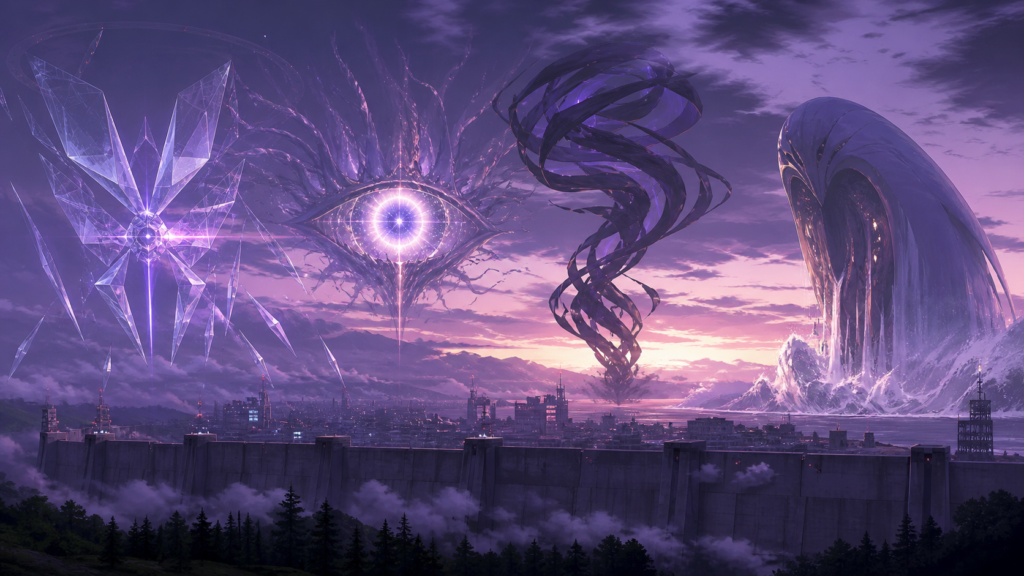
The Angels
Their names, bodies, attacks, and ties to Adam, Lilith, NERV, SEELE, and humanity.

Evangelion Units
Living bodies, armor, souls, pilots, restraints, and the reason the Evas are not giant robots.
Voice Actors
Three performances at the center of The End of Evangelion.
The Japanese cast makes silence, panic, rage, and refusal carry as much weight as the movie’s loudest images. These three profiles lead into the complete franchise cast directory.
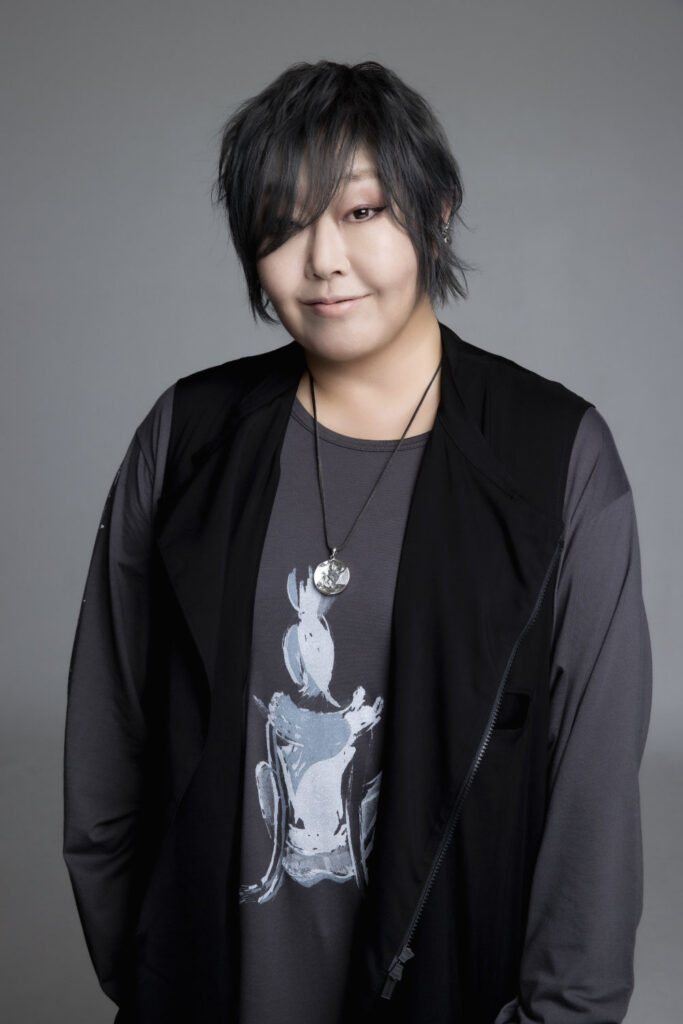
Megumi Ogata
Character: Shinji Ikari
Ogata carries Shinji across numb withdrawal, panic, accusation, dependence, and the final rejection of Instrumentality.
Yuko Miyamura
Character: Asuka Langley Soryu
Miyamura moves from recovered combat confidence to violation, rage, interior confrontation, and the final beach judgment.

Megumi Hayashibara
Characters: Rei Ayanami and Yui Ikari
Hayashibara separates Rei’s quiet refusal, Yui’s maternal distance, and the enormous calm surrounding Instrumentality.
Teas
Evangelion remains active long after the final beach.
Confirmed GKIDS acquired North American theatrical, home-video, and electronic sell-through rights for the original television series, Death (True)², and The End of Evangelion. The 2021 release brought the original continuity to North American Blu-ray and digital purchase platforms through an official rights holder.
Confirmed The official Evangelion site announced a completely new Evangelion series project during the franchise’s thirtieth-anniversary program on February 23, 2026. The announcement proves that the property remains active, but the notice does not turn the 1997 movie into an unfinished chapter. New production news and the original film’s ending need separate continuity labels until official details establish the relationship.
Rumors about creator revenge, hate mail, and a single hidden meaning continue because the movie invites conflict and fandom repeats neat stories faster than production history. The review below rejects the revenge myth and separates later creator comments, documented production limits, fan interpretation, and visible evidence from the film.
Sources and further reading.
Film credits and release information were checked against the British Film Institute’s record for The End of Evangelion. Current U.S. streaming and purchase listings were checked through JustWatch on August 14, 2026. Broader context was cross-checked with peer-reviewed and university research on Evangelion, posthumanism, identity, family structure, spectatorship, and Instrumentality, along with Hideaki Anno’s later interview comments about changes in his creative perspective.
- GKIDS: The End of Evangelion film and purchase page
- Production I.G: The End of Evangelion work record
- British Film Institute: The End of Evangelion film record
- JustWatch: current U.S. viewing options
- Humanities and Social Sciences Communications: Evangelion and posthumanity
- University of Illinois repository: Boy with Machine
- TIME interview with Hideaki Anno