
Maya Ibuki: Evangelion Character Profile
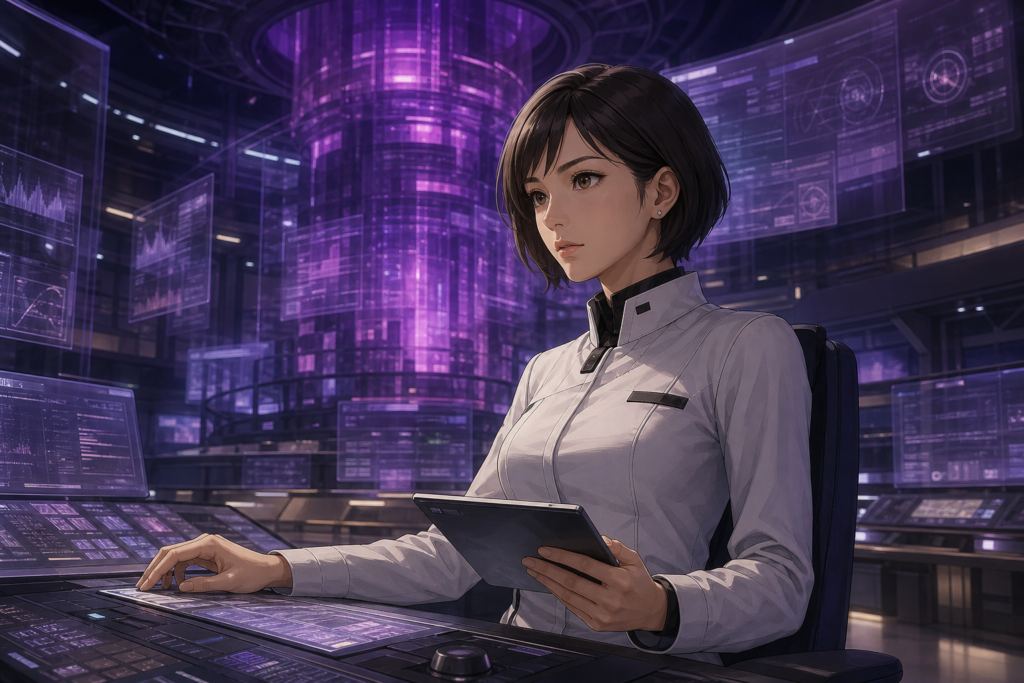
Evangelion Character File
Bottom line first: Maya Ibuki is the conscience sitting at NERV’s keyboard. Evangelion surrounds her with people who can explain genocide as procedure, hide cruelty inside a technical order, and treat a human body like one more replaceable component. Maya understands the machines better than most people in the room, yet she never learns to treat suffering as harmless data. That tension makes her much more than the bridge operator who announces another impossible percentage.
Affiliation
Work
Closest bond
Japanese voice
The person behind the readout
Maya works beside Makoto Hyuga and Shigeru Aoba in NERV’s command center, but the three operators do not carry the same emotional temperature. Hyuga often follows Misato’s lead. Aoba protects himself with cool distance. Maya reacts. She flinches when an Evangelion is torn apart, objects when a new system crosses a moral line, and cannot pretend that a clean monitor makes violence clean. Her job requires exact information under pressure, while her face keeps reminding the audience what those numbers mean to a living person.
The bridge crew also solves a storytelling problem. Giant battles can become noise when every cut stays outside with the monster and the machine. Maya translates scale into consequence. A dropping synchronization rate means a child is losing control. A damaged restraint means the adults have run out of protection. A biological contamination alert means the weapon may never have been a normal machine. Her reports give the spectacle a human pulse without stealing focus from the pilot trapped inside the crisis.
Ritsuko Akagi, admiration, and the cost of trust
Maya calls Ritsuko Akagi her senior because Ritsuko trained her, supervises her, and represents the scientific mastery Maya wants to reach. The bond contains real professional respect. Maya watches Ritsuko solve problems that nobody else in the room can even name. She also believes that intelligence and discipline should serve human survival. Ritsuko slowly proves that brilliance can serve secrecy, revenge, and self-destruction just as easily.
That relationship hurts because Maya is not foolish. Maya notices danger in the Dummy Plug system and expresses discomfort when NERV asks technology to erase human judgment. Her loyalty comes from hope rather than blindness. She wants the woman she admires to remain worthy of admiration. Evangelion keeps forcing Maya to work beside evidence that Ritsuko has accepted compromises Maya would never choose for herself.
The End of Evangelion removes the professional language that kept Maya’s feelings contained. During Instrumentality, Ritsuko appears at Maya’s station and offers the words Maya most needs to receive. The sequence does not provide a neat label for every part of their relationship, and a responsible reading should not invent certainty that the film refuses to hand over. The emotional direction remains clear. Maya’s deepest longing is tied to Ritsuko, to recognition from Ritsuko, and to a closeness that ordinary life never allowed Maya to claim openly.
The moral limit inside NERV
Maya’s refusal to shoot invading soldiers matters because NERV has trained everyone to accept emergency logic. The headquarters is under attack. Coworkers are dying. The command structure treats lethal resistance as obvious. Maya still cannot turn another person into a target. Her choice does not stop the massacre, and Evangelion does not reward her with a heroic victory. The moment establishes a boundary that the institution failed to erase.
Some viewers dismiss that response as weakness because action stories often confuse willingness to kill with maturity. Maya’s reaction exposes the opposite problem. NERV built weapons powerful enough to end the world, placed children inside those weapons, and taught adults to measure disaster in tactical updates. A worker who still vomits at brutality has not failed to adapt. The institution has failed to deserve adaptation.
Maya remains complicit, though. Her hands operate the systems. Her calculations support launches. Her skill helps NERV continue. Evangelion refuses the easy fantasy where a kind employee becomes innocent merely because she feels bad. Maya is valuable precisely because her discomfort does not cancel her participation. She shows how ordinary people become load-bearing parts of violent organizations without becoming cartoon villains.
The End of Evangelion
During The End of Evangelion, Maya experiences NERV’s collapse from the workstation where she once believed science could protect civilization. The command center becomes a trap. Procedures fail, authority fractures, and the staff members who spent years preparing for Angels discover that human beings can invade with simpler weapons and crueler purpose. Maya keeps working while the base dies around her because abandoning the console would abandon everyone still depending on the information.
Instrumentality reaches Maya through intimacy rather than terror. That choice reveals what the apocalypse means in Evangelion. Human beings do not surrender their boundaries only because pain scares them. People also surrender because perfect acceptance feels impossible to refuse. Maya receives the image of Ritsuko offering direct need and physical closeness. The fantasy is tender, devastating, and unfair. Maya does not receive a conversation with the real woman. She receives the exact answer her loneliness can no longer resist.
Rebuild gives the operator authority
The Rebuild continuity lets Maya age into a harder position. After the time gap, she serves WILLE and oversees Evangelion maintenance. The younger technician who once looked toward Ritsuko for certainty has become a senior figure other people must follow. Her sharper manner is not a personality transplant. Years of war, loss, and mechanical responsibility have burned away the softness that once made every crisis visible on her face.
Even then, Maya’s history remains inside the performance. The older Maya has learned how to command, but command does not make the past disappear. Her competence helps keep WILLE alive against NERV’s machinery. The same technical gifts that once supported Gendo’s organization now support resistance. Rebuild therefore gives Maya a form of change the original continuity could not: she survives long enough to decide where her labor belongs.
Miki Nagasawa makes the panic useful
Miki Nagasawa voices Maya in Japanese across the animated series, The End of Evangelion, and the Rebuild films. Nagasawa does not play Maya as a helpless bundle of nerves. The performance keeps her reports crisp enough to sound credible at a military workstation, then lets breath, pitch, and hesitation expose the emotional cost. Maya can deliver data while fear presses against every word. That balance keeps the character professional without sanding away her humanity.
The official Atomic Monkey profile for Miki Nagasawa lists Maya Ibuki among Nagasawa’s major animation roles. The long return to one character matters. Maya changes from an optimistic young technician to a hardened WILLE officer across different productions and decades, yet Nagasawa preserves the recognizable person underneath the change. The voice grows firmer without turning Maya into Aoba, Ritsuko, or Misato.
Why Maya belongs in the Evangelion hub
A complete Evangelion hub cannot stop with pilots and commanders. The franchise is about systems, and systems depend on workers whose names rarely appear in the grand plan. Maya monitors the bodies inside the machines, maintains the computers that govern the base, and absorbs orders created by people with more power. Her story connects the supernatural plot to a familiar social structure: the capable employee asked to make an unethical workplace function.
Maya also keeps Ritsuko from becoming only an isolated genius. Through Maya’s admiration, the audience sees the version of Ritsuko that younger scientists might believe in. Through Maya’s disappointment and longing, the audience sees what Ritsuko’s choices cost beyond her own life. Maya does not need a pilot’s seat to shape the emotional map. She occupies the place where science, labor, loyalty, desire, and conscience collide.
Research routes
- Official Evangelion site for franchise routes and official continuity pages.
- EvaGeeks: Maya Ibuki for episode references, NERV duties, character relationships, and Rebuild distinctions.
- Atomic Monkey: Miki Nagasawa for the Japanese voice actor’s official agency profile and credited roles.