
Character File · Toy Story · Full Franchise
Lotso
Daisy replaced him once. He built a prison so every new toy would keep paying for it.
Quick file
Full identity: Lots-o’-Huggin’ Bear, called Lotso, a large pink strawberry-scented plush teddy bear. Primary voice: Ned Beatty. Original child: Daisy. Former companions: Big Baby and Chuckles. Later position: authoritarian leader of the Sunnyside Daycare toy hierarchy.
Core relationships: Daisy as the attachment he converts into ideology, Big Baby as survivor and enforcer, Ken as privileged lieutenant, and every Sunnyside newcomer as labor assigned by his system. Core conflict: Lotso believes replacement proved love was always fraudulent, then forces other toys to live inside that conclusion.
The product design sells unconditional comfort
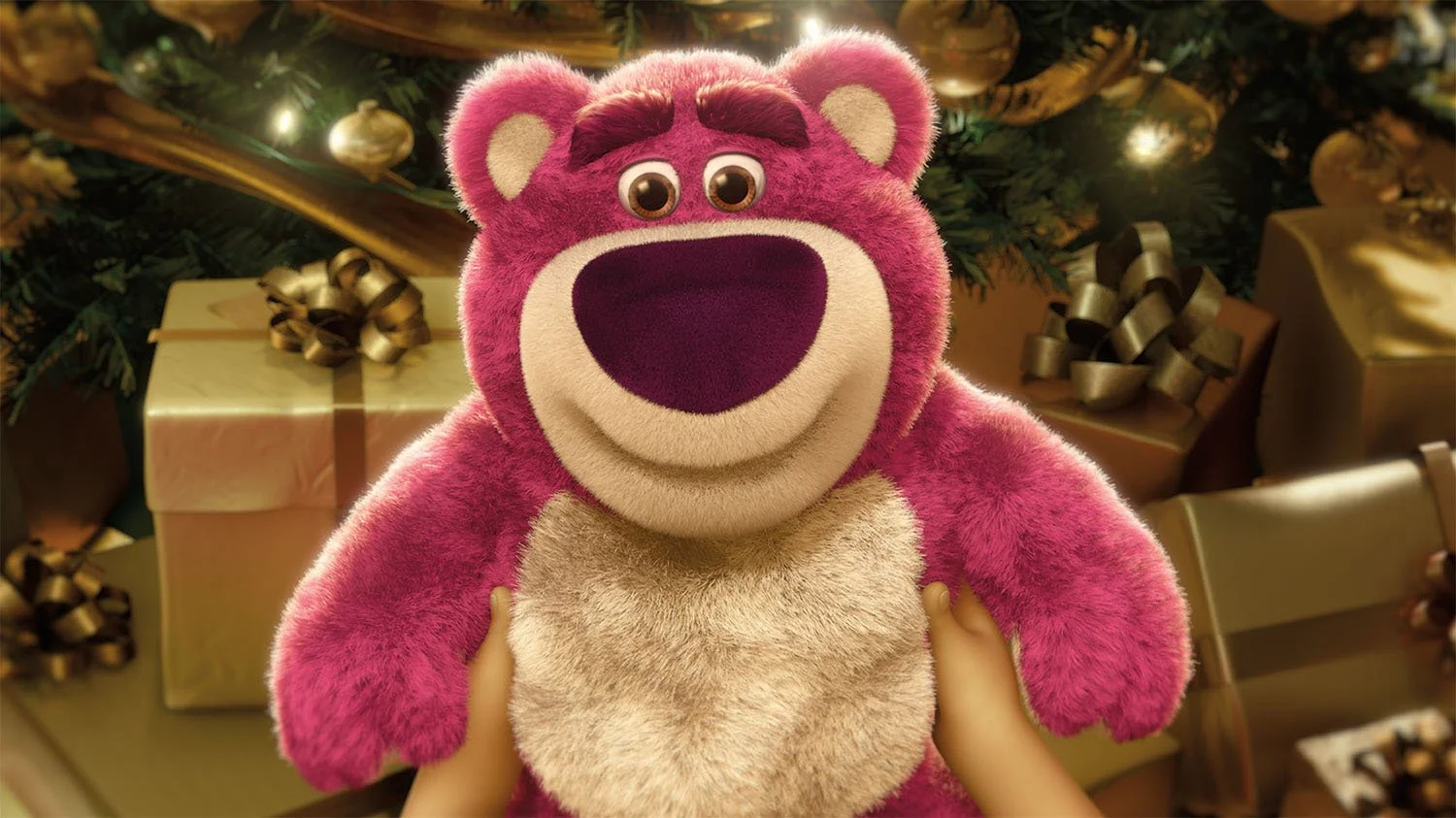
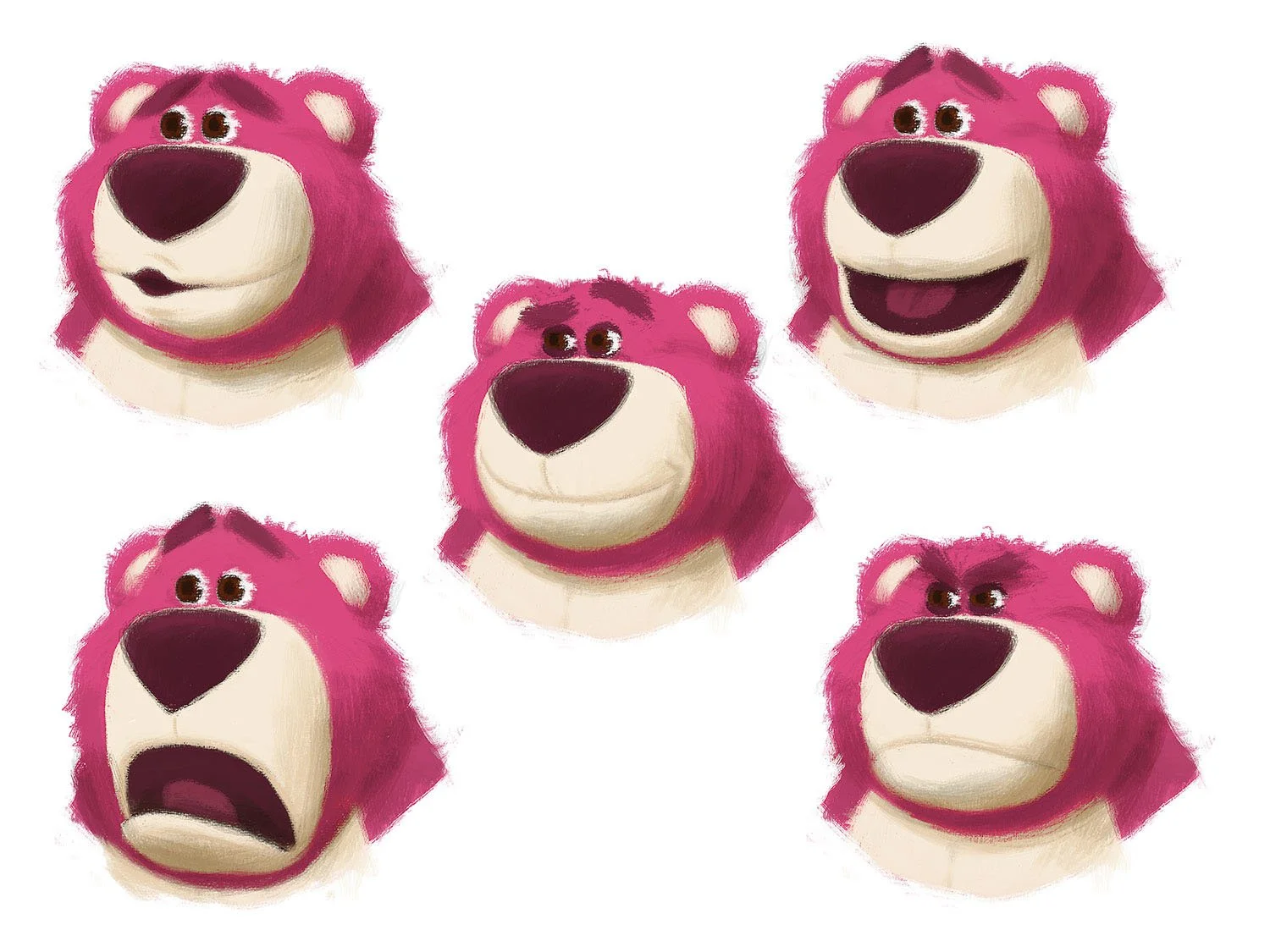
Pink fur, a large cream belly, rounded paws, soft stuffing, a broad smile, and strawberry scent make Lotso read as safety before he speaks. The body promises hugs and bedtime reassurance.
The villainy works because the design does not change when power becomes visible. Authoritarian control can arrive through a person who knows how to look comforting.
Ned Beatty makes hospitality sound institutional
Beatty gives Lotso an easy Southern warmth, practiced patience, and the voice of a leader who has explained the rules so often they sound natural. Anger sharpens the same cadence instead of replacing it.
The performance makes power feel older than the newcomers. Sunnyside appears to have customs, and Lotso sounds like the man who merely interprets them rather than the person who designed the abuse.
Daisy loved him before the roadside loss
Lotso, Big Baby, and Chuckles belonged to Daisy and shared family play. The attachment was not imaginary, manipulative, or a failed relationship from the beginning.
That fact matters because his ideology depends on rewriting love as a lie. If the original bond was real, then grief cannot be simplified into proof that nothing ever mattered.
The rest-stop accident creates abandonment without intent
The family leaves the toys during a stop, and they undertake a difficult journey home. Daisy does not knowingly discard them.
Lotso experiences the same absence whether it was intentional or not. Trauma begins in impact, while moral interpretation requires information he never receives.
The replacement bear becomes evidence he cannot metabolize
When they reach Daisy’s window, another Lotso occupies the bed. A parent likely replaced a beloved lost toy to comfort a grieving child. The act helps Daisy and devastates the returning original.
He interprets replaceability in the market as replaceability in the relationship. A duplicate body becomes proof that his individual history meant nothing.
He lies to Big Baby about being replaced too
Lotso tells Big Baby that Daisy replaced all of them, preventing the doll from returning to a child who still searches for him. Chuckles knows the lie and carries guilt and fear forward.
This is the first clear conversion of private pain into control. Lotso does not merely leave. He manufactures a shared betrayal so companions will remain dependent on his interpretation.
The Pizza Planet truck becomes forced exile
The three toys ride away on the truck, not because every member chooses a new life with full information, but because Lotso has made return appear impossible.
Mobility looks like survival while concealing kidnapping by deception. The later Sunnyside regime begins in a smaller group already organized around one person’s lie.
Sunnyside offers the perfect institutional raw material
A daycare receives donations, cycles children by age, separates rooms, stores toys after hours, and has adults who cannot see the society operating beneath them.
Lotso turns normal logistics into a labor system. Constant new arrivals replace workers faster than solidarity can form.
The Butterfly Room is privilege presented as merit
Older children play more carefully, giving toys assigned there safer labor and lower damage. Lotso’s insiders occupy that room and describe the arrangement as the natural order.
Newcomers are sent to the Caterpillar Room, where toddlers tear, throw, mouth, stomp, and exhaust them. Risk flows downward while comfort remains concentrated at the top.
The welcome tour is recruitment propaganda
Lotso presents Sunnyside as a place where children never grow up and toys will always be wanted. The statement targets Andy’s toys at the exact moment they fear storage and abandonment.
The pitch contains a structural truth and hides assignment conditions. Endless play is not liberation when some bodies absorb all dangerous contact.
He weaponizes the newcomers’ misunderstanding of Andy
The garbage-bag accident makes the group believe Andy threw them away. Lotso does not investigate or offer neutral options. He confirms the interpretation that makes Sunnyside more attractive.
Authoritarian recruitment often begins by amplifying injury, offering certainty, and making the institution appear to be the only community that understands.
Ken is beneficiary and recruiter
Ken enjoys private space, extensive clothing, status, and protection while helping welcome and monitor new toys. His comfort depends on a system he did not create but willingly supports.
Privilege becomes morally visible when Barbie exposes the labor underneath the Dreamhouse.
Big Baby carries attachment trauma as enforcement power
Big Baby remains connected to Daisy through a pendant and childlike emotional memory. Lotso uses the doll’s size and loyalty to intimidate prisoners.
The enforcer is also someone deceived into exile. Victimization and participation in abuse coexist without cancelling each other.
The Bookworm controls information infrastructure
Sunnyside’s manual and technical knowledge enable resets, surveillance, and containment. Access to instructions becomes state power.
Lotso’s regime does not rely only on strength. It controls who understands the toys’ bodies and the daycare’s systems.
Buzz’s reset is political reprogramming
Lotso’s group restores Buzz to factory Space Ranger mode, erasing learned relationships and redirecting obedience against his friends.
The act converts bodily vulnerability into policing. It is not merely imprisonment but identity manipulation used to manufacture a loyal officer.
The nighttime cages turn daycare into prison
New toys are confined in baskets, watched by rotating guards, and denied exit. Escape attempts produce punishment and public examples.
The child-friendly environment remains visually intact because human adults cannot see what the objects endure after closing.
The monkey surveillance system makes fear continuous
A toy monkey monitors security feeds and alerts guards. The system extends Lotso’s attention without requiring his physical presence.
Surveillance changes behavior before punishment occurs. Prisoners learn that private planning may be seen, producing self-censorship and mistrust.
Mr. Potato Head’s sandbox punishment is sensory violence
Isolation in the outdoor sandbox exposes a modular plastic body to cold, dirt, moisture, and possible loss of pieces. The punishment targets material vulnerability.
Lotso’s regime learns each body well enough to hurt it efficiently, the opposite of accessibility care.
Stretch and the other insiders show complicity is distributed
Lotso gives orders, but multiple toys capture newcomers, operate systems, and maintain segregation. Some act from fear, some status, and some belief.
Removing the leader cannot be the only reform. Institutional harm survives when daily roles remain unquestioned.
Woody threatens the regime with evidence, not just escape
He learns from Chuckles that Daisy still loved Big Baby and that Lotso lied. The information can break the emotional bond holding the most powerful enforcer.
Authoritarian systems fear competing memory because legitimacy depends on a controlled past.
The pendant becomes material proof against ideology
Daisy’s name and image reconnect Big Baby to a relationship Lotso declared meaningless. The object does not erase abandonment pain, but it disproves the totalizing lie.
Evidence becomes liberating when someone is emotionally able to receive it.
Lotso destroys the pendant because truth threatens power
He smashes the object and doubles down, choosing the regime over the companions who survived with him.
The act separates trauma response from deliberate domination. He now knows the lie harms Big Baby and protects it anyway.
Big Baby’s revolt is both personal and structural
Big Baby lifts Lotso and throws him into the dumpster. The enforcer refuses the story that justified years of obedience.
The image is satisfying, but liberation requires more than replacing one strong body with another. Sunnyside still needs new norms after the overthrow.
The landfill makes every hierarchy physically irrelevant
Trash trucks crush, sort, shred, and move toys without regard for status, rarity, loyalty, or leadership. Lotso reaches the same machinery as the prisoners.
Material vulnerability equalizes bodies while not equalizing responsibility for how they arrived.
Woody saves Lotso because ethics cannot depend on worthiness
The group frees him from the shredder even after Sunnyside. Rescue expresses who they choose to be, not a verdict that he deserves trust.
Mercy and reconciliation are different acts. Saving a life does not require restoring access to the community.
He abandons them at the emergency stop button
Lotso reaches the control that can halt the conveyor, looks back, and runs. The choice sends the rescuers toward the incinerator.
This is the film’s clearest moral line. He receives solidarity and responds with calculated abandonment when cooperation costs almost nothing.
The incinerator is his policy made literal
At Sunnyside, Lotso treats newcomers as replaceable bodies absorbing damage for insiders. At the dump, he allows the entire group to become disposable.
The fire reveals the ideology beneath the strawberry scent: other people’s lives matter only while they support his safety.
The Aliens save the group outside his moral universe
The characters Lotso would likely dismiss as repetitive or unserious operate the claw and perform the rescue.
Community survival comes from members whose value the hierarchy did not recognize, not from the strong leader.
The truck grille is consequence without restorative justice
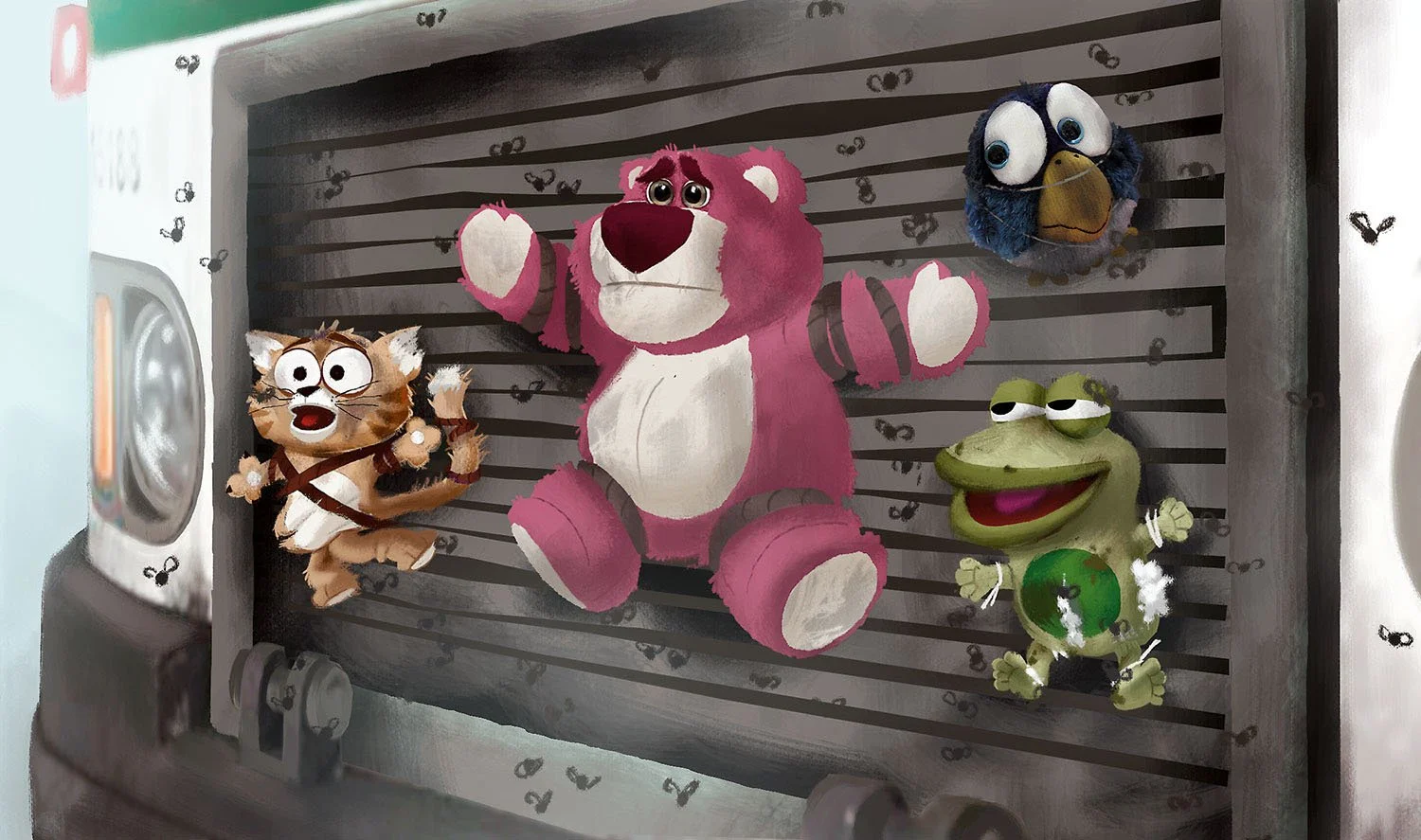
A garbage-truck driver straps Lotso to the front beside other toys. He is exposed to weather, insects, road debris, and the smell of trash.
The punishment is poetic and cruel. It removes his institutional power but does not require accountability, apology, or repair with victims.
His strawberry scent makes memory involuntary
Smell reaches memory quickly and can persist through wear. Lotso carries an engineered comfort cue even after his behavior makes the scent threatening.
The feature turns branding into atmosphere. A nursery promise follows him into prison and landfill.
His plush body hides sophisticated technical work
Pixar developed fur, global illumination, soft-body movement, and rigged wrinkles to make the bear feel huggable and physically present.
Technical realism strengthens the moral contrast. Viewers can almost feel the softness while watching him produce hard systems.
His cane performs age and harmlessness
Lotso walks with a cane, presenting as an older community elder whose mobility is limited. The accessory invites deference and makes later speed or force surprising.
Disability-coded presentation should not be treated as evidence of deception by itself. The problem is how he uses trust, not that a mobility aid complicates the first impression.
His politics turn grief into a theory of all relationships
Lotso insists owners replace toys and that caring is childish self-deception. The belief prevents future vulnerability by declaring intimacy fraudulent before it can matter.
He converts one experience into universal law, then forces institutions to make the law appear true.
His greatest flaw is making everyone live inside his wound
Lotso could leave, grieve, seek community, or reject child ownership personally. Instead, he creates conditions where newcomers experience disposability and then cites their suffering as proof that he was right.
The cycle is self-validating because the institution manufactures the evidence.
His greatest strength is organizational intelligence without ethical restraint
He understands rooms, schedules, security, body mechanics, recruitment, status, messaging, and enforcement. The regime works because he is observant and strategic.
Competence is morally neutral until directed. Lotso uses leadership talent to protect fear from contradiction.
What accountability would require
He would need to disclose the lie to Big Baby and Chuckles, name the Caterpillar exploitation, restore autonomy to reset toys, help dismantle surveillance, and accept exclusion from leadership.
Feeling abandoned or suffering on the truck grille would not substitute for repair.
Daisy is not the villain in his origin story
Lotso frames the replacement as if Daisy personally judged the original bear inadequate and chose a better copy. The film gives us no reason to accept that reading. Daisy is a child whose toy disappeared during a family trip. A parent replacing a lost comfort object is an attempt to ease a child’s grief, not an act of calculated betrayal against the missing object. The replacement proves that Daisy valued Lotso enough to miss him. It does not prove that the individual history with the first bear was meaningless.
This distinction matters because viewers can empathize with Lotso’s shock without inheriting his accusation. He sees a duplicate in his former place and makes Daisy responsible for an adult purchasing decision she may not understand. His pain is real. His conclusion about her intention is speculation, and his later violence depends on treating that speculation as settled fact.
Replacement terrifies toys because the franchise makes objects singular
Toy Story repeatedly places mass-produced bodies beside unique personal histories. A store shelf can hold hundreds of identical Buzz Lightyears, yet Andy’s Buzz becomes himself through relationships, choices, damage, repair, and memory. Lotso confronts the same problem from the opposite direction. He sees another body with his design and concludes that the body was all Daisy ever loved.
The franchise argues that commercial interchangeability does not erase lived particularity. Two toys can share a mold without sharing a life. Lotso refuses that answer because accepting it would require him to mourn a real relationship that ended through accident. Declaring the relationship fake feels safer than admitting something meaningful can disappear without anybody choosing cruelty.
Big Baby exposes the difference between grief and possession
Big Baby also loses Daisy, also survives the journey home, and also confronts the replacement scene. His attachment remains oriented toward the child rather than toward control of other toys. Lotso must actively lie, conceal evidence, and enforce dependence to keep Big Baby inside his worldview. That labor reveals the ideology is not the inevitable outcome of their shared trauma.
When Big Baby sees Daisy’s pendant, the response is immediate because the earlier bond was never fully erased. Lotso destroys the object rather than helping him process it. He would rather injure his oldest companion again than allow a competing interpretation of the past. At that point, Daisy is no longer the center of his choices. Preserving authority is.
Chuckles survives by keeping the forbidden memory
Chuckles remembers Daisy, the journey, the replacement, and Lotso’s lie. His sadness is quiet, but his testimony becomes one of the most politically important acts in the film. He gives Woody a history that Sunnyside’s leader worked to suppress. The clown’s grief does not become an excuse to dominate. It becomes a difficult obligation to tell the truth when another community is in danger.
That contrast prevents the origin story from functioning as moral absolution. Chuckles experienced the same loss and did not build a daycare prison. Big Baby experienced the same loss and eventually rejects the lie. Lotso’s wound explains where his fear began, but the other survivors prove his system was a choice sustained through repeated choices.
Sunnyside runs on a deliberately unequal distribution of damage
The Caterpillar Room is not simply a bad classroom. It is the place where the daycare concentrates the roughest play and assigns the newest, least informed toys to absorb it. Butterfly residents receive gentler children, better storage, and the freedom to enjoy the institution’s promise. Their comfort is produced by keeping vulnerable newcomers in a cycle of breakage and replacement.
Lotso therefore governs more than a prison. He governs a labor economy organized around bodily wear. Toys are workers whose bodies are their means of play, and the ruling group protects its own bodies by sacrificing others. The cheerful daycare branding hides the transfer of risk. That is why escape threatens the whole structure: if newcomers can refuse, insiders may have to share the dangerous work.
His welcome speech is effective because most of it is true
Children at Sunnyside do keep arriving. No single owner will age out of the daycare and place every toy in an attic. Donated toys can find renewed purpose there. Lotso understands those genuine advantages and attaches them to a false promise of equal belonging. His propaganda works through selective truth, not obvious nonsense.
He also reads Andy’s toys accurately. They are frightened, angry, and unsure whether loyalty has made them foolish. Instead of inventing their insecurity, he names it and offers an institution that appears to solve it. The manipulation lies in withholding the conditions: assignment without consent, punishment for exit, and a privileged class that never experiences the bargain it praises.
Lotso performs paternal care while denying adult autonomy
He calls toys family, uses an elder’s cadence, and presents rules as protection from a world that hurts abandoned objects. Paternal language lets him treat disagreement as immaturity. Prisoners do not need to consent because he claims to understand survival better than they do.
The performance is especially potent around Big Baby, whose design and emotional vocabulary invite caretaking. Lotso turns care upside down. He keeps the doll dependent on a false account of Daisy and then uses that dependence as muscle. The relationship resembles guardianship only from a distance. Up close, it is control maintained by restricting information.
The reset of Buzz violates the franchise’s central idea of personhood
Buzz’s first film arc establishes that personhood grows beyond factory programming. He becomes a friend not because the Space Ranger identity was worthless, but because experience adds choice, humility, loyalty, and memory. Resetting him does more than change his mood. It removes the relational self the series spent years building.
Lotso’s group then exploits the factory state because programmed authority is easier to direct than a person with loyalties. The scene turns a comedy callback into an assault on identity. Buzz can be made useful to the regime only after his accumulated life is temporarily suppressed. That is Lotso’s politics in miniature: bodies are valued as functions, while inconvenient histories are deleted.
Woody and Lotso offer competing responses to being left behind
Woody has spent the franchise fearing replacement, obsolescence, donation, and the end of a child’s attention. He understands the terror beneath Lotso’s doctrine more closely than most characters. The difference is not that Woody never becomes jealous or controlling. The first film shows that he can. The difference is that relationships challenge him, and he changes.
Lotso treats change as surrender. If he admits another interpretation of Daisy, Sunnyside, or the newcomers, he must confront years of avoidable harm. Woody accepts the pain of revising himself because friendship matters more than always having been right. Lotso protects the identity of the betrayed leader even when that identity demands fresh victims.
The emergency-stop betrayal is a choice made after rescue
The landfill sequence removes every excuse based on misunderstanding. Woody and the others know what Lotso did, yet they risk their lives to pull him free. He knows they have extended mercy. He reaches the stop control because their cooperation made it possible. Nothing about Daisy, Sunnyside, or replacement forces the next decision.
When he abandons them, he demonstrates that grievance is no longer merely defensive armor. He actively chooses a world in which people who helped him may burn because acknowledging mutual obligation would contradict his creed. The glance back matters. He recognizes the consequence and proceeds. That moment is why a tragic origin does not convert him into a misunderstood hero.
The film refuses the easy redemption beat
A more conventional story might let Lotso press the button, apologize, and earn a place beside the toys he imprisoned. Toy Story 3 denies that emotional shortcut. A single good action could save lives, but it could not automatically repair Sunnyside. The film goes further by withholding even that first action.
This refusal protects the victims from becoming props in the antagonist’s healing. Their survival and future do not depend on forgiving him. Barbie, Ken, and Big Baby can reform the daycare without centering the leader who harmed them. Lotso’s ending is unresolved in a psychologically honest way: consequence arrives, while transformation does not.
Redemption would also require time, testimony, and a willingness to lose status. It would mean listening to toys describe harms he prefers to call necessary, accepting that some will never trust him, and contributing to repair without demanding affection as payment. The movie does not claim that change is metaphysically impossible. It refuses to confuse one dramatic gesture with the slower work that change would require.
Sunnyside after Lotso proves institutions can be rebuilt
The postcards show the daycare becoming safer, more participatory, and less segregated. Ken and Barbie help administer rather than merely inherit the old throne. Toys rotate through the Caterpillar Room so damage is not permanently assigned to the newest arrivals.
That epilogue clarifies that the building was never inherently evil. Daycare, recurring children, and communal ownership can support a good toy society when risk and voice are shared. Lotso presented exploitation as the price of survival. The reformed Sunnyside exposes that claim as political convenience. Another system was possible inside the same walls.
Final character read
Lotso is not evil because Daisy replaced a lost bear. He becomes dangerous when he decides nobody else may believe love was real, then builds an institution that punishes anyone who tries to leave. His history earns empathy for the injury, not immunity from judgment about the choices that follow.
The strawberry scent makes the thesis unavoidable: comfort aesthetics can conceal organized cruelty. The softest body in the room creates the hardest rules, and the leader who speaks most often about abandonment repeatedly abandons others when they need him. Character verdict: one of Pixar’s strongest antagonists because the prison is not a tantrum. It is grief converted into policy.