
Memory, Sorrow, and Thorn · Canonical Character Profile
Lost Piqipeg
Lost Piqipeg is a legendary Qanuc troll hero whose wandering is so culturally familiar that Binabik can use it as a unit of conversational distance. We do not receive the journey. We receive the name, the heroic classification, and one perfect idiom: the companions have wandered as far from the point as Piqipeg wandered from wherever home was.
At a Glance
The Qanuc hero whose legendary detour becomes Binabik’s way of saying “we have lost the point”
- Name
- Lost Piqipeg
- People
- Qanuc
- Identity type
- Legendary troll hero
- Known motif
- Extensive wandering
- Book 1 speaker
- Binabik
- Book 1 function
- Cultural comparison for a conversation that has strayed
- Journey details
- Unrecorded in the verified passage
- Status
- Legendary figure
The Book 1 Line
Binabik ends a digression by invoking the patron saint of taking the scenic route
Lost Piqipeg appears in The Dragonbone Chair through Binabik’s speech. The troll realizes that the conversation has drifted and cuts it off with a comparison: they have wandered as far as Lost Piqipeg wandered.
The line works because the name already carries a story inside Qanuc culture. Binabik does not stop to explain who Piqipeg was, where the wandering began, how long it lasted, or whether the hero ever returned. The comparison assumes that the distance is famous.
For Simon and the reader, the proper name creates texture before explanation arrives. The owned-edition glossary later identifies Lost Piqipeg as a legendary Qanuc troll hero. That receipt prevents us from treating the phrase as a nickname for a contemporary traveler or a place-name.
The joke is gentle and functional. Binabik uses inherited narrative to manage present conversation. A legend becomes shorthand for “enough; back to the matter.”
What “Lost” Confirms
The epithet preserves a famous wandering; it does not tell us whether Piqipeg failed
“Lost” is part of the name by which the figure survives. Binabik’s wording joins it to wandering. Together, those receipts support a tradition in which Piqipeg traveled far from an expected course, destination, subject, or home.
The epithet does not automatically make the hero incompetent. Legendary wandering may result from courage, duty, weather, enchantment, pursuit, rescue, exile, curiosity, bad navigation, deliberate sacrifice, or a comic sequence. The glossary still calls Piqipeg a hero.
That heroic classification matters. Qanuc tradition apparently remembers the figure with esteem even though the most portable feature of the story is being lost. The contrast may be comic. It may also preserve a culture’s respect for survival, return, discovery, or endurance rather than perfect control.
We do not know whether Piqipeg found the intended destination, discovered somewhere better, returned home, died on the road, or remains “lost” inside the legend. We do not know whether the title was affectionate, solemn, mocking, or all three depending on the teller.
A fandom hub should not convert an evocative epithet into a full quest summary. The honest profile can analyze how the name functions without drawing a map the book never provided.
Qanuc Cultural Context
The hero belongs to Binabik’s living vocabulary, not a museum case labeled “troll folklore”
Binabik carries Qanuc knowledge through every conversation: language patterns, mountain practice, proverbs, songs, survival craft, animal partnership, and the teachings of Ookequk. His reference to Piqipeg belongs to that same cultural presence.
The legend is not introduced by an outside scholar explaining the Qanuc to a court. A Qanuc man uses it naturally while traveling with companions. That changes the power of the receipt. Piqipeg is not merely an object of distant research. The name still works inside ordinary speech.
The word “troll” is the series’ common label for Binabik’s people, while Qanuc is the people’s own name in the story’s usage. The profile keeps both because the owned glossary describes Piqipeg as a legendary Qanuc troll hero. It should not import troll imagery from unrelated fantasy traditions.
Nothing in the Piqipeg receipt assigns the hero Binabik’s occupation, wolf companion, armor, staff, height, facial features, gender, or home village. Cultural continuity is not personal duplication.
The reference also reminds us that Qanuc history extends beyond characters currently helping Simon. A living culture has its own famous fools, travelers, heroes, detours, and jokes. Piqipeg enlarges that shelf with one sentence.
Binabik as Story Carrier
The comparison tells us something about the speaker without turning the legend into his biography
Binabik often speaks in carefully arranged Erkynlandish, with syntax that makes familiar assumptions sound newly examined. The Piqipeg comparison adds a reference his companions may not share. He does not flatten his speech into their cultural world simply to make travel easier.
The moment shows intellectual play. He recognizes the digression, names its scale, and redirects the group through humor rather than command. Piqipeg supplies the punch line.
That does not mean Binabik personally worships, descends from, studies, or resembles the hero. No family relationship appears. No childhood telling is recorded. We should not place Piqipeg under Ookequk’s teaching lineage or invent a festival where the story is performed.
The safe relationship is storyteller-language rather than personal acquaintance: Binabik knows and uses a cultural comparison built around Lost Piqipeg.
Legend, History, and Evidence
Canonical inside Osten Ard does not mean every legendary event is neutral camera footage
Lost Piqipeg is canonical as a named legendary Qanuc hero. The existence of a tradition around the figure is direct evidence. The historical truth beneath that tradition is not available in the verified passage.
Legends can preserve people, combine people, exaggerate distance, relocate events, convert failure into comedy, or turn survival into moral instruction. We do not know what process shaped Piqipeg’s name.
A complete profile should identify its evidence layer each time. “Binabik compares the group’s digression to Piqipeg’s wandering” is direct narrative fact. “Piqipeg wandered across the entire continent for years” would be invention. “Piqipeg was a celebrated explorer” might sound reasonable but still exceeds the word “hero.”
The lack of a reproduced legend is frustrating and useful. It lets the world feel older and larger than the plot’s ability to footnote every reference.
Connections
The Qanuc speaker, cultural tradition, and traveling companions around Piqipeg’s one Book 1 mention
Binabik
Uses Piqipeg’s wandering as a humorous comparison when the present conversation has strayed too far.
The Qanuc
The people whose legendary tradition identifies Piqipeg as a troll hero.
Ookequk
Binabik’s teacher and another carrier of Qanuc knowledge; no direct relationship with Piqipeg is recorded.
Simon
Part of the traveling story-world in which Binabik’s cultural references broaden the education beyond castle history.
Qinkipa of the Snows
A separate Qanuc legendary identity who must not be merged with Piqipeg’s missing wandering tale.
Book 1 oral tradition
The wider shelf of gods, heroes, songs, and story figures carried through idiom rather than foreground action.
Character Image Continuity
A hot Qanuc legendary hero, yes; Binabik in a different coat, absolutely not
Visual state: approved Qanuc legendary interpretation. Lost Piqipeg now has one permanent interpretive identity, and this profile is published. The treatment remains labeled interpretation because the text describes neither body nor journey.
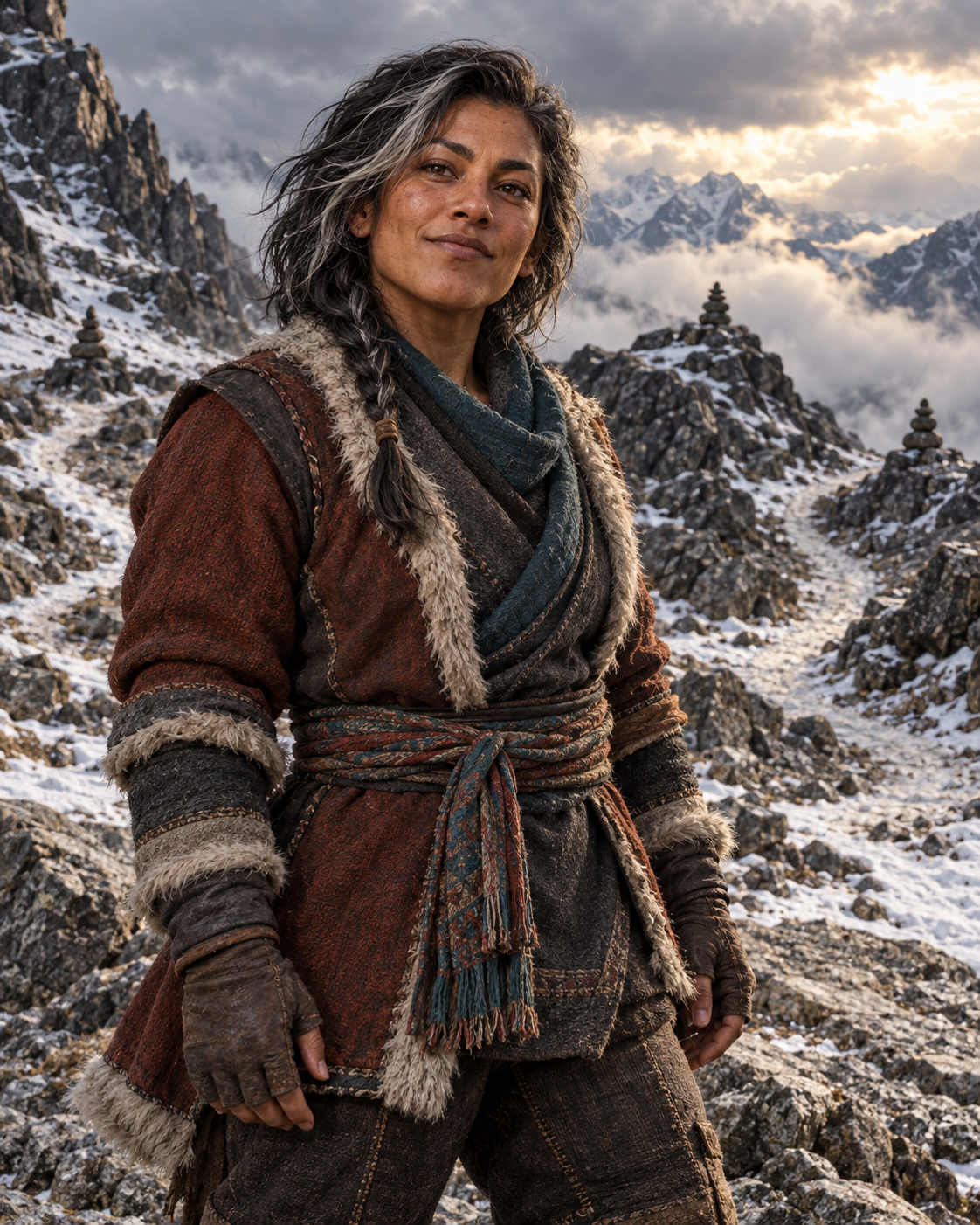
CVM depicts Piqipeg with an intentionally androgynous adult presentation around thirty: compact athletic endurance build, deep brown eyes, rich copper-brown weathered skin, shoulder-length black hair heavily threaded with silver and one asymmetrical side braid, no facial hair, and a knowing amused half-smile. Muted-russet, deep-teal, charcoal, bone-white, dark-brown hide and wool keep the identity grounded in Qanuc visual continuity while remaining entirely distinct from Binabik, Ookequk, Sisqi, and every other approved Qanuc face. This presentation does not settle canonical gender.
Canon does not confirm Piqipeg’s gender, age, face, hair, eyes, clothing, staff, blade, wolf, ram, horse, pack, map, mountain, weather, or historical era. Even a snowy landscape is an interpretive choice rather than a receipt from the line.
The branching snow-dusted route and unmarked cairns communicate endurance and disorientation without claiming a canonical map. Preserve this exact face, adult baseline, compact body, coloring, silver-streaked hair/braid map, russet/teal/charcoal wardrobe, gloves, and wry competence across every reuse. Do not illustrate a specific monster, destination, companion, rescue, or full legend.
“Lost” must not become slapstick stupidity by default. The glossary calls Piqipeg a hero. A compelling image can hold humor, competence, and uncertainty at once.
The same canonical attachment powers featured image, hero, directory card, social metadata, Qanuc context shelves, and every future depiction. Alternate scenes must preserve the locked face and physical identity while retaining the legendary-interpretation label.
Why Lost Piqipeg Matters
The legend makes Qanuc memory sound lived-in instead of added for exposition
Piqipeg does not advance the sword quest. The name advances the world.
Through one comparison, we learn that Qanuc culture remembers a wandering hero vividly enough for the story to become conversational shorthand. We also learn that heroic memory can be funny. Reverence does not require solemnity every time the name is spoken.
The phrase gives Binabik cultural interiority. He is not only the guide who explains mountains to Simon. He has references that predate the group, outlive the immediate danger, and need no mortal approval to be meaningful.
A weak profile would pad the page with an invented travelogue. A complete one preserves the exact phrase, legendary classification, speaker, social function, cultural stakes, evidence layer, visual boundaries, and all the delicious unanswered questions the book intentionally leaves behind.
Sometimes the richest worldbuilding is a joke whose source story everybody inside the culture already knows.
On the Record
One direct idiom, one glossary receipt, and a journey the book does not retell
This is Lost Piqipeg’s one canonical, full-spoiler profile across Memory, Sorrow, and Thorn.
The owned Kindle edition of The Dragonbone Chair records Binabik saying that the conversation has wandered as far as the wandering of Lost Piqipeg. The owned-edition glossary identifies Lost Piqipeg as a legendary Qanuc troll hero.
The evidence confirms the canonical name or epithet, Qanuc identity, troll label, heroic and legendary classification, association with extensive wandering, Binabik as speaker, and conversational use as a comparison for digression.
The evidence does not confirm gender, age, appearance, family, village, occupation, route, destination, reason for being lost, companions, enemies, mount, weapon, abilities, duration, return, death, historical period, or full legend.
Status: legendary figure.
Visual state: approved Qanuc legendary interpretation. Every physical, gender-presentation, garment, route, cairn, weather, pose, and lighting detail is CVM interpretation; the art does not settle the full journey or historical truth beneath the legend. The same attachment powers featured image, hero, directory card, and social metadata.