
Memory, Sorrow, and Thorn · Canonical Ancestral Profile
Lingit
Lingit is Sedda’s hidden son and the ancestral figure through whom the Qanuc understand mortal continuity. He and his twin Yana survive the bird-lord’s taking, choose between two patterns of death, and become roots of peoples whose later friendship still remembers the Moon Woman. His name lives in Chidsik ub Lingit, in Ookequk’s final declaration that he is a Child of Lingit, and in the wind-song sung over Qanuc and Utku dead.
At a Glance
The hidden child whose mortal choice becomes a people’s way of naming themselves
- Name
- Lingit
- Tradition
- Qanuc sacred ancestry and song
- Mother
- Sedda, Moon Woman and Dark Mother
- Twin
- Yana, associated with Sithi ancestry
- Choice
- Bird-death: continuity through descendants
- Descendants
- Qanuc and mortal peoples in Qanuc tradition
- Sacred place
- Chidsik ub Lingit, House of the Ancestor
Moon-Death and Bird-Death
The twins do not choose whether to die; they choose how continuation works
Lingit and Yana must choose between two mortal patterns. Moon-death returns cyclically. Bird-death survives through descendants.
Yana chooses the Moon pattern and becomes a Sithi foremother in Qanuc tradition. Lingit takes the pattern of mortal continuity through offspring and becomes the ancestral root through whom the Qanuc understand themselves.
The distinction changes mortality from a simple divine punishment into an inheritance containing agency. Neither option abolishes loss. One returns; the other continues through children who are related but not identical.
Lingit’s choice makes finitude generative. Mortal lives end, but relationship, teaching, names, bodies, and community move forward. That idea later fits the Qanuc themselves: short-lived beside the Sithi, vulnerable to winter and violence, yet carrying memory through songs, apprentices, children, and collective rites.
Qanuc and Sithi Kinship
The twins place two very different peoples inside one sacred family
Jiriki invokes the Qanuc–Sithi primeval friendship and their shared root in the Moon Woman. The relationship is not simply diplomacy invented during the Storm King crisis. Qanuc tradition already places Lingit and Yana as twins beneath Sedda.
This does not prove that every biological or historical detail of the song is literal. It proves how the Qanuc understand relationship: mortal mountain people and immortal Gardenborn share sacred kinship before later distance and mistrust.
Ookequk learned Sithi speech directly from the Sithi, and Jiriki remembers that his people once loved the Qanuc well. Those historical traces echo the ancestral song. Lingit’s profile therefore belongs not only to creation lore but to the political possibility of renewed alliance.
When Jiriki appeals to shared roots during Binabik’s crisis, myth becomes diplomatic vocabulary. Sacred ancestry provides a reason to listen across difference without erasing the Qanuc leaders’ authority or the real consequences of Binabik’s absence.
Chidsik ub Lingit
The House of the Ancestor turns his name into civic space
At Mintahoq, the great cavern Chidsik ub Lingit—House of the Ancestor—is guarded by immense horned and tusked stone figures. Hundreds of pools of burning oil illuminate the interior.
Nunuuika the Huntress and Uammannaq the Herder rule within a ring of flame. The hearing over Binabik and Sludig occurs inside this sacred-political environment. The house is not a museum dedicated to a dead myth. It is a place where leadership, law, hospitality, punishment, and changed evidence meet.
Sisqi’s familiarity with the House of the Ancestor helps her recognize the black-thong knot sealing Ookequk’s death testament. Her cultural literacy interrupts an execution. Lingit’s name thus surrounds a legal process capable of revising itself when missing knowledge appears.
The space makes ancestry institutional without making it static. Nunuuika concludes that tradition once served the people but now shackles them under unprecedented winter. Inside the ancestor’s house, the leaders honor survival by changing course.
Children of Lingit
Ookequk names life, land, and ancestry together in his final testimony
In the death-song preserved inside his cave, Ookequk identifies himself as Singing Man of Mintahoq and the mountains of Yiqanuc. He warns of the cold darkness from Vihyuyaq, names Binabik as student and successor, and asks the community to honor him.
His farewell celebrates being alive, being a Child of Lingit, and living on beautiful Mintahoq. Ancestry is not abstract blood prestige. It joins mortal life to a particular mountain home, responsibility, and the succession of knowledge.
Ookequk expects death and still speaks of life as a gift worth naming. That posture embodies Bird-death’s logic. The teacher will not return as the same living man, but his warning, scrolls, student, birds, language, and communal judgment continue through other people.
Binabik’s grief proves continuation is not replacement. Becoming the next Singing Man does not make Ookequk’s death painless or complete the interrupted apprenticeship. Lingit’s mortal pattern allows legacy; it does not require survivors to pretend loss is solved.
The Wind-Song
Lingit’s sacred story crosses into a funeral shared with an Utku friend
After the Hunën battle, the company builds ten cairns: nine smaller graves for Qanuc dead and a larger one for Haestan. Binabik sings the Sedda–Lingit–Yana wind-song in Westerling for Haestan.
Sludig adds an Aedonite prayer and leaves his wooden Tree on the cairn. The rites coexist. The song does not convert Haestan into a Qanuc ancestor, and the Tree does not overwrite the Qanuc dead.
Lingit’s mortality tradition becomes appropriate because Qanuc and Utku have fought, bled, and died together for the first time in a thousand years. Continuity through descendants expands into continuity through alliance, memory, and friends willing to carry one another’s names.
Translation matters. Binabik sings in Westerling so the lowlanders can receive meaning rather than only atmosphere. The sacred song remains Qanuc while becoming generous enough to mourn across cultural boundaries.
Connections
The mother, twin, descendants, and memory-keepers around Lingit
Sedda
Moon Woman and Dark Mother who hides Lingit and Yana from the husband taking her children.
Yana
His twin, associated with Moon-death and Sithi ancestry in Qanuc tradition.
Ookequk
Singing Man who names himself a Child of Lingit in the testament that saves Binabik.
Binabik
Teacher and singer who carries the Lingit cycle into friendship, funeral, and the southern war.
The Qanuc
Mortal mountain descendants who place law and leadership inside the House of the Ancestor.
Jiriki
Sitha prince who invokes shared Moon Woman ancestry as part of Qanuc–Sithi relationship.
Why Lingit Matters
He gives mortal life a sacred logic that is neither inferiority nor consolation prize
The Sithi’s long wakefulness can make mortal life appear painfully brief. Lingit’s story refuses the assumption that duration is the only measure of value.
Bird-death creates continuity through other lives. The choice fits the trilogy’s deepest human work: teachers die and students carry questions; parents vanish and children build homes; friends fall and songs preserve them; kingdoms fail and communities revise tradition.
Lingit is therefore not only a glossary entry explaining Qanuc origins. His pattern describes how the entire mortal coalition survives history—never by remaining unchanged, but by passing enough love, knowledge, and responsibility forward for someone else to continue.
On the Record
Books 1–2, sacred ancestry, and one reconciled descent reading
This is Lingit’s one canonical full-spoiler ancestral profile. Book 1 introduces the Sedda song and Qanuc descent. Book 2 places his name in the House of the Ancestor, Ookequk’s death-song, shared-root diplomacy, and the mixed funeral. The existing Books 1–2 scope is retained.
The direct reading receipts identify Lingit as Sedda’s hidden son, Yana’s twin, and the ancestral root connected to Qanuc/mortal continuity through descendants. One later ledger summary accidentally reverses the twin attribution while the detailed receipts and character tracker agree on Lingit; this profile follows the reconciled reading record rather than reproducing the summary error.
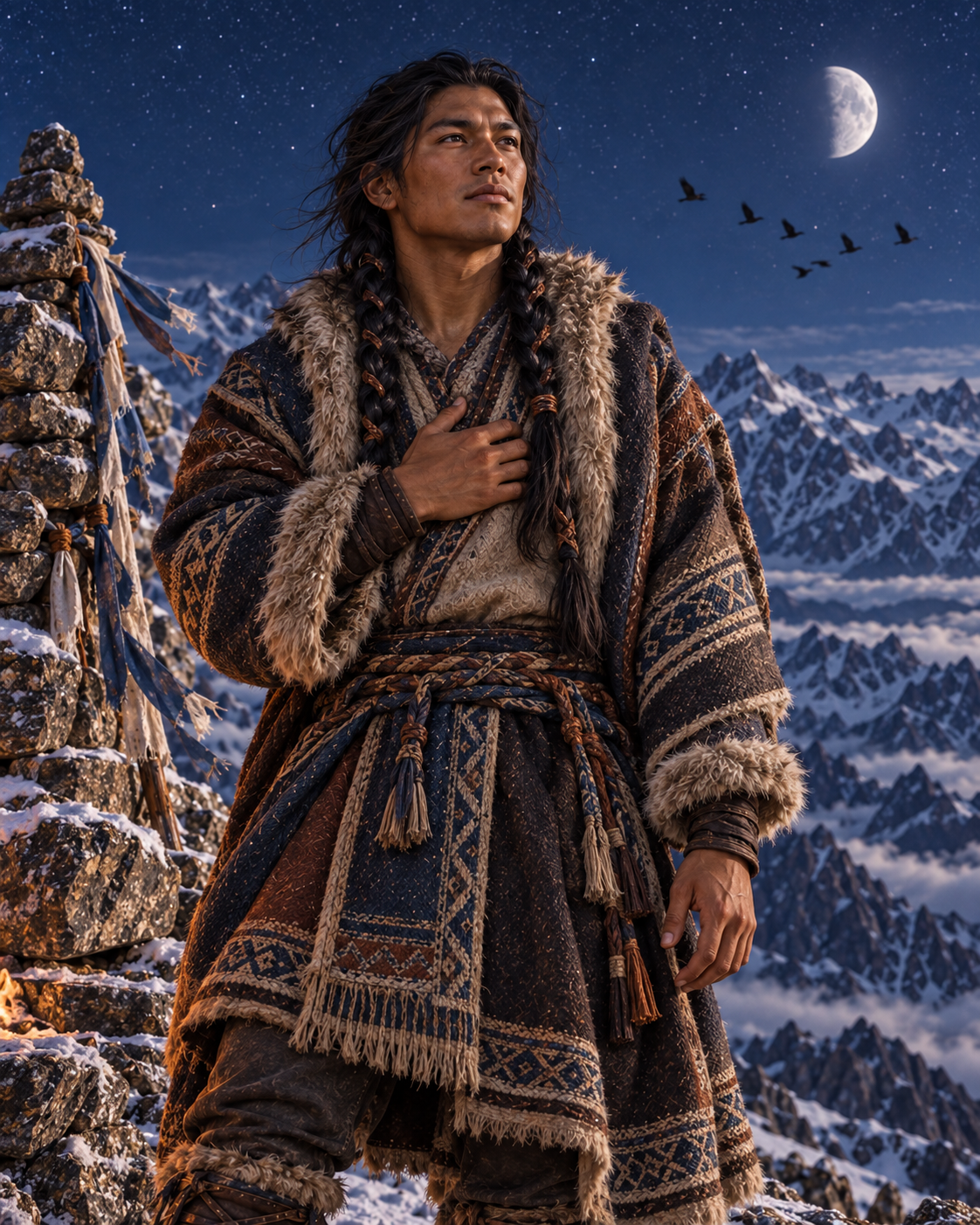
Visual state: approved ancestral interpretation. No material appearance is verified. The text does not supply age, face, body, complexion, eyes, hair, braids, clothing, cairn, birds, ribbons, weather, voice, or a present-tense divine body. Every visible detail is CVM’s visualization of Qanuc sacred tradition and must not be presented as witnessed canon.
The approved attachment is the single source for Lingit’s featured image, visible hero, directory cards, and social metadata. Preserve this exact young adult face, compact athletic body, rounded ears, bronze complexion, dark eyes, and twin heavy braids across every later ancestral visualization. Yana’s eventual identity must read as his sibling without duplicating or gender-swapping him.