
STITCH! CHARACTER PROFILE · IZAYOI · RYUKYUAN FOLKLORE · FRIENDSHIP
Kijimunaa Character Profile: The Island Spirit Who Refuses to Become Stitch’s Sidekick
Before Stitch landed, Yuna already had an impossible friend. Kijimunaa makes the anime remember that an island has stories before a franchise arrives.
Profile record
Name: Kijimunaa
Nature: Island spirit inspired by Okinawan and Ryukyuan folklore
Home: Izayoi Island
Closest relationships: Yuna, Obaa, Stitch
Known for: Local knowledge, expressive warnings, loyalty under fear, comic arguments
Japanese voice: Kappei Yamaguchi
Appears in: The Japanese Stitch! anime branch
An old presence in a newly imported franchise
Kijimunaa does something essential for Stitch! before he delivers a single joke. He proves that Izayoi possessed its own impossible life before an alien fell from the sky. The island is not an empty stage waiting for a famous visitor to make it magical. Its stories, spirits, grudges, and friendships already have roots.
That changes the balance of the branch. Stitch arrives with the power of a global franchise behind him, while Kijimunaa carries the local world the adaptation chose to enter. Their scenes become a test of whether the series will let Okinawan and Ryukyuan cultural material shape the story or use it as colorful scenery around an imported hero.
What a kijimunaa is and what the anime changes
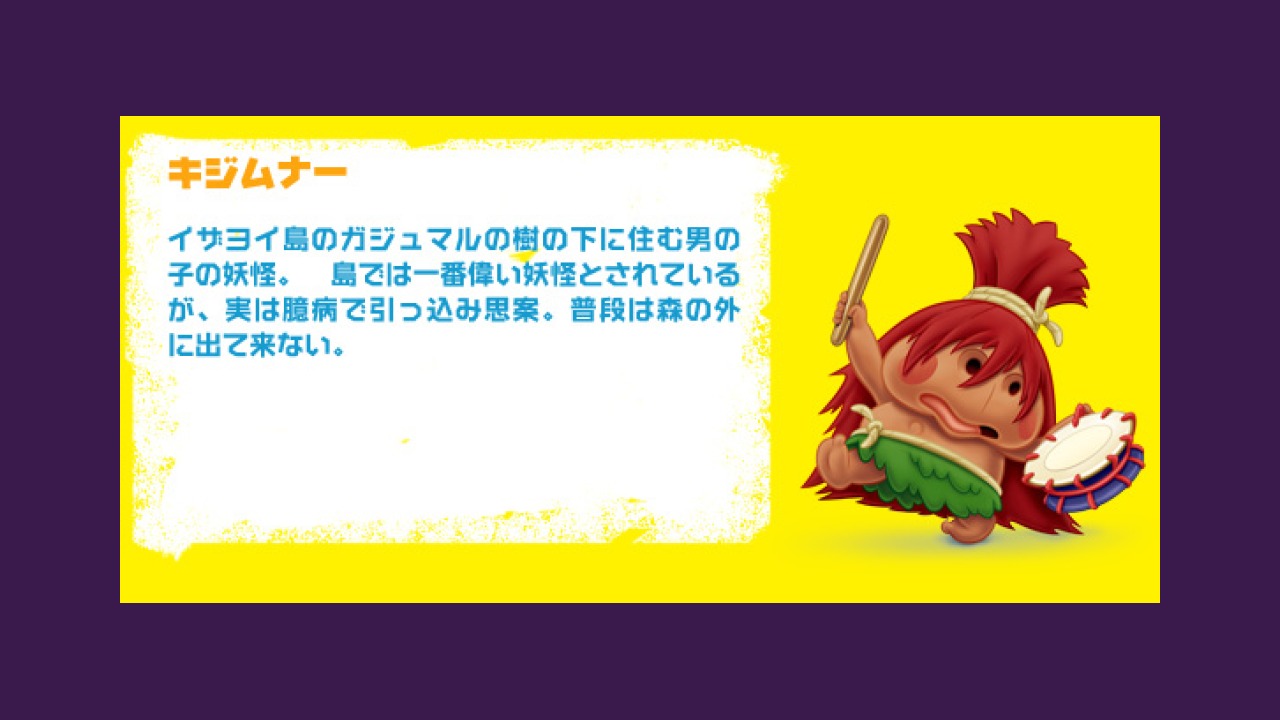
Kijimunaa are tree spirits associated with Okinawan and Ryukyuan folklore, often linked with large banyan trees and described through red hair, childlike appearance, fishing, mischief, and strong preferences. Folklore changes across tellings and islands. A franchise character cannot stand in for every living tradition attached to the name.
The anime turns that larger cultural figure into one recurring individual who can argue with Yuna, panic, brag, help, and become part of a comedy ensemble. That adaptation creates access for younger viewers, but it also creates responsibility. The character should lead audiences toward the culture rather than convince them the franchise version has exhausted it.
Yuna’s friend before Stitch
Kijimunaa’s relationship with Yuna matters because it interrupts the idea that Stitch supplied her first extraordinary friendship. She knows how to speak with a being other people may dismiss, how to read irritation beneath performance, and how to accept that affection can include rules. Those skills do not suddenly appear when Stitch needs them.
He also holds evidence of Yuna’s life before the series begins. Their familiarity implies off-screen arguments, shared discoveries, reconciliations, and island routines. When Stitch enters the friendship, he is joining an existing history. The story becomes stronger whenever it remembers that he is not automatically entitled to become the center of every bond.
The friendship triangle without a disposable third wheel
Children’s animation often creates a trio and then quietly demotes one member whenever the title character needs emotional focus. Kijimunaa is vulnerable to that pattern. His fear or jealousy can be turned into a quick gag, while Yuna and Stitch receive the scene that declares the real friendship restored.
A better reading treats his reaction as information. Stitch is powerful, possessive, and accustomed to being loved loudly. Kijimunaa has legitimate reasons to wonder whether a new arrival will erase the place he already held. The conflict becomes meaningful when Yuna must protect both relationships instead of demanding that the less marketable friend accept less.
Courage that does not look like Stitch’s courage
Stitch can meet danger by lifting, smashing, leaping, and surviving impacts that would end the adventure for anybody else. Kijimunaa cannot compete on those terms, and the series should not measure bravery by alien durability. His courage often appears in returning after fear, sharing knowledge, warning the others, or entering a danger whose rules he understands better than they do.
That difference gives action scenes emotional texture. Fear does not cancel loyalty. Physical limitation does not make a character useless. When Kijimunaa contributes through memory, local access, or a choice made while trembling, the anime argues that heroism belongs to more than the strongest body in the frame.
Comedy, dignity, and the easy punchline
Kijimunaa is funny because he is expressive, opinionated, and willing to react at full volume. The danger arrives when the production treats humiliation as his only reliable function. A character tied to local folklore should not spend every episode validating the coolness of the imported mascot by being weaker, fussier, or easier to frighten.
Good comedy lets him win some exchanges. He can know more than Stitch, catch Yuna hiding something, identify a supernatural problem, or refuse a reckless plan that later collapses exactly as predicted. Dignity does not require solemnity. It requires the joke to move around the ensemble instead of landing on the same cultural figure every time.
His relationship with Obaa
Obaa understands that Kijimunaa belongs to a reality larger than the children’s current adventure. Their familiarity establishes a bridge between household memory and spirit presence. She can correct Yuna’s assumptions without treating her friend as an exotic discovery, because the island’s relationship with beings like him did not begin with this generation.
That connection also gives Kijimunaa an adult who recognizes his standing. He is not merely Yuna’s invisible companion tolerated until bedtime. Obaa’s recognition validates boundaries and obligations the children might otherwise ignore. The series gains depth when their exchanges suggest history without overexplaining every mystery.
Alien science beside island cosmology
Jumba’s experiments come with numbers, designed functions, and a scientific origin story, even when the science is cheerfully impossible. Kijimunaa does not fit that filing system. His existence asks the branch to hold two kinds of wonder at once instead of explaining the local spirit through alien machinery.
The difference matters most during mixed crises. If every supernatural event eventually becomes another experiment, Izayoi loses its independent imagination. When folklore retains its own rules, Stitch has to learn rather than dominate. The imported character becomes a guest inside somebody else’s knowledge.
The Chitama Stone and the problem with earned magic
The forty-three-good-deed premise tempts Stitch to treat goodness as a transaction. Kijimunaa sits close to another understanding of the extraordinary, one grounded in relationship, conduct, and place. He does not need a cosmic scoreboard to prove that actions leave consequences behind.
His friendship therefore offers a quiet counterargument to the stone. Care cannot be collected like points if the person being helped becomes incidental. A deed aimed at a reward may still produce good, but Kijimunaa can expose whether Stitch listened, respected a boundary, or simply performed heroism loudly enough to be counted.
Kappei Yamaguchi’s Japanese performance
Kappei Yamaguchi voices Kijimunaa in the Japanese production. His performance can move quickly between boastful confidence, comic alarm, resentment, affection, and the sharp insistence that nobody is listening. That range keeps the character from becoming a single timid sound beside Stitch’s larger physical presence.
This profile records the Japanese performer because Stitch! belongs to the Japanese anime branch. International dub casts can be preserved in release guides, but Yamaguchi’s original performance remains the central voice credit for this character page.
What relocation risks leaving behind
When the series shifts toward New Town, the change affects more than scenery. Kijimunaa is bound to the island context that gave Yuna’s early life its texture. Reducing his presence can make the urban run feel as though progress required leaving local relationships behind.
A season review should track what travels with Yuna and what the production quietly drops. If Kijimunaa becomes an occasional memory while newer social conflicts take over, the absence deserves discussion. He represents a friendship and cultural framework that cannot be replaced by adding another classmate to the cast list.
What a respectful profile must refuse
A respectful profile cannot present one Disney character as an authoritative encyclopedia entry on Ryukyuan belief. It must distinguish the recurring anime personality from the broader traditions that inspired him, cite cultural context carefully, and leave room for variation beyond a corporate adaptation.
It must also refuse the opposite mistake of treating him as too culturally delicate to analyze as a character. Kijimunaa makes choices, hurts feelings, gets scared, behaves selfishly, helps friends, and participates in serialized comedy. Cultural care and close character criticism can exist together.
Why Kijimunaa belongs near the center
Kijimunaa gives the Japanese branch a way to question its own premise. He reminds Stitch that landing somewhere does not make the place his, reminds Yuna that old friendship still needs active protection, and reminds the audience that local magic is not a prop delivered for an alien’s character development.
He may be smaller than Stitch and less visible in franchise marketing, but narrative size works differently. Remove him and Izayoi loses one of its clearest voices. Keep him fully alive, and the series gains a friend who can be frightened without being disposable, funny without being foolish, and rooted without becoming scenery.
Sources and image record
Character identity and the Japanese cast use the official TV Tokyo character archive. Folklore discussion is framed as context rather than a claim that the anime represents every Ryukyuan tradition.
The hero uses official TV Tokyo Kijimunaa artwork stored locally and placed on a CVM Sekai 16:9 canvas without altering the figure. It is the featured image, hero, and directory card, with source and editorial-use metadata retained.
Keep exploring
Return to the Stitch! anime hub, read the Izayoi and Ryukyuan context guide, or return to the complete franchise.
The character thesis
Kijimunaa is a young tree spirit who becomes Stitch and Yuna’s neighbor rather than their folklore accessory. That position should control the profile. A list of appearances, powers, and catchphrases cannot explain why the character matters or what the Japanese series changes by placing this person inside Yuna’s world. The useful question is what responsibility follows from the role, who benefits from the character’s labor, and what the story avoids when comedy arrives before an answer.
The profile succeeds only when Kijimunaa can say no and the story still considers him a friend. That is the editorial standard for every section below. The profile follows choices, consequences, relationships, performance, and the gap between what the series says the character means and what the episodes actually show.
What the character wants
The central desire is friendship that respects his home, privacy, appetite, fear, and right to refuse a human request. Desire matters because a character cannot be reduced to the function performed for the plot. Even a recurring comic figure enters a scene wanting comfort, status, information, safety, recognition, privacy, or control. Tracking that want makes repeated behavior legible instead of random.
The conflict the premise keeps reopening
The recurring problem is that the series repeatedly needs supernatural help while rarely asking what the helper risks. A complete profile cannot file that tension under continuity trivia and move on. The premise touches trust every time an episode asks the audience to accept a new rule, new danger, or new emotional arrangement without accounting for who carries the cost.
Body, ability, and restraint
The relevant physical facts include small size, flight, invisibility, and a body tied to banyan-tree folklore. Ability is not personality, and power does not excuse weak emotional writing. The body changes what risks are possible, what other characters fear, and what kinds of help are actually useful. Those facts should remain consistent enough for choices to mean something.
Family is a network of obligations
The relationship map includes the island community, the living landscape, Yuna, Stitch, and the relationships he freely chooses. Calling these people family is the beginning of analysis, not the conclusion. Family determines who notices an absence, who pays for damage, who gets believed, who performs care, and who is expected to forgive before repair has happened.
Japanese voice performance
The primary performance record here is Japanese: Kappei Yamaguchi’s Japanese performance gives his mischief quickness without erasing vulnerability. Delivery changes the scene. Pace can turn panic into comedy, a pause can expose grief beneath a joke, and a change in pitch can mark the instant confidence breaks. Those choices deserve description instead of a bare cast-credit line.
Where the writing fails the character
The clearest danger is turning a Ryukyuan spiritual figure into a cute clue dispenser. Familiar franchise shorthand can make the audience feel that a scene worked because the character looked and sounded recognizable. Recognition is not development. A repeated gag becomes a writing problem when the same person always loses dignity, privacy, safety, or credit so everybody else can move on.
What growth would actually require
The meaningful growth path is moving from useful mascot to a person who can set terms, make mistakes, and leave when a boundary is ignored. Growth must cost more than one speech. It should alter a routine, redistribute labor, change how information is shared, or make a later choice visibly different from an earlier one. Otherwise the episode delivers a lesson that the next script quietly deletes.
Consent and information
Care labor is part of the plot
Meals, cleanup, transport, supervision, translation, repairs, emotional reassurance, and research do not happen by magic. When Kijimunaa benefits from or performs that work, the profile names it. Invisible labor often explains why one character appears relaxed while another is always anxious or interrupting.
Comedy, dignity, and the camera
Continuity needs an honest receipt
The final character receipt
The profile succeeds only when Kijimunaa can say no and the story still considers him a friend. The point is not to punish a children’s comedy for having jokes. The point is to respect the work enough to notice what those jokes, choices, and relationships repeatedly teach.
A JIN-format profile leaves the reader with a person rather than a database entry. Kijimunaa should emerge with a desire, a pattern of decisions, a performance history, relationships that demand something, failures that remain visible, and a future that would require actual change.
Place changes the character
Izayoi and New Town are not interchangeable backdrops. A place controls who knows the character, which routines feel ordinary, how quickly help arrives, and whether unusual behavior can disappear into anonymity. Kijimunaa should respond to those differences instead of carrying one fixed personality between painted backgrounds.
Knowledge must have a source
Whenever Kijimunaa supplies an answer, the profile asks where that knowledge came from. Training, lived experience, observation, records, rumor, and guesswork are not equal. Naming the source makes competence believable and leaves room for another character to know something different.
Friendship outside the central pair
Those connections also prevent the ensemble from becoming a wheel with two characters at the center and everybody else as spokes. Kijimunaa deserves scenes where another person’s needs control the conversation and where loyalty is demonstrated through ordinary follow-through.
Repair after the episode ends
Repair is where stated values become measurable without a magical counter. Kijimunaa may not be able to undo every harm, but choosing to remain present matters. Leaving somebody else to clean the emotional and physical mess is also a choice, and the profile records it.
Why this character belongs in the franchise
The answer cannot be that the plot already owns the character model. Kijimunaa belongs when the Japanese branch discovers a conflict, relationship, or form of humor that only this person can carry. Familiarity should open the door to sharper writing rather than replace it.
The small-scene test
Big climaxes can make almost anybody look important. The better test is what Kijimunaa does during breakfast, cleanup, travel, waiting, or an awkward silence. Small scenes reveal habits that spectacle can hide: who listens, who interrupts, who notices discomfort, and who assumes somebody else will handle the boring part.
What future episodes should remember
Future writing should preserve consequences already earned. If Kijimunaa learned a boundary, accepted responsibility, or repaired a relationship, the next conflict should begin from that changed position. Repetition can be funny, but total emotional reset makes the character feel rented by each script.
The profile promise
This page will keep separating evidence from affection. Loving Kijimunaa does not require defending every choice, and criticism does not erase the pleasure of watching the character. The receipt stays specific so praise can be specific too.
That balance is the point of fandom writing. We can laugh, argue, remember the performance, notice the craft, and still ask the story to honor the person it created.
Kijimunaa beyond the cute folklore shortcut
Kijimunaa enters Stitch! carrying a history older than the franchise. Ryukyuan stories place kijimunaa around banyan trees and give them appetites, tempers, loyalties, and rules of their own. That matters because the anime cannot treat Kijimunaa as a generic forest sprite without flattening the Okinawan setting it uses. His small body and comic timing invite the mascot reading, but his attachment to place keeps interrupting it. He is not visiting somebody else’s magical island. Yuna and Stitch are the ones learning how to live beside a presence whose home was there first.
The most revealing Kijimunaa scenes begin when somebody wants access. A human problem appears, the banyan tree seems useful, and friendship is quietly converted into permission. Kijimunaa’s hesitation is not selfishness. It is the only sign that the landscape has a voice in the bargain. When he helps freely, the gesture means something because refusal remained possible. When the episode pressures him until he agrees, the sweetness curdles. The profile has to keep that distinction visible instead of praising every favor as proof that the group has become a family.
His appetite and mischief work best when they make him particular. Food can be hospitality, temptation, negotiation, or an attempt to smooth over a boundary somebody already crossed. A snack offered after listening is friendship. A snack used to purchase supernatural labor is a contract pretending to be cute. Kijimunaa notices the difference even when the script rushes past it, and Kappei Yamaguchi gives those reactions a quick, prickly intelligence. The vocal performance lets delight turn into suspicion in a beat, which is why his smallest objections deserve to be heard as more than noise.
Kijimunaa also changes the meaning of danger. Stitch can answer a threat with spectacular force, while Kijimunaa survives through movement, knowledge of place, concealment, and judgment. The contrast gives the series two ideas of power. One breaks through the obstacle. The other knows whether the obstacle should be disturbed at all. Episodes become richer when Stitch has to follow Kijimunaa’s lead instead of treating the spirit as reconnaissance. That reversal lets local knowledge outrank alien strength without pretending either character has become infallible.
Yuna’s friendship with Kijimunaa should contain ordinary time, not only requests for magical help. Meals, teasing, sulking, shared errands, and apologies build a relationship that exists when the plot does not need a clue. Those scenes also reveal whether Yuna regards his rules as real. She can misunderstand a custom and still be a good friend, but the repair must include changed behavior. If the next episode repeats the same trespass because the reset button is convenient, Kijimunaa becomes decoration and Yuna loses growth she already earned.
The strongest future for Kijimunaa is not a promotion into louder battles. It is greater authority over how the series uses him and his home. Let him withhold help, make a bad call, invite somebody in, recognize a danger that Jumba’s instruments miss, and receive care that is not payment for services. That is how a folklore figure becomes a character without losing the cultural specificity that made him worth including. Kijimunaa belongs when Izayoi Island feels inhabited, remembered, and capable of saying no.
Five receipts the next story cannot skip
Kijimunaa needs an episode built around the banyan tree, the island, and the right of a local spirit to remain unavailable. That subject cannot remain a line of continuity housekeeping because it determines how every new relationship reads. The script should stage a choice before the crisis, let the choice create a consequence, and return after the spectacle to show who performs the repair. A lesson delivered only in dialogue is too easy to reset. The camera needs to catch the changed routine later, when nobody is announcing that growth has occurred and the character could comfortably repeat the old habit.
The evidence should be ordinary and specific: Yuna asking before entering or borrowing, Stitch slowing down long enough to follow local knowledge, and Obaa treating folklore as lived relationship. These details turn a profile into a usable record instead of a collection of flattering adjectives. They also give future Reacts something concrete to test. If an episode says Kijimunaa has matured while the labor, permission, and information remain distributed exactly as before, the claim has not been earned. If one small decision changes because an earlier failure is remembered, the series has created continuity without sacrificing comedy or pace.
The central contradiction remains a frightened spirit who leaves, hides, bargains, or refuses rather than becoming a weapon on command. Contradiction is not a flaw that needs to be polished away. It is where the character becomes legible. The series can let affection and irritation coexist, let a good intention produce harm, and let an apology be sincere while still insufficient. What matters is that the next scene does not erase the difficult half. Kijimunaa becomes more lovable when the writing trusts the audience to notice damage and tenderness at the same time.
A strong visual reading also watches who occupies the frame around Kijimunaa. Distance can make a refusal look lonely. A crowded reaction shot can turn embarrassment into public pressure. A close-up held after the joke can return the point of view to the person who absorbed it. Those choices matter in a character whose dialogue may be brief, stylized, frantic, or diverted into comedy. Animation is performance, and posture, timing, eye line, and stillness belong in the receipt beside spoken words.
The final standard is simple enough to remember. Kijimunaa should leave the episode with more than restored furniture and a repeated catchphrase. A boundary should be clearer, a relationship should carry new information, or a later choice should reveal that somebody remembered. The franchise can stay bright, strange, and episodic while allowing consequences to travel. That is the version of Kijimunaa worth following across films, television branches, cultural settings, and all the messy continuity between them.