
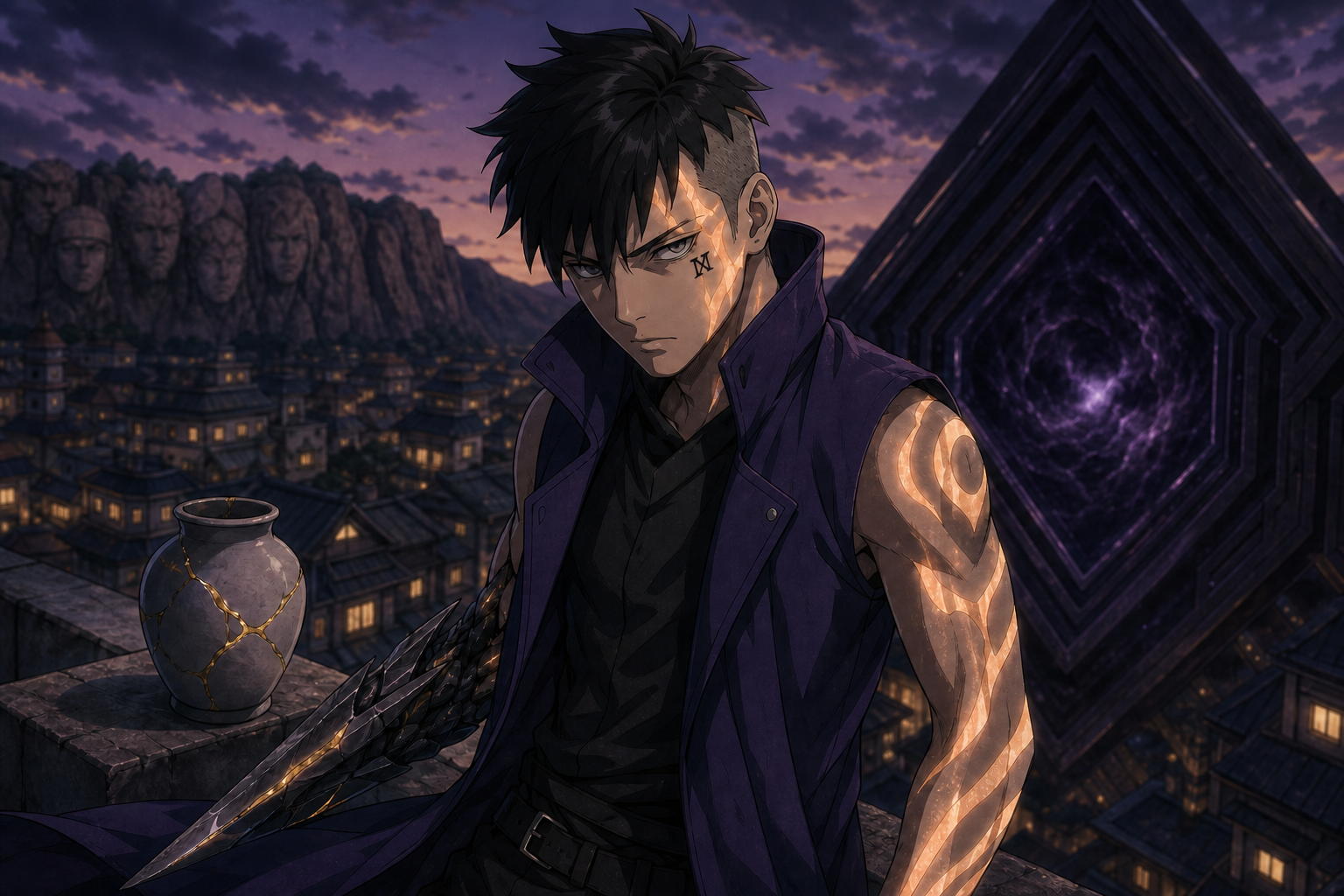
CVM SEKAI CHARACTER FILE
Kawaki
A sold child who finally finds a home, then becomes so terrified of losing it that protection mutates into possession.
RaeRae’s bottom line: Kawaki deserves compassion for every adult who treated his body like inventory. He also deserves accountability for sealing his parents away, trying to kill his brother and accepting a stolen identity while the real son is hunted. Trauma explains the cage in his head. Trauma does not make the cage around everybody else righteous.
THE SHINOBI FILE
Who Kawaki actually is
Kawaki is a boy sold by an abusive father to Jigen, modified by Kara and implanted with Isshiki Ōtsutsuki’s Karma. After escaping Kara, he enters Konoha under Naruto Uzumaki‘s protection and becomes part of the Uzumaki household beside Hinata Hyūga, Boruto and Himawari. His birthday is May 13. The official Naruto site lists taiyaki as a favorite food.
The official database describes Karma as compressed Ōtsutsuki data, effectively a backup file implanted in a vessel. Kawaki survives implantation while other children die around him. Compatibility saves his life only by making that life useful to Isshiki.
Kawaki later loses the original Karma when Isshiki resurrects through Jigen, then receives a reconstructed weapon-only Karma through Amado’s intervention. Isshiki can no longer resurrect through that mark, but Kawaki gains access to combat experience and abilities encoded in it. “Free of possession” does not mean free of the system that built him.
Appearance, marks and a body designed as equipment
Young Kawaki has black hair with shaved sides, gray eyes, an identifying Roman numeral IX beneath his left eye and a Karma mark on his palm. Kara’s scientific modification lets him reshape limbs into weapons. His body is therefore both human tissue and engineered combat platform.
His later Two Blue Vortex design sharpens the undercut, dark streetwear and Karma visual language. The silhouette is guarded and compact. Kawaki often looks like someone preparing for a blow even when nobody has raised a hand.
The marks are not decorative bad-boy branding. The numeral identifies a human experiment. Karma records an alien overwrite. The modified arm proves adults rebuilt a child’s flesh for a mission. Fan art can make those elements stylish, but a profile should not forget the violence that made the style possible.
THE FULL CHRONOLOGY
A childhood sold twice
Kawaki’s biological father, Kokatsu, drinks, abuses him and treats his labor and body as property. Jigen purchases Kawaki. That transaction replaces one father-shaped abuser with another. Jigen speaks of purpose and compatibility while conducting mass experimentation on children.
Kawaki watches candidates die when Karma implantation fails. He survives, becomes Isshiki’s intended vessel and endures training designed to break resistance. Kara’s language calls him valuable. The value belongs to what his body can carry, not to who he is.
This background explains why kindness feels suspicious and why ordinary damage can trigger panic. Kawaki’s conditioning also explains his obsession with becoming useful to the first adult who protects him. Kawaki learned that belonging is conditional, so he tries to make himself indispensable.
Escape, Team 7 and protective custody
An airship crash lets Kawaki escape Kara custody. Team 7 encounters him during a related mission. He fights Garō, exhausts himself and is taken to Konoha. Naruto makes him a ward and brings him into the family home rather than treating him only as an interrogation subject.
Kawaki arrives defensive, hostile and ready to read every gesture as a trap. Boruto sees the Karma they share and dislikes the threat entering his house. Their hostility has practical roots. Both boys are frightened of what the other proves about their own bodies.
Naruto does not earn Kawaki through a speech. He stays. He supervises without humiliating him, introduces routine and makes room for anger. That consistency begins filling the “hollow” identity Kara cultivated.
The broken vase and the work of repair
Kawaki breaks Himawari’s vase and attempts to replace or repair it. The object becomes a small domestic test. In Kara, damage invites punishment or disposal. In the Uzumaki home, damage can be acknowledged, repaired and survived.
The repaired vase never becomes new. Cracks remain visible. That is why the symbol works. Healing is not restoration to a childhood Kawaki never had. Healing is learning that broken history does not eliminate future use or beauty.
His later choices make the vase hurt more. Kawaki learns repair inside the family and still decides preservation requires sealing Naruto and Hinata away. He protects the vessel called “family” by removing the people whose choices make family real.
Delta, the lost arm and belonging through action
When Delta attacks, she targets Himawari to create an opening against Naruto. Kawaki shields them and sacrifices an arm. The act is immediate and bodily. For once, he uses a modified body against the organization that modified it.
Naruto gives him a prosthetic connected to Naruto’s chakra. The replacement carries care, dependence and risk. Kawaki’s body has again been fitted with another person’s power, but the purpose is restorative rather than exploitative.
His bond with Boruto improves. They call each other brothers and train around Karma. The relationship becomes real before it becomes tragic. Kawaki does not later attack a symbolic rival. He attacks someone who welcomed him, fought beside him and shared the fear of becoming a vessel.
Jigen, Isshiki and the end of the original Karma
Jigen invades Konoha, defeats Naruto and Sasuke and takes Naruto into another dimension. Kawaki works with Boruto, Sarada and Mitsuki to rescue him. Their battle with Boro proves Kawaki can function inside a team rather than as Kara property.
Isshiki eventually resurrects through Jigen, causing Kawaki’s original Karma to vanish. Isshiki still needs Kawaki as a new vessel and hunts him. Kawaki uses strategy, a shadow clone and Isshiki’s shrinking lifespan to deny the reimplantation. The child Kara called empty defeats the owner who assumed property would always return.
The victory should be liberation. Momoshiki’s continued presence inside Boruto prevents Kawaki from believing liberation is secure.
The reconstructed Karma and Boruto’s death
Amado reconstructs Kawaki’s Karma as a weapon. Kawaki wants power to protect Naruto and Konoha. Amado wants a controllable answer to future threats and has his own plans. Consent exists, but the choice is shaped by dependency, fear and an adult who knows which fear to press.
When Momoshiki takes Boruto, Kawaki fights with Isshiki’s abilities. Boruto regains enough control to uphold an earlier agreement. Kawaki strikes through him and kills him. The decision is shared in advance, but the action still scars every relationship around them.
Momoshiki revives Boruto by sacrificing remaining Karma data, making Boruto biologically complete as an Ōtsutsuki while preventing Momoshiki’s ordinary resurrection. Kawaki sees that technical distinction and still concludes Boruto must die.
Devotion to Naruto becomes authoritarian protection
Kawaki loves Naruto because Naruto gives him the first stable experience of unconditional care. That love is real. Kawaki then treats Naruto’s survival as the highest good, above Naruto’s judgment, relationships and right to choose risk.
He tells Naruto and Hinata that he will destroy every Ōtsutsuki, including Boruto. When they resist, he sends them to a dimension where time does not flow. Their bodies are protected. Their agency is gone.
This is not noble sacrifice. Kawaki is not sacrificing himself. He is sacrificing everybody else’s consent so he does not have to endure loss. Protection without the protected person’s voice becomes control.
Omnipotence and the stolen life
After attacking Boruto and injuring his eye while Boruto shields Sarada Uchiha, Kawaki flees. Eida finds him. Kawaki expresses the wish that Boruto were the outsider and he were Naruto’s true son, a person the village could mourn and defend.
Eida’s Omnipotence rewrites nearly everyone’s memories, switching Kawaki and Boruto’s positions. The official account stresses that the power activates in response to Kawaki’s wish. Eida does not calmly draft every consequence. Kawaki still recognizes the result and lets the lie stand.
He goes further by telling Eida to report Naruto dead at Boruto’s hands. That additional lie converts stolen identity into a murder accusation. Trauma explains why Kawaki wants safety inside Naruto’s family. Trauma does not excuse manufacturing a global manhunt for the boy whose life he occupies.
Two Blue Vortex: the fraud at the center of Konoha
Three years later, Kawaki lives publicly as Naruto’s son while Naruto and Hinata remain sealed away. The village regards Boruto as the traitor. Sarada and Sumire retain the true memory. Mitsuki’s devotion attaches to Kawaki, but lived emotional mismatch begins creating doubt.
Kawaki has access to power, protection and a social position he did not earn. He remains focused on eliminating Boruto and every Ōtsutsuki threat. Yet the world expands beyond his single-purpose plan: Code’s Claw Grimes, self-aware Divine Trees and shifting alliances create dangers his obsession does not solve.
The manga remains ongoing. Kawaki’s accountability, possible confession, final relationship with Boruto and fate of Naruto and Hinata are unfinished. Redemption is possible only if the story permits truth, consequence and repair. Feeling bad while keeping the stolen house would not be enough.
POWERS WITH RECEIPTS AND LIMITS
Karma and Isshiki’s inherited combat data
Karma enhances Kawaki’s physical ability, chakra and access to the Ōtsutsuki combat record encoded in the mark. His current Karma is reconstructed without Isshiki’s resurrection function, but the power still comes from the system that prepared him as a vessel.
Kawaki uses Sukunahikona to shrink himself and nonliving matter. Daikokuten stores shrunken objects in a dimension where time does not flow and retrieves them instantly. Black rods and large cubes turn space itself into an ambush inventory.
He also uses space-time movement associated with Karma. The same type of dimension holds Naruto and Hinata. A rescue technique, an escape route and a prison can share mechanics. Ethics depend on use.
Scientific body modification and ninjutsu
Kawaki reshapes limbs into blades and shields, absorbs attacks through Karma and fights at close range with brutal efficiency. His modifications offer regeneration and durability, though neither is unlimited. Damage, chakra use and stronger opponents can overwhelm him.
Naruto teaches him basic shinobi methods, including chakra control and shadow clones. Kawaki learns quickly because he was trained to survive, but village technique is different from Kara conditioning. Shinobi training ideally places power inside cooperation and judgment.
His firepower does not solve emotional tunnel vision. Kawaki can shrink an object too small to see and still miss the moral fact standing in front of him.
Limits and vulnerabilities
Kawaki’s abilities consume chakra and depend on perception, timing and access to stored material. Living beings cannot simply be shrunk by Sukunahikona as ordinary objects. Strong opponents can read, counter or outlast his patterns.
His largest vulnerability is psychological. Threats to Naruto collapse his moral field. He interprets uncertainty as permission for preemptive violence. Amado, Eida and the Ōtsutsuki conflict all exploit that fixation.
Power makes the fixation more dangerous. Kawaki no longer needs institutional approval to imprison a Hokage, attack a teammate or cross dimensions. The boy who once had no control over his body gains extraordinary control over space and uses it to control other bodies.
THE RELATIONSHIP ATLAS
Naruto Uzumaki: father, savior and possession
Naruto gives Kawaki shelter, training and affection without demanding that he first become useful. Kawaki responds with deep love and loyalty. Their relationship is one of Boruto’s strongest arguments for chosen family.
Kawaki’s later confinement of Naruto exposes the shadow inside that love. He protects Naruto’s pulse while rejecting Naruto’s personhood. A father is not an object a frightened child gets to store until the world feels safe.
Boruto Uzumaki: brotherhood under a death sentence
Boruto and Kawaki begin with hostility, build cooperation and call each other brothers. Their shared Karma gives them knowledge nobody else can fully feel. The bond makes the killing agreement possible and makes Kawaki’s later absolutism more painful.
Kawaki wants to eliminate Momoshiki. Boruto is the body and person carrying Momoshiki. Kawaki eventually refuses to hold that distinction. Omnipotence then gives him Boruto’s social identity while leaving the real Boruto with exile and accusation.
Hinata, Himawari, Eida, Amado and Jigen
Hinata
Welcomes him into the household and confronts his plan to kill her son. Kawaki seals her away with Naruto rather than accept her refusal.
Himawari
Her vase and Delta rescue anchor his earliest domestic repair. She offers sibling warmth before memory rewrites family positions.
Eida
Loves Kawaki, manifests Omnipotence around his wish and later helps maintain the false world. Her power, desire and responsibility must be separated rather than collapsed.
Amado
Restores Karma as a weapon and embeds his own agenda in Kawaki’s power. Their alliance is practical, manipulative and unstable.
Jigen and Isshiki
Captors who call ownership fatherhood and compatibility destiny. Kawaki’s entire life becomes an argument against their claim.
Sarada and Mitsuki
Former teammates divided by Omnipotence. Sarada remembers the truth. Mitsuki feels the emotional wrongness before he can name the false memory.
WHY KAWAKI MATTERS
Protection becomes abuse when consent disappears
Kawaki repeats the structure of his childhood while believing he has reversed it. Jigen confines, modifies and directs a child “for a purpose.” Kawaki confines Naruto and Hinata and directs Boruto’s fate “for protection.” The justification changes. The removal of agency remains.
A Confucian reading makes his filial devotion fail its own moral test. Gratitude toward a parent does not authorize disobedience to the parent’s humanity. Proper family duty includes reciprocity, truthful conduct and respect for relationship roles. Kawaki preserves the father while destroying the father’s household.
A Buddhist lens finds attachment hardened into grasping. Kawaki cannot accept impermanence or the possibility of Naruto’s death, so he tries to freeze the loved object outside time. The attempt to eliminate suffering creates wider suffering because possession cannot produce safety.
Class, trafficking and the shinobi world’s useful children
Kawaki begins as a poor abused child who can be sold. Kara’s advanced technology does not erase the economics. The organization buys disposable bodies, tests compatibility and invests only in the survivor who can hold elite power.
Konoha offers rescue, but also protective custody, surveillance and strategic interest. Naruto humanizes the response. The institution still wants information about Karma and Kara. Kawaki lives where foster care, national security and weapons research overlap.
His story asks whether the village can love a child without turning him into an asset. The answer remains mixed. Individuals love him. Systems continue planning around his body.
Fandom arguments that flatten him
“Trauma excuses everything.” No. Trauma explains reactions and increases the duty of care around him. Accountability remains necessary, especially when he harms other traumatized children.
“Kawaki never loved Boruto.” The brotherhood is real. That is why his choice is tragedy rather than ordinary villainy.
“Eida did everything.” Omnipotence manifests through her power, but Kawaki voices the wish, accepts the reversal and adds the claim that Boruto killed Naruto.
“Naruto should have known better than to take him in.” Rescue was not the mistake. Love without sufficient trauma support, boundaries and shared institutional responsibility left one family carrying an impossible security crisis.
“He is already redeemed because he wants to protect Naruto.” Motive is not repair. Redemption would require truth, release, consequence and changed conduct.
Japanese performance and adaptation boundaries
Yūma Uchida performs Kawaki in the original Japanese anime. This edition credits the verified performer without inventing scene-level vocal technique not directly rewatched for this pass.
The manga provides the central Kara, Karma, Uzumaki-family, Isshiki, Boruto killing, confinement, Omnipotence and Two Blue Vortex record. The anime expands Kawaki’s village integration, Academy experience, friendships and daily domestic repair. Those additions deepen him but remain adaptation material when the manga does not show the same event.
Games and promotional material translate Karma and body modification into spectacle. Move lists are not substitutes for manga mechanics or moral consequence.
CANON AND CURRENT STATUS
What is confirmed and what remains open
Confirmed core facts include Kawaki’s May 13 birthday, abuse and sale, Karma compatibility, Kara modification, escape, Uzumaki household placement, bond with Naruto and Boruto, loss and reconstruction of Karma, Boruto’s death and revival, Naruto and Hinata’s confinement and Omnipotence’s identity reversal.
The official database confirms Karma’s backup-file function and resurrection process. The current manga continues Kawaki’s use of Isshiki-derived abilities and his conflict with Boruto amid the Divine Tree threat.
Two Blue Vortex is ongoing. Final allegiance, accountability, possible redemption, the release of Naruto and Hinata and the resolution of the brother conflict are unfinished. A complete living profile tells the truth up to the current record and leaves the ending where the manga left it.
WHEN PROTECTION BECOMES POSSESSION
Kawaki recreates the cage with himself holding the key
Kawaki knows what it means to be treated as property. His father sells him. Jigen buys him, alters his body, marks him as a vessel and makes survival conditional on usefulness. The Uzumaki home matters because Naruto offers belonging without a price tag.
The tragedy is that Kawaki learns love more quickly than he learns trust. He believes Naruto’s life gives his own life meaning, then decides protecting that meaning permits any action. Sealing Naruto and Hinata looks merciful beside killing them, but a painless prison is still a prison. Their refusal has been removed from the equation.
Control feels like safety to somebody whose childhood made helplessness lethal. That history explains why Kawaki reaches for absolute measures. It does not make the measures loving. Protection requires the protected person to remain a person, not a valuable object stored beyond risk.
The vase is repair with the cracks still visible
The broken vase gives Kawaki a domestic problem no weapon can solve cleanly. He can gather pieces, replace water, and participate in making the object usable again. The cracks remain. Naruto does not demand an untouched child before offering family.
That lesson is more radical than the later power scale. Repair does not restore a fictional before. It creates a future that includes evidence of damage. Kawaki initially accepts that possibility for himself, then loses faith in it when danger reaches Naruto.
His later choices try to replace repair with prevention so total that nobody can move. If the family stays frozen, it cannot break. If Boruto dies, Momoshiki cannot emerge. If memory gives Kawaki the safe identity, society cannot question his place. Every solution removes another person’s agency.
A stolen identity does not heal the child who wanted one
Omnipotence gives Kawaki the social position he could never trust himself to keep. The village recognizes him as Naruto’s son. Boruto carries the accusation and exile. The exchange answers Kawaki’s deepest fear with the worst possible method: belonging produced by another person’s erasure.
He does not design the phenomenon like an engineer, but he chooses what to do after it happens. Continuing the lie protects his campaign against Boruto and protects the identity under which Konoha will defend him. Trauma explains why that shelter is tempting. Accountability begins with admitting who is standing outside in the storm because he stayed under it.
The false position cannot create the relationship Kawaki wants. Naruto would reject the imprisonment. Hinata already rejected the intended killing. Himawari’s bond grows under altered memory rather than informed truth. Public recognition without consent is another form of possession.
Boruto is a brother, not a problem to delete
Momoshiki makes Boruto genuinely dangerous. Kawaki does not invent the risk. His failure is treating risk as the entire person. Once he decides Ōtsutsuki existence must be eliminated, every memory of shared meals, arguments, training and brotherhood becomes an obstacle to necessary action.
Boruto refuses the mirror logic. He wants Kawaki stopped, his parents released, and the truth restored without pretending the abused child has vanished beneath the threat. That refusal is not soft. It demands more control than killing the person who hurt him.
Kawaki’s possible return cannot be purchased with one sad explanation or a heroic final move. Repair requires opening the sealed dimension, naming the identity theft, accepting the lives endangered, and allowing the family to respond without controlling the answer. Redemption without consent would repeat the problem.
The body remains a battlefield after Jigen is gone
Isshiki’s resurrection threat ends, but Amado’s reconstructed Karma keeps the old power available inside Kawaki. The mark no longer has the same purpose, yet the body still carries decisions made by older men who believed extraordinary capacity justified intervention.
Kawaki chooses to use that power because he sees it as the only reliable way to protect Naruto. Choice matters here, but the menu remains shaped by abuse. He reaches for the tool installed through violation because every adult crisis taught him power was the only language danger respected.
Breaking that pattern requires more than losing a fight. Kawaki needs a self that can survive Naruto’s disagreement, Boruto’s existence, and a future he cannot secure in advance. The child who was property deserves that freedom. The people he has confined and hunted deserve it too.
RAERAE’S FINAL TAKE
Kawaki breaks the vase again when he mistakes love for storage
The repaired vase teaches him that damage can remain visible and still belong inside a home. Kawaki later rejects that lesson. He decides the family must be made unbreakable, even if he has to remove its members, kill its son and rewrite its history.
I do not hate him for being afraid. I refuse to call fear a moral blank check. Kawaki’s path back, if the story gives him one, has to begin with opening the dimension, naming the lie and accepting that love cannot be proven by holding people still.
The child was property. The tragedy is that he grows powerful enough to make property of everyone he loves.
Sources and continuity boundary
The Boruto manga and Boruto: Two Blue Vortex manga control the continuing chronology. Anime-original arcs, novels, games, films, and adaptation expansions are identified instead of being blended into one false record. Ongoing developments should be dated and revised when later chapters change the evidence.
Primary franchise references: Naruto Official and VIZ Media Boruto: Two Blue Vortex. CVM Sekai’s conclusions about Kawaki’s abuse, Karma, Naruto, family, confinement, Omnipotence, Boruto, possession, repair, and accountability are editorial analysis, not invented creator quotations.