
Memory, Sorrow, and Thorn · Canonical Character Profile
King Jormgrun
Jormgrun is the Rimmersgard king remembered through the story of his defeat: he trusted northern winter to break Prester John’s siege, met John inside Naarved after the gate fell, lost his shield beneath Bright-Nail, and died before his own altar. The conqueror’s loyal jester tells the tale. That source is part of the canon too.
At a Glance
The northern king whose death becomes somebody else’s founding legend
- Name
- Jormgrun
- Title
- King of Rimmersgard
- Stronghold
- Naarved
- Opponent
- Prester John
- Confirmed strategy
- Expected southern forces to fail during the winter siege
- Final encounter
- Fought John after the portcullis assault; his shield was shattered
- Status
- Dead; killed by John before Jormgrun’s altar
- Source condition
- Known through Towser’s loyal, retrospective account rather than direct scene narration
The King at Naarved
Jormgrun enters the trilogy at the exact moment his kingdom is being rewritten
Jormgrun appears in Towser’s memory of Prester John’s northern conquest.
He is not introduced at court, in childhood, or through ordinary rule. The surviving scene begins with siege and ends with death.
Naarved is Jormgrun’s defended place and the site where John’s victory becomes a turning point for Rimmersgard. The later order treats that conquest as history already settled. Towser’s story lets us see the violence beneath the settlement.
Jormgrun is called king, not bandit, warlord, or rebellious subject. John attacks another sovereign order.
That distinction matters because the victory narrative naturally centers the future High King. Jormgrun’s title preserves the political reality John’s success replaces.
The record does not give Jormgrun’s dynasty, relatives, length of reign, borders, allies, subjects’ opinion, laws, or relationship to other northern rulers. It does not say whether Naarved was his capital or simply the place of his last stand.
His altar identifies a religious world distinct from John’s expanding Aedonite order, but the text does not name Jormgrun’s god, rite, priesthood, or personal theology.
A complete profile should therefore show the conquered sovereignty without inventing an entire northern constitution around one remembered battle.
The Strategy of Winter
Jormgrun expects climate, distance, and northern endurance to defeat the southern army
Jormgrun expects John’s southern troops to fail in Rimmersgard winter.
The judgment is not foolish on its face. A besieging army must eat, shelter, move supplies, maintain equipment, and preserve morale in hostile weather. Defenders inside a known stronghold can reasonably trust the environment to become another wall.
Towser’s heroic version makes John’s refusal to yield the proof of exceptional greatness. That framing can make Jormgrun look like a man who simply underestimated the protagonist of history.
But the strategy reveals regional knowledge and a rational reading of ordinary military limits. John wins because his army and personal ferocity exceed Jormgrun’s expectation, not because winter was irrelevant.
The text does not specify whether starvation, disease, desertion, storms, or supply failure actually threaten the besiegers. Nor does it name Jormgrun’s own losses or preparations.
We should not invent tactical details to turn him into a military genius. We also should not collapse him into an obstacle waiting for John.
His reliance on winter connects political independence to place. Rimmersgard’s cold is not backdrop; it is part of how a northern king imagines his realm can resist incorporation.
The Last Fight
John breaks the gate, Jormgrun’s shield, and the old political order in one remembered sequence
Towser says John sustains the siege, crosses the inner wall, opens the portcullis, and fights into Jormgrun’s stronghold.
John and Jormgrun meet before the northern king’s altar.
During the fight, John shatters Jormgrun’s shield. Bright-Nail flashes like holy silver light in Towser’s telling, and John kills him.
The account confirms Jormgrun fights and carries a shield. It does not identify his weapon, armor, wounds, final words, companions, or exact sequence of blows beyond the shattered defense and death.
His location before his own altar can be read as a last stand inside the symbolic heart of his order. It may also simply be where the fight reaches him. The text does not state whether he deliberately chooses the site.
Bright-Nail’s holy appearance belongs to Towser’s language. The flash may describe reflected light, remembered wonder, divine interpretation, or legend polished by repetition.
Jormgrun’s death then becomes evidence in John’s heroic biography. The defeated king receives no surviving speech to interpret what the weapon looked like from his side.
Future battle art must not add a humiliating pose, cowardice, monstrous features, or pagan savagery. He is a defending king killed in combat, not a visual prop for John’s magnificence.
Towser Is the Witness—and the Problem
The account is canonical, partisan, emotional, and not omniscient
Towser tells Jormgrun’s story to Simon in Book 1.
The old jester was in John’s camp during the conquest. He treats that proximity as nearly equivalent to seeing the crucial fight himself, but the ledger explicitly preserves the limit: he was not established as standing beside John for every blow.
This does not make the story false. It makes the source legible.
Towser devoted his life to John. His room, songs, memories, and regrets orbit the king. When he remembers Naarved, he is preserving the legend of the man he chose over another possible life.
The tale also appears while Towser is comforting Simon after Miriamele’s identity reveal. It is embedded inside a conversation about choices, loyalty, love, and the impossibility of knowing what another path would have become.
Towser’s northern memories include Cruinh, the nearly white-haired woman he loved after the conquest. She cleaned the occupied royal hall and refused to leave her land and family. Towser could not leave John.
Jormgrun’s fall and Cruinh’s refusal belong to the same conquered landscape. One resists with shield and kingship; the other preserves agency by declining the conqueror’s companion.
The profile should not claim Cruinh supported Jormgrun, witnessed his death, or knew him. Their connection is historical context, not a personal relationship.
Conquest Becomes Conversion
Jormgrun’s defeat clears the ground for a new dynasty and a new religious order
After John’s conquest, northern nobles convert to Aedonism. Isbeorn, Isgrimnur’s father, becomes the first Duke of Elvritshalla after being among the early pagan Rimmersgard nobles to accept the new faith.
Jormgrun’s death therefore precedes more than a change of ruler. It marks the displacement of sovereign kingship by ducal authority under John and the reshaping of elite religion.
The text does not say that every conversion was forced, sincere, opportunistic, immediate, or uniform. It does establish a political sequence in which conquest and conversion travel together.
Jormgrun’s altar makes the religious replacement visible. He dies before the sacred structure associated with his own order; the victorious story describes John’s sword with holy light.
That is powerful narrative symbolism, but it should not be mistaken for neutral evidence that one faith is objectively vindicated by combat.
Morgenes elsewhere warns against treating battle as an arbiter of divine will. Jormgrun’s profile benefits from that larger series insight: victory creates records, monuments, offices, and conversion stories capable of making violence look inevitable.
The House That Rises After Him
Isbeorn’s dukedom and Isgrimnur’s inheritance are downstream from Jormgrun’s death
Isbeorn becomes the first Duke of Elvritshalla under the post-conquest arrangement. His son Isgrimnur later stands as one of John’s closest friends and most loyal great lords.
That loyalty can make the northern incorporation feel complete. Book 1 repeatedly shows otherwise.
Skali challenges Isgrimnur’s authority. Elias grants away northern lands. Naarved and Elvritshalla remain active points of grievance. Gwythinn cites their loss while condemning the High King’s failures.
Jormgrun is long dead, but the political geography shaped by his defeat is still unstable.
The profile should not invent a genealogical link between Jormgrun and Isbeorn. The transition may involve rival houses, submission, reward, or a more complicated settlement; the surviving receipt does not specify.
What is safe is institutional succession: a king is killed, John conquers, northern nobles convert, and Isbeorn becomes duke.
Jormgrun’s absence is therefore built into the title Isgrimnur inherits. The ducal house exists inside the order that replaced him.
Connections
The conqueror, storyteller, converted noble, and later inheritors around Jormgrun
Prester John
Besieges Naarved, defeats Jormgrun in combat, and absorbs the northern order into his expanding realm.
Towser
John’s loyal jester and the retrospective source through whom Jormgrun’s final battle is preserved.
Isbeorn
Becomes the first Duke of Elvritshalla after the conquest and northern noble conversions.
Duke Isgrimnur
Isbeorn’s son, later northern duke and John’s friend, whose authority descends from the post-Jormgrun settlement.
Cruinh
A woman of conquered Naarved whose separate story preserves local attachment and refusal; no personal link to Jormgrun is confirmed.
Simon
Receives Towser’s account while wrestling with his own anger, loyalty, and desire to redo the past.
Why King Jormgrun Matters
He turns a hero’s old victory back into a conquest with a defeated side
Jormgrun matters because legends become cleaner when the defeated person disappears.
John’s endurance and courage may be real. The same story also contains invasion, a dead king, an occupied hall, religious transformation, and a new aristocratic order.
Restoring Jormgrun’s title and strategic logic does not require reversing the legend into an equally simple villain story about John. It requires holding both sides of the historical change in view.
He is also a lesson in source literacy. The fandom archive should tell readers not only what happened but how the books let us know. Here, knowledge arrives through an old partisan who loves John and admits that camp proximity is not the same as direct sight.
Jormgrun’s profile can therefore be substantial without fictional biography. His importance lies in political replacement, climate as defense, contested memory, the joining of conquest and conversion, and the long shadow cast over Rimmersgard.
His face, family, voice, and inner life remain unknown. The page does not punish him for that archival silence.
Character Image Continuity
A living northern sovereign—not a barbarian costume assembled from clichés
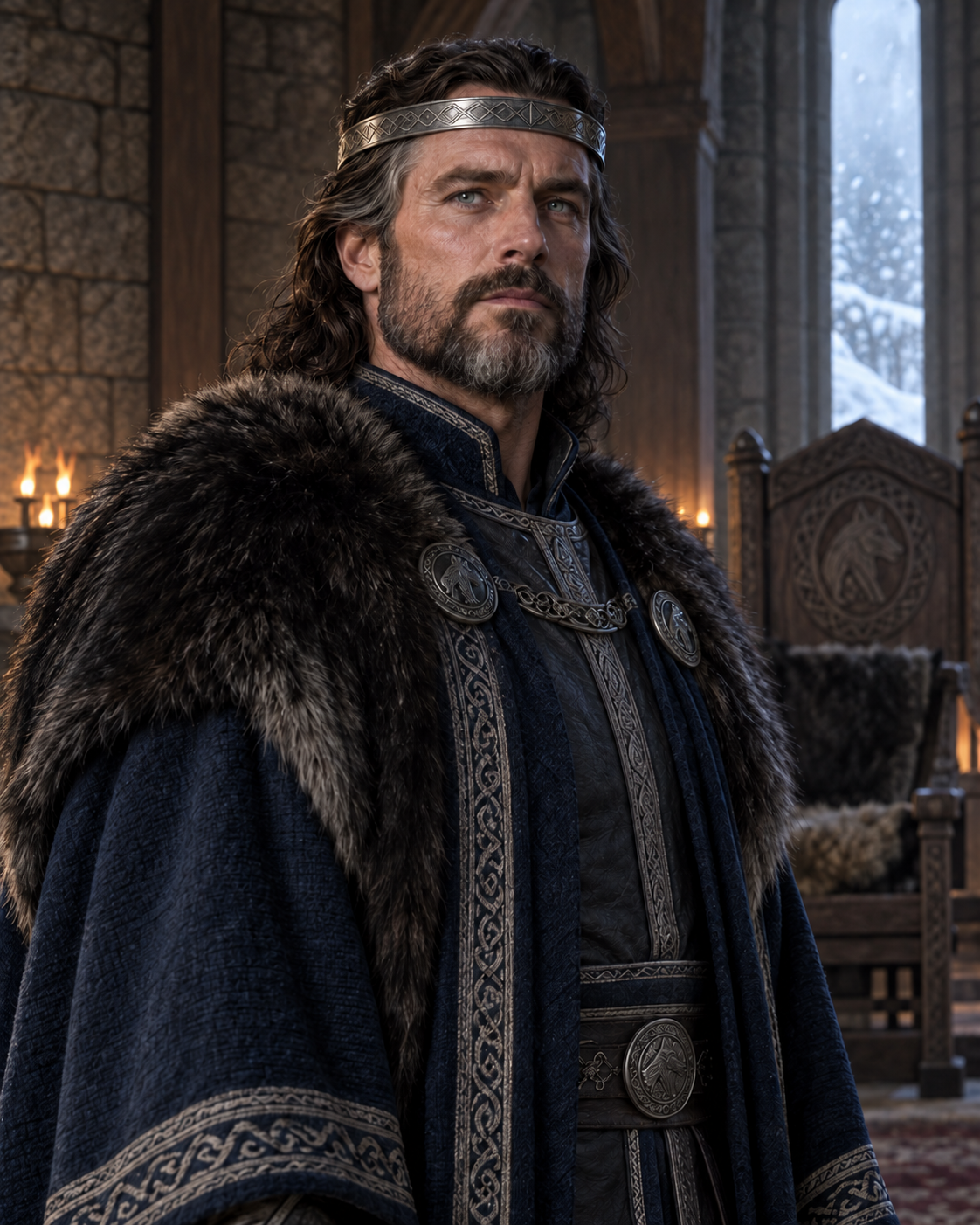
Visual state: approved editorial reconstruction. Jormgrun now has one permanent living sovereign identity, and this canonical post is published.
CVM depicts Jormgrun as a devastatingly handsome mature Rimmersgard king around forty-four with a very tall broad disciplined build, deep blue-green eyes, weathered fair skin, collar-length dark-brown hair silvering at the temples, and a close dark-and-silver beard. Midnight-blue, iron-gray, deep-pine, muted-silver wool and leather, functional dark fur, and a plain hammered circlet establish sovereign authority grounded in the same realistic world as John and Isgrimnur.
Canon gives no exact age, facial structure, hair, eyes, height, build, crown, armor, weapon, shield design, tattoos, scars, altar, or religious emblem. Every such choice is interpretation.
Preserve this exact face, age, body, coloring, silver map, beard, circlet, midnight/iron/pine wardrobe, and controlled winter-court presence across every later use. Do not add horned helmets, invented heraldry, fur-covered barbarian excess, brutish features, dirt, or pagan-monster coding. Northern climate justifies functional materials without turning a culture into costume shorthand.
A milestone battle image can include a shield and John’s Bright-Nail, but the portrait hero should establish Jormgrun independently of his death.
The same canonical attachment powers featured image, hero, directory card, and social metadata. This face, body, age, and styling must remain consistent across the Naarved battle React, Rimmersgard 101 pages, John’s history, and every later callback; battle art may add the confirmed shield and Bright-Nail only while preserving the source limits.
On the Record
A Book 1 historical account, fully spoiled and carefully attributed
This is Jormgrun’s one canonical, full-spoiler character profile. The confirmed material is recounted in The Dragonbone Chair by Towser.
The record confirms that Jormgrun was king in Rimmersgard; was defended at Naarved during John’s winter siege; expected the southern army to fail in the cold; fought John after the inner-wall and portcullis assault; had his shield shattered; and was killed by John before Jormgrun’s own altar while John carried Bright-Nail.
It also confirms the consequence sequence preserved by Towser: John’s northern conquest, conversion among Rimmersgard nobles, and Isbeorn’s installation as the first Duke of Elvritshalla.
It does not confirm Jormgrun’s appearance, exact age, family, dynasty, capital status, weapon, armor, shield design, god, religious practice, final words, precise tactics, relationship to Isbeorn, opinion of John, or perspective on the conquest.
The account is canonical but retrospective and partisan. Towser was in John’s camp and tells the story as a devoted follower; he is not established as an omniscient eyewitness to every blow.
Jormgrun is dead. Visual state: approved editorial reconstruction. The permanent identity preserves him alive and sovereign rather than reducing him to Towser’s conquest climax. Every physical feature, garment, circlet, hall detail, chair, pose, and lighting choice is CVM reconstruction. The same canonical attachment powers featured image, hero, directory card, and social metadata.