
Memory, Sorrow, and Thorn · Canonical Character Profile
Queen Inahwen
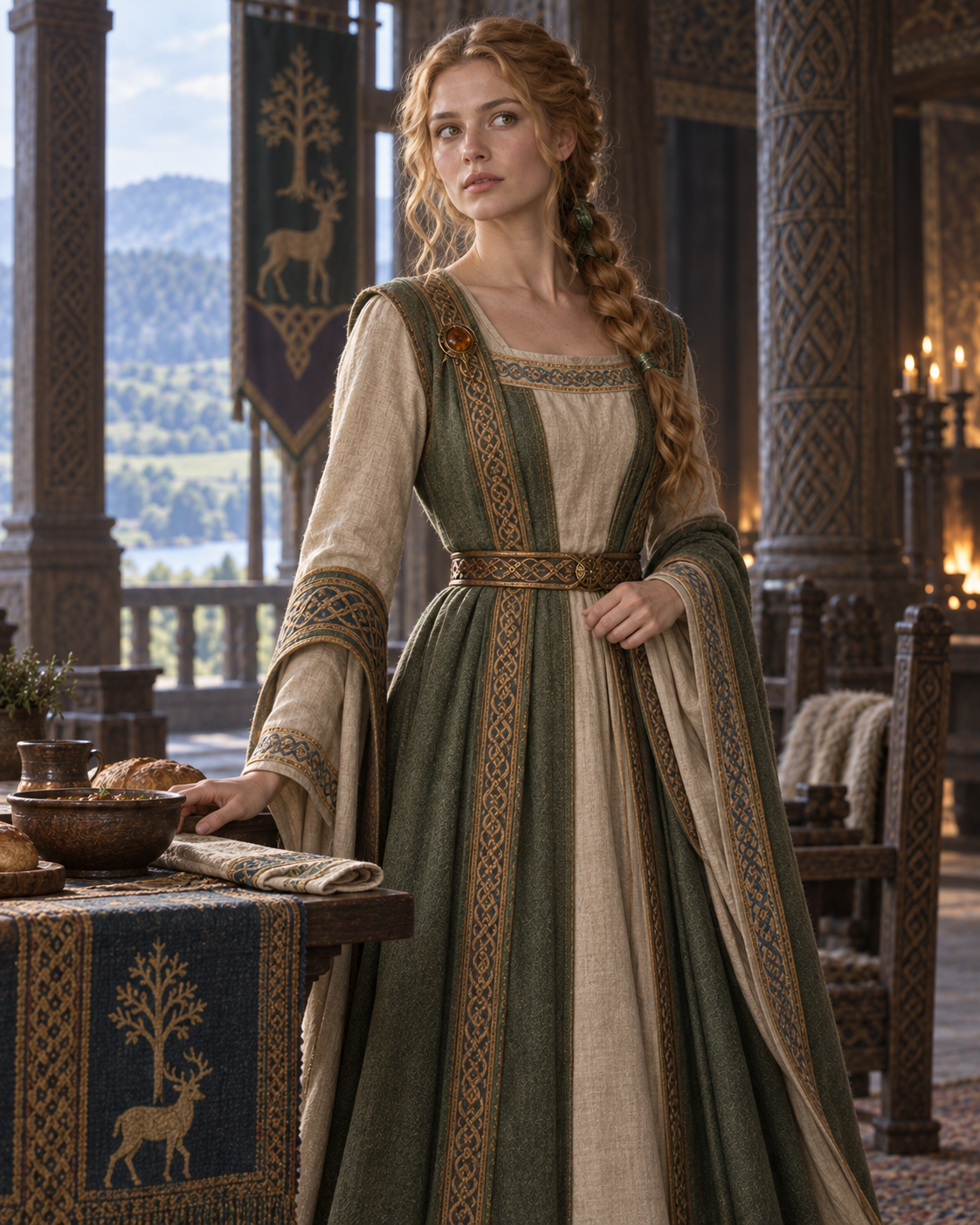
Inahwen is King Lluth’s third wife, a golden-haired young queen only one year younger than her stepdaughter Maegwin. She manages meals, fear, and bedside care while men turn the Taig into a stage for threats. After Hernystir falls, her likely objections still carry enough legitimacy that Craobhan invokes them against Maegwin’s unilateral rule. Inahwen is not the loudest person in the royal household. She is the woman whose quiet authority becomes most visible when someone else starts treating it as optional.
At a Glance
The young queen whose gentleness should never be mistaken for nonexistence
- Name
- Inahwen
- Title
- Queen of Hernystir
- Marriage
- Third wife of King Lluth ubh-Llythinn
- Age relation
- One year younger than Maegwin
- Appearance
- Golden-haired and lithe
- Character evidence
- Good-hearted, frightened by political pressure, attentive to Lluth’s care
- Last confirmed scope
- Alive among the Grianspog-era royal survivors
Lluth’s Third Wife
Her marriage places a near-peer inside Maegwin’s family hierarchy
Inahwen is King Lluth’s third wife. The household chronology matters because Maegwin experiences it personally. Maegwin’s mother Penemhwy died when Maegwin was four. Fiathna later took her place and became the mother of Gwythinn. Inahwen comes after both women.
She is only one year younger than Maegwin. The title “stepmother” therefore describes legal and dynastic position much better than ordinary generational experience. Maegwin faces a young woman nearly her own age seated beside her father as queen.
The narration calls Inahwen golden-haired, lithe, good-hearted, and visibly vulnerable to the pressure gathering around the Taig. None of those qualities make her foolish. They establish why the household’s emotional geometry is awkward even without cruelty.
Maegwin has never fully adjusted to the marriage. That discomfort belongs to Maegwin’s grief history and relationship with Lluth; it is not evidence that Inahwen has mistreated her. The record instead shows Inahwen performing care inside a family where everyone’s position has been shaped by earlier deaths.
A responsible profile must resist two lazy transformations. Inahwen is not an evil young stepmother competing with a princess, and she is not a decorative child-bride whose only purpose is to look fragile beside an older king. She is a queen with domestic and political standing, even when the narrative gives her less space to exercise it.
The Taig Under Threat
She watches a royal confrontation while fear enters the room before the army does
At the Taig, Guthwulf presses Elias’s claim over Hernystir under the High Ward. King Lluth refuses. Drought, ruined weather, frightened livestock, and starving people have already made royal demands obscene; Lluth will not tithe suffering into deeper suffering.
Inahwen sits beside him as the confrontation escalates. Guthwulf spits citril before the throne. Gwythinn draws blood at his throat. Lluth orders his son to sheath the weapon, preserving the protection owed an emissary even while the emissary threatens that the Taig’s beams may burn and its children cry.
The record describes Inahwen as visibly frightened by this pressure. That fear is accurate perception. The room is one sword movement away from war, and Guthwulf’s departing threat names civilians and children as future targets.
Inahwen also monitors Lluth’s meals and domestic care. Court history often treats this work as scenery because it does not arrive carrying a banner. Here it shows the young queen maintaining the king’s body while that body is expected to embody national resistance.
She leaves one charged household confrontation frightened. The exit does not prove cowardice or political indifference. It shows how royal conflict penetrates domestic space and how easily a good-hearted young woman can be positioned as the person expected to absorb fear quietly.
“Lend Her Your Strength”
Lluth loves both women and still makes Maegwin responsible for managing the comparison
Before dawn, Lluth prepares to leave for war and makes Maegwin mistress of the Taig. Maegwin wishes she were the son who could fight beside him. Lluth answers by telling her she is stronger than Inahwen and must lend that strength to the wife he also loves.
The request recognizes Maegwin’s capacity and confirms Lluth’s love for Inahwen. It also triangulates the two young women. One becomes “strong” through contrast; the other becomes the person who needs strength supplied.
That framing helps explain the later political problem. Inahwen possesses the title of queen, yet Lluth’s farewell installs Maegwin as active mistress of the Taig and caretaker of the supposedly weaker wife. Affection and hierarchy arrive tied together.
Inahwen does not speak in the preserved farewell receipt, so the profile cannot tell us how she would describe the arrangement. What can be said is that others repeatedly define her: good-hearted, frightened, loved, weaker. Her own authority risks vanishing behind the care people claim she needs.
Maegwin hides her fear for Lluth’s sake and cries later where no one can hear. The contrast complicates “strength” itself. Maegwin is not fearless; she is performing control. Inahwen’s visible fear may be less politically useful, but it is not necessarily less honest.
The Vigil
When the king returns broken, care becomes the last functioning court ritual
Lluth returns gravely wounded from the Inniscrich. In the Grianspog refuge he lies wax-pale, burning with fever, silently moving his lips on a rough bed after losing speech.
Maegwin and Inahwen keep vigil. The oak chair, antlers, audience chamber, and smiling public mask are gone. Kingship has contracted to a wounded body in a cave and the women attending it.
For Inahwen, this continues the caretaking already visible at the Taig. Monitoring meals becomes bedside presence under conditions where food, cloth, medicine, privacy, and safety are all compromised.
The scene also refuses to make the two women simple rivals. Whatever Maegwin’s discomfort with her peer-aged stepmother, both remain beside Lluth during the destruction of the household that defined their relationship.
The record does not assign specific medical acts, dialogue, or a private exchange between them. Their shared vigil is enough. In a dynasty obsessed with sons, swords, and oaths, the king’s final human continuity is held by a daughter and wife.
The Queen Someone Else Can Overrule
Craobhan invokes Inahwen because her likely objections still have constitutional weight
After Lluth and Gwythinn die, Maegwin treats herself as the last surviving authority of Lluth’s blood. She orders exploration of deeper Grianspog caverns and proposes moving the Hernystiri farther inside the mountain.
The plan has practical strengths. Deeper tunnels may place the refugees beyond Skali’s reach, and Maegwin thinks in terms of hunting, gathering, raids, and storage. Grief has not erased her ability to solve material problems.
Craobhan raises food, cloth, grain, Eolair’s return, and Inahwen’s likely objections. Inahwen is not physically centered in the exchange, yet her name functions as a boundary: the king’s widow and current queen may have standing that the king’s daughter cannot simply absorb.
Maegwin answers with Lluth’s house and Eolair’s oath. Dissent increasingly feels to her like betrayal of the dead. The response does not seriously engage Inahwen’s title or imagined objections.
This is where Inahwen’s quietness becomes politically revealing. Her authority exists strongly enough for an elder to invoke, but not strongly enough to stop Maegwin from proceeding without recorded consultation. She is present in governance as the person whose consent should matter and may not be obtained.
The profile cannot claim Inahwen opposed the migration, because Craobhan speaks only of what she would likely say. It can record that experienced survivors understood her as an independent political subject whose position required consideration.
Good-Hearted Is Not Government
The novels expose how praise can reduce a woman at the same time it protects her reputation
“Good-hearted” is kind characterization. It protects Inahwen from the malicious-stepmother script and establishes warmth in Lluth’s last household.
It is also incomplete. Goodness tells us how others experience her disposition, not what policy she favors, how she understands Hernystir’s crisis, or what she wants after Lluth’s death.
The same is true of “weaker.” Lluth uses the comparison to give Maegwin responsibility, but the record does not stage a trial proving Inahwen incapable. Her visible fear is repeatedly interpreted around her rather than heard from her.
A full fandom page should not solve that absence by inventing hidden speeches. It should make the absence visible. Inahwen’s profile is partly about how a queen can remain structurally important while narrative and household language keep translating her into temperament.
Connections
The husband, stepchildren, and elder who define the borders of Inahwen’s authority
King Lluth
Her husband, whom she cares for at the Taig and during his final decline beneath Grianspog.
Maegwin
Her stepdaughter and near age-peer, made mistress of the Taig and later increasingly willing to act without Inahwen’s recorded consent.
Prince Gwythinn
Her stepson, whose fury at Guthwulf turns a diplomatic confrontation physically dangerous.
Craobhan
Invokes Inahwen’s likely objections as a legitimate constraint on Maegwin’s migration decision.
Count Eolair
Another absent authority Craobhan names while challenging Maegwin’s claim to act alone.
Penemhwy and Fiathna
Lluth’s earlier wives, whose deaths shape the household into which Inahwen marries.
Why Inahwen Matters
She reveals the difference between possessing a title and being allowed to use it
Inahwen has few direct scenes, but her position clarifies Hernystir’s collapse. At the Taig, she is queen beside a king under coercion. In the refuge, she is the king’s widow and one of the adults whose voice should shape survival.
Yet her authority is repeatedly mediated. Lluth frames her as needing Maegwin’s strength. Craobhan predicts her objection. Maegwin answers around her. The narrative record remembers her care and fear more readily than her speech.
That pattern is not proof that Inahwen secretly possessed a grand suppressed plan. It is evidence that political systems can render a woman symbolically central and operationally optional at the same time.
Her profile therefore belongs in the full ecosystem rather than a family-tree footnote. She helps us see what Maegwin inherits, what Maegwin overrides, and how the destruction of Lluth’s household redistributes power unevenly among the women who survive it.
On the Record
Books 1 and 2, one canonical queen, and no invented opposition speech
This is Inahwen’s one canonical full-spoiler profile. Book 1 establishes her as Lluth’s third wife, the golden-haired young queen at the Taig, the object of Lluth’s love and protective comparison, and a caretaker during Hernystir’s collapse. Book 2 preserves her relevance in the Grianspog refuge when Craobhan raises her likely objections to Maegwin’s unilateral decision. No direct Inahwen receipt appears in Books 3 or 4.
The record confirms that Inahwen is golden-haired, lithe, good-hearted, one year younger than Maegwin, frightened by political pressure, attentive to Lluth’s meals, loved by Lluth, present in the wounded king’s care, and politically relevant enough that Craobhan invokes her likely objection. It does not confirm her exact age, eye color, parentage, birthplace, marriage date, private political program, direct response to the cave migration, later fate, or the content of any unrecorded conversation with Maegwin.
The approved identity presents an exceptionally beautiful young adult queen with a softly triangular face, freckled warm-ivory skin, amber-brown eyes, true-golden hair in a low looped braid, green ribbon, oat-and-willow clothing, and restrained bronze-and-amber jewelry. Her precise age, face, complexion, eyes, freckles, hair arrangement, ribbon, dress, jewelry, meal vessels, food, textiles, deer-and-tree motifs, Taig architecture, pose, weather, and light are CVM editorial reconstruction—not additional claims about the text.
This exact face, adult age baseline, lithe body, coloring, braid map, ribbon, and palette now govern the Taig, Grianspog refuge, directory, hero, social, and every later scene. Refugee-era materials may weather and simplify without aging her into Lluth’s generation, turning accurate fear into childishness, or collapsing her into Maegwin, Penemhwy, Fiathna, a servant, or a generic blonde princess.