
Release file
Released: July 26, 2026
Runtime: 02:57
Label / channel trail: HYBE LABELS
Sound: ILLIT brought a school play, a bargain-bin kaiju, magical-girl powers, two HANA members, and exactly zero interest in giving me the bridge I deserved.
Sources: Exact official playlist uploadDaily+53.7KTotal views19.3M.
I Got Your Back
ILLIT brought a school play, a bargain-bin kaiju, magical-girl powers, two HANA members, and exactly zero interest in giving me the bridge I deserved.
July 26, 2026
ILLIT Japan 2nd Single
Pop-rock · J-pop · two-step lift
What changed every time I replayed it
First listen: We are doing magical girls with visible stage ropes and a kaiju who looks exhausted by union negotiations. Perfect. The guitars sprint, the drums keep shoving the song forward, and friendship becomes an emergency power source.
Second listen: JISOO and MOMOKA stop feeling like guests and start feeling like missing structural pieces. JISOO adds weight to ILLIT’s polished blend. MOMOKA adds rhythmic teeth. The collaboration changes the song’s texture instead of decorating its credits.
Third listen: The promise in the title becomes more practical. “I got your back” does not mean everything will become easy. It means somebody will catch, lift, redirect, or stand behind you while the difficult thing remains difficult.
Fourth listen: The missing bridge becomes a crime scene. The track sets up a section where the two groups could trade lines, alter the key, or let the magical-girl team lose before the final power-up. Instead, the song sprints into the credits. I checked the progress bar like it had betrayed me personally.
What “I Got Your Back” actually means
This is a friendship song for the day when encouragement stops sounding cute and starts sounding necessary. The core promise is not “everything will be fine.” It is: when anxiety, pressure, and failure make you want to disappear, somebody is staying behind you. The title works as both emotional reassurance and literal staging. Everyone spends the video catching, lifting, redirecting, or powering up someone else.
That is why the collaboration makes sense beyond marketing. ILLIT’s lighter voices sell the vulnerable side of the promise. JISOO and MOMOKA bring weight and abrasion. They sound like the friends who are not asking whether you need help; they have already arrived with snacks and a weapon.
The song: pop-rock with no time to waste
The track moves like it is late for its own chorus. The guitars are bright rather than heavy, the drums push forward, and the vocal arrangement keeps handing the reassurance from member to member. There is a nostalgic Japanese TV-theme energy here, the kind of song that could open an anime about girls discovering their powers and then immediately having homework.
The feature is the structural surprise. HANA’s JISOO has a fuller, distinct vocal color that cuts through ILLIT’s polished blend. MOMOKA gives the song a rhythmic bite ILLIT usually does not chase. Fan reaction focused on exactly that contrast: the feature feels integrated, not stapled on, and several listeners said it sent them directly toward HANA’s catalog.
My complaint is not subtle. The song is under three minutes and behaves like a bridge is about to show up, make a dramatic speech, and save the day. Instead, the credits arrive. The final chorus works, but another thirty seconds could have let the collaboration breathe instead of making the HANA section feel like a delicious sample at a grocery store.
The music video: the school play saves the world
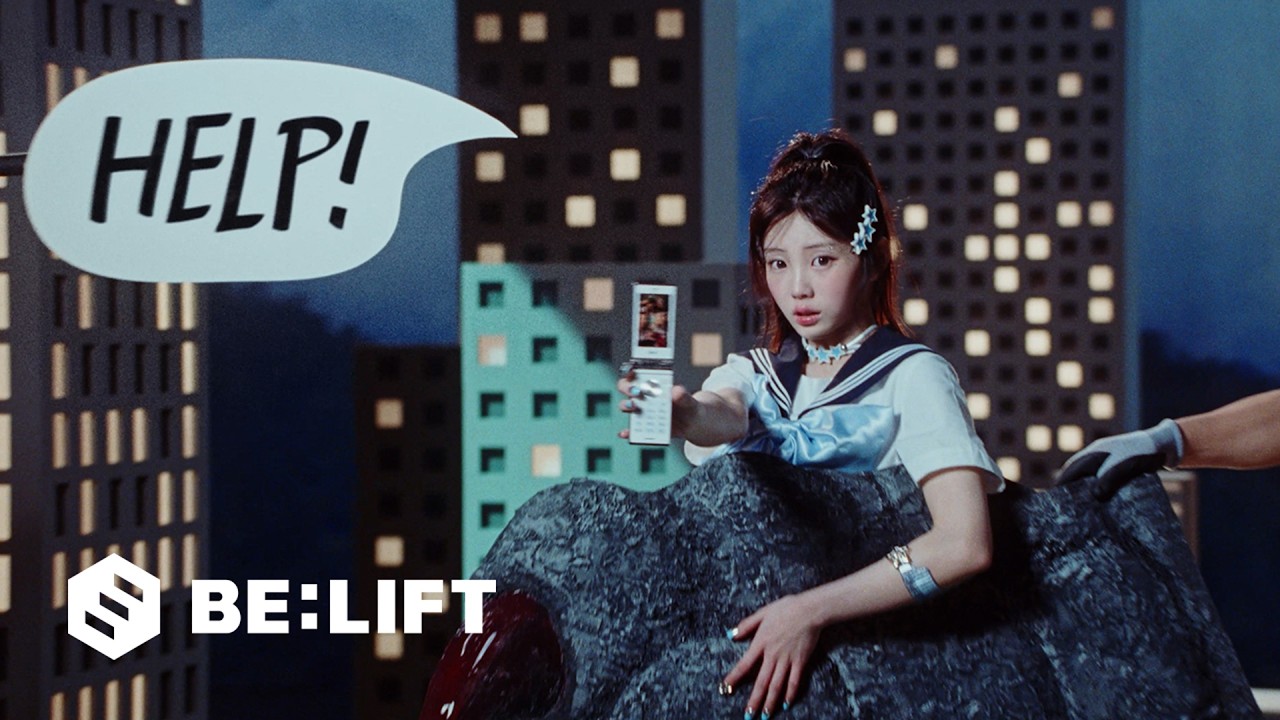
The video’s smartest choice is refusing expensive realism. The girls are inside a theatrical school production where the machinery is visible, props behave like props, speech bubbles become scenery, and a kaiju can look like somebody’s extremely committed craft project. That artificiality is not a budget apology. It is the joke.
ILLIT’s magical-girl identity returns through transformations, powers, team formations, and the basic rule that friendship becomes a usable source of energy. The monster is less frightening than inconvenient. Wonhee gets placed in danger; the others mobilize; time, force, and theatrical chaos become part of the rescue. Even the visible harnesses help. The video wants the audience to enjoy how the trick is made.
Moka’s appearance matters because she has been absent from some active schedules. The video does not treat her like a ghost or hide the group’s five-member identity. Fans immediately noticed her presence, her time-related power moment, and how good it felt to see her included even while recovery remains the priority.
JISOO and MOMOKA did not come over to stand in the back row
The HANA feature could have been two names in the metadata and six seconds of separate footage. Instead, JISOO and MOMOKA participate in the performance world, contribute lyrics, and bring a contrast that explains why these two members were selected. JISOO’s vocal tone provides gravity. MOMOKA’s rap instincts give the track a sharper attack. Together they make the collaboration feel like two pop systems meeting in the same room instead of emailing files across labels.
Also: yes, this is HANA’s JISOO, not BLACKPINK’s Jisoo. And MOMOKA is not ILLIT’s MOKA with an extra syllable. The comment sections spent an unreasonable amount of time solving those two mysteries.
The cultural machinery under the school play
The video borrows from magical-girl anime and tokusatsu, but it understands why those genres last. The costume, transformation, monster, and team pose are not the emotional point. They give visible form to ordinary fears: failing publicly, losing control, being isolated, or needing help when you wanted to look capable.
The school-play framing makes that message warmer. Viewers can see the ropes, painted sets, and handmade logic. Instead of hiding labor behind perfect effects, the video lets teamwork become part of the spectacle. The fantasy works because people coordinate the trick.
A Buddhist lens adds a quieter point. Anxiety asks us to believe the frightened self is fixed and alone. The video keeps changing positions, roles, props, and power. The bad moment is real, but it is not permanent. Somebody can stand behind you until the scene changes.
The collaboration also works as cross-fandom diplomacy. ILLIT and HANA do not need a fake supergroup or a new permanent profile. Two members enter one song, carry real creative and performance weight, then bring curious listeners back toward both catalogs. That is how a collaboration should expand a world without creating administrative nonsense.
Moka’s presence must be handled with the same care. Showing her inside the five-member identity honors continuity. It does not give fans permission to demand medical details or a return schedule. Visibility can reassure without turning recovery into content.
Easter eggs, details, and things worth pausing
- The school-play framing: painted scenery, practical props, and deliberately visible stagecraft turn low-tech spectacle into the concept.
- Magical-girl callbacks: the powers reconnect the Japanese release to ILLIT’s larger fantasy language instead of creating a disconnected side era.
- The kaiju: fans immediately read it through tokusatsu and Godzilla language. It is a loving genre reference, not literally Godzilla.
- Speech bubbles: text becomes part of the physical stage, matching a song about saying the reassurance out loud.
- The name flashes: the HANA feature gets announced visually, making the crossover legible even to viewers who arrived without reading the title.
Who made the song
The official release credits Japanese singer-songwriter Yuika as a lyricist and Kanata Okajima as a composer. HANA’s JISOO and MOMOKA participated as featured performers and lyric contributors. The single contains “I Got Your Back,” “Sunday Morning,” and a Korean version of “I Got Your Back,” with the Korean version initially arriving as a CD-first track.
Official film credits recovered for this release name executive producer Kim Taeho, creative director Heu Serian, and music-video director Xavier Tera. No authoritative larger crew roll surfaced, so cinematography, editing, art direction, VFX, locations, and individual member line allocation remain unassigned here.
The Japanese audio and official video arrived together at 8 p.m. JST on July 26. The physical second single followed July 29 with “Sunday Morning” and a Korean version. The Korean version belongs to this same song family, but it was initially CD-only and must not be described as a July 26 digital release. Member solo-jacket packages are merchandise versions, not solo recordings or separate reviews.
The RaeRae verdict
This collaboration works because it has an actual reason to exist. ILLIT supplies the sparkling magical-girl world. HANA supplies two voices that can bruise it a little. The music video understands camp, the feature changes the texture of the song, and the message is sincere without becoming a motivational poster taped to a dentist’s ceiling.
Would I add a bridge? Immediately. Would I remove the tired craft-store kaiju? Never. He has suffered enough.
Sources and receipts
ILLIT Japan official release announcement and track list
Bugs licensed Korean album notes and credits
USEN label-supplied release and video report
iMBC Korean release report
Spotify licensed track listing
HANA official member profile
JOYSOUND report on writing and composition credits
Chosun report on the collaboration
HANA official collaboration notice
Fan reaction thread, used only for audience interpretation