
Memory, Sorrow, and Thorn · Canonical Character Profile
Ikferdig the Burned King
Ikferdig is the last of the Hayholt’s three remembered Rimmersman kings, the frightened stone face in the throne room, and the final known bearer of Minneyar before the sword called Memory vanishes into dragonfire and rumor. His biography is a ruin; his place in the mystery is load-bearing.
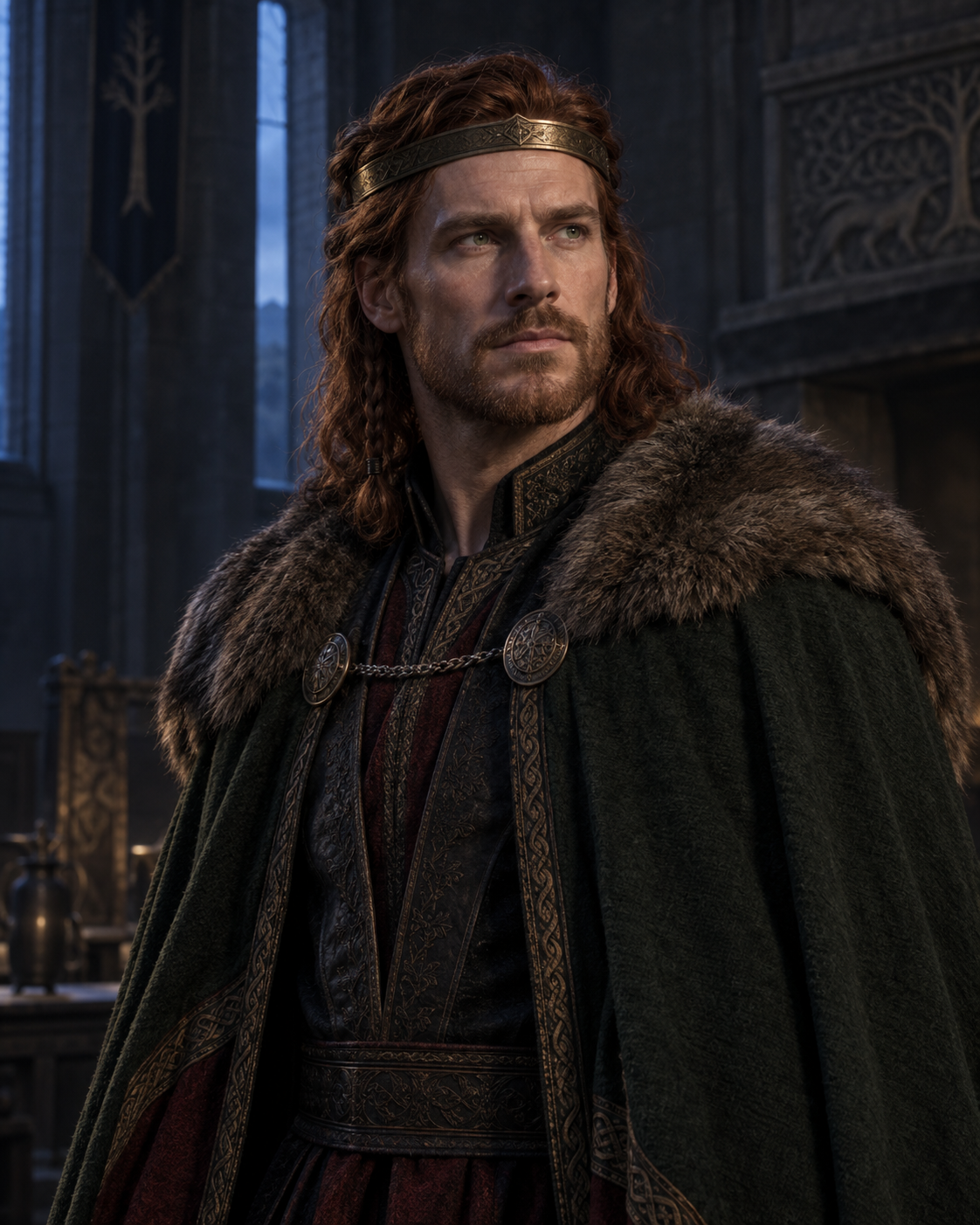
At a Glance
The king at the last known point in Memory’s chain of custody
- Name
- Ikferdig
- Title
- King of the Hayholt; remembered as the Burned King
- Dynasty
- Rimmersman line
- Predecessor
- Hjeldin the Mad King
- Sword
- Minneyar, called Memory
- Encounter
- Meets the fire-drake Shurakai at night
- Monument
- Statue among the Six Kings, face carved in fear and doubt
- Status
- Dead; historical figure
The Third Rimmersman King
Ikferdig closes one ruling line and opens the Hayholt’s dragon age
The Six Kings rhyme places Ikferdig after Fingil the Bloody King and Hjeldin the Mad King.
Those three Rimmersman rulers stand on the left side of the Dragonbone Chair. Sulis, Tethtain, and Eahlstan stand on the right.
Ikferdig’s position makes him the last of the remembered northern dynasty before other mortal kings occupy the Hayholt and Shurakai’s presence transforms the castle’s history.
The text does not identify Ikferdig’s parents, spouse, children, route to succession, length of reign, court, laws, campaigns, friendships, or enemies. It does not say he is Hjeldin’s son merely because he succeeds him.
What survives is a title and an ending: Burned King, meeting the fire-drake at night.
Simon first knows him through the rhyme learned in childhood and through the statue standing around the throne. That is how history works inside the Hayholt. Monument and song preserve a sequence while reducing individual lives to the manner in which each reign became memorable.
Ikferdig’s statue is not neutral. Its face is carved in fear and doubt. The sculptor or later tradition chooses vulnerability as the king’s permanent expression.
Bearer of Minneyar
The sword called Memory reaches Ikferdig—and then the archive catches fire
Minneyar begins as the iron keel of King Elvrit’s dragon-ship.
The Dverning smiths forge it. Elvrit kills the master smith rather than pay and takes the weapon, naming it “Year of Memory.” The sword later passes through Fingil and Hjeldin to Ikferdig.
Ikferdig is therefore the last known bearer in the surviving succession.
The record does not show the transfer. It does not say whether Hjeldin gives it to him, whether he inherits it ceremonially, whether he takes it after Hjeldin’s death, or whether a missing intermediary exists.
Nor does the record tell us what Ikferdig calls the blade, how he carries it, whether he knows its origin, or whether he understands it as one of the Three Great Swords.
His importance is archival. When Josua’s council searches for Memory, the trail narrows to Ikferdig and then splits: hidden somewhere in the Hayholt, or destroyed in Shurakai’s fire.
A complete profile cannot solve that fork earlier than the characters do. Ikferdig marks the boundary between known custody and speculation.
The Fire-Drake at Night
The rhyme gives us encounter and terror, not a full battle report
Ikferdig meets a fire-drake at night. The wider Hayholt history identifies Shurakai as the dragon who later occupies the castle and whose bones become Prester John’s throne.
The king’s epithet, “Burned,” ties his end to fire. His statue’s fear and doubt make the emotional memory unusually explicit.
But the surviving receipt remains small.
The text does not confirm where inside or around the Hayholt the encounter begins, whether Ikferdig attacks, flees, negotiates, protects anyone, wounds the dragon, carries Minneyar, or dies instantly. It does not describe flames touching his body or preserve a corpse.
“Burned King” should not be converted into invented scar patterns for his living portrait. A later memorial may evoke fire, but the art cannot claim injuries the prose never describes.
The phrase “at night” gives the scene its most reliable atmosphere. Darkness, dragonfire, the fearful statue, and the disappearance of the sword create a powerful visual grammar without supplying choreography.
Ikferdig is not diminished by fear. Shurakai’s skull eventually forms the canopy of the Dragonbone Chair, with teeth as long as a hand and bones thicker than Simon’s legs. Terror before that creature is evidence of scale, not cowardice.
What Happened to Memory?
Ikferdig becomes the hinge between “lost” and “destroyed”
Centuries later, the League of the Scroll and Josua’s allies need Minneyar because Nisses’s prophecy names three swords against the spreading winter.
Their evidence ends with Ikferdig.
If he carried Minneyar during the dragon crisis, the sword might lie somewhere within the immense, layered Hayholt. If Shurakai’s fire consumed it, the search could be impossible.
Those are the council’s possibilities, not confirmed outcomes.
The profile must not use later reader knowledge to rewrite the uncertainty experienced at this point. Discovery is part of the story’s machinery. The archive gives a chain, a catastrophe, and a blank.
Ikferdig’s role in that blank is thematically exact. Memory does not vanish in an ordinary succession dispute. It disappears at the moment fire overwhelms a king and takes possession of a castle.
When Simon later returns to the Hayholt, every stone can plausibly conceal history. Ikferdig’s failure to leave a clean record makes the setting itself into an evidence field.
The Statue in the Throne Room
Fear and doubt survive where biography does not
The Six Kings statues surround the Dragonbone Chair beneath Shurakai’s skull.
Ikferdig’s carved face carries fear and doubt. Unlike a verified portrait made during life, this is a later representation shaped by memorial purpose.
It confirms how the Hayholt remembers him, not necessarily his everyday appearance.
Future art can echo the statue’s emotional truth without freezing the living king into one panicked expression. The canonical character identity should remain attractive, dignified, and age-correct; scene art for the dragon encounter may then show fear under specific pressure.
The memorial arrangement is cruelly elegant. The king who meets the fire-drake is made to stand forever beneath that dragon’s skull after John kills Shurakai and turns its bones into royal furniture.
The novel does not tell us who commissions Ikferdig’s statue or whether John preserves, moves, or reframes it. We can read the visual irony without inventing its installer.
Connections
The kings, dragon, sword, and search attached to Ikferdig
Hjeldin the Mad King
Ikferdig’s predecessor and the previous named bearer of Minneyar.
Minneyar
The sword called Memory, whose last known historical location belongs with Ikferdig.
Shurakai
The fire-drake connected to Ikferdig’s fatal historical memory and the sword’s disappearance.
Prester John
Later kills Shurakai and builds the Dragonbone Chair beneath which Ikferdig’s statue stands.
Simon
Learns Ikferdig through rhyme and monument before the missing sword becomes part of his own journey.
Josua’s council
Reconstructs Minneyar’s custody and reaches Ikferdig as the last secure point before uncertainty.
Why Ikferdig Matters
He proves a minor historical king can hold a major structural secret
Ikferdig matters because the whole search for Memory runs through his ending.
He does not need invented speeches or a fabricated romance to become important. His confirmed place in the sword’s succession, the dragon encounter, the statue’s expression, and the unresolved aftermath already form a complete narrative function.
He also changes how the Hayholt feels. The castle is not only where Shurakai died. It is where an earlier king met the dragon, where a Great Sword vanished, and where later rulers placed both king and beast around the same throne.
Finally, his fearful monument resists easy heroic history. Osten Ard remembers conquest through Fingil, madness through Hjeldin, and terror through Ikferdig. The Rimmersman line does not receive one polished triumphal legend.
Ikferdig is the archival burn mark: everything before him can be traced, and everything after him must be excavated.
Character Image Continuity
A distinct Rimmersman king whose fear is human, not ugly
Visual state: approved editorial reconstruction. Ikferdig now has one permanent living historical identity, and this profile is published.
CVM depicts Ikferdig as a devastatingly handsome Rimmersman king around thirty-seven with a tall lean-athletic build, deep moss-green eyes, weathered fair skin, shoulder-length dark copper-red hair with one narrow braid behind the ear, and a short immaculate copper beard. Deep forest-green, soot-charcoal, muted-bronze, dark-oxblood, restrained fur, and a simple bronze circlet establish a dignified historical identity distinct from Fingil, Hjeldin, Elias, and Simon.
Canon supplies no living face, hair, eyes, age, height, build, facial hair, crown, clothing, armor, scars, burns, or weapon appearance. The statue’s fearful, doubtful expression belongs to the memorial and should not become his only facial setting.
Preserve this exact face, age, body, coloring, hair/braid map, beard, circlet, and forest/charcoal/bronze costume logic across every later historical scene. Do not place Thorn, Sorrow, or Bright-Nail in his hands. Minneyar remains absent until the site establishes and approves one consistent design for Memory.
The same canonical attachment powers featured image, hero, directory card, and social metadata. Preserve the same face, age, body, royal styling, and scene-era logic across Six Kings art, Shurakai imagery, and Memory history pages; a later fearful expression must belong to the specific memorial or encounter context rather than replacing his living identity.
On the Record
Book 1 historical evidence with every gap left visible
This is Ikferdig’s one canonical, full-spoiler character profile. His evidence is concentrated in The Dragonbone Chair: Simon’s Six Kings rhyme and throne-room observation, the Hayholt’s dragon history, and the later reconstruction of Minneyar’s chain of custody.
The record confirms Ikferdig is a Rimmersman king of the Hayholt, successor to Hjeldin in the remembered order, called the Burned King, and the last known bearer of Minneyar. It confirms he meets the fire-drake at night and that his statue’s face is carved in fear and doubt.
The record leaves Minneyar either hidden within the Hayholt or destroyed by Shurakai’s fire at the point when the council first reconstructs the trail.
It does not confirm Ikferdig’s parentage, family, reign dates, policies, battles, private temperament, exact encounter with Shurakai, wounds, corpse, final words, burial, deliberate concealment of Memory, or supernatural afterlife.
Status: dead; historical figure.
Visual state: approved editorial reconstruction. The portrait preserves Ikferdig alive before Shurakai, with no invented burns, weapon, battle choreography, or grotesque fear. Every physical feature, garment, circlet, hall detail, pose, and lighting choice is CVM reconstruction. The same canonical attachment powers featured image, hero, directory card, and social metadata.